You Are Paying QAR 12,000 a Month in Rent, Earning Tax-Free Income in a Dollar-Pegged Economy, and Watching Colleagues Buy Apartments in The Pearl and Lusail. Nobody Has Explained That Service Charges in Those Towers Run QAR 12,000 to QAR 18,000 a Year Before a Single Utility Bill, That the District Cooling Fee Is Billed Monthly Whether You Live There or Not, or That the QAR 730,000 Residency Threshold Comes With a 90-Day Annual Stay Requirement That Nobody Mentions Until You Miss It.
You have browsed property listings on QatarProperty.com and Property Finder, compared unit prices in The Pearl and Lusail, and read developer brochures advertising 6% gross yields and seamless residency permits. You have scrolled through QatarLiving.com and r/qatar where expats give contradictory advice about freehold versus usufruct, whether off-plan delays in Lusail are still a problem, and how service charges actually work. You have seen agents quote gross rental yields without subtracting the Qatar Cool capacity charge that arrives every month regardless of whether anyone is living in the apartment.
You are not confused because you have not researched enough. You are confused because Qatar layers a bifurcated ownership system --- freehold in 10 zones, usufruct in 25 --- on top of a residency program with two distinct financial tiers and a minimum stay rule, a mortgage regime where expatriates need 25% down and cannot exceed 50% of their salary in total debt, service charges that range from QAR 60 to QAR 150 per square metre per year depending on which tower you pick, district cooling monopolies that bill a fixed capacity charge even on vacant units, and an off-plan market where delivery delays of two to three years are not exceptions but recurring patterns. All of this wrapped in a zero-tax jurisdiction attractive enough to hold your attention but opaque enough to cost you money if you skip the details.
Here is the problem no free resource solves: Developer brochures advertise 6% gross yields but do not explain that QAR 120-per-square-metre service charges and a QAR 700-to-1,100 monthly cooling bill can cut that to 3% net. Agency blogs mention residency permits but skip the distinction between the QAR 730,000 temporary permit and the QAR 3,650,000 permanent residency that is capped at approximately 100 approvals per year. Forum posts share real buying experiences but lack the legal framework to explain why one buyer closed in days via SAK while another waited months for a developer to sort out their escrow account. The legal protections exist. The digital infrastructure is world-class. But they only work if you understand the ownership system, the true cost structure, and the exact sequence of steps before you wire your down payment.
The Buying Property in Qatar --- Expat Guide is the Qatar Property Decision Framework. Not a developer blog designed to funnel you toward a listing. Not a law firm page designed to sell retainers. It is a structured decision system that decodes every stage of the Qatari property purchase --- from understanding which of the 10 freehold and 25 usufruct zones fit your goals, through calculating true net yields after service charges and cooling fees, securing mortgage pre-approval under Qatar Central Bank rules, navigating the SAK digital registration system, and applying for self-sponsored residency --- so you make each decision understanding the legal mechanism behind it, the financial reality beneath it, and the consequence of skipping it.
What's Inside the Qatar Property Decision Framework
The complete 10-chapter guide plus standalone printable tools --- covering every stage from eligibility assessment through post-purchase management, with the structural detail that developer marketing and commission-driven agents leave out:
Foreign Ownership Rights --- Freehold, Usufruct, and the Zones That Determine Everything
The full legal framework under Law No. 16 of 2018 and Council of Ministers' Decision No. 28 of 2020. All 10 freehold zones mapped with key characteristics --- The Pearl-Qatar, Lusail City, West Bay Lagoon, Al Dafna, Al Qassar, Msheireb Downtown, Al Khor Resort, Rawdat Al Jahaniya, Al Wakra, and Al Khraijeh. The 25 usufruct zones covering Al Sadd, Bin Mahmoud, Musheireb, and Old Airport. The precise legal difference between permanent land ownership and 99-year leasehold: what each lets you do, what each restricts, when usufruct actually makes more financial sense than freehold, and the two carve-outs that allow foreign buyers to purchase commercial property and single residential units beyond the designated zones.
The Residency Advantage --- Decoupling From the Kafala System
Two-tier residency program explained step by step. Tier 1: purchase QAR 730,000 or more in any approved zone for a self-sponsored residence permit --- no employer needed, renewable indefinitely, extends to immediate family. Tier 2: purchase QAR 3,650,000 or more for permanent residency eligibility --- access to free government healthcare and public education, but capped at approximately 100 approvals per year with a 90-day annual minimum stay requirement. The SAK fast-track system that can process title deeds and residency permits within 24 hours. The exact documents required, the administrative sequence, and the conditions that maintain or void your permit.
Financing --- Qatar Central Bank Rules, Bank-by-Bank Comparison, and the Numbers That Matter
Macro-prudential regulations that govern every expatriate mortgage in Qatar. Maximum 75% LTV on properties up to QAR 6 million (25% mandatory cash down payment). LTV drops to 70% above QAR 6 million. Non-residents capped at 50% LTV. The 50% Debt Burden Ratio ceiling --- total monthly debt cannot exceed half your salary. Maximum 25-year term for residents, 15 years for non-residents, and the permanent-residency loophole that extends to 30 years. Current interest rates from 4.5% (green mortgages) to 6.25%. Minimum salary requirements: QAR 15,000 (QNB, Doha Bank), QAR 20,000 (QIB), QAR 35,000 (Ahlibank). Age limits, documentation requirements, and the specific conditions where developer payment plans make more sense than bank financing.
The True Cost of Ownership --- What Developer Brochures Hide
The forensic breakdown of costs that turns a 6% gross yield into a 3% net yield. Service charges in The Pearl: QAR 60 to QAR 150 per square metre per year, meaning QAR 12,000 to QAR 18,000 annually for a standard two-bedroom apartment. District cooling: Qatar Cool (The Pearl) and Marafeq (Lusail) charge a mandatory fixed capacity fee every month regardless of occupancy, plus metered consumption. Combined monthly utility overhead of QAR 700 to QAR 1,100 in peak summer. Property management fees of 5-10% of annual rent. Why Qatar does not use the UAE's Mollak system, what Aqarat's new escrow requirements mean for buyer protection, and how to calculate net yield correctly before making an investment decision.
Where to Buy --- District-by-District Comparison
The Pearl-Qatar versus Lusail City --- the central geographic decision for every expatriate buyer, with data instead of marketing. The Pearl: mature infrastructure, proven tenant demand, immediate beachfront, gross yields of 6% to 6.3%, but legacy cooling systems and the highest service charges in Qatar. Lusail: smart city infrastructure, passive cooling standards, 15% lower average utility costs, gross yields up to 6.9%, but ongoing construction, off-plan delivery delays, and amenities still maturing. West Bay Lagoon for villa buyers who want privacy. Al Khor and Al Wakra for value-seekers who will accept distance from central Doha. Each district analyzed on price per square metre, yield profile, tenant demand, infrastructure maturity, and suitability for different buyer types.
The Buying Process --- From Search to Title Deed via SAK
The complete transaction mapped step by step. Engaging a licensed broker (verified through the Aqarat digital portal). Running a MALAK title check for encumbrances, liens, and disputes. Signing the Memorandum of Understanding. Submitting the purchase request. Paying the 0.25% registration fee at the Real Estate Registration and Documentation Department. Digital completion via SAK under Law No. 5 of 2024 --- electronic documents carry full legal validity. Remote transaction capability for non-residents through NAS authentication and video-call verification. Timeline: 14 to 30 days for standard transactions, as fast as a few days for streamlined secondary market deals.
Investment Strategy --- Defensive Asset Selection in a Zero-Tax Market
Why Qatar is not a capital gains market --- and why that is actually the point. The mathematical case for tax-free passive income over speculative flipping. Off-plan risks: delivery delays, low initial rental rates in new districts, empty stock. How to evaluate developer payment plans against bank financing. Short-term rental potential versus long-term lease stability. The post-World Cup absorption story: 74% surge in apartment transactions, QAR 34.4 billion in total sales, and what the 0.3% quarterly VPI decline signals about where the market sits today.
Legal Protections --- Aqarat, Escrow, and the New Regulatory Framework
The General Authority for Regulating the Real Estate Sector (Aqarat) and its mandate. Mandatory project-specific escrow accounts with the Qatar Central Bank for all off-plan developments. The 10% post-completion defect repair reserve. Broker licensing verification. The distinction between Aqarat's protections and the UAE's Mollak system --- why regional expats searching for "Mollak Qatar" need to understand what Qatar has built instead. How Law No. 6 of 2014 and recent directives ring-fence buyer funds from developer insolvency.
Ongoing Management --- What Happens After You Close
Utility setup with Kahramaa (electricity and water) and your district cooling provider. Property management for remote owners: what a 5-10% management fee covers and what it does not. Annual cost budgeting: service charges, cooling capacity fees, utilities, insurance. The Sharia inheritance default and why every foreign owner in Qatar must register a will specifying their desired property distribution. Lease compliance, tenant sourcing, and the practical realities of managing a rental property from abroad.
Plus Standalone Printable Tools
In addition to the full guide, you get standalone PDFs you can print and bring to property viewings, broker meetings, and financial planning sessions:
- Freehold and Usufruct Zone Reference --- All 10 freehold and 25 usufruct zones with key characteristics, typical price ranges, and yield profiles on a single printable sheet
- Net Yield Calculator Worksheet --- Fillable worksheet that walks you through gross rent, service charges, district cooling, utilities, management fees, and vacancy to calculate your true net return
- Bank-by-Bank Mortgage Comparison --- QNB, Doha Bank, QIB, and Ahlibank side by side on LTV, minimum salary, interest rates, maximum term, and age limits
- Residency Application Checklist --- Tier 1 and Tier 2 requirements, documents needed, SAK fast-track process, and the 90-day minimum stay rule in one printable reference
- Transaction Cost Calculator --- Registration fee, broker commission, legal fees, and the total closing cost range calculated for your specific purchase price
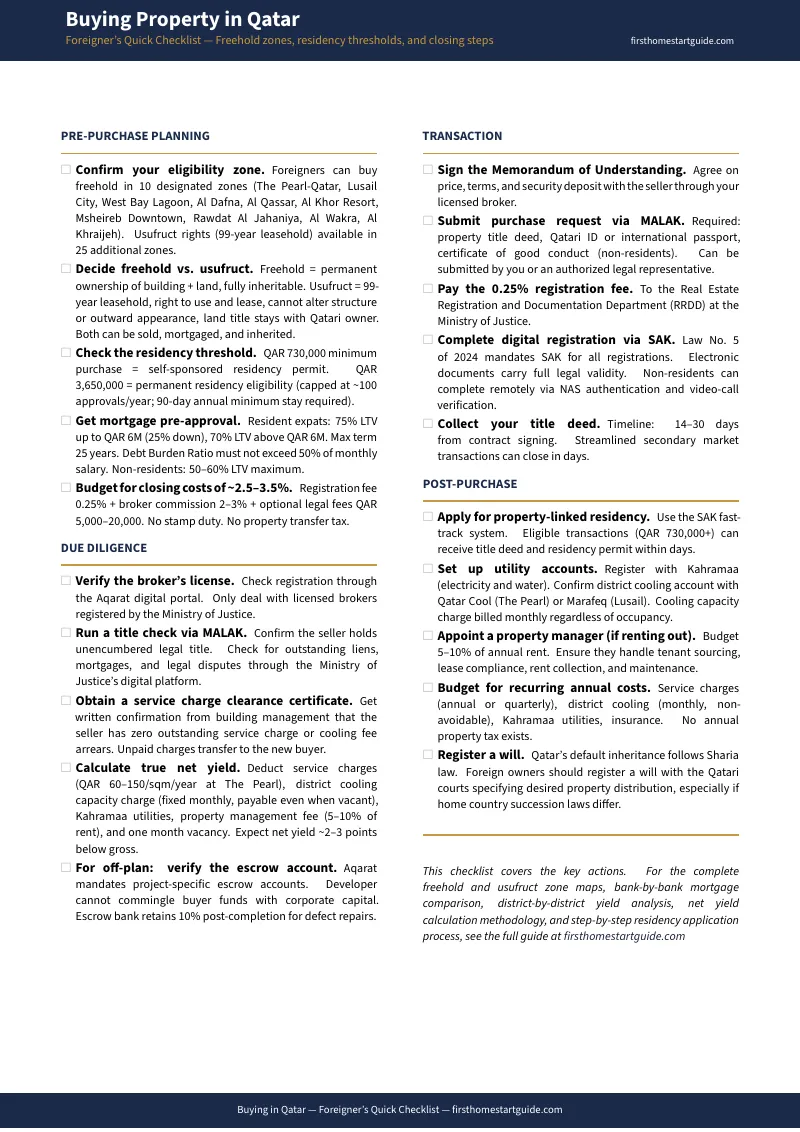
- Foreigner's Quick Checklist --- The step-by-step action plan covering eligibility, due diligence, transaction, and post-purchase phases that you also receive as a free download
Who This Guide Is For
This guide is for foreign buyers and expats purchasing property in Qatar who:
- Have been renting in Doha for years --- paying QAR 10,000 to QAR 15,000 a month --- and need a clear financial comparison of the true cost of owning versus renting, including the service charges and cooling fees that most buy-versus-rent calculators ignore
- Are zero-tax yield investors with surplus capital who want to build a rental portfolio in a jurisdiction with no income tax, no property tax, and no capital gains tax --- but need to calculate net yields after service charges and district cooling instead of relying on developer-quoted gross numbers
- Are residency strategists who want to decouple from employer sponsorship under the Kafala system and need the exact mechanics of the QAR 730,000 temporary permit and QAR 3,650,000 permanent residency program --- including the 90-day stay requirement, annual cap, and family extension rules that forum posts mention but never fully explain
- Are regional capital allocators from the GCC, India, Pakistan, or Egypt seeking a safe-haven asset in a dollar-pegged, politically stable economy --- and need to understand the remote purchasing process via SAK, non-resident mortgage restrictions, and how to appoint reliable local management
Why Not Free Resources?
Free information on buying property in Qatar is not scarce. Here is what each source actually delivers:
- Developer brochures and marketing websites from UDC (The Pearl), Qatari Diar (Lusail), and others highlight luxury amenities, gross rental yields, and lifestyle photography. They do not disclose that service charges in their own towers run QAR 60 to QAR 150 per square metre per year. They do not explain the district cooling capacity charge that is billed monthly even when your unit sits empty. They do not mention that off-plan delivery in Lusail has historically slipped two to three years past the promised handover date. The information is designed to sell units, not to help you calculate whether those units actually cash-flow.
- Agency blogs and brokerage websites publish helpful overviews of the buying process and mention the residency program. They are accurate on the basics. They are also lead generation for commissions of 2-3% of the transaction value, and they consistently understate total costs, overstate yields, and treat the residency permit as a simple checkbox rather than a program with specific financial thresholds, renewal conditions, and annual stay requirements.
- Institutional reports from ValuStrat, Asteco, and Cluttons deliver precise data on market indices, supply pipelines, and commercial yield compression. They are written for institutional investors and corporate stakeholders in industry jargon. A first-time foreign buyer trying to decide between a two-bedroom in Porto Arabia and an off-plan unit in Yasmeen City will not find what they need in a 40-page institutional PDF that discusses citywide VPI fluctuations.
- QatarLiving.com, Reddit (r/qatar), and Facebook expat groups contain genuine buyer experiences alongside advice that is outdated, jurisdiction-specific to the UAE (people searching for "Mollak Qatar" because they assume the Dubai escrow system exists in Doha), or based on pre-2024 regulations that predate the SAK digital platform. You will find someone who closed in 48 hours and someone whose off-plan handover was delayed three years. Both stories are true. Neither tells you how to avoid the outcome you do not want.
This guide fills the structural gap --- the space between knowing that foreigners can buy in Qatar and understanding exactly which of the 35 designated zones matches your investment thesis, between seeing a 6% gross yield advertised and calculating the 3% net yield after service charges and cooling fees, between hearing about the residency permit and understanding the two-tier system with its financial thresholds and annual stay obligation. It is the analysis an independent advisor with no units to sell and no commissions to earn would give you, structured as a permanent reference you own.
--- Less Than Your Monthly District Cooling Bill
A single month of Qatar Cool capacity charges on a two-bedroom apartment in The Pearl runs QAR 400 to QAR 900. Broker commissions on a QAR 1.5 million apartment run QAR 30,000 to QAR 45,000. The service charge differential between the cheapest and most expensive towers in The Pearl --- QAR 60 versus QAR 150 per square metre --- translates to QAR 10,800 per year on a 120-square-metre unit. That is QAR 10,800 every year, compounding over the life of your ownership, determined entirely by which building you pick.
This guide does not replace your broker or your lawyer. But it gives you the zone-by-zone ownership map, the net yield calculation methodology, the bank-by-bank mortgage comparison, the residency application sequence, and the cost-of-ownership framework that ensure you walk into every viewing, every negotiation, and every contract signing understanding the financial reality beneath the marketing --- instead of discovering how Qatar's property costs work by absorbing them.
If it shifts you from a QAR 150-per-square-metre tower to a QAR 60-per-square-metre tower, identifies a district cooling charge the developer did not disclose, prevents you from miscalculating your Debt Burden Ratio before applying for a mortgage, or clarifies the residency stay requirement before you plan your year around it, it pays for itself before you have finished reading it.
Money-back guarantee, no time limit. If the guide does not make the Qatar property purchase clearer and your financial position stronger, you pay nothing.
Download the free Quick Checklist to see the step-by-step action plan covering eligibility zones, freehold versus usufruct, residency thresholds, mortgage pre-approval, due diligence checks, and transaction steps. When you are ready for the full Qatar Property Decision Framework --- complete with the district-by-district yield analysis, the true cost of ownership breakdown, the bank-by-bank financing comparison, and the residency application roadmap --- the complete guide is here.
You have found the market. Now make sure the zone, the building, and the numbers behind the listing are what the brochure promised.
Frequently Asked Questions
What if the rules change after I buy?
We update the guide when the rules change. Email us any time, even years later, and we'll send you the current edition free.