
You Heard Foreigners Can Buy Property in Saudi Arabia Now --- But Nobody Can Tell You Exactly How It Works
You read the headlines in 2023. Saudi Arabia is opening real estate to foreigners. Vision 2030. Premium Residency. Freehold ownership in Riyadh. You earn well, you pay zero income tax, and your SAR 18,000-a-month Riyadh apartment keeps getting more expensive every renewal cycle. The math on buying seems obvious.
Except you cannot figure out whether the 2023 announcements actually became law. They did --- Royal Decree M/14 took effect on January 21, 2026 --- but the English-language coverage is a patchwork of corporate law firm memos written for institutional investors, JLL market reports analyzing yields for hedge funds, and three-year-old Reddit threads from people who heard something from a colleague who talked to a broker. None of them walk you through what happens when you, an individual expat on a standard Iqama, try to buy an apartment.
Then there is the cost. You budgeted for the property price plus the 5% RETT. But the 2026 law introduced a second levy --- REGA's foreign transfer fee, capped at another 5%. Add the standard 2.5% broker commission and your actual entry cost is up to 12.5% of the purchase price before you receive a single key. On a SAR 2,000,000 apartment, that is SAR 250,000 in friction costs that nobody mentioned in the property listing.
And the question you cannot get a straight answer to: what happens to your property if you lose your job? Your Iqama expires. The Ministry of Interior initiates Final Exit processing. Your bank accounts freeze. You cannot leave the country until every asset registered in your name --- including real estate --- is cleared from the system. You are staring at a forced liquidation of an illiquid asset under time pressure, with escalating overstay fines of SAR 100 per day, while your bank account is frozen and you cannot access the sale proceeds until the entire clearance chain completes. This is the elephant in every Saudi property conversation that brokers, agents, and government portals refuse to address in plain English.
And then there is inheritance. If you die owning property in Saudi Arabia, Sharia succession law applies to that property --- regardless of your religion, your nationality, or what your will says back home. You can only bequeath one-third of your estate by will. The remaining two-thirds distribute automatically under a formula you did not choose. Unlike the UAE, which built the DIFC Wills Service Centre specifically for non-Muslim expats, Saudi Arabia has no equivalent registry. Your Western will may be unenforceable for your Saudi assets.
The problem is not that Saudi Arabia restricts foreign buyers. The problem is that Saudi Arabia layers a brand-new foreign ownership law with designated zone restrictions, a one-home rule for Iqama holders outside those zones, a Mecca and Medina blanket ban, a 12.5% transaction cost hurdle that most buyers discover at closing, a Final Exit visa system that forces property liquidation before you can leave the country, Sharia inheritance rules that override your will, an Islamic finance system where the bank buys the property and resells it to you at a markup, and a digital title deed platform that most English-speaking buyers have never heard of --- and no single existing resource in English explains all of these together from the perspective of an individual buyer.
The Buying Property in Saudi Arabia --- Expat Guide is The Expat Regulatory Blueprint --- a structured walkthrough of every legal requirement, every cost layer, every residency interaction, and every inheritance trap that determines whether your Saudi property purchase builds wealth or creates a crisis you cannot exit. It replaces months of cross-referencing corporate law firm memos, institutional brokerage reports, Arabic-heavy government portals, and outdated expat forum threads with a single reference that covers the intersection of property law, residency rules, Islamic finance, inheritance, and tax that no existing resource in English addresses for individual buyers.
What's Inside the Expat Regulatory Blueprint
A 58-page guide, a quick-start checklist, and 5 standalone printable tools (7 PDFs total) --- covering every stage from legal eligibility through post-purchase compliance, built specifically for the regulatory structures that make buying property in Saudi Arabia as a foreigner fundamentally different from buying anywhere else:
The 2026 Legal Framework Decoded
Royal Decree M/14 replaced the restrictive 2000-era foreign ownership law. But understanding what it actually permits requires separating three distinct ownership regimes. Inside designated zones: freehold ownership, long-term leasehold, and usufruct rights for both residents and non-residents. Outside designated zones: one residential property for personal use, Iqama holders only, Ministry of Interior approval required. Mecca and Medina: blanket prohibition on foreign residential ownership, with extremely narrow exceptions for non-Saudi Muslims under specific conditions. The guide breaks down each regime clause by clause, explains how the forthcoming Geographic Scope Document will define the designated zones, and clarifies exactly which regime applies to your situation --- so you stop guessing whether the 2023 headlines apply to you.
Premium Residency --- The Real Estate Track
The Premium Residency "Real Estate Owner" category ties indefinite, self-sponsored residency to property ownership. But the qualification criteria are ruthlessly specific. The property must be residential, developed, valued at minimum SAR 4,000,000, appraised by Taqeem-accredited valuers, and purchased entirely without financing --- no Murabaha, no mortgage, cash only. If you sell the property, you have 90 days to acquire a replacement of equal or greater value or lose your residency status. The guide covers every qualification requirement, compares the Real Estate Owner track against the Special Talent (SAR 35,000-80,000 monthly salary), Investor (SAR 7,000,000 investment), and fee-based tracks (SAR 100,000/year or SAR 800,000 one-time), and helps you determine whether the property route makes financial sense versus the alternatives.
Murabaha Financing --- Bank by Bank
Conventional mortgages do not exist in Saudi Arabia. Banks use Murabaha contracts: the bank buys the property from the seller, then immediately resells it to you at a fixed profit margin, payable in installments over up to 25-30 years. The bank holds the title until your final payment. For expats, the qualification barriers are steep. Bank Albilad requires a minimum salary of SAR 20,000. Emirates NBD KSA requires SAR 9,000-12,000 depending on salary transfer status. Every bank demands a minimum 30% down payment for non-Saudis on ready-built units. Employment tenure requirements run 3-6 months minimum. Self-employed expats face 2-3 years of documented business history. And unless you hold Premium Residency, you need prior Ministry of Interior approval before the bank will process the financing. The guide covers each major bank's eligibility criteria, the Murabaha mechanics in plain English, and the exact documentation package you need.
The 12.5% Cost Hurdle --- Every Fee Itemized
The Real Estate Transaction Tax (RETT) is 5% of the sale price, payable before or during ownership transfer. The 2026 law authorized REGA to levy an additional foreign transfer fee of up to 5%. Standard broker commission adds 2.5%. On a SAR 2,000,000 property, your total transaction friction reaches SAR 250,000 --- before notarial fees, valuation costs, and any Murabaha profit margin. The critical detail: the Saudi government's RETT exemption for first-home buyers (up to SAR 1,000,000) applies only to Saudi citizens, not to expats. The guide provides a complete cost breakdown at multiple price points so you can model your actual capital requirement before making an offer.
The Final Exit Forced Liquidation Problem
This is the highest-stakes, least-discussed topic in Saudi expat real estate. If your employment ends and your Iqama is cancelled, the Ministry of Interior initiates Final Exit processing. Your bank accounts freeze. Your Final Exit visa will not be issued until every registered asset in your name is cleared --- including real estate. You must sell the property, complete the ownership transfer, clear the Real Estate Registry, settle all bank obligations, and obtain systemic clearance through Absher before you can legally leave. Overstaying an expired Iqama incurs fines of SAR 100 per day, potential deportation, and multi-year GCC re-entry bans. The guide covers the exact clearance sequence, realistic timelines for distressed property sales, how the bank freeze interacts with property liquidation, and the contingency planning steps you should put in place before you buy --- not after you receive a termination notice.
Sharia Inheritance for Non-Muslims
Saudi inheritance law applies Sharia forced heirship to all real estate located in the Kingdom, regardless of the owner's religion or nationality. You can bequeath a maximum of one-third of your estate by will, and only to non-heirs. The remaining two-thirds distribute automatically under Quranic formulas --- male heirs receive twice the share of female heirs at the same degree of kinship. If you die without a will, the entire estate distributes under these rules. Unlike the UAE (DIFC Wills Service Centre), Saudi Arabia has no dedicated non-Muslim will registry. A will drafted under your home country's laws may be unenforceable for Saudi-located assets. The guide explains the forced heirship mechanics, the practical limitations of foreign wills in Saudi courts, and the estate planning strategies that sophisticated expats use to mitigate this risk.
WAFI Off-Plan Protections
Off-plan purchases in Saudi Arabia are regulated by the WAFI program under REGA. Developers must hold a WAFI license, maintain an escrow account for buyer funds, and meet construction milestone requirements before releasing payments. The guide covers how to verify a developer's WAFI registration, how the escrow mechanism protects your capital, what happens if the developer defaults or delays, and why buying off-plan outside the WAFI framework exposes you to risks that the regulatory system was specifically designed to prevent.
Wathiq and Najiz --- The Digital Title Deed System
Saudi Arabia has moved property registration to electronic title deeds issued through the Wathiq platform, integrated with the Ministry of Justice's Najiz portal. The electronic Wathiq record is the definitive proof of ownership --- not a digital copy of a physical document. SAMA has directed all financing companies to accept electronic deeds without physical originals. But for non-Saudis, there is an additional registration layer: all foreign ownership must be recorded on REGA's "Saudi Properties" platform. Failure to register carries penalties up to SAR 10,000,000 and forced auction of the property. The guide walks you through both registration processes and explains exactly what constitutes valid, legally defensible proof of ownership.
City Comparison --- Riyadh vs. Jeddah vs. NEOM
Riyadh is experiencing 9.3% annual rental growth driven by the government mandate for multinational headquarters relocation. Jeddah offers more stable 4-5% growth with lower entry prices and a more established expat lifestyle infrastructure. NEOM and the Red Sea mega-projects represent speculative freehold opportunities in designated zones with dramatically different risk profiles. The guide compares price per square meter, rental yields (6-9% across major markets), supply-demand dynamics, lifestyle factors, and the specific regulatory regime that applies to each location --- so you can match your investment thesis to the city that actually supports it.
Who This Guide Is For
- Western expats on standard Iqamas who earn well, are tired of annual rent increases in Riyadh or Jeddah, and need to understand the full legal and financial picture --- the 2026 ownership regimes, the 12.5% cost hurdle, the Murabaha qualification barriers, and the Final Exit forced liquidation risk --- before committing capital to an illiquid asset in a country where their residency depends on their employer
- South Asian professionals targeting 6-9% rental yields as a hard-currency-pegged wealth vehicle, who need bank-by-bank Murabaha eligibility criteria and the exact documentation package to secure financing at the SAR 20,000+ salary thresholds Saudi banks impose on non-nationals
- Premium Residency seekers using the SAR 4,000,000 real estate route to escape the Kafala sponsorship system, who must verify that their target property meets every qualification criterion --- residential, developed, mortgage-free, Taqeem-appraised --- before deploying capital that cannot be leveraged
- Remote foreign investors targeting freehold opportunities in designated zones and mega-projects, who need to understand the non-resident ownership mechanics, REGA's Saudi Properties registration requirement, and the repatriation framework for rental yields and capital gains
- Any expat buying property in Saudi Arabia for the first time who cannot afford to discover the Final Exit forced liquidation problem after they own an illiquid asset, agree to a Murabaha contract without understanding the bank's profit margin structure, or learn about Sharia forced heirship after it is too late to plan around it
Why Not Free Resources?
- JLL, CBRE, and Colliers market reports provide exceptional macroeconomic data --- 9.3% rental growth, yield analyses, supply projections. But they are written for institutional investors, hedge funds, and developers. They do not cover how an individual expat qualifies for a Murabaha, what the Final Exit process means for property owners, or how Sharia inheritance applies to a non-Muslim's villa. You get market intelligence for billion-riyal portfolios, not a buying guide for your first apartment.
- Corporate law firms (Curtis, White & Case, King & Spalding, Trowers) have published precise technical analyses of Royal Decree M/14. But their audience is foreign institutional investors and multinational corporate entities. They do not address the individual Iqama holder's forced liquidation risk, the retail banking hurdles for Murabaha qualification, or the personal inheritance planning that a Western expat with a family needs. You get corporate legal commentary, not consumer-level guidance.
- Reddit and Expat.com threads (r/saudiarabia, r/expats) provide real sentiment and genuine warnings. But the advice is a mix of pre-2023 regulations, speculation about designated zones that have not been published yet, and legally dangerous suggestions about overstaying Iqamas to avoid the Final Exit process. Sorting current from outdated takes longer than reading a guide that verified everything against the 2026 law.
- Government portals (REGA, Ministry of Justice, MISA) are authoritative primary sources. But they operate in silos --- the MoJ site explains Wathiq deeds but does not explain how those deeds interact with the Ministry of Interior's Final Exit rules. Most interfaces are Arabic-heavy, and the English translations use dense bureaucratic language that assumes you already understand the system. You get individual puzzle pieces scattered across five different agencies, not the assembled picture.
This guide fills the Saudi Arabia gap --- the space between knowing that foreigners can now buy property and knowing how to actually navigate the ownership regimes, the cost layers, the residency interactions, the financing mechanics, and the inheritance rules when you do. It is the analysis that would take a Saudi real estate lawyer, a Murabaha specialist, an immigration consultant, and a Sharia inheritance advisor to assemble --- structured as a reference you own permanently and can bring to every meeting.
--- Less Than One Hour with a Saudi Property Lawyer
A consultation with a bilingual real estate attorney in Riyadh runs SAR 1,500 to SAR 5,000. A single session with an immigration consultant to discuss Premium Residency costs SAR 2,000 or more. Discovering after you sign a Murabaha contract that you did not qualify for the terms you were quoted, or learning about the Final Exit forced liquidation problem after you already own a property you cannot quickly sell? That costs you months and potentially hundreds of thousands of riyals --- and there is no going back.
This guide does not replace your real estate attorney or your financial advisor. But it gives you the 2026 legal framework breakdown, the Murabaha bank comparison, the 12.5% cost model, the Final Exit contingency plan, the Sharia inheritance analysis, the WAFI off-plan verification process, the Wathiq registration walkthrough, and the city-by-city comparison --- so you understand exactly what each regulation means, exactly what each cost layer adds, and exactly where expat buyers lose money or get trapped, before you sign anything or transfer a single riyal.
If it prevents the Final Exit forced liquidation problem alone --- if it makes you build an exit plan before you buy, instead of discovering the clearance chain after your Iqama is cancelled --- it pays for itself before you finish the first chapter.
Money-back guarantee, no time limit. If the guide does not sharpen your Saudi property buying analysis and protect your investment, you pay nothing.
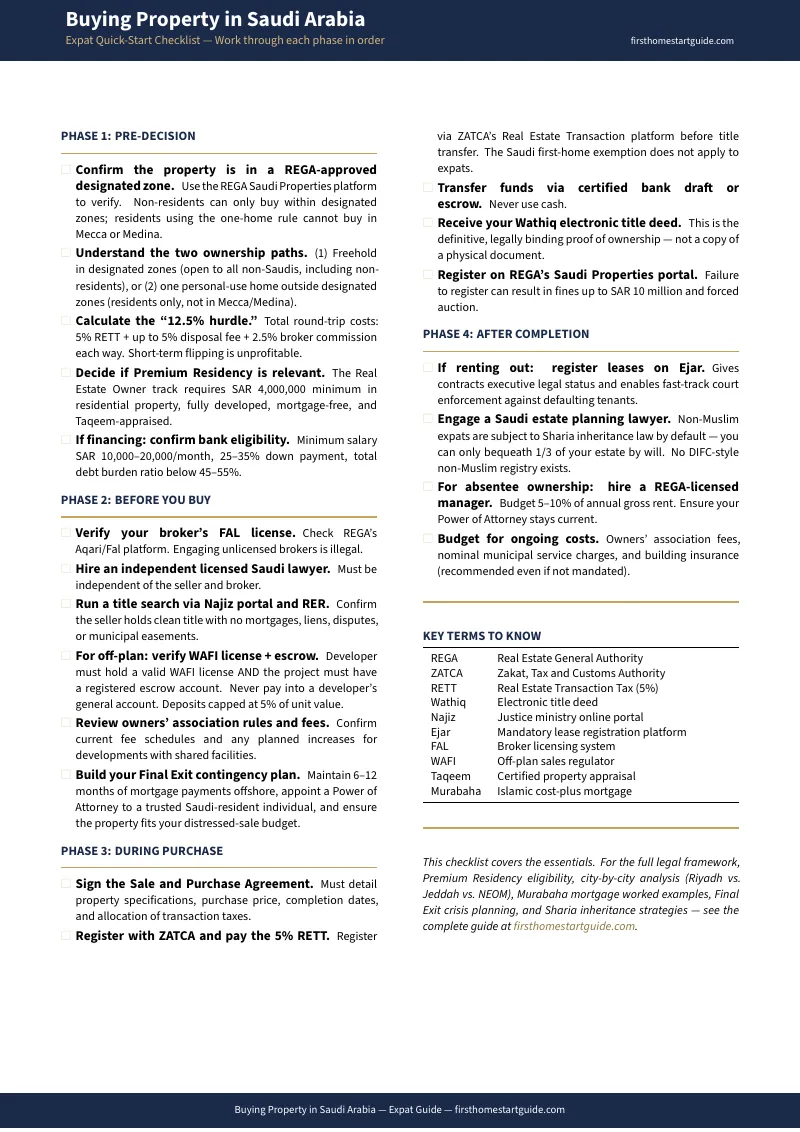
Download the free Buying in Saudi Arabia Quick Checklist to see the compliance framework covering legal eligibility, the 2026 ownership regimes, transaction cost items, and post-purchase obligations. When you are ready for the complete guide plus all 5 standalone printable tools --- the Transaction Cost Calculator, Murabaha Bank Comparison, Final Exit Contingency Planner, Sharia Inheritance Reference, and Buying Process Timeline --- the full toolkit is here.
Saudi Arabia's property market is open to foreigners for the first time in history. This guide makes sure you enter it with your eyes open.