
You Found Your Dream Property in Spain. The Civil Law System Between You and the Keys Has Three Versions of the Deposit Contract, Two Unlinked Property Registries, and 17 Different Transfer Tax Rates.
You've spotted a sun-drenched apartment on the Costa Blanca, a restored cortijo in Andalusia, or a modern flat in a Valencia beach town. You've checked the exchange rate, compared asking prices to London or Sydney, and started picturing yourself on the terrace with a cold cerveza. Within a week you've learned that the estate agent showing you properties works exclusively for the seller and has no legal obligation to disclose structural problems. The notary handling the transaction is a neutral state official whose job is to read the deed aloud and verify identities — not to investigate planning violations, check for unpaid community debts, or protect your interests. And the deposit contract you're about to sign comes in three legally distinct versions, only one of which lets you walk away cleanly if your mortgage falls through.
You search online for help. Idealista publishes a "buying guide for foreigners" maintained by a property portal that earns listing fees from agents. Spanish law firm websites publish technically precise articles on individual topics — the NIE, the arras contract, ITP rates — each functioning as an SEO lead-generation page for billable consultations at EUR 200-400 per hour. Reddit and expat forums contain real stories from real buyers alongside confidently stated advice that pre-dates the 2025 Golden Visa abolition, confuses the three types of deposit contract, and claims you need a military permit for a flat in central Barcelona. You don't.
Here's the problem no free resource solves: Spain's property system runs on civil law where the notary is neutral, two unlinked registries can disagree on your property's legal boundaries by 30%, three arras contract types determine whether you lose your deposit or get trapped in litigation, community debts from the last four years attach to the property (not the seller), transfer tax rates swing from 6% to 13% depending on which of Spain's 17 autonomous communities you buy in, and non-EU buyers — including every British citizen since Brexit — need Ministry of Defence authorization to buy in 1,560 municipalities including the entire Balearic and Canary Islands. The system has structural protections, but only if you know they exist, understand the Civil Code articles behind them, and activate them before you sign.
The Buying Property in Spain — Expat Guide is The Regional Risk Decoder. Not a lifestyle article about finding your dream villa on the Costa del Sol. It's a structured decision system that decodes every stage of the Spanish property purchase — from the NIE application through the arras contract, the nota simple, the Catastro-Registro check, the escritura publica, and the non-resident tax filings — so you make each decision understanding the legal mechanism behind it, the regional variation that applies, and the financial consequence of getting it wrong.
What's Inside The Regional Risk Decoder
The complete 16-chapter guide, a quick-start checklist, and 8 standalone reference cards (10 PDFs total) — covering every stage from your NIE application through key collection, with the Spanish legal terms, regional tax rates, contract clauses, and bureaucratic deadlines that determine whether your transaction succeeds or collapses:
Arras Contract Shield
When you agree to buy, you sign a contrato de arras and hand over a 10% deposit. Spanish law recognizes three distinct contract types, and the one you sign determines your entire legal position if the deal falls apart. Under arras penitenciales, you lose the deposit and walk away — clean exit, no further liability. Under arras confirmatorias, there is no automatic exit right: the seller can sue for full specific performance, forcing you to complete the purchase or pay damages far exceeding the deposit. Under arras penales, the deposit acts as a penalty, but the seller may still pursue litigation. If your contract doesn't explicitly specify the type, legal precedent may default it to confirmatorias — trapping you in court if your mortgage falls through or you discover structural problems late. The guide covers all three types, explains the protective clauses your lawyer must insert (financing contingency, due diligence escape, NIE delay provision), and gives you the exact Spanish terminology to demand in the contract.
Regional Tax Calculator
The single biggest variable in your closing costs — and the one that generic guides get wrong by saying "about 10%." Spain's transfer tax (Impuesto sobre Transmisiones Patrimoniales, ITP) is set by each autonomous community independently. Madrid charges 6%. Andalusia charges 7%. Valencia charges 10%. The Balearics apply a progressive scale from 8% to 13% on luxury purchases. On a EUR 300,000 property, the difference between buying in Madrid and Valencia is EUR 12,000 in tax alone. Since 2022, ITP is calculated against the higher of your purchase price or the government's Valor de Referencia Catastral (VRC) — eliminating the old practice of under-declaring prices and meaning your actual tax bill may exceed what you budgeted based on the negotiated price. The guide includes a complete ITP table for all 17 autonomous communities plus Ceuta and Melilla, explains the VRC system, and covers the reduced rates available to young buyers and large families in specific regions.
The DAFO Trap — Rural Property Decoder
The idyllic rustic finca in the Andalusian hills — the one with the pool, the olive grove, and the guest cottage — may have been built on rural land without planning permission. These properties exist in an urbanistic grey area. The DAFO/AFO certificate (Declaracion de Asimilado a Fuera de Ordenacion) can regularize them — protecting against demolition orders, allowing utility connections, and clearing the way for sale. But a DAFO does not make the illegal structure fully legal. You cannot extend the footprint. You cannot add a guest bedroom. You cannot build a pergola. The application requires an architect's structural project, a compliant septic system, and town hall taxes, costing EUR 10,000-20,000 and taking one to three years. And the property must be at least 6 years old and not on protected land — conditions that agents routinely fail to verify before showing the property. The guide covers the full DAFO eligibility criteria, the application process, the costs, and the permanent limitations that apply even after regularization.
Catastro vs. Registro Reconciliation
Spain has two unlinked property databases. The Catastro is a fiscal registry that values the property and sets boundaries. The Registro de la Propiedad is the legal land registry that guarantees ownership and records debts. In rural and older coastal properties, the physical square meterage recorded in one routinely diverges from the other. Under Ley 13/2015, discrepancies exceeding 10% require a georeferenced topographical survey, neighbor notifications, and a notary-led rectification process before a clean sale can complete. Buyers are regularly blindsided by the costs (EUR 2,000-5,000 for the survey) and multi-month delays. The guide explains exactly how to request and read both records, what the tolerance threshold means, and how to negotiate the rectification costs with the seller before you sign the arras.
Military Zone Navigator
Since Brexit, every British buyer — alongside Americans, Canadians, Australians, and all other non-EU nationals — needs Ministry of Defence authorization to purchase property in approximately 1,560 municipalities designated as strategically sensitive under Royal Decree 689/1978. This includes the entire Balearic Islands, the entire Canary Islands, coastal Galicia, border zones with Portugal and France, and the Strait of Gibraltar. The application requires detailed property plans, passport copies, and a translated apostilled criminal record check. Processing takes 2-6 months. Properties in consolidated urban centers are generally exempt, but the determination is property-specific, not postcode-based. The guide covers the full permit process, the exemption criteria, and how to build the military permit timeline into your arras contract deadline.
Non-Resident Tax Playbook
After you buy, Spain keeps taxing. Non-resident owners must file Modelo 210 annually — even if the property sits empty. The imputed income calculation uses the property's cadastral value multiplied by either 1.1% (if the municipality revised values in the last 10 years) or 2% (if not), taxed at 19% for EU/EEA residents or 24% for everyone else. When you eventually sell, a mandatory 3% capital gains withholding is deducted from the sale price at the point of completion. Failure to file Modelo 210 accumulates penalties and severely complicates any future sale. The guide covers the full annual tax calendar, worked examples for both EU and non-EU owners, the IBI property tax, the wealth tax thresholds, and the capital gains calculation including the inflation adjustment that reduces your liability the longer you hold.
Spain vs. Portugal Comparison
Buyers evaluating Mediterranean property routinely compare Spain and Portugal. The guide provides a structured, number-driven comparison: Spain's larger market (705,000 transactions vs. Portugal's 160,000), its wider price range (EUR 150,000 coastal apartments to EUR 5 million Marbella villas vs. Lisbon averaging EUR 5,400/m2), the 19% vs. 28% rental income tax rate for EU non-residents, Portugal's more generous Non-Habitual Resident (NHR) successor program vs. Spain's Beckham Law, and the practical differences in bureaucratic speed, digital infrastructure, and healthcare access.
12-Week Transaction Timeline
The complete timeline from property search to key collection — what happens at each stage, how long each step actually takes, and where the bottlenecks hit. NIE processing (2-6 weeks). Military permit if applicable (2-6 months). Arras signing and deposit transfer (1-2 weeks after agreement). Mortgage approval and mandatory 10-day cooling-off period (4-8 weeks). Notary completion and escritura publica (1-2 weeks). ITP payment and Land Registry filing (4-8 weeks post-completion). The guide maps the realistic sequence so you build appropriate deadlines into your arras contract and avoid the most common timeline trap: signing a 60-day completion clause before your NIE appointment is confirmed.
Who This Guide Is For
This guide is for foreign buyers and expats purchasing property in Spain who:
- Are buying their first Spanish property and need the entire transaction mapped — from the NIE through the arras contract, the nota simple, the Catastro-Registro check, the escritura publica, and the non-resident tax filings — so they understand what happens at each stage, what it costs, and what can go wrong
- Have found a property and need to know, before signing anything, which arras type protects them, how much ITP they owe in that specific region, and whether the property carries inherited community debts
- Are British and need to understand how post-Brexit reclassification as non-EU nationals affects their purchase — military zone permits, the 24% non-resident tax rate instead of 19%, and the loss of EU freedom-of-movement residency rights
- Are American, Canadian, or Australian and need the military permit process mapped out before committing to a property in the Balearics, Canaries, or coastal zones
- Are considering a rural finca in Andalusia and need to understand the DAFO/AFO system, the 6-year rule, the protected land exclusion, and the permanent limitations that survive regularization
- Are digital nomads evaluating Spain's Digital Nomad Visa and Beckham Law 24% flat tax rate alongside a property purchase
- Want to know the true total cost — not the asking price, but the asking price plus 10-15% in ITP, notary fees, registry fees, legal fees, gestor fees, and ongoing annual taxes — broken down by region
- Want every transaction cost, every contract clause, every regional tax rate, and every bureaucratic deadline in one document — so they walk into notary appointments, bank meetings, and contract signings with the same structural understanding as a Spanish buyer
Why Not Free Resources?
Free information on buying property in Spain as a foreigner is abundant. Here's what each source actually delivers:
- Idealista and Kyero publish buying guides written in clear English — maintained by property portals that earn listing fees from agents. The guides cover the transaction steps at a high level and correctly identify the need for an NIE, a notary, and legal representation. What they don't cover: the difference between the three arras contract types, the 17 different ITP rates by autonomous community, the DAFO limitations on rural properties, the military permit requirement for non-EU buyers, or the post-2022 Valor de Referencia Catastral system that can push your tax bill above what you budgeted. The information is real. The regional risk factors that cost buyers real money are systematically absent.
- Spanish law firm websites (Lawants, Fuster Associates, Strong Abogados) publish technically precise articles on individual topics — the arras contract, non-resident taxation, the nota simple. Each article is accurate in isolation and functions as a lead-generation tool for EUR 200-400/hour consultations. What they don't provide: a single integrated roadmap that connects the legal, financial, bureaucratic, and regional tracks into one cohesive sequence. You get fragments of expertise designed to demonstrate competence, not to replace it.
- Reddit and expat forums (r/GoingToSpain, r/ExpatFIRE, Facebook groups) contain genuine experiences from real buyers — alongside advice that pre-dates the Golden Visa abolition, confuses arras penitenciales with confirmatorias, claims that buying property grants residency, and recommends skipping the independent lawyer because "the gestor handles everything." You'll find someone who closed smoothly in Malaga and someone who lost their deposit over an undisclosed DAFO issue in Almeria. Both stories are true. Neither tells you which outcome applies to your property.
- Independent lawyers and gestors offer professional representation — lawyers at 1-1.5% of the purchase price (EUR 1,500-3,000+), gestors at EUR 300-1,500 for bureaucratic administration. The good ones navigate the system expertly. But their pitch begins with "the process is too complicated to do alone" — which is true only if you don't understand the process. Understanding the process is what this guide provides.
This guide fills the structural gap — the space between knowing that Spain has a notary system and understanding exactly how that system works at each stage, what the Civil Code says, what the nota simple reveals, what your arras type means for your legal exposure, how much ITP you actually owe in your specific region, and what happens to your money when you miss a deadline. It's the analysis an independent advisor with no commission to earn would give you, structured as a permanent reference you own.
— Less Than One Hour of a Spanish Lawyer's Time
An independent abogado charges EUR 1,500-3,000 for legal due diligence on a single transaction. A gestor costs EUR 300-1,500 for bureaucratic navigation. The 10% deposit you're protecting in the arras contract is EUR 15,000-50,000. A single arras type error, a single inherited community debt, or a single DAFO ineligibility can cost you the entire deposit or more.
This guide doesn't replace your lawyer or your gestor. But it gives you the arras contract decoder, the regional tax calculator, the DAFO eligibility analysis, the Catastro-Registro reconciliation process, the military permit navigator, and the non-resident tax playbook that ensure you walk into every appointment, every viewing, and every contract signing understanding the mechanism behind each step — instead of discovering how Spanish civil law works by losing money to it.
If it prevents a single deposit forfeiture from the wrong arras type, catches a single DAFO ineligibility before you sign, or identifies the regional ITP rate that saves you EUR 12,000 in transfer tax, it pays for itself before you've finished reading it.
Money-back guarantee, no time limit. If the guide doesn't make the Spanish property transaction clearer and your financial position stronger, you pay nothing.
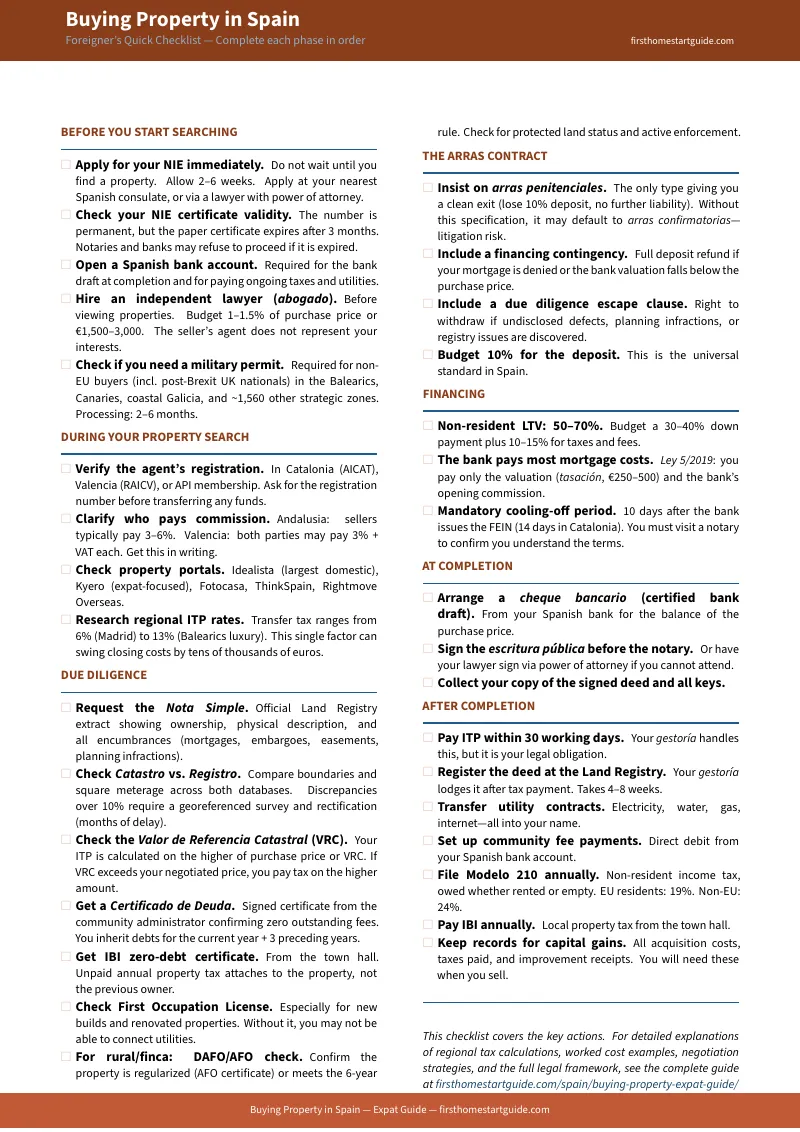
Download the free Quick Checklist to see the step-by-step action plan covering NIE processing, arras contract types, nota simple checks, community debt verification, and the completion timeline. When you're ready for the full Regional Risk Decoder — complete with the regional tax calculator, DAFO trap decoder, military zone navigator, non-resident tax playbook, and 12-week transaction timeline — the complete guide is here.
You've found the property. Now decode the regional risk that stands between you and the keys.
Frequently Asked Questions
What if the rules change after I buy?
We update the guide when the rules change. Email us any time, even years later, and we'll send you the current edition free.