You Found a Taipei Apartment Listed at 50 Pings. The Measurement System, Reciprocity Framework, and Capital Gains Trap Between You and the Keys Assume You Already Know How They Work.
You've found a modern 3-bedroom near Xinyi MRT, a surprisingly affordable 2-bedroom in Beitou, or a renovated apartment in Zhongshan listed on 591.com.tw. You've converted the asking price to your home currency, confirmed your budget covers the number on screen, and started imagining weekend hikes on Elephant Mountain. Within a week you've discovered that the "50-ping" apartment is actually 32 pings of living space and 18 pings of lobbies, elevator shafts, and mechanical rooms you'll never set foot in. You don't know whether your nationality is even allowed to buy — because Taiwan evaluates reciprocity country by country, and for Americans, state by state. The handful of banks that lend to ARC holders cap your mortgage at 20 years instead of 30 and want 6-12 months of local income proof, while the Central Bank's 7th wave credit controls mean a "high-value housing" property in Taipei above NT$70 million demands 70% down. And the affordable pre-1999 building you found in Wanhua was constructed before the seismic code overhaul triggered by the 1999 Chi-Chi earthquake — which killed over 2,400 people and exposed fatal design flaws in exactly the type of building you're considering.
You search online for help. 591.com.tw is entirely in Chinese and optimized for local buyers who already understand the ping system, the public facilities ratio, and how to read a title deed. Reddit and Forumosa contain genuine experiences from expats who navigated HSBC pre-approvals and E.Sun Bank mortgage terms — alongside advice that confuses the HLUT 2.0 holding period rules, recommends skipping the dai-zheng-shi, and confidently states that presale contracts can be freely resold. They cannot — the 2023 amendment banned it. Taipei law firm websites publish technically precise articles on reciprocity restrictions or capital gains thresholds, but each covers one topic in isolation, functions as a lead-generation page for billable consultations, and never connects the financing, seismic, tax, and exit strategy tracks into a single actionable sequence.
Here's the problem no free resource solves: Taiwan's property system runs on structural assumptions that directly contradict Western real estate logic. The advertised size of your apartment is inflated by 30% through the public facilities ratio — a concept that doesn't exist in Western listings. Whether you can buy at all depends on a reciprocity framework that evaluates your nationality against a three-tier classification maintained by the Ministry of the Interior. The professional who handles your closing isn't a lawyer or title company — it's a dai-zheng-shi (地政士), a licensed land administration agent whose role has no equivalent in English-speaking countries. A single mistake on your tax residency planning — failing to maintain 183 days in Taiwan during the year you sell — permanently locks you into a 35% capital gains rate regardless of how long you held the property. And the 2023 anti-speculation amendments banned presale contract resale entirely, creating a liquidity trap that can strand your capital for years if you need to leave Taiwan before construction completes. The system has real protections — the escrow trust mechanism, the MOI standard contract terms, the self-use HLUT exemption — but only if you know they exist, understand the eligibility rules, and verify compliance before you sign.
The Buying Property in Taiwan — Expat Guide is The Reciprocity Navigator. Not a lifestyle article about cheap apartments outside Taipei. It's a structured decision system that decodes every stage of the Taiwanese property purchase — from nationality verification and ping system analysis through the dai-zheng-shi process, seismic code screening, and post-purchase exit strategy planning — so you make each decision understanding the regulatory mechanism behind it, the Chinese term that governs it, and the financial consequence of getting it wrong.
What's Inside The Reciprocity Navigator
The complete 15-chapter guide plus a quick-start checklist — covering every stage from reciprocity verification through post-purchase tax compliance, with the Chinese legal terms, statutory references, tax rates, and seismic thresholds that determine whether your purchase builds equity or traps capital:
Reciprocity Framework Decoder
The single biggest unknown for foreign buyers in Taiwan isn't price — it's permission. Article 18 of the Land Act determines your property rights through a doctrine of equal reciprocity: you can buy only if your home country grants Taiwanese citizens the equivalent right. The Ministry of the Interior maintains a three-tier classification — fully reciprocal (UK, Australia, Japan, 41 US states including NY, CA, TX), conditionally reciprocal (Singapore, Philippines, Thailand with specific limitations), and non-reciprocal (Indonesia, Vietnam, Myanmar — absolute prohibition). For Americans, it gets worse: reciprocity is evaluated state by state. Citizens domiciled in Oklahoma are entirely barred. Mississippi faces conditional restrictions on certain land types. The guide maps every classification, explains the 30-ping land cap on foreign residential ownership (Article 19), and shows why the cap is functionally irrelevant for urban apartments but critical for townhouse and rural purchases.
Ping System Translator — From Advertised Area to Livable Space
Every listing on 591.com.tw reports total registered area (權狀坪數) — a number that includes three components: main building area (主建物, your actual rooms), ancillary area (附屬建物, balconies and terraces), and shared public facilities (公設, lobbies, stairwells, elevator shafts, gyms, mechanical rooms). In post-2005 buildings, the public facilities ratio (公設比) runs 30-35%. A "50-ping" apartment with a 35% ratio and 10% ancillary space delivers only 27.5 pings — 91 square meters — of indoor living. When you recalculate price per main building ping instead of total registered area, the true cost per livable ping jumps 50-80% above the advertised rate. The guide includes worked examples showing how two apartments at the same listed price per ping can differ by millions of NT dollars in actual cost per livable space, and teaches you to isolate the main building area from every listing before committing to a viewing.
Seismic Code Screen — Pre-1999 vs. Post-2005
The 1999 Chi-Chi Earthquake (magnitude 7.3, 2,400+ deaths, 105,000 buildings destroyed) divided Taiwan's building stock into two eras. Pre-1999 buildings used basic static seismic analysis, lacked ductile moment-resisting frames, and included no adjustments for near-fault zones or the Taipei Basin's soil liquefaction characteristics. Post-2005 buildings meet overhauled codes requiring rigorous dynamic analysis, mandatory ductile detailing, and specific microzones for basin effects. The most dangerous structural type — soft-story buildings (軟腳蝦, "soft-legged shrimp") with open commercial arcades on the ground floor — are common in older Taipei neighborhoods and collapse first in lateral shaking. The guide shows you exactly how to verify construction era from the building's use license (使用執照), check soil liquefaction risk maps, identify soft-story indicators, and confirm whether a building carries a yellow or red structural tag — all before you invest time in a viewing.
HLUT 2.0 Exit Strategy Planner
Taiwan's House and Land Unified Tax (房地合一稅 2.0) imposes capital gains rates of 45% for properties held under 2 years, 35% for 2-5 years, 20% for 5-10 years, and 15% for 10+ years. But here's the trap that catches expats: the self-use exemption — which drops the rate to 10% with a NT$4 million gain exclusion — requires holding for 6+ years, maintaining household registration at the property, never renting it out, and selling while you are a tax resident with 183+ days in Taiwan during the year of sale. If you leave Taiwan before selling, you're classified as a non-resident and permanently locked into a 35% flat rate regardless of holding period. There is no graduated scale for non-residents. The guide maps every exemption pathway, explains the 183-day trap with worked examples, and builds the exit timeline you need to plan from the day you close — not the day you decide to sell.
Dai-Zheng-Shi (地政士) Selection Guide
The dai-zheng-shi is the most important professional in your transaction — and a concept that doesn't exist in Western property markets. Licensed by the Ministry of the Interior, this land administration agent handles contract drafting, title verification, tax calculation and filing, escrow coordination, and final registration at the Land Office. They are not your real estate agent (房仲), who works on commission and whose incentive is closing the deal. You can bypass the agent entirely; you cannot bypass the dai-zheng-shi. Fees run NT$20,000-50,000 or 0.1-0.2% of transaction value — a fraction of agent commission. The guide explains how to verify credentials through the MOI's online system (不動產經紀業及地政士資訊系統), what questions to ask, and why a competent dai-zheng-shi is worth more to you than any English-speaking agent in Taiwan.
Foreigner Mortgage Navigator
Mortgage access for foreigners in Taiwan is restricted but not impossible. HSBC, Land Bank of Taiwan, and E.Sun Bank are known to lend to ARC holders, but terms differ significantly from what citizens receive: expect 20-year maximum terms (vs. 30-40 for citizens), interest rates of 2.18-2.5%, and requirements for 6-12 months of Taiwan income documentation plus potentially a local guarantor. The Central Bank's 7th wave of selective credit controls (2024) sets maximum LTV ratios at 70-80% for first homes, 50% for a second outstanding mortgage, and as low as 30% for properties exceeding the "high-value housing" thresholds — NT$70 million in Taipei City, NT$60 million in New Taipei, NT$50 million elsewhere. The guide maps every bank's current lending criteria for foreign nationals, calculates the true down payment you need at each tier, and explains why getting pre-qualified before viewing a single property prevents the most expensive mistake foreign buyers make.
Transaction Cost Breakdown
Closing costs in Taiwan run 1.7-2.7% of transaction value — lower than most Western markets but structured differently. The Deed Tax (契稅) is 6% of the government-assessed building value (not market price — typically 10-30% of what you paid). Stamp Tax is 0.1% of the SPA value. The dai-zheng-shi fee runs NT$20,000-50,000. Agent commission is capped at 6% total (buyer typically pays 1-2%). The guide itemizes every fee, provides worked examples at NT$15M, NT$25M, and NT$40M price points, includes the annual holding costs (House Tax at 1.0-1.2% for self-use, Land Value Tax at 0.2% for self-use), and calculates exit costs including the HLUT and LVIT — so you know the true all-in cost before you sign anything.
Presale Market Warning — The 2023 Liquidity Trap
Presale apartments (預售屋) offer lower entry costs and brand-new construction. But the 2023 amendment to the Equalization of Land Rights Act banned the resale of presale contracts before completion and title registration. For expats on temporary assignments, this creates a genuine liquidity trap: if your employer transfers you out of Taiwan before the building finishes construction (2-4 years), your capital is locked. You cannot sell the contract. You must wait for completion, take delivery, register title, and then sell the completed property — paying full HLUT capital gains tax, which starts at 45% if you've held for under 2 years from registration. The guide explains exactly when presale makes sense, when it doesn't, and how to evaluate developer risk in a market where developer defaults are rare but not impossible.
Country-Specific Tax Reporting — US, UK, Australia
Your obligations don't end at the Taiwan border. US citizens must file FBAR (FinCEN Form 114) if any Taiwan bank account exceeds US$10,000 at any point, report property sales on Schedule D, and navigate a critical asymmetry: the HLUT is creditable as a Foreign Tax Credit, but the LVIT (Land Value Increment Tax) is not — per IRS ruling ILM 202317020. UK residents face capital gains tax on worldwide property disposals with a 60-day reporting deadline. Australian residents must declare worldwide rental income and capital gains with specific CGT discount rules for properties held over 12 months. The guide covers the reporting requirements for all three home-country tax systems and flags the specific traps that generate unexpected double taxation.
Who This Guide Is For
This guide is for foreign buyers and expats purchasing property in Taiwan who:
- Are living in Taiwan on an ARC or APRC — TSMC engineers, English teachers, remote workers, NGO staff — and want to transition from renting to ownership, but need to confirm their nationality qualifies, map the mortgage landscape for foreign nationals, and understand the ping system before committing capital
- Have found an apartment on 591.com.tw and need to know, before they make an offer, whether the construction date passes the seismic screen, what the true livable space is behind the listed ping count, and what the full closing cost will be beyond the asking price
- Are married to a Taiwanese citizen and weighing whether to put the title in one name or both — with the tax residency, capital gains, and exit strategy implications of each approach mapped out
- Are American buyers who need to verify their specific state's reciprocity status, understand the FBAR filing requirements, and navigate the HLUT/LVIT foreign tax credit asymmetry that catches US expats in unexpected double taxation
- Are considering a presale apartment and need the 2023 resale ban explained clearly — including the liquidity trap it creates for expats who might need to leave Taiwan before construction completes
- Want every reciprocity rule, every ping conversion, every seismic threshold, every HLUT rate, every mortgage requirement, and every dai-zheng-shi verification step in one document — so they enter agent meetings, bank appointments, and contract signings with the same structural understanding as a local buyer working with a family dai-zheng-shi
Why Not Free Resources?
Free information on buying property in Taiwan as a foreigner exists. Here's what each source actually delivers:
- 591.com.tw is the dominant property portal — and it's entirely in Chinese. Listings report total registered area in pings without separating main building from public facilities. Prices are listed per total ping, not per livable ping. For a foreign buyer who doesn't read Chinese fluently, the portal is functionally opaque — and even if you can navigate it, the listing format systematically overstates livable space by 30-35% in modern buildings. The platform is built for local buyers who already understand the system.
- Reddit (r/taiwan, r/PersonalFinance) and Forumosa contain real experiences from expats who've navigated Taiwan property purchases — genuine accounts of HSBC mortgage applications, dai-zheng-shi recommendations, and earnest money negotiations. The problem: this intelligence is scattered across years of chronologically decaying threads, mixed with advice that confuses old and new HLUT rules, recommends approaches that the 2023 anti-speculation amendments have since banned, and occasionally states that the 35% non-resident capital gains rate can be avoided through holding period alone. It cannot.
- Taipei law firms and international tax advisors publish technically precise articles on reciprocity restrictions, capital gains thresholds, or deed tax calculations. Each article is accurate in isolation and functions as an SEO entry point for retainer-based consulting at premium hourly rates. What they don't provide: a single integrated roadmap that connects the reciprocity check, ping system, seismic screening, mortgage access, transaction process, tax architecture, and exit strategy into one coherent decision sequence.
- Bilingual real estate agents provide invaluable service for property search and negotiation. They work on 1-2% commission from the buyer side and their primary incentive is closing the deal. What they consistently underexplain: the public facilities ratio that inflates advertised size, the seismic era that determines building safety, the HLUT exit strategy that determines your capital gains rate, and the presale resale ban that can trap your capital. Agent education ends where buyer education needs to begin.
This guide fills the structural gap — the space between knowing that foreigners can buy property in Taiwan and understanding exactly how the reciprocity framework, ping measurement system, seismic code eras, dai-zheng-shi process, HLUT capital gains architecture, and mortgage lending criteria actually work at each stage of the purchase. It's the analysis an independent advisor with no commission to earn would give you, structured as a permanent reference you own.
— Less Than One Hour With a Taipei Property Lawyer
A bilingual real estate agent charges 1-2% commission on every transaction — NT$200,000-400,000 on a standard NT$20 million apartment. A single consultation with a Taipei property lawyer runs NT$5,000-10,000 per hour. The down payment you're committing as a first-home buyer is NT$4-6 million at 70-80% LTV. A single mistake on HLUT residency planning — selling as a non-resident instead of maintaining 183 days — can cost you 15-25% of your capital gains in excess tax that no advisor can recover.
This guide doesn't replace your dai-zheng-shi or your tax advisor. But it gives you the reciprocity framework decoder, the ping system translator, the seismic code screen, the HLUT exit strategy planner, the foreigner mortgage navigator, and the transaction cost breakdown that ensure you walk into every bank appointment, every property viewing, and every contract signing understanding the mechanism behind each step — instead of discovering how Taiwanese property law works by losing capital to it.
If it prevents a single rejected purchase from approaching a Land Office without confirmed reciprocity, catches a single pre-1999 soft-story building before you commit capital, or maps the 183-day residency rule before you accidentally lock yourself into a 35% capital gains rate, it pays for itself before you've finished reading it.
Money-back guarantee, no time limit. If the guide doesn't make the Taiwanese property transaction clearer and your financial position stronger, you pay nothing.
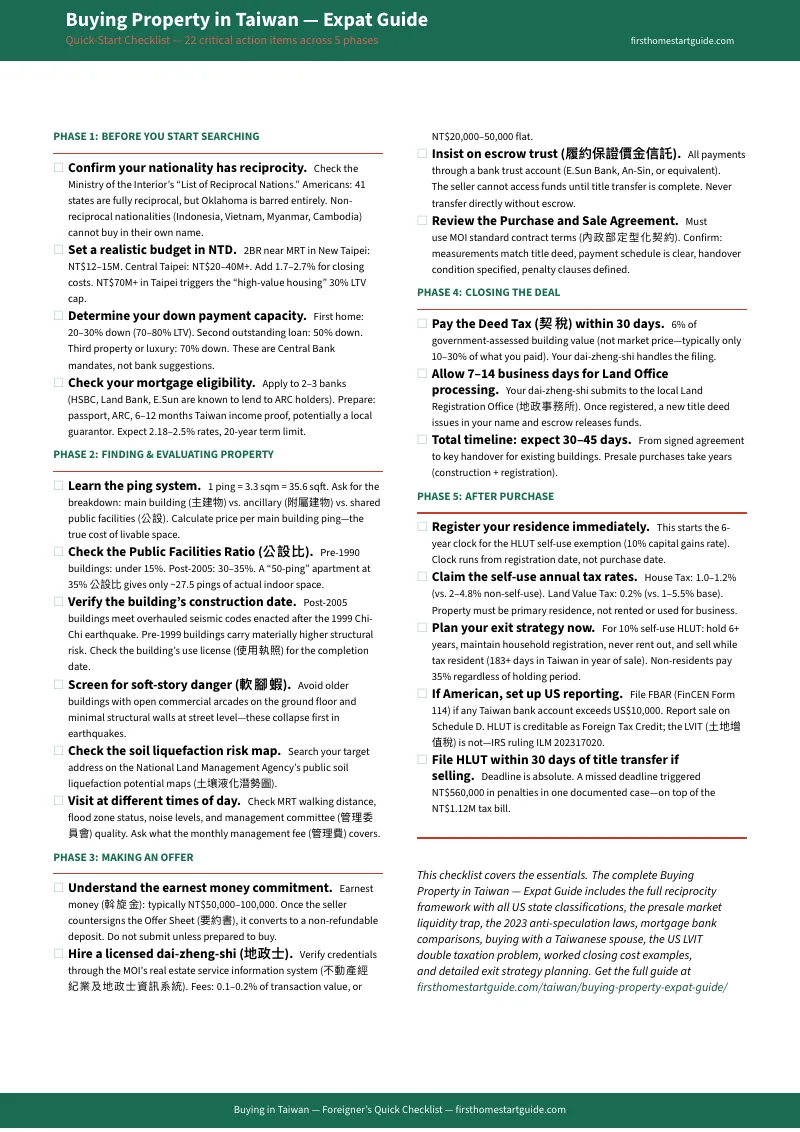
Download the free Quick Checklist to see the 20-item action plan covering reciprocity verification, ping system analysis, seismic screening, earnest money commitment, and HLUT residency planning. When you're ready for the full Reciprocity Navigator — complete with the ping system translator, seismic code screen, HLUT exit strategy planner, foreigner mortgage navigator, presale liquidity trap analysis, and country-specific tax reporting — the complete guide is here.
You've found the apartment. Now decode the system that stands between you and the keys.
Frequently Asked Questions
What if the rules change after I buy?
We update the guide when the rules change. Email us any time, even years later, and we'll send you the current edition free.