You Found a Condo in Bangkok. The Thai Legal System That Governs Your Purchase Just Made Every Workaround You Researched a Criminal Offense.
You've done the research. You've compared Sukhumvit condos against Phuket beachfront units, watched YouTube tours of Chiang Mai rooftop pools, run Wise transfer calculations at midnight to model the exchange rate on a 5-million-Baht apartment. You've read that foreigners can buy condos under the 49% foreign quota. You've seen forum posts describing Thai company structures as a reliable way to own a villa. Three things have changed since you started researching — and any one of them can cost you the entire investment.
First: the nominee company structure is now a criminal offense under active prosecution. DBD Order No. 1/2569 (April 2026) requires every Thai shareholder in a property-holding company to submit an Investment Confirmation Letter proving their funds are genuinely their own. The Supreme Court's "substance-over-form" doctrine has already resulted in land titles being forcibly cancelled, properties subjected to compulsory disposal, and both foreign nationals and Thai nominees facing criminal prosecution under Section 36 of the Foreign Business Act. If you're being told a Thai company structure "works fine if you set it up correctly," you're being told to commit a crime that is now technologically enforced through data integration between the DBD, the Land Department, and the Anti-Money Laundering Office.
Second: the "90-year lease" does not exist. Supreme Court Case No. 4655/2566 (2023) ruled definitively that any arrangement extending a lease beyond 30 years through pre-paid automatic renewals is void from the outset. Section 540 of the Civil and Commercial Code caps every lease at 30 years, period. The second and third 30-year terms that the developer marketed? They are unenforceable personal promises between the original two signatories. If the Thai landowner dies, goes bankrupt, or sells the land, their heirs or the new owners owe you nothing. Buyers who paid upfront for 90 years of security have legal protection for exactly 30.
Third: you find the condo, agree on a price, and your bank transfers 6 million Baht from your overseas account. But you converted to Baht before the wire crossed the Thai border. Or the transfer went through a domestic payment rail instead of SWIFT. Or the wire memo said "property purchase" instead of the exact unit number and your full passport name. Any of these means the Thai receiving bank cannot issue the Foreign Exchange Transaction (FET) form. Without the FET form, the Land Office will categorically refuse to register the freehold title in your name — regardless of the SPA, regardless of the payment, regardless of whether you're physically standing in the unit. Your capital is stranded in Thailand with no title and no mechanism to repatriate it.
None of this means Thailand is the wrong decision. The lifestyle case — cost of living, climate, healthcare, infrastructure — is as strong as ever. Freehold condominium ownership within the 49% foreign quota remains a legitimate, well-established legal path. But the gap between what expat forums and agent blogs describe and what the 2026 regulatory environment actually enforces has never been wider.
You search for help. DDproperty and FazWaz have the listings but zero transactional guidance — no explanation of FET form mechanics, no warning about the nominee crackdown, no mention that the "30+30+30" lease your agent is promoting was invalidated by the Supreme Court. Agency blogs publish polished lifestyle guides that systematically minimize the legal restrictions to avoid losing potential clients. Thai law firm websites cover individual topics — Chanote verification, Sap-Ing-Sith registration, condominium quota rules — in precise technical isolation, each article functioning as a lead-generation page for consultations billed at THB 5,000–30,000. And on ASEAN Now and Reddit, someone posted last week that nominee companies are "fine if you use the right lawyer." They are not fine. They are a path to criminal prosecution and total asset forfeiture.
Here's the problem no free resource solves: Thailand's property system runs on a legal framework where foreigners cannot own land, where the only freehold path is a condominium within a hard 49% quota, where the critical compliance document (the FET form) can be invalidated by a single wrong word in a wire transfer memo, where "90-year leases" have been voided by the Supreme Court, and where escape routes, protections, and strategic structures exist at every stage — but only if you know they're there and activate them before you sign.
The Buying Property in Thailand — Foreigner's Guide is the Legal Compliance Blueprint. Not a lifestyle article about finding your dream condo in Phuket. It's a structured decision system that maps every stage of the Thai property purchase — from ownership structure selection through FET form compliance, title deed verification, due diligence, and transfer day at the Land Office — telling you what agent blogs, property portals, and commission-driven brokers deliberately leave out, so you make each decision understanding the 2026 law that governs it and the financial consequence of getting it wrong.
What's Inside the Legal Compliance Blueprint
A comprehensive 18-chapter guide, a quick-start checklist, and 7 standalone printable tools — instant download, ready to use before your next viewing. Covering every stage from ownership structure decision through post-purchase administration, organized in the order you'll encounter each decision: legal restrictions first, then compliance mechanics, then due diligence, then transfer costs, then the step-by-step process:
Ownership Structure Navigator
The guide opens with the binary reality every foreign buyer must accept: freehold condominium within the 49% quota, or a 30-year time-limited right (leasehold or Sap-Ing-Sith) on Chanote-titled land. It dismantles the three structures agents still promote — nominee companies (now a criminal offense under active DBD prosecution), "30+30+30" leases (voided by Supreme Court Case 4655/2566), and the unlegislated 75%/99-year proposals (neither enacted as of 2026). For each legal path, the guide maps what you actually own, how long you own it, what happens when the term expires, and what your exit looks like. This is what prevents you from deploying capital into a structure that doesn't survive its first legal challenge.
FET Form Compliance System
The Foreign Exchange Transaction form is the single document that determines whether you can register freehold title and whether you can ever repatriate your capital when you sell. The guide covers the exact SWIFT transfer mechanics: foreign currency from overseas, exact wire memo wording ("For the purchase of Condominium Unit No. [X] in [Project Name] by [Your Full Passport Name]"), the USD 50,000 threshold for full FET issuance versus Confirmation Letters for smaller amounts, and why converting currency before it crosses the Thai border permanently disqualifies you. It covers using Wise, Revolut, and other fintech platforms safely — specifically the International Fund Transfer (FTT) processing requirement and the in-person Thai bank branch coordination step that most transfer guides skip. This is what prevents a THB 6-million wire transfer from becoming stranded capital with no title and no way home.
Title Deed Decoder
Thailand has four tiers of land documentation, and only one is safe for foreign capital. Chanote (Nor Sor 4 Jor) — GPS-surveyed, concrete-pegged, red Garuda emblem — is the only title with verified boundaries and full legal protections. Nor Sor 3 Gor has aerial-surveyed boundaries and is upgradeable. Nor Sor 3 has never been measured and leads to boundary disputes. Sor Kor 1 confers no ownership rights at all. The guide explains how to identify each title type, why Phuket and Koh Samui properties face elevated risk of forest reserve overlap (where titles are revoked without compensation), and the exact Land Office verification process your lawyer must complete. This is what prevents you from buying a house on land the government can reclaim.
Sap-Ing-Sith vs. Leasehold Comparison
When you want a villa or landed property, your choice is between a standard 30-year registered lease and a Sap-Ing-Sith (Right to Use Immovable Property) under the 2019 Act. The guide provides a side-by-side comparison across six dimensions: transferability (lease requires landowner consent; Sap-Ing-Sith is freely transferable), inheritability (lease often terminates on death; Sap-Ing-Sith is fully inheritable), building alterations, collateralization, and renewal mechanics. It explains why agents marketing Sap-Ing-Sith as "30+30 renewable" are misrepresenting an Act that contains zero renewal provisions. Both instruments are 30-year wasting assets — but one gives you significantly more control over what you can do with the property during that term.
Due Diligence Framework
Thai real estate agents have no fiduciary duty to the buyer. The guide covers the five mandatory verification steps that must be completed before you sign any SPA or transfer any deposit: physical title search at the Land Office (uncovering hidden mortgages, liens, and servitudes), Foreign Quota Certificate from the condominium's Juristic Person, Free Debt Certificate proving all CAM fees are paid, developer financial solvency check (completion rates, court cases, capitalization), and physical property inspection. It covers off-plan risks — the absence of mandatory escrow (developers use your installments to fund construction), the Waterfront Suites catastrophe in Pattaya where buyers lost 75% of their capital, and the specific SPA clauses that protect you from developer insolvency. This is what stands between you and a deal that looks perfect on a property portal but collapses at due diligence.
Transfer Costs, Taxes, and Exit Planning
The 2% transfer fee, the 3.3% Specific Business Tax (if selling within 5 years), the 0.5% stamp duty, progressive withholding tax — the guide breaks down every cost payable at the Land Office, who conventionally pays each one, and the exact negotiation leverage you have. It covers the Yellow Tabien Baan registration that unlocks the 10-million-Baht annual tax exemption and an alternative SBT exemption if you sell after one year of registration. It maps the 180-day tax residency rule and the 2024 revision that subjects foreign-sourced income remitted into Thailand to progressive personal income tax (up to 35%). And it covers the complete capital repatriation process — the FET form, sale agreement, and tax receipts you'll need to present to the bank to authorize outward transfer of your original principal. This is what prevents you from buying a property that makes financial sense on paper but loses 8-12% to costs you didn't model.
Location Intelligence: Bangkok, Phuket, Chiang Mai, Pattaya, Hua Hin, Koh Samui
The guide covers each major foreign buyer market with the information that lifestyle articles leave out: foreign quota availability and saturation risk, title deed quality by area, developer concentration and off-plan exposure, rental yield ranges, secondary market liquidity for resale, and location-specific risks (Phuket's forest reserve overlaps, Pattaya's historical oversupply, Koh Samui's limited condo stock). This is what helps you choose a location based on legal security and financial fundamentals — not marketing photography.
Plus 7 Standalone Printable Tools
Print these individually and bring them to viewings, lawyer meetings, bank appointments, and the Land Office: Due Diligence Checklist (the five mandatory verification steps as a printable checklist), Transaction Cost Calculator (fillable worksheet for transfer fees, taxes, and total year-one costs), FET Form Requirements Card (exact SWIFT process and wire memo template), Title Deed Comparison (four-tier title system with risk levels), Land Office Transfer Day Checklist (everything you need before, during, and after transfer day), Thai Real Estate Glossary (every Thai legal and property term you'll encounter), and Ownership Structure Decision Flowchart (the legal paths mapped visually — including why nominee companies and 90-year leases are now illegal or void).
Who This Guide Is For
This guide is for foreign buyers and expats purchasing property in Thailand who:
- Are buying their first Thai property and need the entire transaction mapped — from ownership structure selection through FET form compliance, title verification, due diligence, SPA negotiation, and transfer day at the Land Office — so they understand what happens at each stage, what it costs, and where the system diverges from what they expect
- Have found a condo and need to know, before they transfer funds, exactly how the FET form process works — the SWIFT requirement, the wire memo wording, the receiving bank coordination — so their capital arrives with the documentation the Land Office requires to register freehold title
- Have been told by agents or forums that a Thai company structure is "safe if set up correctly" and need to understand the 2026 DBD orders, the Supreme Court's substance-over-form doctrine, and what actually happens when nominee structures are unwound — before they commit their savings to a vehicle that the government is actively dismantling
- Are considering a villa or landed property and need to understand the real difference between a standard lease and Sap-Ing-Sith — not the marketing version, but the legal reality of what each instrument provides, what it doesn't, and why neither extends beyond 30 years regardless of what the contract says
- Are digital nomads, retirees, or long-term expats who need the visa, tax residency, and remittance implications mapped alongside the property transaction — including the 180-day rule, the 2024 foreign income revision, and the LTR/Elite visa pathways
- Want every transfer cost, every tax rate, every legal deadline, and every compliance requirement in one document — so they walk into lawyer meetings, bank appointments, and Land Office transfers understanding exactly what's happening and why
Why Not Free Resources?
Free information on buying property in Thailand as a foreigner is everywhere. Here's what each source actually delivers:
- DDproperty, Dot Property, and FazWaz have every listing in Thailand — and zero guidance on FET form mechanics, no warning about the nominee company crackdown, no explanation of why the "30+30+30" lease structure was invalidated by the Supreme Court. You can find a 5-million-Baht condo in Sukhumvit in ten minutes. What you can't find on any portal: whether that building's foreign quota is already exhausted, which means you won't be able to register freehold title regardless of what the SPA says.
- Agent blogs and developer marketing produce polished guides emphasizing lifestyle opportunity and projected rental yields — maintained by businesses whose revenue depends on closing sales. What they consistently minimize: the legal death of nominee companies, the unenforceability of 30+30+30 leases, the severity of FET compliance failures, and the absence of mandatory escrow for off-plan deposits. Their content is designed to accelerate the transaction, not to protect your capital.
- Thai property law firms (Siam Legal, Belaws) publish technically precise articles on individual topics — Chanote verification, Sap-Ing-Sith registration, FET requirements. Each article covers one concept in isolation and functions as a lead-generation page for consultations at THB 5,000–30,000. What they don't provide: a single integrated roadmap connecting the ownership structure, compliance, due diligence, tax, and transfer tracks into one sequence you can follow from first viewing to key collection.
- On ASEAN Now, Reddit, and Facebook groups, you'll find genuine experiences from real buyers alongside threads where someone confidently states that nominee companies are "fine with the right lawyer," three people agree, and nobody posts the Supreme Court cases that say otherwise. You'll find advice recommending fintech transfers without mentioning the FET form, promoting 90-year leases without citing the 2023 ruling, and skipping independent due diligence because "the agent handles everything." The agent does not handle your legal protection.
This guide fills the structural gap — the space between knowing that Thailand has a 49% foreign quota and understanding how the 2026 enforcement landscape, FET compliance mechanics, title verification process, and tax obligations actually interact at each stage of your specific transaction. It's the analysis an independent advisor with no commission to earn would give you, structured as a permanent reference you own.
— Less Than One Hour of a Thai Property Lawyer's Time
An independent Thai property lawyer charges THB 5,000–30,000 for due diligence on a single transaction. The FET documentation process your bank must execute correctly costs nothing — but getting it wrong strands your entire purchase price in Thailand with no title and no repatriation mechanism. The nominee company structure that agents still promote carries criminal penalties and total asset forfeiture under the 2026 DBD orders. The "90-year lease" that developers market as equivalent to freehold gives you legal protection for exactly 30 years. The cost of navigating all of this through conflicting free resources, outdated forum threads, and commission-driven agency blogs? Months of confusion and decisions made on information that the Supreme Court has already invalidated.
This guide doesn't replace your property lawyer. But it gives you the ownership structure navigator, the FET compliance system, the title deed decoder, the due diligence framework, and the transfer cost calculator that ensure you walk into every viewing, every lawyer meeting, and every Land Office transfer understanding the 2026 rules — instead of discovering how Thai property law works by losing money to it.
If it prevents a single FET documentation failure, catches a nominee company pitch before you commit capital, identifies a title deed that wouldn't survive a Land Office audit, or reveals the 30-year reality behind a "90-year lease" before you sign, it pays for itself before you've finished reading it.
Money-back guarantee, no time limit. If the guide doesn't give you a clearer, more confident understanding of the Thai property transaction, you pay nothing.
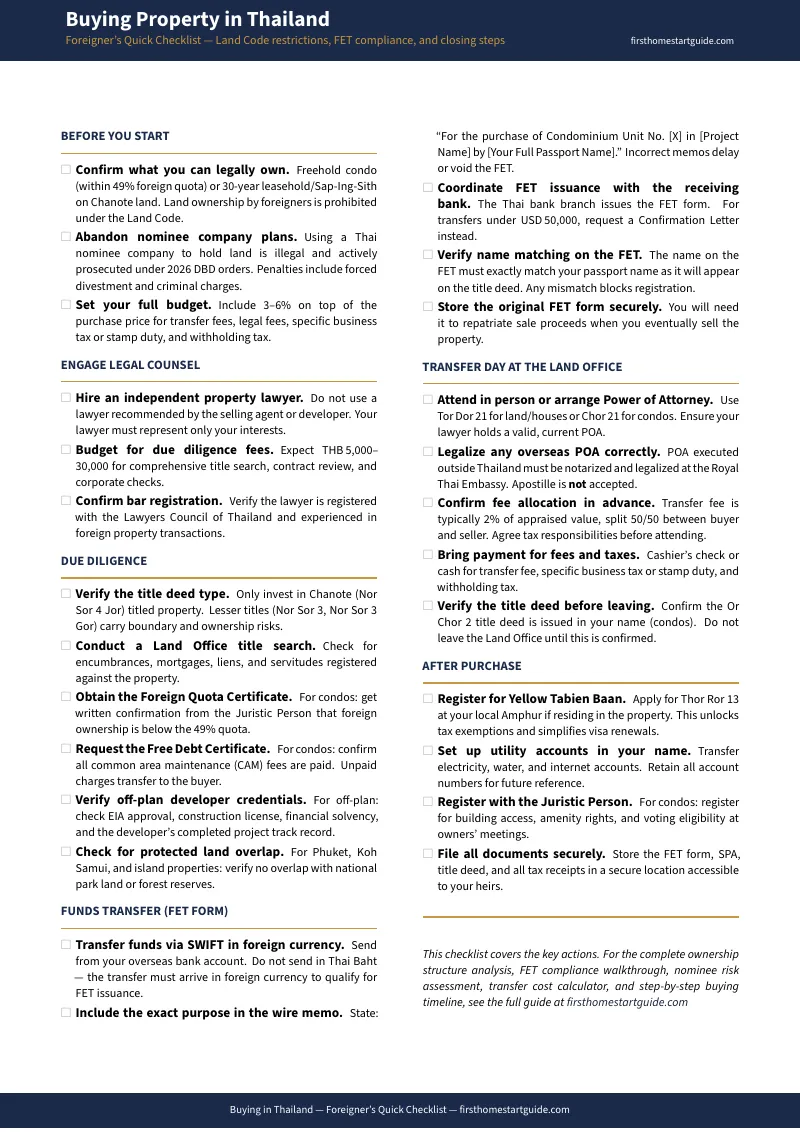
Download the free Quick Checklist to see the step-by-step action plan covering ownership structure selection, FET form compliance, title verification, due diligence, and the transfer timeline from first viewing to key collection.
When you're ready for the full guide — the complete Legal Compliance Blueprint with the ownership structure navigator, FET compliance system, title deed decoder, Sap-Ing-Sith comparison, due diligence framework, transfer cost calculator, location intelligence, and 7 standalone printable tools you can bring to every meeting — the complete guide is here.
You've found the property. Now understand the legal system that governs your purchase — before you sign.
Frequently Asked Questions
What if the rules change after I buy?
We update the guide when the rules change. Email us any time, even years later, and we'll send you the current edition free.