You Have $200,000 in Home Equity. Your Lender, Your Credit Union, and Three Fintech Apps All Want to Help You Spend It. None of Them Will Tell You Which Product Is Right.
You opened the app and it told you your home is worth $520,000. You owe $295,000. That means you have $225,000 in equity. It feels like a financial superpower --- a quarter-million dollars sitting in your walls, ready to renovate the kitchen, wipe out the credit card balances, or fund your kid's tuition.
So you Googled "HELOC vs home equity loan." You read six articles. Three said a HELOC is better because you only pay interest on what you draw. Two said a home equity loan is better because the rate is fixed. One said you should cash-out refinance because you can write off the interest. None of them mentioned that your 2.9% first mortgage is an irreplaceable financial asset --- and that a cash-out refi would destroy it to save you a few hundred dollars a month on credit card payments you could restructure without touching your primary lien at all.
You are stuck. Not because you lack options, but because you have too many --- and the people offering advice all profit from the transaction, not from the quality of your decision.
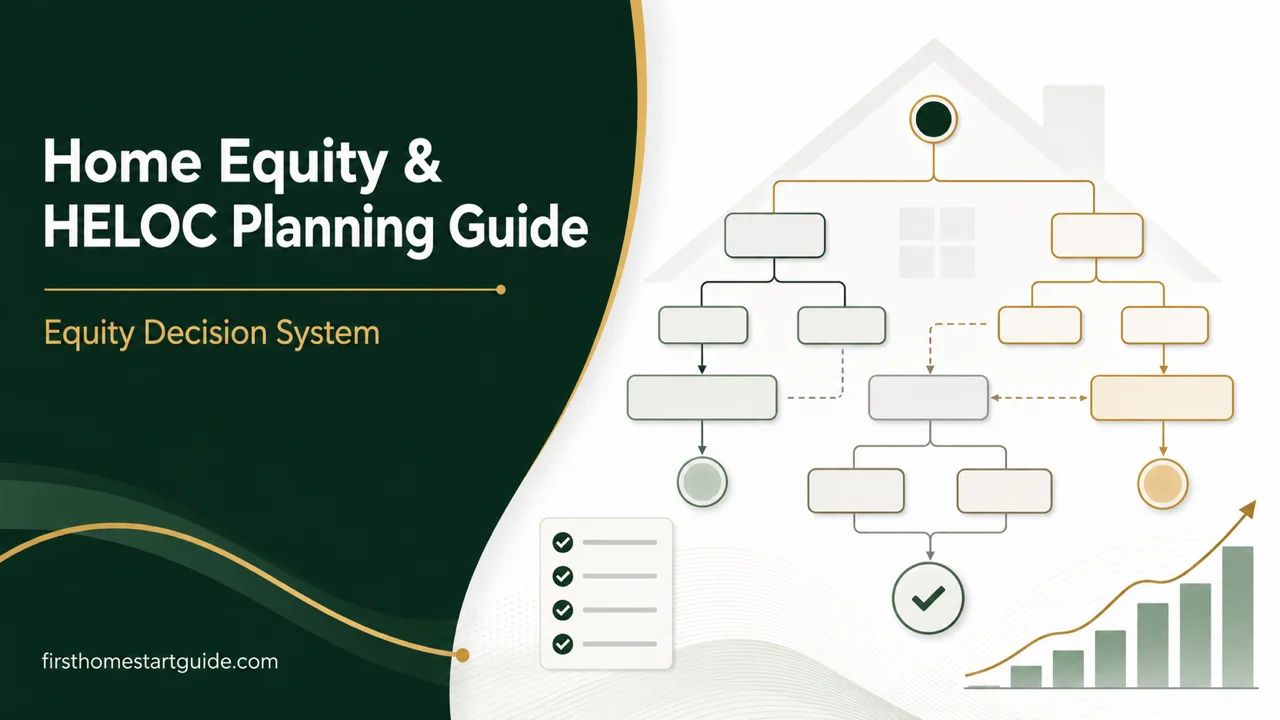
The Home Equity & HELOC Planning Guide is an Equity Decision System. It takes the five decisions that paralyze homeowners --- which product, how much to borrow, what rate structure, whether it is tax-deductible, and how to avoid over-leveraging --- and gives you a structured framework to work through each one with your own numbers. Not a glossary. Not a rate table. A complete decision architecture that turns $34 trillion in household equity confusion into a clear action plan for your specific situation.
What Is Inside the Equity Decision System
An 11-chapter guide plus a quick-start checklist --- organized around the five mathematical and structural decisions that determine whether tapping your equity builds wealth or erodes it:
Product Selection Framework: HELOC vs HEL vs Cash-Out Refi
A side-by-side comparison that goes far beyond the basic table you have already read ten times. This chapter models the total cost of each product over 5, 10, and 15 years for YOUR loan amount, YOUR first-mortgage rate, and YOUR draw schedule. It shows you the exact dollar crossover points --- when a HELOC at 8.5% on a $60,000 draw is cheaper than replacing your 3% first mortgage with a 6.5% cash-out refi on your entire $300,000 balance. The blended rate math that NerdWallet mentions but never calculates for you.
CLTV and Qualification Reality Check
Lenders advertise "borrow up to 85% of your home's value." What they mean is 85% CLTV minus your existing mortgage. If your home is worth $500,000 and you owe $380,000, your tappable equity at 85% CLTV is $45,000 --- not the $120,000 in "equity" your app shows you. This chapter gives you the exact formulas, worked examples at multiple CLTV thresholds, and the credit score and DTI benchmarks that determine whether lenders will offer 80%, 85%, or 90%.
Variable Rate Stress Test
Every HELOC explainer mentions that rates are "variable, tied to Prime." None of them tell you what that means in dollars on your monthly statement when the Fed raises rates by 200 basis points over 18 months. This chapter models your specific draw amount at today's rate, plus 100bp, plus 200bp, plus 300bp --- and shows you the monthly payment at each scenario, the lifetime cap ceiling in actual dollars, and the exact rate environment where a fixed home equity loan becomes cheaper despite its higher starting rate. Payment shock quantified, not feared.
Tax Deductibility Decision Tree (2026 OBBBA Rules)
Most content online still references the "2025 TCJA sunset" that already happened. The One Big Beautiful Bill Act permanently locked the $750,000 mortgage interest deduction limit, raised the SALT cap to $40,000 through 2029, and made PMI deductible as interest starting 2026. This chapter gives you a decision tree: Are you itemizing? Is your total qualified debt under $750k? Are you using the funds to "buy, build, or substantially improve"? If the answer to any is no, your HELOC interest is not deductible --- and that changes the cost comparison math. This is the tax guidance that 90% of HELOC content gets wrong because it has not been updated since the OBBBA passed.
Over-Leveraging Protection Protocol
The most dangerous use of home equity is consolidating credit card debt --- not because the math is bad (8% beats 24%), but because 60% of borrowers who consolidate run their credit card balances back up within three years. Now they have HELOC payments AND credit card payments, secured against a home they can lose. This chapter gives you the behavioral guardrails: credit freeze protocols, draw-limit sizing rules, the 75% CLTV safety margin rationale, and a monthly monitoring routine so you never drift into negative equity territory without noticing.
The Application Playbook
Rate shopping for equity products works differently than mortgage shopping. This chapter covers the 45-day credit inquiry window, how to compare margins (not just APR), which lender types offer which advantages (banks, credit unions, non-bank lenders, fintechs), how to evaluate "no closing cost" offers that embed early-closure penalties, and the negotiation leverage points most borrowers miss. Step-by-step, from choosing lenders through closing.
Monthly Monitoring Routine
An open HELOC is not a set-and-forget product. Your rate changes with Prime. Your home value fluctuates. Your CLTV ratio moves. If you drew $100,000 and your home drops 10% in value, your CLTV may exceed your lender's threshold --- triggering a line freeze or reduction. This chapter gives you the quarterly check: current balance, current rate, current estimated value, current CLTV, and the early warning signals that mean you need to accelerate paydown or convert to a fixed rate.
Standalone Printable Worksheets Included
In addition to the 11-chapter guide and quick-start checklist, you get 7 standalone printable tools --- fill them in with your numbers, bring them to lender meetings, and post them where you will see them:
- Equity Position Worksheet --- Calculate your tappable equity at 80%, 85%, and 90% CLTV thresholds with your actual home value and mortgage balance
- Rate Stress Test Worksheet --- Model your monthly payment at today's rate through the worst-case lifetime cap, plus payment shock when the draw period ends
- Product Comparison Card --- HELOC vs home equity loan vs cash-out refinance side by side, with the decision framework for choosing the right product
- Tax Deductibility Decision Tree --- Three-question flowchart showing whether your specific use of funds qualifies for the interest deduction under 2026 rules
- Lender Comparison Worksheet --- Compare 3-5 lenders on margin, lifetime cap, closing costs, early closure penalties, and fixed-rate conversion options
- Application Document Checklist --- Every document you need assembled before your first lender appointment
- Monthly Monitoring Tracker --- Quarterly equity position check, rate monitoring log, and draw period countdown calendar
Who This Guide Is For
- Homeowners with a sub-4% first mortgage who know they should NOT refinance but want to access equity through a second lien --- and need to understand whether a HELOC or a fixed home equity loan is the right structure for their specific situation
- Homeowners carrying $15,000 to $60,000 in credit card debt who are considering equity-based consolidation but want to understand the over-leveraging risk, the tax implications, and the behavioral guardrails before committing their home as collateral
- Homeowners planning a $50,000+ renovation who need to compare a HELOC (draw as needed, variable rate) vs a home equity loan (lump sum, fixed rate) for a multi-phase project --- and want the math modeled for their timeline, not generic advice
- Homeowners who got pre-approved for less equity than expected and want to understand why CLTV calculations limit their borrowing power, what they can do to increase their approved amount, and whether alternative lenders offer higher thresholds
- Homeowners approaching Year 9-10 of an existing HELOC draw period who need to prepare for the repayment phase transition --- when interest-only payments convert to fully amortizing and monthly costs can triple overnight
- Anyone confused about whether HELOC interest is tax-deductible and needs the current 2026 rules (post-OBBBA) explained in plain language, with a decision tree for their specific use of funds
Why Not Free Tools and Bank Websites?
- NerdWallet and Bankrate publish rate tables and basic product explainers because their revenue comes from lender affiliate fees. They tell you what a HELOC is. They do not tell you whether YOUR situation calls for a HELOC or a home equity loan, what YOUR blended rate actually is, or how much YOUR monthly payment increases when rates rise 200 basis points. Their content is a glossary, not a decision system.
- Bank of America, Chase, and Wells Fargo publish HELOC content that transitions from a two-paragraph explainer directly into an application button. They want you to apply through THEIR portal. They do not publish the stress test showing what your payment looks like at their lifetime rate cap of 18%. They do not tell you that a credit union two miles away is offering a 5% lower margin because credit unions are not-for-profit. They do not tell you because telling you reduces their applications.
- HELOC "calculators" ask for a loan amount and a rate, then show you a monthly payment. They do not model the draw-period-to-repayment transition. They do not compare HELOC vs HEL vs cash-out refi for your specific first-mortgage rate. They do not factor in tax deductibility (which depends on what you USE the money for, not just whether you borrow it). They give you one number devoid of the five decisions that actually determine whether borrowing against your home is smart or catastrophic.
- Reddit and personal finance forums are full of people who got good advice mixed with people who got terrible advice, and you cannot tell which is which until after you have signed closing documents. The advice is anecdotal, jurisdiction-unaware, and frequently out of date on tax law. Crowdsourced validation is no substitute for structured decision-making with your actual numbers.
This guide fills the gap between free glossary content and a $300-per-hour consultation with a fee-only financial planner. It gives you the complete decision architecture --- product selection, qualification math, rate stress testing, tax planning, and behavioral guardrails --- so you can walk into a lender's office already knowing what you need, what you qualify for, and what it will actually cost.
--- Less Than One Hour of a Financial Planner's Time
A fee-only financial planner charges $200 to $400 per hour to help you evaluate equity products. A bad HELOC decision --- drawing too much, choosing the wrong product structure, or failing to understand your rate exposure --- can cost $10,000 to $40,000 over the life of the loan in excess interest, payment shock, or tax deductions you never claim.
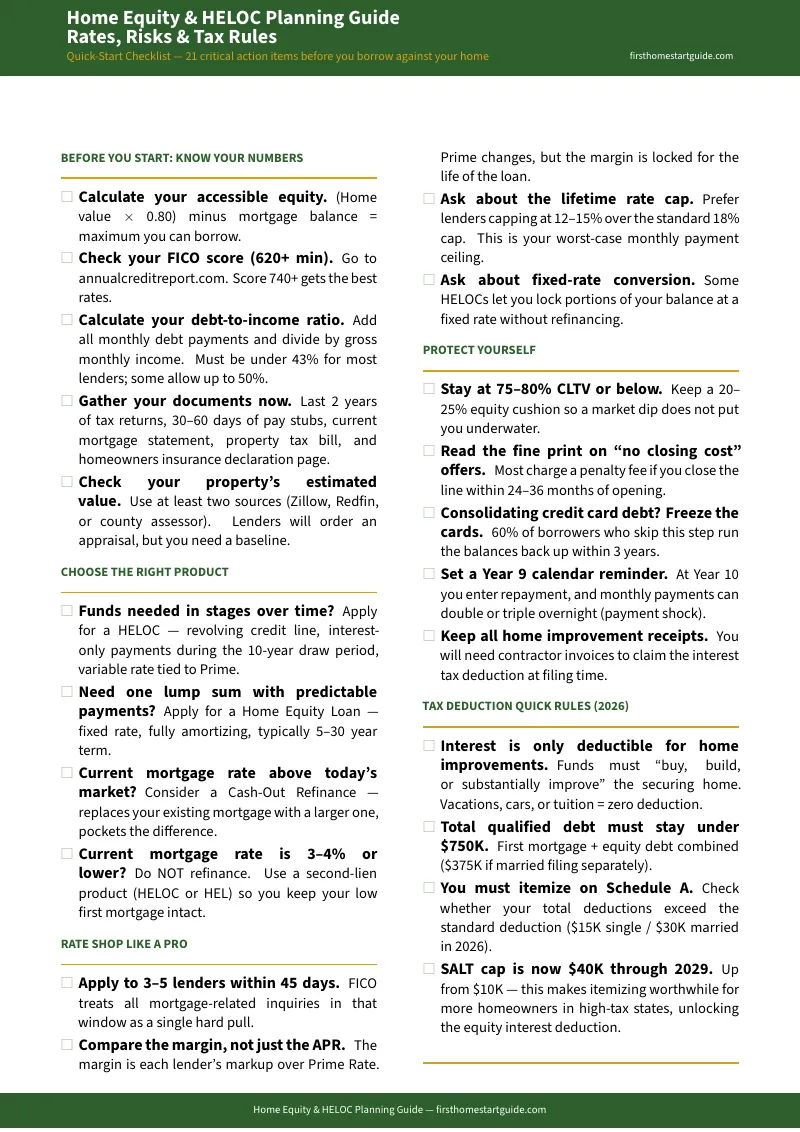
This guide gives you the Equity Decision System: an 11-chapter guide covering product selection, CLTV qualification, rate mechanics and stress testing, fees and hidden traps, smart uses vs dangerous uses, 2026 tax rules, alternatives, the application playbook, and a monthly monitoring routine --- plus a quick-start checklist and 7 standalone printable worksheets you fill in with your own numbers.
If it prevents one wrong product choice, identifies one lender offering a better margin, or catches one tax deduction you would have missed, it pays for itself before you finish Chapter 2.
Money-back guarantee, no time limit. If the guide does not give you a clear, dollar-specific framework for deciding whether, how, and how much to borrow against your equity, you pay nothing.
Download the free Home Equity Quick-Start Checklist to run through qualification checks, product selection logic, and rate-shopping fundamentals. When you are ready for the full stress tests, tax decision tree, application playbook, and the complete Equity Decision System, the full guide is here.
Your lender has an application button. This guide has the math that tells you whether clicking it is the right move.