The Paperwork Is Signed. The Keys Are Yours. Now What?
Your agent handled the offers, the counteroffers, the inspections, the appraisal, and the closing table. Your mortgage broker handled the financing. Your attorney reviewed the contracts. Then you got the keys, and every one of those professionals walked away.
Now you are standing in an empty house. The internet will not be connected for 12 days because you did not know installations need 7-14 business days of lead time. The smoke detectors are chirping because every battery is dead. The previous owner's cleaner, contractor, and three neighbours still have keys to your front door. You cannot find the water shut-off valve. The municipal trash bin you assumed would be waiting on the curb does not exist --- you need to call the hauler and wait two weeks for delivery. And the toilet does not have a plunger.
Then there is the money. You budgeted for the down payment and closing costs. You did not budget for the relentless cascade of $50-to-$500 purchases that starts on day one and does not stop for a month: rekeying locks ($150-$300), window treatments for every room ($500-$3,000+), yard tools you never needed in an apartment ($300-$600), a basic toolset, cleaning supplies, smoke detector batteries, a garden hose, trash bins the municipality charges for separately. First-time buyers routinely spend $1,500-$5,000 in unplanned post-closing expenses.
None of this had to be chaotic. The problem is not that moving is inherently hard. The problem is that nobody gives you the operational sequence. Every task has a specific week it needs to happen, a specific lead time it requires, and a specific consequence if you miss it. The Moving Day Toolkit is a Post-Closing Operations System --- a structured countdown from 8 weeks before moving day through 90 days after, with every task sequenced to the right week, every cost range documented, and every administrative step pre-populated so you are not assembling a plan from 30 browser tabs at midnight.
What's Inside the Post-Closing Operations System
A 14-chapter guide, a quick-start checklist, and 8 standalone printable tools --- organized by timeline phase so you always know exactly what to do this week:
8-Week Countdown Timeline
A phase-by-phase schedule from closing date confirmation through Day 90 of occupancy. Every task has a specific week assignment and a clear reason for its timing --- not "hire movers early" but "book FMCSA-registered carriers at 8 weeks because peak-season rates inflate 20-40% and preferred dates fill up." Not "schedule internet" but "request installation at 4+ weeks because fibre and new builds require 7-14 business days and remote workers cannot afford a two-week gap." The timeline eliminates the guesswork that turns moving into a scramble.
Post-Closing Budget Tracker
Category-by-category cost breakdown covering the micro-expense surge that blindsides every buyer. Security ($200-$600): lock rekeying, smart doorbells, motion sensors. Sanitation ($150-$400): deep cleaning, new toilet seats, drain tools. Window treatments ($500-$3,000+): the single largest surprise expense for buyers moving from apartments. Yard and maintenance ($500-$1,800): tools, mowers, hoses, ladders. Safety systems ($100-$250): smoke detectors, CO alarms, fire extinguishers, first aid. Each category includes real cost ranges so you can set aside the right amount before closing --- instead of discovering the total after you have already spent it.
Complete Change-of-Address Directory
Pre-populated list of every entity that needs your new address, organized by urgency and category. Government agencies (USPS, DMV, IRS Form 8822, voter registration, Social Security). Financial institutions (banks, credit cards, investment accounts, insurance, student loans). Medical providers (doctors, dentists, pharmacies, specialists, veterinarians). Subscriptions and memberships. Professional licenses. Free checklists say "update your address." This directory tells you with whom, how, what form to file, and how long processing takes.
Utility Transfer Protocol
Setup timelines and sequencing for electricity, gas, water, internet, cable, and municipal waste. The lead times are not obvious and they are not equal --- electricity needs 3-5 business days, internet needs 7-14, and trash service can take 1-2 weeks for bin delivery. The protocol sequences disconnections at the old address and activations at the new address so nothing overlaps, nothing gets missed, and you are not sitting in a dark house on moving day because you assumed utilities "just switch over."
Day-One Safety Protocol
The tasks that must happen before you move a single piece of furniture inside --- because they are dramatically harder (or impossible) once furniture is in place. Rekeying locks. Locating and labelling the water shut-off valve, gas shut-off, and electrical breaker panel. Testing every smoke and CO detector. Deep cleaning kitchens and bathrooms. Resetting smart home devices the previous owner may still have remote access to. The floor refinishing sequence that most buyers get backwards (refinish first, move furniture in second --- not the other way around).
The "Open First" Essentials Box
Complete packing list for the one box that rides in your car, not the moving truck. Phone chargers. Toilet paper. Hand soap. Cleaning wipes. Utility knife. Screwdriver set. Flashlight. Trash bags. Shower curtain with hooks. Medications. Clean sheets. Pillows. Snacks. Bottled water. Paper plates. Coffee maker and mugs. Pet food and bowls. Without this box, your first evening in the new house involves emergency trips to hardware stores while surrounded by 47 unmarked cardboard boxes.
Moving Company Vetting Guide
How to compare estimates, spot red flags, and protect yourself during the move. The difference between a carrier (owns trucks, liable for cargo) and a broker (intermediary, not liable for damage). How to verify USDOT numbers at safer.fmcsa.dot.gov. Why binding estimates protect you and non-binding estimates do not. What to check on the Bill of Lading before signing. Long-distance movers charge $0.50-$0.80 per pound --- the guide shows how to reduce weight strategically and save $250-$400+ through the declutter process.
Room-by-Room Packing System
Box labelling protocol (destination room + brief contents + handling instructions), furniture disassembly sequence with hardware bagging in labelled zip-lock bags, appliance prep timelines (refrigerators need 24+ hours to defrost), and the category of items that never go on the moving truck: jewellery, cash, irreplaceable documents, hard drives, prescription medications.
School and Medical Transfer Guide
Timeline for requesting academic transcripts, immunisation records, IEP/504 plans, dental files, and specialist referrals. This process starts at 4-8 weeks and the lead times are enforced by school districts and medical offices, not by you. Miss the window and your child's enrollment gets delayed. The guide covers exact document requests and the sequence for contacting both the current and new school.
International Relocation Module
Cross-border logistics for expats and corporate transferees. Visa timeline coordination (3-6 months advance). Sea freight windows (up to 12 weeks). FBAR reporting threshold ($10,000 aggregate foreign account balance). No-Claims Bonus transfers for auto insurance. International driving permits. Pet importation protocols --- ISO-compliant microchipping, rabies certifications, quarantine requirements by destination country. If you are moving between countries, this module covers the regulatory and logistical layer that domestic checklists ignore entirely.
The Free Checklist: 20 Actions That Prevent 90% of Moving Problems
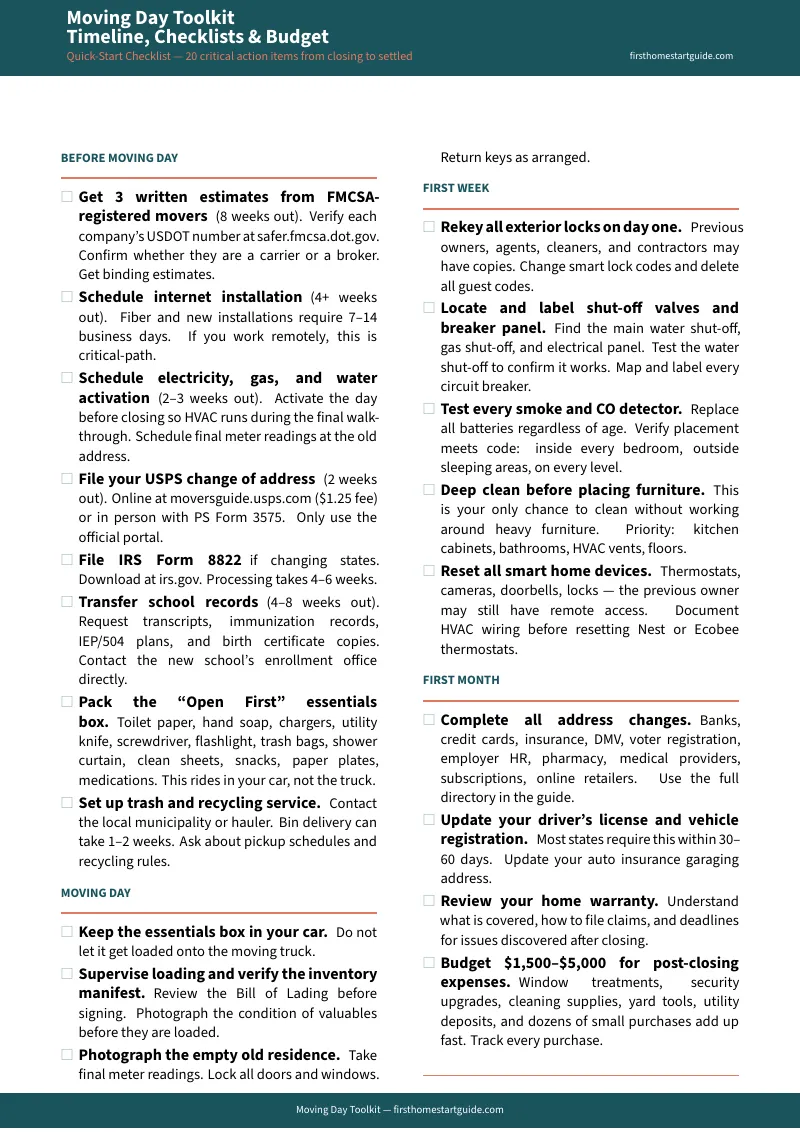
The Moving Day Quick-Start Checklist is a free one-page reference covering the 20 highest-impact actions organized by timeline phase --- before moving day, moving day itself, and the first month of occupancy. Includes the complete "Open First" essentials box packing list and the key budget categories with cost ranges so you know what to set aside. Print it and work from it as your starting point.
Who This Is For
- First-time buyers moving from a rental who have never managed a property transition independently --- you have no baseline for what needs to happen, what order it happens in, or how much the first 30 days actually cost when you add up the security upgrades, cleaning supplies, window treatments, and yard tools that never applied in an apartment
- Families upgrading to a larger home with children, pets, remote work schedules, and zero margin for error on school enrolment deadlines, medical record transfers, or arriving at the new house with no internet for two weeks
- International relocators and corporate transferees coordinating visa timelines, cross-border shipping, foreign financial reporting, pet importation, and the challenge of establishing a household in a new country without a local network
- Anyone who closed on a home and has 2-8 weeks before moving day who wants a structured countdown instead of a growing pile of sticky notes, bookmarked articles, and half-remembered advice from friends who moved five years ago
Why Not Free Checklists?
- Moving company blogs (PODS, Allied, U-Haul) exist to sell you their service. Their checklists cover "pack boxes, hire us, change your address" and stop there. They do not include post-closing budget tracking, utility transfer lead times, day-one safety protocols, or any operational detail that does not lead to a booking.
- Lifestyle sites (The Spruce, Apartment Therapy, HGTV) publish linear article checklists built for page views. They are not structured by timeline phase, they do not include cost ranges, and they are written for apartment-to-apartment moves --- not the homeowner-specific transition that involves rekeying locks, locating shut-off valves, coordinating school transfers, and budgeting for $1,500-$5,000 in purchases nobody mentions.
- Printable templates on Etsy ($1-$5) are static PDFs that look nice but give you empty boxes to fill in yourself. They do not tell you what goes in the boxes --- no pre-populated address change contacts, no utility lead times, no cost ranges, no task sequencing by week.
- Premium Notion planners ($18-$49) are complex digital systems that require you to learn someone else's workflow before you can start planning your move. They do not include the domain-specific content --- the FMCSA verification process, the IRS Form 8822 requirement, the international FBAR threshold --- that makes the difference between a plan and an actual operational system.
This toolkit fills the gap between "hire movers and change your address" and the operational reality of moving into a home you own. It is the reference that takes the combined knowledge of experienced homeowners, professional organizers, and relocation specialists and sequences it into a structured countdown you work through week by week.
--- Less Than a Single Emergency Hardware Store Run
That midnight trip to the hardware store because you forgot to pack a flashlight, a screwdriver, and toilet paper --- that costs more than this toolkit. The window treatment estimate that shocks you because nobody mentioned it --- that runs $500 to $3,000. The internet installation you scheduled too late, forcing you to work from a coffee shop for two weeks --- that disruption has no price tag but a very real cost.
The toolkit gives you the sequenced timeline, the pre-populated directories, the cost ranges, and the safety protocols. It turns the post-closing chaos into a structured countdown where every task is assigned to the right week and every surprise expense is anticipated before it hits.
If it saves you from one missed utility lead time, one forgotten address change, or one post-closing budget shock, it pays for itself before you finish the first chapter.
Money-back guarantee, no time limit. If the toolkit does not give you the structure and clarity to manage your move without the midnight panic, you pay nothing.
Download the free Moving Day Quick-Start Checklist to start with the 20 highest-impact actions and the complete "Open First" essentials box packing list. When you are ready for the full Post-Closing Operations System --- the 8-week countdown, the budget tracker, the change-of-address directory, the utility transfer protocol, and all 14 chapters --- the complete toolkit is here.
Your closing date is set. The countdown starts now.