Your Closing Disclosure Has $4,000 in Title Insurance Charges. Your Agent Said "That's Standard." Do You Know If That's True?
You got your Loan Estimate three days after applying for the mortgage. Somewhere between the origination charges and the government recording fees, there was a line for title insurance --- $2,000 for the lender's policy, another $3,500 for the owner's policy. Your agent said you need both. Your lender said the same thing. Nobody explained why the policy you're required to buy protects only the bank, or why the "optional" one you're pressured into protects only you, or why the math on your Closing Disclosure produces a negative number for a product that costs thousands of dollars.
So you did what every confused buyer does at 11pm. You opened Reddit. You found a thread where someone's owner's title insurance jumped $2,000 between the Loan Estimate and the Closing Disclosure, and the top comment said "you're being ripped off." You found another thread where a first-time buyer asked if the owner's policy was worth it, and seventeen strangers said "absolutely, a widow lost her house over a $20,000 lien she didn't know about." You found an article about TRID simultaneous issue calculations that used the word "formula" six times without showing you the formula.
By midnight you had eight browser tabs open, a growing conviction that your title company is either scamming you or saving you from catastrophe, and no way to tell which one it is.
That confusion is structural, not personal. Over 40% of American homebuyers report feeling confused or taken advantage of by title insurance charges at closing. Title premiums increased by over 36% between 2021 and 2023 as part of the broader closing cost surge. The CFPB has launched formal investigations into "junk fees" embedded in settlement charges. And the free resources that show up when you Google "title insurance explained" --- NerdWallet, Bankrate, the CFPB's own explainer --- accurately define what title insurance is but never tell you how to evaluate your specific quote, which administrative fees are pure profit padding, or how to calculate whether your builder's $10,000 closing cost credit actually costs you $40,000 over the life of your loan.
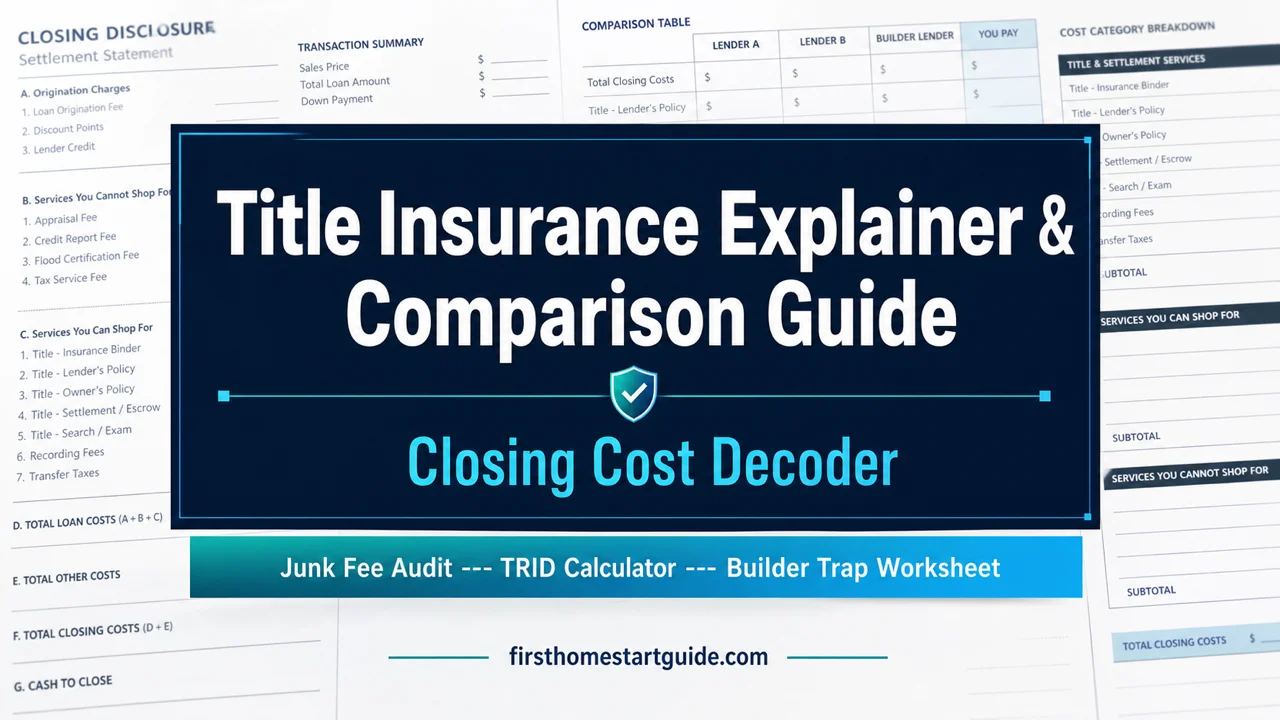
The Title Insurance Explainer & Comparison Guide is a Closing Cost Decoder --- a structured reference that sits between you and your settlement charges, translating every line item on your Closing Disclosure into a clear category: regulated and fixed, negotiable, or outright padding. It replaces the midnight research spiral with a reference you open alongside your closing documents, match each charge against, and walk away knowing exactly what you're paying for, what you can challenge, and what discount you're entitled to that nobody mentioned.
What's Inside the Closing Cost Decoder
A 16-chapter guide, a quick-start checklist, and 5 standalone printable tools --- 7 PDFs total, organized by the specific question you're trying to answer, so you can find your answer in under two minutes:
Lender's vs. Owner's Policy --- The $250,000 Distinction
The lender's policy you're required to buy protects only the bank's investment. If a title defect surfaces, the insurer pays the bank --- not you. A worked example shows exactly what happens when a forged deed from 20 years ago invalidates your title: the lender's policy makes the bank whole at $350,000, while you lose your $100,000 down payment, $50,000 in principal payments, and $100,000 in appreciation. Total personal loss: $250,000. The guide explains the coverage mechanics, the claims process, and why declining the owner's policy is one of the most dangerous financial decisions a homebuyer can make --- with real cases including a Missouri couple saved from a $419,000 missed mortgage lien because they had owner's coverage.
Standard vs. Enhanced Policy Comparison
Title companies routinely upgrade buyers to the enhanced ALTA Homeowner's Policy --- 10% more expensive --- without explaining what the upgrade buys. The guide provides a side-by-side matrix: 10 covered risks under the standard policy vs. 33 under the enhanced. The critical additions include post-policy forgery protection (someone steals your title after closing), automatic inflation coverage up to 150% of purchase price, building permit violation coverage (a previous owner enclosed a patio without permits and the city forces you to tear it out), and boundary encroachment protection. You see exactly what the 10% premium increase buys and whether it's worth it for your specific situation.
The TRID Simultaneous Issue Decoder
The single greatest source of closing table confusion in American real estate. When you buy both policies from the same title company, you get a simultaneous issue discount. But the CFPB mandates a formula that shows the lender's policy at its full un-discounted price and calculates the owner's policy as: Full Owner's Premium + Simultaneous Lender's Premium - Full Lender's Premium. This regularly produces a negative number on your Closing Disclosure --- a $2,568 owner's policy can appear as negative $407 while the lender's policy shows $3,175. The guide walks through the math step by step, reconciles the federal Closing Disclosure against the state-level ALTA Settlement Statement, and explains why the numbers look wrong but the total is correct.
The Junk Fee Audit
A line-by-line breakdown of every fee that appears in Section C of your Loan Estimate. Each fee is categorized as fixed and regulated (government recording fees, state-promulgated premiums), legitimate but variable (title search, settlement fee, closing protection letter), or negotiable padding (document preparation fees, "processing" fees, email delivery charges, document storage fees). The guide includes the exact language to use when challenging inflated fees: "I've compared your administrative fees against two other quotes. Your courier fee, document prep fee, and processing fee total $375 more than the lowest competitor. Can you match their fee structure, or should I move my business?"
The Builder's Trap Calculator
Corporate builders offer $5,000 to $15,000 in closing cost credits --- but only if you use their affiliated lender and title company. The guide walks through the false economy: a builder offering $10,000 in credits through an affiliated lender charging 7.25% instead of an independent lender at 6.875% costs you $112 per month more on a $450,000 loan. Over 30 years, that's $40,000 in excess interest --- four times the "free" credit. The builder's affiliated title company then charges maximum allowable premiums and inflated administrative fees on top. The guide provides a step-by-step net-cost worksheet so you can calculate whether the incentive actually saves money or whether you're paying $40,000 for a $10,000 coupon.
Title Commitment Reader
Your title commitment arrives as an impenetrable legal document. The guide breaks it into its three functional sections --- Schedule A (basic facts to verify), Schedule B-I (requirements that must be met before closing), and Schedule B-II (exceptions carved out of your coverage permanently). The Schedule B-II section is critical: if an easement crosses the exact location where you plan to build a pool, or a covenant prohibits renting the property, the title policy provides zero protection after closing. The guide tells you what to check, what to challenge, and when to raise objections before it's too late.
Endorsement Cost Guide
Endorsements modify your base policy and can add hundreds or thousands of dollars to your premium. The guide explains the common ones --- ALTA 8.1 Environmental Protection Lien ($75, generally worth it), ALTA 9 Restrictions and Encroachments (10% of base premium nationally, up to 25% in Florida), ALTA 22 Location, ALTA 28 Easement Damage --- and tells you which are lender-required vs. optional, which overlap with the enhanced policy, and when stacking individual endorsements costs more than simply upgrading to the enhanced tier.
State-by-State Pricing Reference
Title insurance costs vary by thousands of dollars depending on whether your state has promulgated (government-fixed) or competitive rates. In Texas, a $475,000 property carries a state-mandated premium of $4,185 --- every company charges the same amount and your only savings lever is administrative fees. In competitive states like California and New York, you can shop aggressively on the premium itself. The guide includes a cost comparison table, explains the promulgated vs. competitive distinction, and maps county-by-county customs for who pays (seller pays in most of Florida except Miami-Dade; buyer pays in Northern California but seller pays in Southern California).
Reissue Rate Discount Guide
If the property was purchased within the last 3 to 10 years and you can produce a copy of the prior owner's title policy, you may qualify for a 20-40% premium discount. Title companies rarely volunteer this. The guide explains the qualification rules, provides state-specific discount tiers (Florida's administrative code sets exact reduced rates per thousand of coverage), and gives you the script to request the discount --- regardless of whether your transaction is being handled by the same company that issued the prior policy or a different one.
The Free Checklist: 18 Items to Check Before You Close
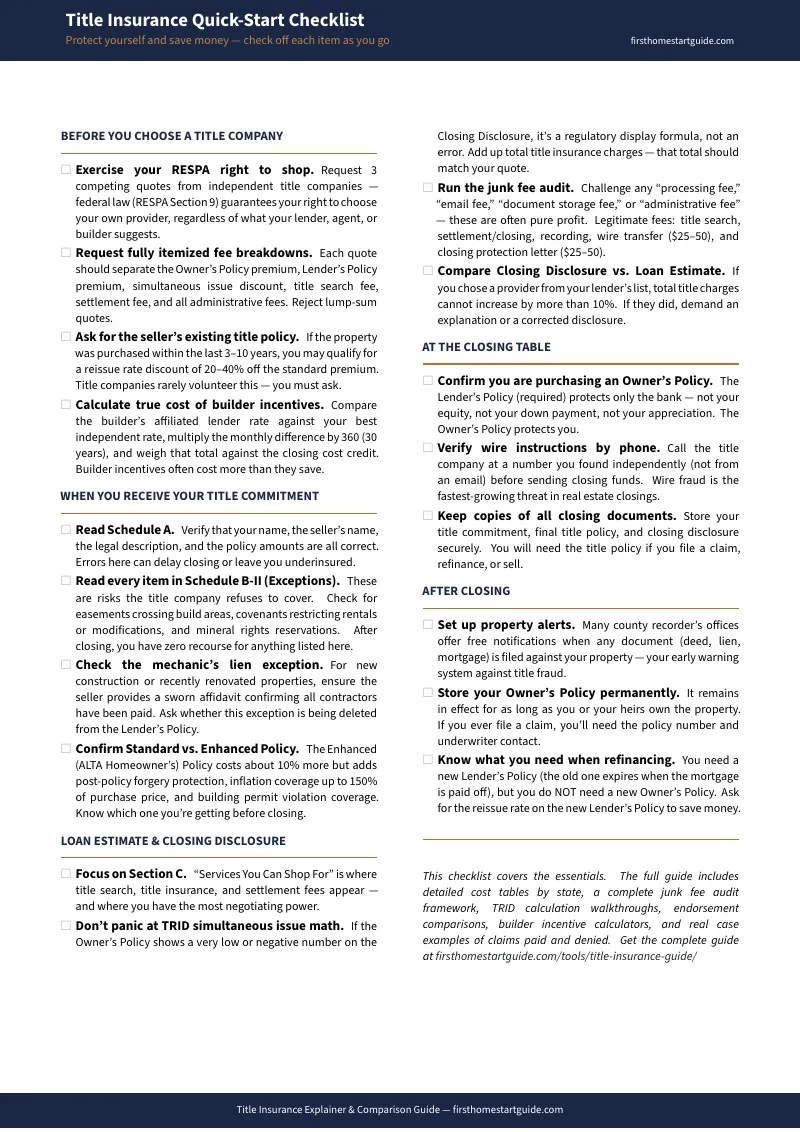
The Title Insurance Quick-Start Checklist is a free one-page reference covering the 18 highest-impact actions across five stages of the closing process --- before choosing a title company, when reviewing the title commitment, when reviewing the Closing Disclosure, and at the closing table. Each item is a concrete action: request 3 competing quotes, ask the seller for the prior title policy, verify you're getting the simultaneous issue rate, run the junk fee audit on Section C. Print it and use it alongside your closing documents.
Who This Guide Is For
- First-time buyers who just got their Loan Estimate and are staring at $3,000 to $5,000 in title insurance charges with no idea whether the amount is correct, whether the owner's policy is worth it, or whether they're allowed to shop for a different title company
- Buyers comparing their Closing Disclosure to their Loan Estimate and finding numbers that don't match --- especially the TRID simultaneous issue math that makes the owner's policy show up as a negative number on one document and a $2,500 charge on another
- New construction buyers being steered toward a builder's affiliated title company with $10,000 in closing cost credits that sound irresistible but may cost $40,000 over the life of the loan through inflated lender rates and maximum-allowable title premiums
- Refinancing homeowners confused about why they need new title insurance on a property they already insured 18 months ago --- and who don't realize they need a new lender's policy but not a new owner's policy, and that a reissue discount could save hundreds
- Anyone who suspects they're being overcharged at closing but can't tell which fees are legitimate, which are negotiable, and which are padding --- and doesn't want to pay $200-$500 for a real estate attorney's hourly rate to find out
Why Not Free Resources?
- NerdWallet and Bankrate explain what title insurance is. They do not explain how to evaluate your specific quote, which administrative fees on your Closing Disclosure are profit padding, how to reconcile the TRID simultaneous issue math, or how to calculate whether your builder's closing cost credit is actually costing you money. They define the product. This guide decodes your actual charges.
- Reddit threads give you contradictory panic. One commenter says you're being ripped off. Another says title insurance saved them from a $419,000 lien. Neither can see your documents, and neither is liable for their advice. The midnight research spiral leaves you more confused than when you started.
- Your real estate agent wants the deal to close. Agents rely on preferred title companies to ensure a smooth path to closing and commission. An agent who encourages you to shop aggressively for competing quotes risks delaying the transaction. The commission structure does not incentivize your agent to help you reduce settlement costs.
- Real estate attorneys charge $200 to $500 per hour. A one-hour consultation to review your closing documents is excellent protection but costs more than many buyers can justify. This guide provides the same analytical framework --- junk fee identification, TRID reconciliation, endorsement evaluation, builder incentive math --- in a reference you can use on every transaction.
This guide fills the gap between what free articles define and what you actually need to know to evaluate your specific closing costs. It is the reference that would take a title attorney, a settlement agent, and a consumer advocate sitting together in one room to assemble --- organized so you can match any charge on your Closing Disclosure to a clear explanation in under two minutes.
--- Less Than a Single "Junk Fee" on Your Closing Disclosure
A single inflated document preparation fee costs $150 to $350. A single unnecessary endorsement in Florida can add $644 to your premium. Accepting a builder's affiliated title company without running the math can cost $40,000 over 30 years. The average buyer doesn't overpay at closing because the charges are legitimate. They overpay because they can't tell which charges are legitimate and which are padding --- and nobody at the closing table is incentivized to help them find out.
This guide gives you the decoding layer that sits between your settlement charges and your signature --- the fee categories, the TRID math, the endorsement comparisons, the builder incentive calculator, the reissue discount scripts, and the negotiation language. It turns a Closing Disclosure designed to satisfy federal regulations into a decision tool designed to protect your money.
If it helps you challenge one inflated fee, claim one reissue discount, or avoid one builder incentive trap, it pays for itself before you get to the endorsement chapter.
Money-back guarantee, no time limit. If the guide does not give you the clarity and confidence to evaluate your title insurance charges and negotiate from a position of knowledge, you pay nothing.
Download the free Title Insurance Quick-Start Checklist to see the 18 highest-impact actions to take before closing. When you are ready for the complete Closing Cost Decoder --- with the junk fee audit, TRID calculator, builder trap worksheet, endorsement guide, reissue discount scripts, and state-by-state pricing reference --- the full guide is here.
Your Closing Disclosure has the charges. This guide teaches you which ones you can fight.