Your Tenant Moves In Next Month. Do You Have a System, or Are You Just Hoping It Works Out?
You listed the property. The applications came in. You picked the one who seemed nice, had a steady job, and looked you in the eye when they said they always pay on time. You printed a lease template from the first Google result. You collected first month's rent and a security deposit and put it in your checking account. You handed over the keys and thought: "This should be fine."
Then it starts. The tenant is three days late on the second month. You send a text. No reply. You send another. They call back with a story about a medical bill and a payroll mix-up. You feel bad. You say "just get it to me when you can." Two weeks later, still nothing. You Google "how to evict a tenant" and discover it takes 30 to 90 days, costs $3,000 to $15,000 in legal fees and lost rent, and you cannot change the locks, turn off the utilities, or remove their belongings --- all of that is illegal, even though they are living in your property rent-free.
Or it goes differently. The tenant pays on time, but their "small dog" turns out to be a 90-pound pit bull, and when you say something, they produce an Emotional Support Animal letter from an online service. You learn that under the Fair Housing Act, an ESA is legally classified as an assistive aid, not a pet. You cannot charge pet rent. You cannot enforce breed restrictions. You cannot deny the accommodation. First offense fines start in the five figures.
Or it goes differently still. Everything is smooth for 14 months. The tenant moves out. You find $8,000 in damage --- holes in the drywall, stained carpet, a cracked toilet, a kitchen that needs to be gutted. You kept a $1,500 security deposit. You have no move-in photos, no dated inspection checklist, no written record of the property's condition before they moved in. In small claims court, the judge asks for your documentation. You do not have any. The tenant's attorney asks for treble damages because you missed your state's 21-day return deadline by six days. The judge grants it.
These are not worst-case scenarios. They are Tuesday for the unprepared landlord. One poster on r/Landlord described themselves as a "full-time idiot" after their first rental destroyed years of home equity. Another recounted a property left "super duper trashed" --- animal waste, frozen water heaters from cut power, thousands in unpaid utilities. A third said the entire experience felt like a "COMPLETE GAMBLE."
The problem is not that you are a bad landlord. The problem is that nobody taught you how to be a landlord at all.
The Gap Nobody Talks About
The resources that exist for new landlords fall into three categories, and none of them actually solve the problem:
Legal encyclopedias like Nolo's Every Landlord's Legal Guide give you 400 pages of statute-by-statute analysis. Technically flawless. Also technically unreadable for the person who just needs to know what to do when rent is late on Tuesday morning. You do not need a law school textbook. You need a procedure.
Property management software like Avail, TurboTenant, and TenantCloud will collect rent, syndicate your listing, and run background checks. But the software assumes you already know what screening criteria to set, what late fee amount is legal in your state, and how to process a background check result without violating Fair Housing disparate impact rules. The software gives you an engine. Nobody gives you the manual for how to drive it.
Investor communities like BiggerPockets are built for the person scaling to 127 units in three years. If you are an accidental landlord who just wants to rent out the house you moved away from without getting sued, the BRRRR strategy and cap rate analysis are not what you need.
What is missing is the layer between knowing the law exists and knowing what to do about it --- the operational playbook that tells you, step by step, how to screen a tenant without breaking Fair Housing, how to structure a lease that actually protects you, how to handle late rent without emotional negotiation, how to document your property so you never lose a deposit dispute, and how to file your taxes without leaving thousands of dollars on the table.
The Rental Income Starter Kit is that playbook.
What's Inside the Rental Income Starter Kit
A complete landlord guide, a quick-start checklist, and 8 standalone printable tools --- 10 PDFs total --- organized chronologically from the moment you decide to rent your property through your first full tax year, so every step has a template, a procedure, and a plain-English explanation of the law behind it:
Lease Agreement Architecture
Not a generic one-page template from Google. A clause-by-clause walkthrough of what belongs in a residential lease and why --- rent amount, due date, grace period, late fee structure, security deposit terms, maintenance responsibilities, entry notice requirements, pet policy, and lease termination provisions. Each clause includes the legal principle it protects, the common mistake it prevents, and fill-in guidance so you can adapt it to your property and jurisdiction. This is the lease you would write if you had a real estate attorney sitting next to you explaining every line.
Tenant Screening Rubric
A numeric scoring system that removes subjectivity from the application process. Credit score thresholds, income-to-rent ratios, employment verification steps, landlord reference questions, and criminal background check processing rules --- all structured so that every applicant is evaluated against the same written criteria. When a rejected applicant asks why they were denied, you point to the rubric. When a fair housing tester calls, you hand them the same form you use for everyone. No gut feelings. No "picking the one you like." No legal exposure.
Fair Housing Compliance Guide
The federal Fair Housing Act prohibits discrimination based on race, color, national origin, religion, sex, familial status, and disability. State and local laws frequently add source of income, sexual orientation, gender identity, and other protected classes. This guide translates the statutes into a concrete do's-and-don'ts reference: what you can and cannot say in a listing, what questions you can and cannot ask on the phone, how to handle international applicants (denying someone because they are not a citizen violates national origin protections), and how to process applications consistently so your screening process survives scrutiny. Written for landlords, not lawyers.
ESA Decision Tree
The single most confusing issue in modern property management, distilled into a step-by-step decision framework. When a tenant presents an Emotional Support Animal letter: what documentation you can legally request, what documentation you cannot demand, when the owner-occupied exemption applies, how to handle requests that arrive after lease signing, what constitutes a "direct threat" exception, and how to document accommodation decisions so they hold up if challenged. Includes a pet vs. ESA comparison chart and a lease addendum template for each scenario.
Security Deposit Playbook
Security deposits are not your money. They are tenant funds held in trust, and mishandling them triggers penalties that range from full forfeiture to treble damages plus attorney's fees. The playbook covers: how to hold deposits (separate account requirements by jurisdiction), what you can legally deduct for (damage vs. normal wear and tear, with photo examples of each), how to calculate deductions with itemized receipts, and the state-by-state return deadline reference so you never miss the 14-to-45-day window. Includes a deposit disposition letter template.
Move-In / Move-Out Inspection System
The document that wins or loses deposit disputes. A room-by-room, item-by-item inspection checklist designed to be completed with date-stamped photographs at both move-in and move-out. Wall condition, flooring, fixtures, appliances, windows, doors, smoke detectors, exterior --- every element documented with a condition rating and photo reference. When a departing tenant claims the carpet stain was already there, you open the move-in checklist and show the dated photo. When their attorney threatens small claims, you produce a matching pair of signed documents. This is your evidence.
Rent Collection Setup Guide
How to structure rent collection so you never have to chase a payment or send an uncomfortable text. Online payment platforms (ACH, credit card, Zelle --- with fee comparisons), automatic payment scheduling, grace period configuration, late fee enforcement procedures, and a rent ledger template for tracking payments, late fees, and partial payments. Includes a late rent communication sequence: the exact language to use at day 1, day 3, day 5, and the point where you serve formal notice --- so the process is automatic, not emotional.
Late Rent and Eviction Process Guide
When rent is late, the single worst thing you can do is negotiate informally over text. The guide walks you through the formal process: grace period rules, Pay-or-Quit notice requirements (timing, language, service methods), the difference between certified mail and posting on the door, how to document every communication, and when to file for eviction. Includes notice templates and a procedural timeline. Also covers the self-help eviction traps that seem logical but are illegal everywhere --- changing locks, removing belongings, turning off utilities --- and the civil and criminal penalties they trigger.
Rental Property Tax Guide
Your rental income is taxable. Your rental expenses are deductible. The difference between understanding these two facts and actually filing correctly is thousands of dollars. The guide covers Schedule E fundamentals, the full list of deductible expenses (mortgage interest, insurance, repairs, property management fees, travel, advertising, professional services), the critical distinction between capital expenditures and maintenance (a $5,000 roof replacement is capitalized over decades; a $200 plumbing repair is deducted immediately), and the depreciation benefit most accidental landlords miss entirely. The IRS allows you to deduct the cost of the building over 27.5 years --- a non-cash deduction that shelters operational cash flow from immediate taxation. The guide explains how to calculate cost basis, claim depreciation, and avoid the depreciation recapture trap that creates unexpected tax liability when you sell.
Property Prep and Listing Checklist
Before you list the property: habitability requirements, safety compliance (smoke detectors, carbon monoxide, lead paint disclosure for pre-1978 properties), cosmetic preparation that maximizes rental value, listing photography tips, how to write a Fair Housing-compliant advertisement, and where to syndicate your listing for maximum visibility. A chronological checklist from "decided to rent" to "ready for showings."
Who This Kit Is For
- Accidental landlords --- you relocated, could not sell, or are renting out your primary home temporarily. You are not trying to build a real estate empire. You just want to protect your biggest asset without making a catastrophic legal mistake.
- House-hackers --- you bought a duplex, converted a basement, or built an ADU. Your tenant lives 20 feet from your kitchen. You need boundaries, procedures, and a lease that covers shared spaces, noise, parking, and utilities.
- First-time investors --- you bought your first rental property and you have read everything BiggerPockets has to offer about deal analysis. Now you need the operational manual for what happens after closing day.
- Room-renters --- you are renting out a spare bedroom in your home to offset costs. You need to understand the legal distinction between a tenant and a lodger, structure a room rental agreement, vet someone who will share your living space, and know your rights if it goes wrong.
- Inheritors --- you received a property from a family member. It may already have tenants, outdated leases, or informal month-to-month arrangements that have never been documented. You need to modernize the operation without triggering a hostile eviction scenario.
Why Not Free Tools?
- Free lease templates from Google say "Late Fee: $_____." This kit tells you what late fee amount is legally defensible, how to structure the grace period so it complies with your state's statute, and what language to include so the fee holds up if the tenant challenges it. The difference between a blank field and an informed answer is the difference between a lease clause that protects you and one that a judge throws out.
- Nolo's 400-page legal guide is technically comprehensive. It is also the reason you are still Googling at midnight instead of taking action. You do not need a treatise on the historical evolution of landlord-tenant common law. You need a procedure that tells you what to do on Tuesday when rent is late, what form to fill out, and where to send it.
- Property management software assumes you already know the rules. Avail will prompt you to enter a late fee amount. TurboTenant will run a background check. TenantCloud will generate a lease. None of them will tell you whether your late fee violates state usury law, how to legally deny an applicant based on their background check results, or what your state requires you to disclose in the lease. The software executes. The kit educates.
- State landlord-tenant handbooks tell you what you cannot do. They define the boundaries of the law --- illegal lockouts, maximum deposit limits, required notice periods. They do not tell you what you should do. They will not give you a screening rubric, a move-in checklist, a rent collection system, or a tax deduction reference. They are written to protect the state from liability, not to help you run a business.
- Reddit and landlord forums give you anecdotes, not systems. You will get "I just use a handshake agreement and it's been fine for 10 years" and "I lost $40,000 on my first tenant" in the same thread, from people who cannot see your property, your lease, or your state's statutes. Crowd-sourced advice is free because nobody is liable for the outcome.
--- Less Than One Hour of a Real Estate Attorney's Time
A single consultation with a real estate attorney runs $150 to $400 per hour. A single botched eviction costs $3,000 to $15,000 in legal fees, lost rent, and property damage. A single missed security deposit deadline triggers treble damages --- three times the deposit amount, plus the tenant's court costs and attorney's fees. A single year of unclaimed depreciation leaves thousands of dollars of tax savings on the table permanently, because the IRS charges depreciation recapture when you sell regardless of whether you claimed the deduction.
The Rental Income Starter Kit gives you the lease architecture, the screening rubric, the inspection system, the rent collection procedures, the eviction timeline, the tax framework, and the legal compliance references that would take an attorney, an accountant, and a veteran property manager sitting in the same room to assemble. It is the operational manual for your first rental --- and it pays for itself the first time it prevents a single mistake that would have cost you more than you paid for it.
Money-back guarantee, no time limit. If the kit does not give you the structure, the procedures, and the confidence to manage your rental property like a business instead of a gamble, you pay nothing.
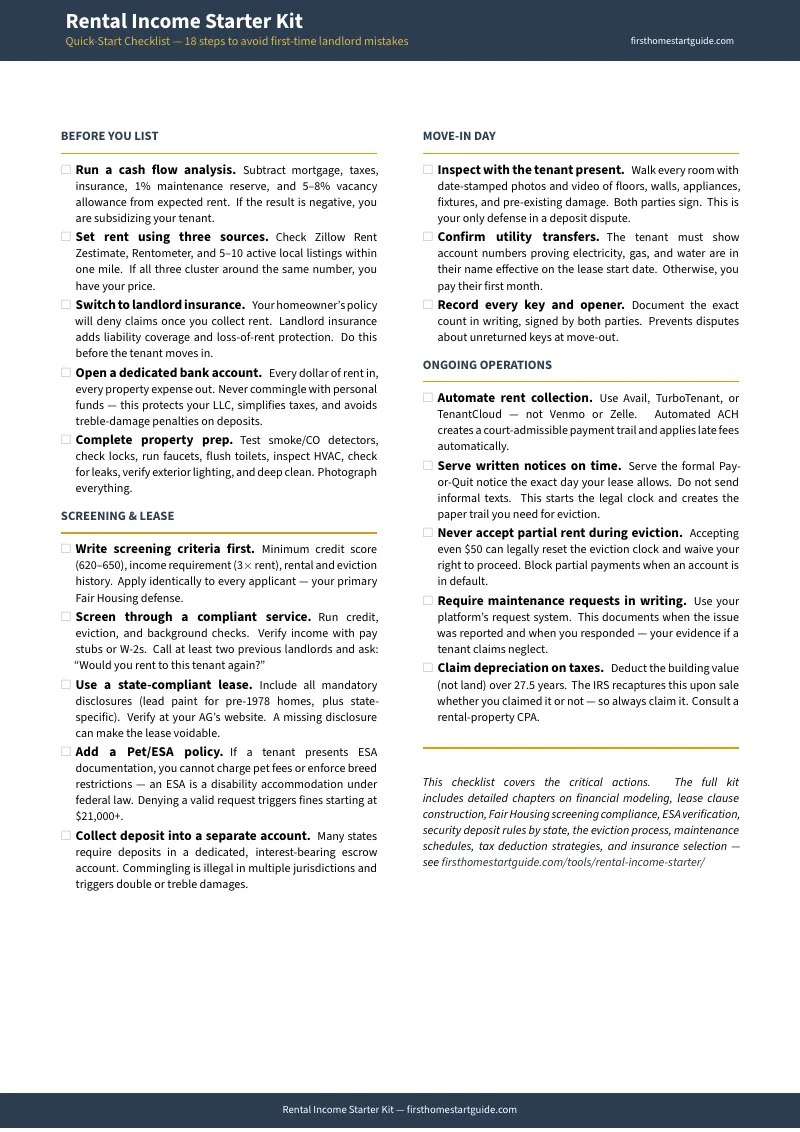
Download the free Rental Income Quick-Start Checklist to see the essential first steps for getting your property rent-ready and legally protected. When you are ready for the complete Rental Income Starter Kit --- with the full lease walkthrough, the screening rubric, the inspection system, the ESA decision tree, the eviction process guide, and the tax depreciation framework --- the full kit is here.
Your property is an asset. This kit turns it into a business.