
Your HVAC Just Died. The Warranty Company Says It's "Pre-Existing." Now What?
Home warranties are sold at closing tables like safety nets. The brochure says never pay for covered repairs again. Your real estate agent says you need one. The seller throws it in as a concession.
Then the furnace dies. You call the warranty company. They send a technician who spends ten minutes, collects a $100 service fee, and files a report saying the failure was caused by "lack of routine maintenance." Claim denied. You still owe $6,000 for a new furnace — plus you're out the $100.
This isn't an edge case. Choice Home Warranty paid $11.8 million to settle consumer fraud allegations in Arizona. The state found they were systematically denying claims while marketing "comprehensive coverage." American Home Shield faces ongoing class-action lawsuits alleging the same pattern. The industry's profitability is mathematically inverse to its claim approval rate — the less they pay you, the more they keep.
The comparison sites ranking on Google won't tell you this. They earn affiliate commissions when you buy a warranty, so they rank providers by "best overall" instead of telling you whether you should buy one at all.
The Warranty Decision System
This guide replaces gut-feel decisions with contract math. Instead of asking "which warranty is best?" (a question that assumes buying one is the right move), it answers the question that actually matters: should you buy a warranty at all — and if yes, under exactly what conditions?
The answer depends on three variables: the age of your home's systems, the size of your emergency fund, and whether someone else is paying the premium. This guide gives you the data and the framework to answer with certainty, not anxiety.
What's Inside
Provider-by-Provider Contract Teardown
Six major providers compared on the numbers that actually matter — per-item payout caps, aggregate term limits, pre-existing condition definitions, and litigation history. Not marketing bullet points. AHS Platinum caps HVAC at $5,000. Select Home Warranty caps most appliances at $500. That difference determines whether a $8,000 replacement is mostly covered or barely touched.
The Self-Insurance Calculator
The "Warranty Cost + 50% Method" shows you exactly how much to set aside each year to self-insure. After three years, a self-insured homeowner has $3,150+ in a dedicated maintenance fund. A warranty buyer has spent $2,700 in sunk premiums with nothing to show for it. The guide walks you through both scenarios with five-year projections.
12-Point Contract Audit Checklist
Twelve specific clauses to find and evaluate before you sign anything. Per-item caps, maintenance documentation requirements, the pre-existing condition paradox (known vs. unknown), cash-in-lieu calculation methods, code upgrade exclusions, and arbitration clauses. This checklist catches the traps that generate 90% of claim denials.
Claim Denial Playbook
Step-by-step escalation: formal demand letter template, state Attorney General and Department of Insurance complaint procedures, and a small claims court filing guide including how to locate the company's registered agent via your Secretary of State. You paid for coverage — this section shows you how to enforce it.
ASHRAE Lifespan Data for Every Major System
Central AC lasts 12–17 years. Tank water heaters last 8–12. A furnace is good for 15–20. Cross-reference your systems' ages against this engineering data to know whether they're in the failure zone (75%+ of lifespan) where warranty coverage can actually pay for itself — or in the end-of-life zone where providers deny claims using "beyond useful life" clauses.
Seller-Paid Warranty Negotiation Scripts
How to negotiate the tier (not just the existence) of a seller-paid warranty. Demand a premium plan with high HVAC caps instead of accepting the basic plan the listing agent prefers. Use the inspection report as leverage — a 15-year-old HVAC system noted by the inspector means you should be specifying First American for their improper installation coverage, not whatever provider the agent has a relationship with.
The Real Estate Agent Question — Answered
Is your agent pushing a warranty because it protects you, or because it shields them from liability when something breaks? RESPA Section 8 makes referral kickbacks explicitly illegal. The guide explains why agents push warranties anyway (liability deflection, not commissions) and how to evaluate the recommendation independently.
Who This Is For
- Buyers at the closing table being handed a warranty brochure and told they need one — who want to know if it's actually worth signing
- Homeowners facing a renewal notice for $650–$700 and wondering whether to renew or pocket the money
- Anyone whose claim was just denied and needs a step-by-step process to fight back
- Buyers negotiating with sellers who want to demand a premium-tier warranty instead of accepting whatever the listing agent recommends
- Homeowners considering self-insurance who want the math to confirm whether their emergency fund is large enough to skip the warranty entirely
Why Not Just Read the Free Comparison Sites?
Because they're paid to sell you a warranty. NerdWallet, Forbes Home, and the top-ranking comparison pages earn affiliate commissions on every warranty purchase they drive. Their "Top 10 Best Home Warranties" lists are monetized recommendations — not objective analysis.
Consumer Reports publishes rigorous, unbiased data — behind a paywall most buyers never access during the frantic inspection period.
Reddit captures real frustration from homeowners who've been burned, but scattered threads don't give you a systematic framework for evaluating contracts, calculating self-insurance thresholds, or fighting denials.
This guide combines what each of those sources does well — data, contract analysis, and real-world experience — without the affiliate bias, the paywall, or the disorganization.
The Free Checklist Gets You Started
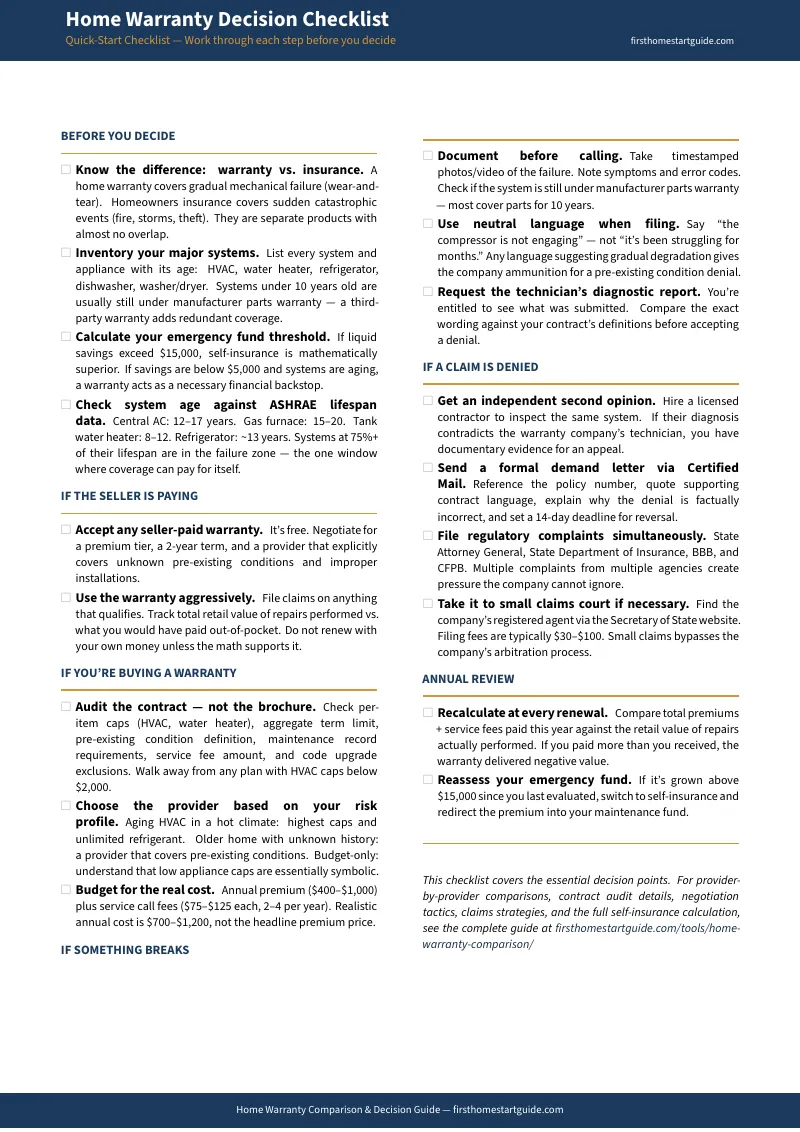
The free Quick-Start Decision Checklist distills the core decision points into 18 actionable items: system inventory, emergency fund threshold, ASHRAE lifespan cross-reference, contract audit essentials, and claim denial steps. It tells you what to check.
The full guide tells you how — with provider-by-provider contract teardowns, the complete self-insurance calculation, negotiation scripts, demand letter templates, and the 12-point contract audit that catches the clauses most buyers never read until it's too late.
— Less Than a Single Service Call Fee
One denied warranty claim costs you the $75–$125 service fee plus the full repair bill. One year of unnecessary warranty premiums costs $600–$1,000. The math in this guide pays for itself before you finish reading Chapter 5.
Every purchase is backed by a full satisfaction guarantee. If the guide doesn't give you a clear, confident answer about your warranty decision, email [email protected] for a complete refund.
Frequently Asked Questions
What if the rules change after I buy?
We update the guide when the rules change. Email us any time, even years later, and we'll send you the current edition free.