
Your Agent Said "Waive the Inspection." You Need Better Language, Not Worse Advice.
You found the house. You toured it twice. Your pre-approval is strong. And now your agent is telling you the only way to win is to strip every protection out of your offer — waive the inspection, cover any appraisal gap, shorten every deadline to five days. They call it making a "clean offer." What they mean is: assume all the risk so the seller picks you over the other six buyers who showed up this weekend.
But here is what your agent is not telling you: between "full contingency protection" and "waive everything" is an entire spectrum of contractual strategies that sophisticated buyers and real estate attorneys use every day. An informational-only inspection clause that lets you walk away from a failing foundation but waives your right to nickel-and-dime the seller over a dripping faucet. A cost-threshold inspection that absorbs the first $10,000 in repairs but preserves your right to terminate if the structural engineer finds $40,000 in foundation work. An escalation clause with mandatory proof-of-competing-offer language that prevents the seller's agent from fabricating a phantom bid to trigger your ceiling price. These are not tricks. They are standard clauses in well-structured real estate transactions. You just need the exact wording.
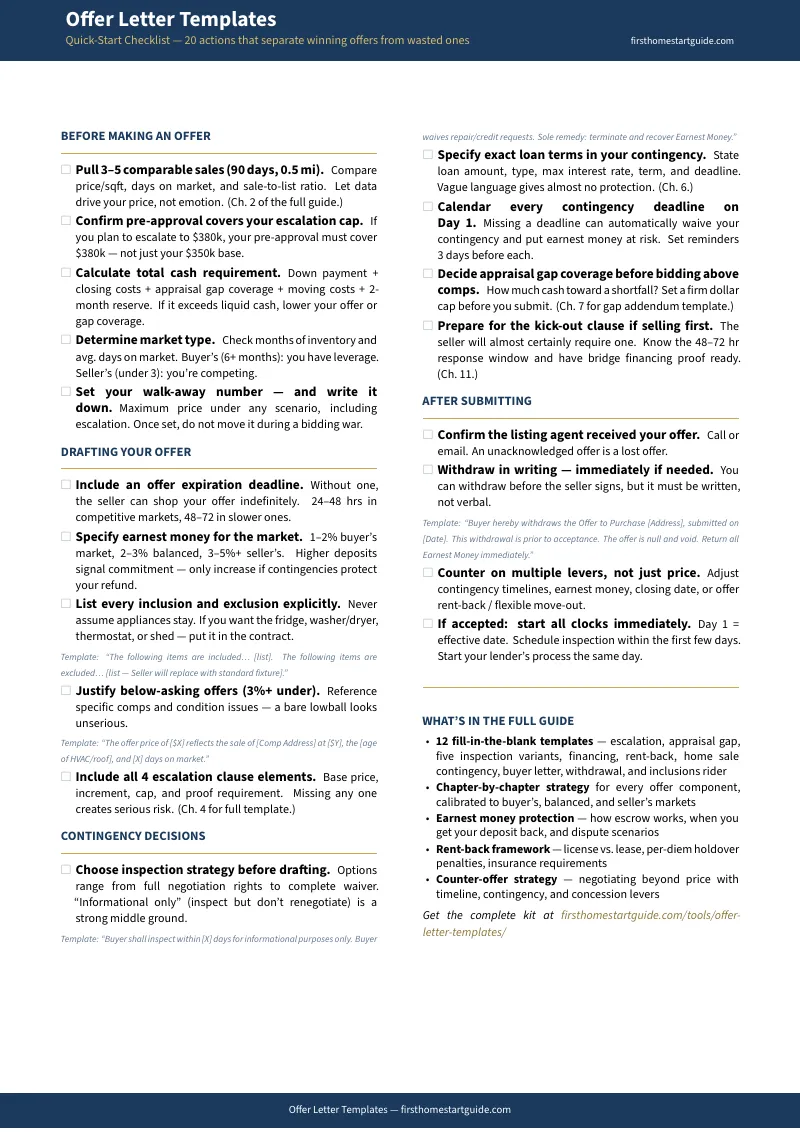
The Offer Letter Templates & Strategy Guide is an Offer Defense Toolkit — 12 fill-in-the-blank templates covering every critical component of a home purchase offer, each with strategic guidance explaining when to deploy it, how to modify it for your specific market, and what happens if you get the language wrong. It replaces the hours you would spend cobbling together definitions from Rocket Mortgage articles, blank forms from LegalZoom, and conflicting Reddit advice from strangers in different states — with a single reference that gives you the protective contract language and the tactical context to use it.
What's Inside the Offer Defense Toolkit
A comprehensive strategy guide, a quick-start checklist with 3 ready-to-use templates, and 8 standalone printable addendums and letters (10 PDFs) — covering every stage from pricing your offer through post-closing occupancy, built for buyers who want to compete aggressively without surrendering their legal protections:
Escalation Clause Addendum — Stop Guessing in Bidding Wars
Most buyers either guess a round number and lose, or panic and offer their absolute maximum on the first bid. An escalation clause automates the process — your offer increases by a set increment above the highest competing bid, up to a hard cap you define in advance. But an escalation clause without all four protective elements is a liability, not a strategy. The template includes base price, automatic increment, maximum ceiling, and mandatory proof-of-competing-offer language. It also includes net-offer calculation wording that ensures competing bids are compared after accounting for seller concessions — so a $350,000 offer demanding $8,000 in closing cost credits is not treated as equivalent to your clean $345,000 bid.
Five Inspection Contingency Variants — Because "Waive or Keep" Is a False Choice
Standard full-negotiation contingency for buyer's markets. Informational-purposes-only for competitive markets where you need to inspect but are willing to waive repair negotiations. Cost-threshold waiver that absorbs repairs up to a dollar cap you define while preserving termination rights for catastrophic defects. Pre-offer inspection strategy for the most competitive situations. And complete waiver language for new builds or investor purchases where you have already assessed the risk. Each variant includes the exact contract language — not a summary of what to ask your agent to write, but the specific wording to insert into your purchase agreement.
Appraisal Gap Addendum — Cap Your Cash Exposure
When you offer above recent comparable sales, the lender's appraisal may come in lower than your contract price. Without gap coverage language, you either cover the entire shortfall in cash or the deal collapses. The template caps your maximum cash contribution at a dollar amount you choose, with automatic renegotiation rights if the gap exceeds your limit. It specifies exactly what happens if the seller refuses to reduce the price — you terminate and get your earnest money back.
Financing Contingency — Protect Your Deposit When Lending Falls Through
A vague financing contingency like "subject to satisfactory financing" gives you almost no protection. If the lender approves you at a higher interest rate than you wanted, you may be legally obligated to close or forfeit your deposit. The template specifies exact loan amount, mortgage type (conventional, FHA, VA), maximum acceptable interest rate, term, and the deadline by which you must secure a firm lender commitment. If any parameter is not met despite good-faith effort, you walk away with your full deposit.
Rent-Back Agreement — Structured So You Can Actually Remove the Seller
When the seller needs extra time to vacate after closing, a standard lease agreement inadvertently grants them full tenant protections under state law — meaning if they refuse to leave, you face a formal eviction process on a property you already own. The template is structured as a license to occupy, not a lease, enabling summary removal proceedings. It includes a fixed termination date, refundable security deposit held in escrow, per-diem holdover penalty that makes overstaying economically unviable, maintenance responsibilities, and insurance requirements.
Fair Housing Compliant Buyer Letter — Stand Out Without Creating Legal Liability
Buyer "love letters" mentioning your family, your children, your holiday traditions, or your ethnicity create federal Fair Housing Act liability for both you and the seller. A growing number of listing agents refuse to present them. The template strips every demographic identifier and focuses exclusively on financial strength, timeline flexibility, and objective property features — the only factors that actually help your offer without exposing anyone to a discrimination claim.
Offer Withdrawal Notice — Kill a Deal Before It Kills You
You can withdraw any offer before the seller signs and delivers acceptance. But "I changed my mind" is not a legal withdrawal. The template provides the exact language to formally revoke your offer, with delivery confirmation instructions that establish the timing beyond dispute.
Below-Asking Justification, Counter-Offer Framework, Home Sale Contingency, Inclusions Rider, and Strategic Pricing
Data-driven justification for offers below asking. Counter-offer scripts that negotiate beyond price using closing dates, contingency timelines, earnest money, and rent-back offers. A home sale contingency with kick-out clause for buyers who need to sell first. A line-item inclusions and exclusions rider that prevents post-closing fights over appliances. And a comparable sales analysis methodology calibrated to buyer's, balanced, and seller's markets.
Who This Guide Is For
- First-time buyers writing their first offer who do not know what goes into a purchase agreement, what an escalation clause is, how contingencies protect their deposit, or why their agent's "clean offer" advice may be prioritising the agent's commission over the buyer's financial safety
- Buyers pressured to waive their inspection who want intermediate strategies — informational-only or cost-threshold — that keep them competitive without assuming catastrophic property risk
- Anyone in a multiple-offer bidding war who needs an escalation clause with mandatory proof requirements, net-offer calculation, and a hard cap that prevents panic overbidding
- Unrepresented buyers purchasing FSBO properties who bear the full drafting burden and cannot access the proprietary forms controlled by state REALTOR associations and MLS systems
- Buyers whose appraisal came in below the contract price who need to cap their cash exposure while keeping the deal alive
- Anyone negotiating a post-closing rent-back who needs a properly structured occupancy agreement that prevents the seller from gaining tenant protections under state law
Why Not Free Templates?
Free resources on offer letters and purchase agreements exist. Here is what they actually deliver:
- Rocket Mortgage, Realtor.com, and Bankrate publish polished articles explaining what an escalation clause is, what an appraisal gap means, and why contingencies matter. They never provide the exact contract language. They explain the concept and send you to your agent — the same agent who is telling you to waive everything.
- LegalZoom and Rocket Lawyer sell generic fill-in-the-blank purchase agreements. The forms provide the legal skeleton but zero strategy — no guidance on when to use a cost-threshold inspection versus a full waiver, no escalation clause addendum, no appraisal gap cap language, no rent-back structured as a license to occupy. You get a blank form for a standard transaction in a market where standard transactions do not exist.
- Reddit and BiggerPockets threads contain real buyer experiences mixed with advice from agents in different states, investors with different risk tolerances, and people who waived their inspection and got lucky. Sorting applicable legal language from inapplicable anecdotes takes longer than reading a guide that has already done it — and a Reddit comment is not a tested contract clause.
This guide fills the gap — the space between knowing you need an escalation clause and having the exact four-element wording that actually protects you, between understanding that "as-is" does not mean "no inspection" and having the contract language that preserves your right to walk away.
— Less Than Your Agent's Commission on a Single Showing
A single missed contingency deadline can forfeit a $10,000 earnest money deposit. An escalation clause without a proof requirement can let the seller manufacture a phantom competing bid. A rent-back agreement structured as a lease instead of a license can turn a 30-day holdover into a 6-month eviction. An appraisal gap with no dollar cap can drain your cash reserves the week before closing.
This guide does not replace your real estate attorney. But it gives you the exact contract language, strategic context, and tactical alternatives that ensure you know what to include, what to modify, and what to refuse — before your agent's "clean offer" advice costs you the protections you needed most.
Frequently Asked Questions
What if the rules change after I buy?
We update the guide when the rules change. Email us any time, even years later, and we'll send you the current edition free.