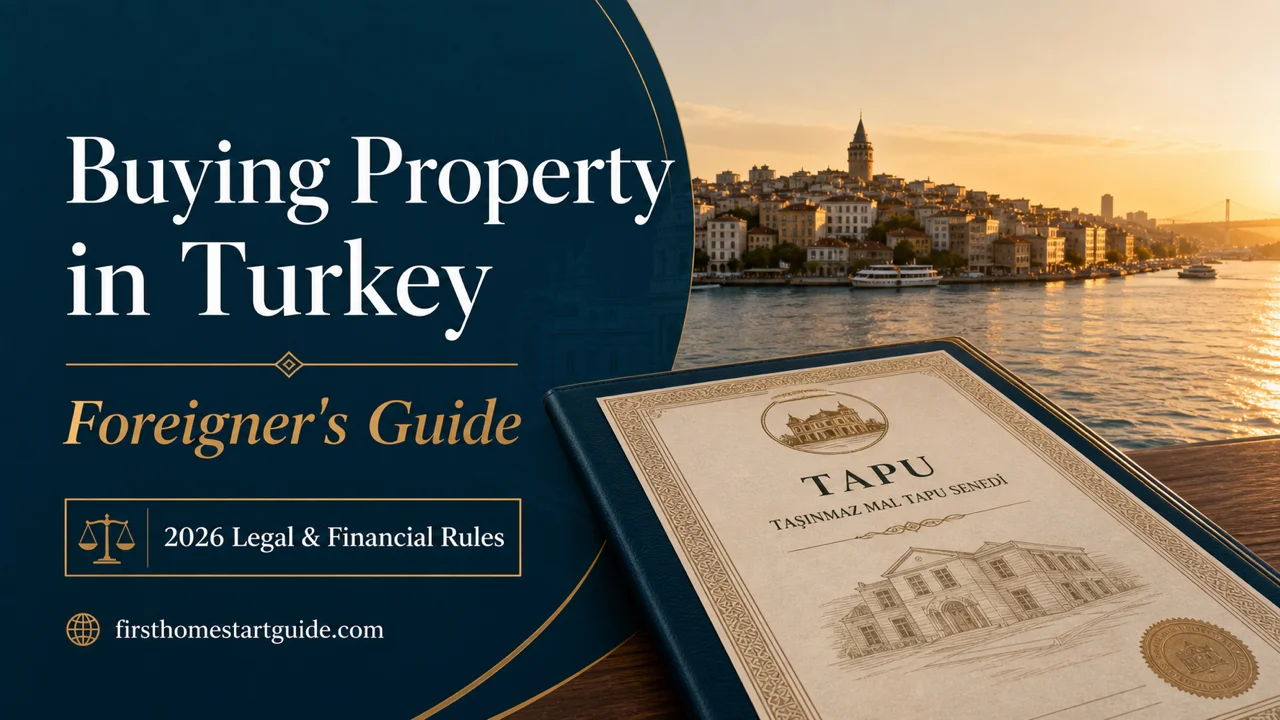
You can afford Turkish property. But the legal system is designed to punish buyers who don't understand it.
You've seen the listings. Mediterranean views for the price of a parking space back home. Currency conversion makes the numbers look like a rounding error. You start running scenarios — retirement villa, rental income, maybe even a Turkish passport. It feels like the last genuinely affordable property market in a desirable location.
Then you start researching. First week, you learn that "title deed" means two completely different things in Turkey — one type means you own a finished apartment, the other means you own a share of a construction site, even if the building looks finished and people live in it. Second week, you discover that the price on the deed must match the price in your bank transfer, or an algorithm flags you for a 100% penalty fine. Third week, you find out your foreign currency has to be sold to the Central Bank before you can pay the seller — and the conversion spread is a hidden cost nobody mentioned. Fourth week, you realize the Tapu office charges foreigners triple the administrative fee that Turkish citizens pay.
The free information online makes it worse, not better. Real estate agencies (PropertyTurkey, AntalyaHomes) publish beautiful guides — but they earn commission on your purchase, so they downplay risks. They won't tell you that off-plan fraud costs British buyers millions every year, or that hundreds of Istanbul neighborhoods are closed to new foreign residents. Legal blogs explain the dangers accurately — in dense Turkish legalese designed to funnel you toward a $500+ consultation. Expat forums (TurkishLivingForums, r/expats) share real horror stories — but a 2023 post about military clearances may be wrong for 2026, and you can't tell which advice is current.
The core problem: there is no single resource that takes a foreign buyer from first inquiry to Tapu transfer — connecting the DAB currency conversion, title deed verification, Secure Payment System escrow, earthquake insurance, tax traps, citizenship thresholds, and military zone restrictions into one decision system. The information exists in fragments across agencies, lawyers, and forums. But the sequence — what to check, in what order, at what cost, and what kills a deal — doesn't exist anywhere.
Buying Property in Turkey — Foreigner's Guide is a Foreign Buyer Protection System. Not a glossy overview. Not an agency brochure. A decision framework that maps every legal, financial, and regulatory step — from your first eligibility check through Tapu registration — built around the 2026 rules that most free resources haven't caught up with yet.
What's Inside the Foreign Buyer Protection System
19-chapter comprehensive guide, 20-item quick-start checklist, and 8 printable reference tools — covering every stage of the foreign property purchase process, current to the July 2026 regulatory changes:
Title Deed Analysis — Kat İrtifakı vs. Kat Mülkiyeti
The single most dangerous trap for foreign buyers. A Kat İrtifakı deed means the building is legally classified as an "unfinished construction site" — even if it's painted, occupied, and the agent tells you it's complete. Without the İskan permit that triggers Kat Mülkiyeti status, you can't get individual utility connections, you face demolition risk, and citizenship applications tied to the property will likely be rejected. The guide explains exactly how to verify which deed type a property holds and what to do if it's stuck at Kat İrtifakı.
DAB Currency Conversion — The Mandatory First Step
You cannot pay for Turkish property with foreign currency. The Central Bank requires a Döviz Alım Belgesi (DAB) certificate proving your USD, EUR, or GBP was sold through a licensed Turkish bank before the Tapu office will process the transfer. The guide walks through the DAB process step by step — which banks to use, how conversion spreads work, and the documentation the Tapu office actually checks.
The Secure Payment System — Mandatory Escrow from July 2026
Cash is banned. Direct bank transfers to sellers are banned. The Güvenli Ödeme Sistemi routes all property payments through state-regulated escrow. Your funds are locked until the Tapu office confirms the title deed transfer — then automatically released to the seller. If the transfer fails, you get an automatic refund. The guide covers the escrow mechanics, participating banks, and exactly how this protects buyers from the wire-first-pray-later nightmare that plagued the old system.
Taxes, Fees, and the 100% Under-Declaration Penalty
Agents will tell you "everyone declares a lower price on the deed." In 2026, the Değer Bilgi Merkezi algorithm cross-references your bank transfer, mortgage valuation, and regional sales data — and catches discrepancies instantly. The penalty: 100% of the missing tax, plus interest. If you bought for citizenship, your application is cancelled. The guide breaks down all transaction costs — the 4% title deed fee, the tripled Foreigner Tariff, VAT exemptions for foreign buyers, capital gains rules, and annual property tax after the 2026 municipal revaluation that tripled assessed values.
Citizenship ($400K) and Residency ($200K) Routes
The citizenship-by-investment threshold is $400,000 USD — but the real cost is much higher. Stacking five cheap units to reach the threshold now costs 100,000+ TL in tripled administrative fees alone. The Mahalle Quota System has closed hundreds of Istanbul and Antalya neighborhoods to new foreign residents. The guide covers both the $400K citizenship and $200K residency paths, including closed districts, aggregation costs, the three-year holding requirement, and which property types actually qualify.
Earthquake Insurance, Structural Due Diligence, and DASK
DASK earthquake insurance isn't optional — it's a legal prerequisite for title deed transfer and utility connections. Let it lapse and your utilities freeze and your property becomes unsellable until you renew. The guide covers DASK requirements, the transition to ZAS comprehensive insurance, what a structural inspection should actually check (concrete class, column condition, soil reports), and which construction standards apply to buildings built before vs. after the updated seismic code.
Regional Guide, Fraud Prevention, and Remote Buying via Power of Attorney
Where foreigners actually buy — Antalya, Istanbul, Bodrum, Fethiye, Alanya — broken down by buyer profile, price range, and regulatory status. The fraud chapter covers the documented scam patterns (off-plan theft, concealed İskan defects, fictitious tenants blocking viewings) with the specific checks that would have caught them. And if you're buying remotely, the Power of Attorney chapter covers the noterlik process, consulate authentication, and which powers to grant — and which to never grant.
8 Printable Reference Tools
Standalone PDFs you print and bring to viewings, bank meetings, and the Tapu office: Title Deed Verification Card (Kat İrtifakı vs. Kat Mülkiyeti checklist), DAB Currency Conversion Reference (step-by-step bank process), Transaction Cost Estimator (fillable worksheet for all fees and taxes), Citizenship vs. Residency Comparison ($400K and $200K routes side-by-side), Off-Plan Risk Checklist (BTS and İskan verification), Transaction Steps Tracker (15-step process with date fields), Fraud Prevention Checklist (6 traps + 10 verification items), and Legal Terms Glossary (22 Turkish terms with practical meanings).
Who This Guide Is For
This guide is written for foreign buyers purchasing property in Turkey:
- European expats and retirees buying lifestyle or holiday homes along the Mediterranean and Aegean coasts — and wanting to understand the Double Taxation Agreement advantages and the real costs beyond the listing price
- Investors evaluating Turkey for rental yield, capital appreciation, or geographic diversification — who need the current tax treatment, the 2026 municipal revaluation impact, and the new short-term rental licensing restrictions
- Citizenship-by-investment buyers who need to navigate the $400K threshold, district quotas, tripled administrative fees, and the property types that actually qualify
- Remote buyers managing the process from abroad via Power of Attorney — who need to know which steps can be delegated, which require physical presence, and how the Secure Payment System changes the closing timeline
- Anyone who's been told by an agent that everything is "easy" in Turkey — and wants the independent, unvarnished picture before signing anything
Why Free Resources Aren't Enough
Plenty of free information exists about buying property in Turkey. Here's what each source actually provides:
- Real estate agency guides (PropertyTurkey, AntalyaHomes, Spot Blue) are beautifully produced and rank well on Google — because they're commission-funded marketing. They won't explain that Kat İrtifakı properties are legally unfinished, that off-plan developers routinely fail to get İskan permits, or that the Foreigner Tariff now triples your administrative costs. Their job is to close the sale, not protect the buyer.
- Legal blogs (Turkish law firms) get the technical details right — in dense legalese designed to make you feel you need a $500 consultation before doing anything. They explain risks but not sequences. They tell you what can go wrong but not what to check first.
- Expat forums (TurkishLivingForums, Reddit) share genuine experiences — but a 2023 post about military clearances in Bodrum is wrong for 2026. The Secure Payment System didn't exist when most forum advice was written. You can't tell which advice is current and which will cost you money.
- Government portals (TKGM, WEB-TAPU) provide official procedures in official language — but don't tell a foreign buyer which seven checks to run in which order before the Tapu appointment. The information is accurate but the guidance is absent.
This guide bridges the gap — the space between knowing Turkey has property laws and understanding exactly how those laws affect your specific transaction, in the specific regulatory environment of 2026. It gives you the independent analysis you'd get from a retained consultant, as a permanent reference document you can use throughout the entire process.
— Less Than One Tapu Office Visit
A single title deed verification from a Turkish property lawyer costs $200–$800. An independent property valuation runs $300–$500. The Foreigner Tariff at the Tapu office now exceeds 21,000 TL per deed. On a $400K citizenship purchase, the total transaction costs — title deed fee, administrative fees, VAT, agent commission — routinely exceed $25,000.
This guide doesn't replace your lawyer. But it arms you with the title deed analysis, currency conversion mechanics, escrow procedure, tax calculations, and due diligence checklist you need so that every professional you hire is accountable to you — not the other way around. You arrive at each meeting knowing what to ask, what to verify, and what to refuse.
If it saves you from one Kat İrtifakı mistake, one under-declaration penalty, or one missed DASK renewal — you've recovered the cost before you finish reading.
Money-back guarantee, no time limit. If the guide doesn't make your purchase process clearer and your financial position stronger, you get a full refund.
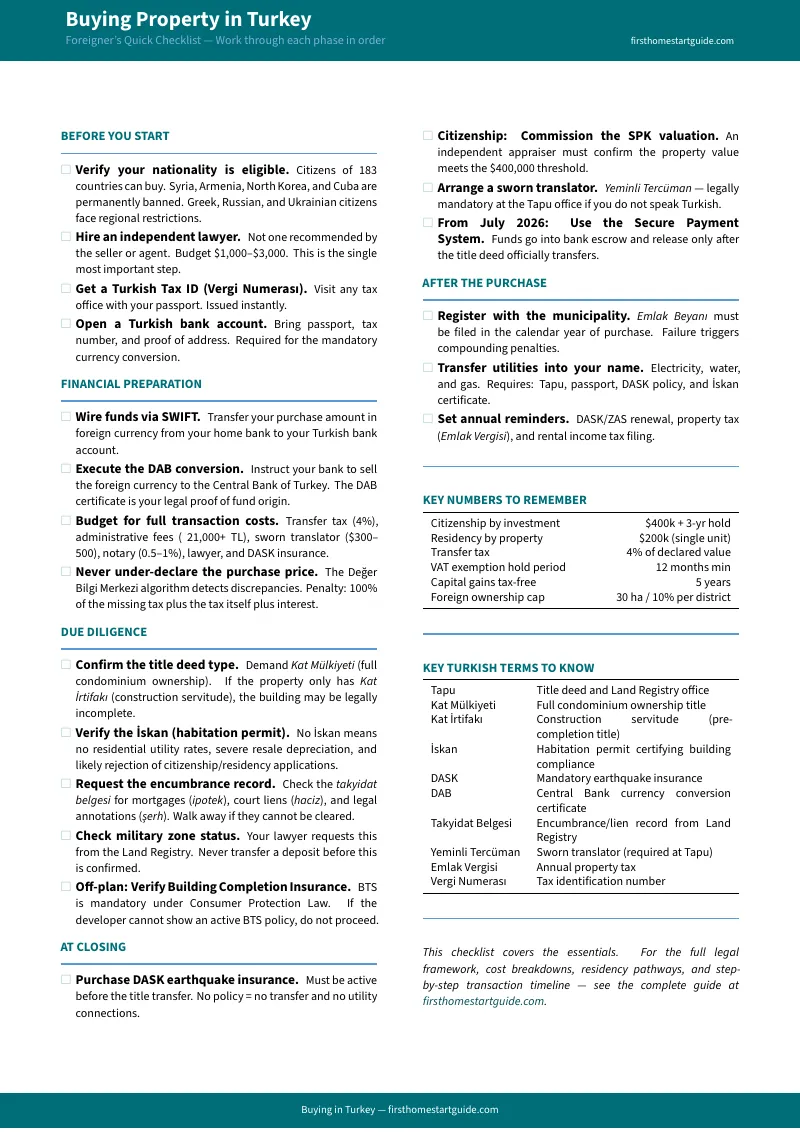
Download the free Foreigner's Quick Checklist — 20 action items covering eligibility verification, DAB conversion, title deed checks, DASK requirements, and Tapu appointment preparation. Ready for the full Foreign Buyer Protection System? The 19-chapter guide, 8 printable reference tools, and complete due diligence system — get the complete guide here.
The Turkish property market rewards buyers who understand its rules. It punishes everyone else. Know the rules before you sign.
Frequently Asked Questions
What if the rules change after I buy?
We update the guide when the rules change. Email us any time, even years later, and we'll send you the current edition free.