You Have Read the Expat Forums, Scrolled Through InfoCasas, and You Still Cannot Tell Whether Your Deposit Is Refundable, How the Transfer Tax Actually Works, or What Happens If the Architect Finds an Undeclared Bathroom
You have found the apartment in Pocitos. Or the house in Punta del Este. Or the estancia in Rocha that you have been daydreaming about since your first trip across the river. You have read enough forum threads to know that Uruguay is "foreigner-friendly" and that everything is priced in dollars. You are ready to move. And then the details start collapsing.
Someone on Reddit says the transfer tax is 4% of the purchase price. Someone else says it is 2%. An Argentine friend says it is based on "valor catastral" but cannot explain what that means or how it changes your closing budget. You learn that you need an escribano publico and assume this is a notary who stamps documents — it is not. The escribano conducts a 30-year title search, holds your deposit in escrow, drafts every contract from reservation through deed, files the registration, and bears personal civil liability for errors. Their fee is 3% plus 22% IVA. You do not know whether that is standard or a rip-off, because no English-language source has ever explained what you are paying for.
Then there is the boleto de reserva. You sign it, deposit 10% into the escribano's escrow, and your money is gone if you change your mind. Not "negotiable." Not "subject to inspection contingency." Gone. Unless the title search reveals an incurable defect — and only if your boleto includes that contingency clause, which it does not by default. You find this out after three hours of reading conflicting advice on r/uruguay.
Here is the structural problem no free resource solves: the Uruguayan property purchase runs through six independent systems — the escribano's 30-year title search determines if the property is clean, the BPS construction inspection determines if undeclared renovations will block your sale for four months, SENACLAFT determines whether your source-of-funds documentation is sufficient to proceed, the ITP is calculated on a cadastral value that nobody explains how to look up, the propiedad horizontal regime governs your apartment with strict national legislation (not voluntary bylaws), and Law 20.446 rewrote the entire tax residency framework in January 2026. Each system has its own institutions, its own documents, its own penalties. No English-language source integrates them into a single transaction sequence. You piece it together from forum threads, outdated blog posts, and a real estate agent whose incentive is to close the deal this month.
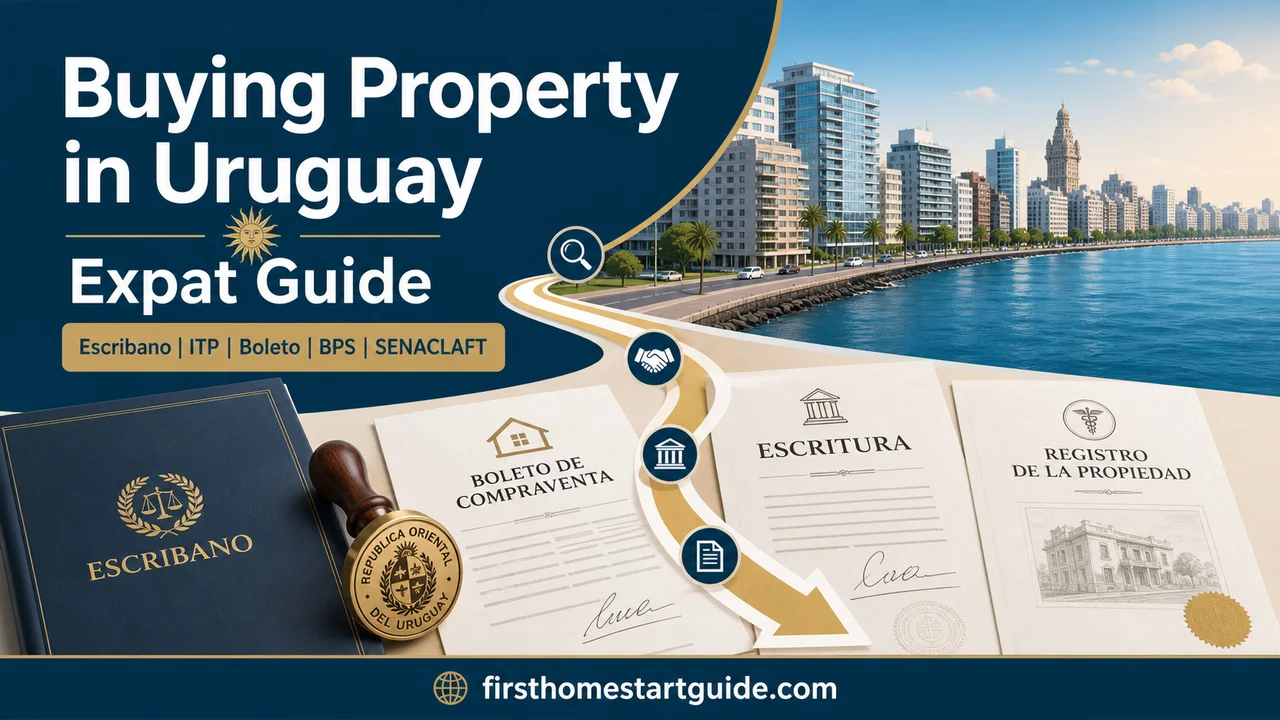
The Buying Property in Uruguay — Expat Guide is The Civil Law Transaction Decoder. Not a listing portal's FAQ page or a forum thread compiled by strangers. It is a structured decision system that decodes every stage of the Uruguayan property purchase — from opening a bank account through registering your deed at the Direccion General de Registros — so you understand the regulation behind each step, the document that governs it, and the financial consequence of getting it wrong.
What's Inside The Civil Law Transaction Decoder
The complete 16-chapter guide, a 20-item step-by-step checklist, and 8 standalone printable tools — covering every stage from SENACLAFT source-of-funds preparation through deed registration, with the tax rates, legal mechanisms, penalty clauses, and institutional contacts that determine whether your transaction closes in 45 days or stalls for four months. Print the standalone worksheets and take them to your escribano meeting, your bank appointment, and your architect's inspection:
The Escribano System Decoded
If you come from a common-law country, nothing in your experience prepares you for the escribano publico. This is not a notary who witnesses signatures. The escribano conducts a 30-year retrospective title search covering chain of ownership, municipal debts, Primaria education tax liens, judicial embargoes, and BPS construction levies — because in Uruguay, debts attach to the property itself, not to the seller. If the escribano misses a lien, you inherit it. The guide covers exactly what the 30-year search investigates, why debts follow the property (in rem liability), how the fee structure works (3% plus 22% IVA on purchase price — approximately 3.66% effective), why you must retain your own escribano independently from the seller, and why this front-loaded due diligence system replaces title insurance entirely. The escribano bears personal civil and criminal liability for the transaction's accuracy. That is what you are paying for.
The Boleto de Reserva — What Your Deposit Actually Commits You To
The boleto is the document that takes the property off the market and locks in the price. It is also the document that can cost you your entire deposit if you misunderstand it. You deposit a sena (5-10% of the purchase price) into the escribano's escrow account. If you withdraw for subjective reasons — cold feet, financing fell through, found a better apartment — you forfeit the full deposit. If the seller backs out, they return your deposit plus pay you an equal penalty from their own pocket. The guide explains the arras penitenciales penalty mechanism, the only contingencies that protect your money (incurable title defects and failed BPS clearance), exactly how to draft the contingency clause your escribano should include, and the timeline from boleto through compromiso to final escritura.
ITP Transfer Tax — The Cadastral Value Calculation That Cuts Your Tax Bill
The ITP (Impuesto a las Transmisiones Patrimoniales) is 2% paid by the buyer and 2% paid by the seller. The part every English-language source gets wrong: it is calculated on the cadastral value, not the market price. Cadastral values sit 30-60% below the transaction price. On a USD 500,000 property with a cadastral value of USD 175,000, your ITP is USD 3,500 — an effective rate of 0.7% on your actual capital deployed. The guide includes worked examples at multiple price points, the full closing cost breakdown (agent 3.66% + escribano 3.66% + ITP 2% cadastral + registry fees — total approximately 8-9% of purchase price), and the seller's IRPF capital gains tax calculation that helps you understand their negotiation floor.
BPS Construction Clearance — The Inspection That Blocks Sales
The hidden danger that no listing portal mentions. The Banco de Prevision Social requires that all construction — every remodeled kitchen, every added bedroom, every swimming pool — be registered and the Aporte Unificado de la Construccion (71.4% tax on gross daily construction wages) be paid. Before the deed can be signed, a licensed architect must inspect the property and certify that the physical structure matches the cadastral plans. If undeclared renovations from the past 10 years are found, the sale is immediately halted. The property is legally blocked until the seller pays retroactive BPS taxes plus compounding fines — a process that routinely adds four months to your closing. The guide covers the BPS Special Certificate, the architect's certification process, the 10-year lookback rule under Law 19.996, and how to make your boleto deposit conditional on satisfactory BPS clearance.
SENACLAFT Anti-Money Laundering Compliance
Uruguay's AML framework is strict, formalized, and non-negotiable. Escribanos and real estate agents are legally designated non-financial reporting subjects under SENACLAFT. They cannot proceed without verifying the exact, legitimate origin of your funds. The guide covers exactly what documentation you need (settlement statements from foreign property sales, bank statements spanning 12-24 months, business sale contracts, brokerage liquidation statements), the mandatory certified Spanish translation requirement, when apostilles are needed, and why this paper trail actually protects your investment by establishing an approved chain of custody for your capital — making future sales and fund repatriation smoother.
Banking, FATCA, and the Letra de Cambio
On closing day, you do not wire funds digitally. You physically hand a letra de cambio — a certified bank draft — to the seller in front of the escribano. But before you get to that point, you need a Uruguayan bank account. The guide covers non-resident account opening at BROU, Santander, and BBVA (2-8 week processing timeline), the KYC documentation package, FATCA reporting obligations and FBAR filing requirements for US citizens, the non-resident mortgage landscape (30-40% down payment, USD or UI denomination), and the step-by-step mechanics of the letra de cambio closing.
Propiedad Horizontal — The Condominium Regime That Is Not an HOA
When you buy an apartment, you are buying under Law 10.751 — strict national legislation, not voluntary community bylaws. The guide covers expensas (monthly common charges including the portero salary that can consume 30% of your gross rent), the mandatory fondo de reserva for structural repairs, the asamblea de propietarios that operates entirely in formal legal Spanish, the juicios ejecutivos fast-track proceedings for unpaid charges, and how to execute a power of attorney so a local proxy can vote on your behalf at building assemblies.
Tax Residency Under Law 20.446 (2026) and the 11-Year Holiday
The tax residency framework was completely overhauled in January 2026. The real estate pathway now requires approximately USD 2 million (up from USD 590,000) plus 60 days of physical presence per year. An alternative pathway requires USD 100,000 annual contributions to the Innovation Fund for 11 years. The simplest route remains 183 days of physical presence with zero investment. The guide covers all three pathways, the 11-year tax holiday on foreign-sourced capital income, the critical distinction between legal residency and tax residency, the Rentista and Pensionado immigration visas, and the grandfathering rules for pre-2026 tax residents.
Who This Guide Is For
This guide is for foreign nationals buying property in Uruguay who:
- Are buying their first Uruguayan property from abroad and need the entire civil law transaction mapped — from SENACLAFT source-of-funds preparation through escribano selection, boleto de reserva negotiation, BPS construction clearance, escritura signing, and Direccion General de Registros inscription — so they understand what happens at each stage, what document governs it, and what the penalty is for missing it
- Come from common-law countries (US, UK, Canada, Australia) and need to understand why the escribano system works fundamentally differently from title companies and escrow agents, why the boleto deposit is not refundable under most circumstances, and why debts attach to the property rather than the seller
- Are evaluating Montevideo neighborhoods (Pocitos, Punta Carretas, Buceo, Parque Rodo) for a primary residence or rental investment and need to model the true net return after ITP, escribano fees, expensas, property tax, wealth tax, and rental income withholding
- Want to understand Vivienda Promovida — the 10-year tax exemption program on certified new-build apartments that eliminates ITP, IRPF rental income tax, and wealth tax — and whether the 5.1-6.3% net yields in USD make urban Montevideo competitive with their current investment portfolio
- Are European investors considering Uruguay for the 11-year tax holiday on foreign-sourced income and need to understand that Law 20.446 raised the real estate investment threshold to USD 2 million in January 2026
- Are Argentine or Brazilian buyers parking capital in Uruguay who assume the process mirrors their home country and need to understand why SENACLAFT source-of-funds documentation requirements will block the transaction if they cannot produce a clean paper trail
- Plan to close remotely and need the poder especial (special power of attorney) protocol — drafting, home-country notarization, Hague Apostille, certified Spanish translation, and Uruguayan protocolization — before they can authorize a representative to sign the escritura and hand over the letra de cambio on their behalf
Why Not Free Resources?
Free information on buying property in Uruguay exists. Here is what each source actually delivers:
- InfoCasas and MercadoLibre are listing aggregators that operate in Spanish and serve the domestic market. They show you asking prices and square footage. They do not explain the escribano's 30-year title search, the boleto forfeiture rules, the BPS construction clearance process, or the SENACLAFT documentation requirements that determine whether your transaction actually closes. You get property discovery without transaction education.
- Real estate agency websites publish overview pages on "buying in Uruguay" that cover the highlights: foreigners can buy freely, transactions are in USD, the market is stable. What they omit: the escribano's role beyond "notary," the difference between cadastral and market value for ITP calculation, the BPS 10-year lookback rule, the specific SENACLAFT documentation by source of funds, and the propiedad horizontal governance that affects every apartment purchase. Their incentive is to move you from browsing to touring properties, not to explain the regulatory system between you and the deed.
- Reddit and expat forums (r/expats, r/uruguay, r/digitalnomad) contain genuine experiences from buyers who closed successfully — alongside advice that confuses the 2% buyer ITP with a 4% total rate applied to market price, quotes pre-2026 tax residency thresholds, recommends sharing an escribano with the seller to "save money," and dismisses BPS clearance as a formality. Some of these people bought smoothly. Some of them discovered an undeclared terrace during the architect's inspection and waited four months. Both stories are real. Neither tells you which outcome applies to your property.
- Law firm and tax advisory blogs publish technically accurate articles on individual topics — the ITP, the escribano, the tax holiday. Each article covers one legal mechanism in isolation and functions as a lead-generation page for consultations. What they do not provide: a single integrated roadmap that connects SENACLAFT compliance, BPS clearance, escribano due diligence, ITP calculation, propiedad horizontal governance, and the 2026 tax residency overhaul into one transaction sequence you can follow from start to finish.
This guide fills the structural gap — the space between knowing that foreigners can buy property in Uruguay and understanding exactly how the six regulatory systems interact at each stage, what document governs each step, what the timeline is, and what the financial consequence is for getting it wrong. It is the analysis an independent cross-border advisor with no commission to earn and no listing to close would give you, structured as a permanent reference you own.
— Less Than One Hour of a Montevideo Law Firm's Time
A Uruguayan escribano charges 3.66% of the purchase price for the transaction — on a USD 300,000 apartment, that is approximately USD 10,980. A tax advisor's consultation on Law 20.446 residency planning runs USD 200-400 per session. A failed BPS clearance that halts your closing for four months costs you in carrying costs, rebooking flights, and lost rental income. A boleto de reserva signed without contingency clauses puts your entire 10% deposit at risk.
This guide does not replace your escribano or your tax advisor. But it gives you the escribano system decoder, the closing cost worksheet with ITP cadastral calculations, the BPS clearance reference card, the SENACLAFT documentation checklist, the boleto contingency guide, the neighborhood comparison sheet, the tax residency pathway comparison, the Vivienda Promovida yield analyzer, and the power of attorney process checklist — 10 PDFs total that ensure you walk into every professional meeting understanding the mechanism behind each step, instead of discovering how Uruguay's civil law system works by forfeiting a deposit or waiting four months for a blocked sale to resolve.
If it prevents a single boleto signed without contingency clauses, catches a single BPS clearance issue before you commit your deposit, or saves you from budgeting ITP on market price instead of cadastral value, it pays for itself before you have finished reading it.
Money-back guarantee, no time limit. If the guide does not make the Uruguayan property purchase clearer and your transaction planning stronger, you pay nothing.
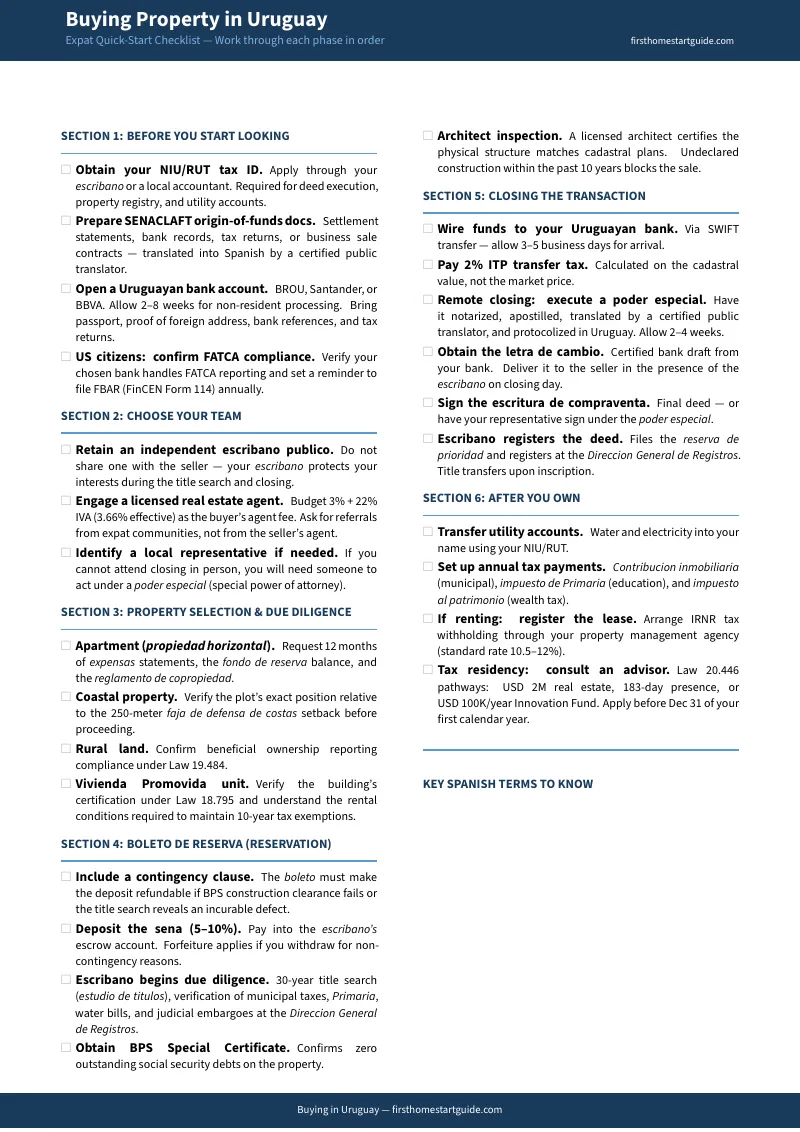
Download the free Foreigner's Quick Checklist to see the 20-item action plan covering SENACLAFT documentation, escribano selection, BPS clearance, ITP calculation, and deed registration. When you are ready for the full Civil Law Transaction Decoder — complete with the escribano system guide, boleto negotiation protocol, Vivienda Promovida analysis, Law 20.446 residency breakdown, and regional market comparisons — the complete guide is here.
You have found the property. Now decode the civil law system that stands between you and the escritura.