
You Have Checked the AHFA Website, Googled "Do I Need an Attorney to Close in Alabama," and Asked Your Coworker About Termite Bonds. You Still Cannot Figure Out How to Stack Step Up Assistance With an FHA Loan, Whether Your Seller Is Hiding Foundation Damage Behind Caveat Emptor, or Why Your County Tax Office Says You Owe Twice What Your Agent Quoted.
You have been pre-approved for a mortgage and started looking at three-bedrooms in Hoover, ranch homes in Madison, or new construction off County Line Road. You may have found the AHFA website and spent twenty minutes clicking through program descriptions written in government-procurement English before closing the tab without understanding whether you qualify for Step Up, First Step, or both. Or you relocated to Huntsville for a defense job, discovered Alabama requires a closing attorney instead of the title company you used in Texas, and now you are trying to figure out who pays for what and why your closing costs look $2,000 higher than you budgeted. Or you closed on your first home in October, nobody mentioned the homestead exemption, and you just learned you have been assessed at the 20% commercial rate instead of the 10% residential rate — overpaying your property taxes by hundreds of dollars a year with no automatic correction coming.
The problem is not a shortage of information. The AHFA publishes income limits and participating lender lists. HUD counseling agencies explain FHA basics. Reddit threads in r/HuntsvilleAlabama debate which credit union has the lowest origination fees. But no single resource explains how the Step Up 4% second mortgage stacks with an FHA first mortgage and a USDA zero-down option in USDA-eligible suburbs — where they combine, where they conflict, and which combination produces the lowest cash-to-close for your specific income bracket. Nobody explains that Alabama is a caveat emptor state where the seller has no legal obligation to disclose defects they did not actively misrepresent, and that your inspection is not a formality but your only line of defense. Nobody walks you through the difference between a retreat-only termite bond that covers re-spraying but leaves you holding a $40,000 structural repair bill and a retreat-and-repair bond that actually protects your investment. And nobody warns you that 44% of eligible Alabama homeowners fail to file their homestead exemption before the December 31 deadline, permanently overpaying their property taxes until they discover the error themselves — because no one at the closing table tells them.
The Alabama First-Time Home Buyer Guide is an Alabama Transaction Protocol — a single, structured reference that maps every assistance program, tax optimization, legal requirement, and environmental liability into a step-by-step process you work through before you make an offer, before you sign at the closing table, and before you miss a single filing deadline. It replaces weeks of cross-referencing the AHFA portal, parsing Reddit anecdotes from 2023, guessing at termite bond terms, and hoping your agent mentions the homestead exemption before December.
What's Inside the Alabama Transaction Protocol
A comprehensive guide, a quick-start checklist, and standalone worksheets — covering every stage from calculating your true borrowing power through to filing your homestead exemption, built specifically for the programs, legal structures, environmental risks, and tax mechanics that make buying in Alabama different from every other state:
The AHFA Program-Stacking Strategy — Step Up + First Step + Federal Loans in One Purchase
The AHFA Step Up program provides 4% of the sales price (capped at $10,000) as down payment assistance, structured as a 10-year second mortgage running alongside your 30-year first mortgage. The income limit is $172,800 — high enough that dual-income professionals in Huntsville and Birmingham qualify even with strong salaries. Step Up works with FHA, VA, USDA, and conventional HFA Advantage loans. The First Step MRB program delivers below-market interest rates, with higher income limits in federally designated target areas where repeat buyers are also eligible. The guide provides worked cash-to-close calculations showing exactly how these programs combine at three price points — $200,000, $275,000, and $350,000 — so you can see what you actually need in the bank on closing day, not just a list of programs you might qualify for.
The Caveat Emptor Survival Guide — Your Inspection Is Your Only Protection
Alabama follows the doctrine of caveat emptor — "let the buyer beware." Unlike states that require sellers to fill out a detailed property disclosure form listing every known defect, Alabama sellers have no statutory obligation to volunteer information about foundation cracks, water damage, mold, or aging HVAC systems. They cannot actively lie or conceal a defect they know about, but they are not required to bring it up. Your pre-purchase inspection is not a checkbox — it is your entire defense. The guide covers how to structure your inspection contingency, which specialist inspections to order beyond the general inspection (foundation, septic, well water, radon), the specific questions to ask when the seller says "sold as-is," and how to use the inspection report as a negotiation tool for repair credits without killing the deal.
The Attorney-Supervised Closing Process — What to Expect, What It Costs, and Who Pays
Alabama is one of a handful of states where a licensed attorney must handle your closing — drafting legal documents, rendering title opinions, and resolving defects in the chain of title. If you relocated from a state where a title company handled everything, the attorney requirement feels like an unexpected expense. It is actually a layer of legal protection that title companies are prohibited from providing. The guide explains the attorney's role at each stage, the typical cost split between buyer and seller (you generally pay half the settlement fees plus document preparation and recording fees), how to find an attorney who handles residential closings efficiently, and why inherited family land with unrecorded claims — common across rural Alabama — makes the attorney review worth every dollar.
Simultaneous Filing Tax Optimization — Homestead Exemption + Property Tax Classification
Alabama's property taxes are among the lowest in the country, but only if you file correctly. Owner-occupied homes are assessed at 10% of appraised value (Class III). Investment and commercial properties are assessed at 20% (Class II). The homestead exemption further reduces your tax burden by approximately $180 to $200 annually. But neither the favorable classification nor the exemption is applied automatically at closing. You must file with your county Revenue Commissioner or Tax Assessor's office. You must own and occupy the home as your primary residence by October 1. You must file by December 31 of the same year. The guide provides the simultaneous filing protocol — homestead exemption plus Class III confirmation in a single visit — with the exact documentation you need (recorded deed, Alabama driver's license matching the property address, utility setup letter) and the county-specific office contacts for Jefferson, Madison, Mobile, and Baldwin counties.
The Termite Bond Deep Dive — Retreat-Only vs. Retreat-and-Repair, Decoded
Alabama's climate makes subterranean termites an inevitability, not a possibility. Homeowners insurance universally excludes termite damage. A termite bond is your only financial protection. Retreat-only bonds (starting around $495/year) guarantee the pest company will re-treat if termites appear — but you pay for all structural repairs out of pocket. Retreat-and-repair bonds ($500 to $2,500/year depending on home size) cover both re-treatment and structural damage up to a specified cap, ranging from $25,000 to over $1,000,000. The guide explains how to evaluate bond terms, which questions to ask pest control companies before signing, how to negotiate bond transfer from the seller at closing, and the updated VA regulation that now allows veterans in Alabama to pay for the mandatory termite inspection directly — eliminating a negotiation hurdle that weakened VA offers for decades.
The FORTIFIED Home and Strengthen Alabama Homes Grant
For buyers in Mobile, Baldwin County, and coastal Alabama, property insurance is the variable that determines whether your debt-to-income ratio qualifies you for the mortgage. FORTIFIED Roof certification triggers a legally mandated 25% to 35% discount on wind insurance premiums. FORTIFIED Silver delivers 35% to 45%. FORTIFIED Gold — a continuous load path from roof to foundation — unlocks 45% to 55% discounts. The Strengthen Alabama Homes (SAH) program provides grants up to $10,000 for retrofitting existing homes to FORTIFIED standards. The guide explains how to identify FORTIFIED-certified homes during your search, how to budget for retrofitting a non-certified home, and how SAH grant funding cycles work so you do not miss the application window.
Regional Market Breakdowns — Huntsville, Birmingham, Montgomery, Mobile, and Coastal Baldwin
Alabama's housing market operates as five distinct micro-economies. Huntsville's median sale price sits at $309,990 with 66 days on market and inventory finally normalizing after years of defense-fueled frenzy. Birmingham's first-time buyers navigate a tiered suburb system — Vestavia Hills for schools ($350K+), Hoover for amenities ($250K+), Pelham for affordability, Irondale for proximity and value ($225K to $400K). Montgomery offers the lowest entry prices but requires careful neighborhood-level due diligence. Mobile and Baldwin County demand FORTIFIED certification literacy to make the insurance math work. The guide provides median prices, days on market, USDA eligibility boundaries, and the specific trade-offs in each region so you compare real numbers, not Zillow averages.
USDA Zero-Down Geographic Strategy
USDA loans offer 100% financing — zero down payment — in eligible rural areas. Alabama's definition of "rural" is broad. While Birmingham, Huntsville, Montgomery, and Mobile city centers are excluded, dozens of rapidly growing suburbs fall just outside the boundary: Walker County near Birmingham, outer Madison and Limestone counties near Huntsville, Elmore County near Montgomery. The guide maps the USDA eligibility perimeter around each major metro, identifies the specific communities where new construction overlaps with USDA eligibility, and shows how to combine USDA financing with the First Home Buyer Savings Account for maximum tax efficiency.
6 Standalone Printable PDFs
Closing cost calculator with AHFA Step Up assistance and simultaneous filing formulas. AHFA program eligibility self-assessment for Step Up, First Step MRB, and AISG. Inspection checklist built for caveat emptor states — general, specialist, and direct inquiry questions that trigger the seller's disclosure obligation. Termite bond comparison worksheet for evaluating pest company quotes side by side. Homestead exemption filing tracker with required documents, county office details, and exemption tier determination. Monthly cost projection with Class III property tax formula, DTI calculations, and termite bond budgeting. Print the ones you need and bring them to your lender, attorney, or inspection.
Who This Guide Is For
- Out-of-state professionals relocating to Huntsville for defense, aerospace, or tech jobs who need a crash course on attorney closings, termite bonds, and the AHFA programs they never heard of in their previous state
- Birmingham renters whose lease renewal now costs more than a mortgage payment and who need to know which suburbs offer the best value for first-time buyers — not just the ones their agent is listing in
- First-generation home buyers with no family real estate experience who need every step explained from credit check through closing, including the programs designed specifically to bridge the down payment gap
- Active-duty military and veterans at Redstone Arsenal or Maxwell AFB who want to maximize their VA loan benefit while navigating Alabama's termite inspection requirements and closing attorney mandate
- Buyers considering coastal Alabama who need to understand FORTIFIED certification, wind insurance math, and the SAH grant before making an offer on a property where insurance alone could disqualify their DTI
- Anyone earning under $172,800 who has not been told about the AHFA Step Up program — the most accessible down payment assistance in the Southeast, available to a far wider income range than most buyers assume
Why Not Free Resources?
Free information on buying your first home in Alabama exists across government websites, agent blogs, and Reddit threads. Here is what it actually delivers:
- The AHFA website publishes program descriptions, income limits, and a list of participating lenders. It does not provide worked cash-to-close calculations, explain how Step Up's 4% second mortgage interacts with your FHA or VA first mortgage at specific price points, or model the tax savings from the First Home Buyer Savings Account over a five-year horizon. You get the program catalog without the financial planning that makes the programs actionable.
- Real estate agents will walk you through the offer and closing process. Most will not proactively explain the homestead exemption deadline, the difference between retreat-only and retreat-and-repair termite bonds, or the fact that Alabama's caveat emptor doctrine means the seller is not required to disclose that the basement floods every spring. Their business model rewards closing speed, not buyer education.
- Reddit threads in r/HuntsvilleAlabama and r/Birmingham contain genuine buyer experiences — but a 2023 thread about USDA eligibility boundaries may not reflect 2026 maps, termite bond advice from a commenter in Georgia references different state regulations, and "just get a good inspector" does not tell you which specialist inspections to order in a caveat emptor state or how to structure your contingency clause. Sorting current from outdated and Alabama-specific from generic takes longer than reading a guide that has already done it.
This guide fills the Alabama-specific gap — the space between knowing you want to buy a first home and knowing how to navigate a state where the seller does not have to tell you about the foundation crack, the closing attorney is mandatory, the termite bond is non-negotiable, the homestead exemption has an invisible deadline, and the most powerful down payment assistance program in the Southeast has a $172,800 income limit that your lender may never mention.
— Less Than a Single Termite Inspection
A termite inspection costs $75 to $150. A home inspection runs $300 to $500. Failing to file your homestead exemption costs you $180 to $200 every year you miss it — and the average overpayment before discovery spans multiple years. Choosing a retreat-only termite bond over a retreat-and-repair bond exposes you to structural repair bills averaging $8,000 to $15,000. Being assessed at the 20% commercial rate instead of the 10% residential rate because you did not confirm your Class III filing doubles your property tax bill indefinitely. Missing the AHFA Step Up program means bringing $10,000 more to closing that you did not need to.
This guide does not replace your closing attorney. But it gives you the program-stacking strategy, the caveat emptor inspection protocol, the termite bond comparison framework, the homestead exemption filing checklist, and the regional market breakdowns that ensure you identify every Alabama-specific risk and capture every Alabama-specific advantage before you sign a purchase agreement — not when the tax bill arrives, the termites do, or your agent asks why you did not file the exemption seven months ago.
If it saves you from a single missed exemption deadline, a single wrong termite bond, or a single undisclosed defect you would not have caught without the right inspection protocol, it pays for itself before you finish reading it.
Money-back guarantee, no time limit. If the guide does not sharpen your due diligence and protect your investment in Alabama's housing market, you pay nothing.
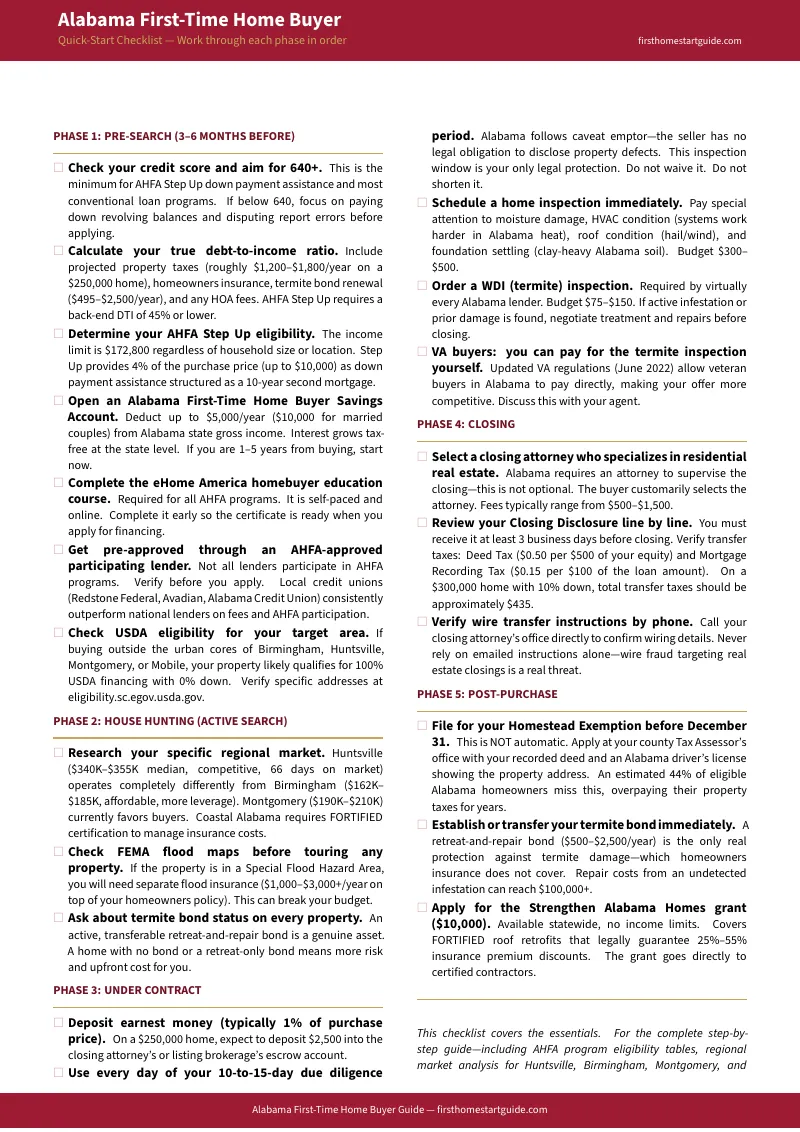
Download the free Alabama Quick-Start Home Buying Checklist to see the step-by-step framework covering pre-approval, house hunting, inspections, and closing. When you are ready for the full program-stacking strategy, caveat emptor survival guide, termite bond deep dive, and complete cost breakdowns, the complete guide is here.
The programs are generous. The traps are hidden. This guide makes sure you claim the first without falling into the second.