
Your Lender Pre-Approved You. Nobody Mentioned the $383-per-Month Heating Bill, the Permafrost Under the Foundation, or the Earthquake Deductible That Absorbs Your First $60,000.
You qualified for a mortgage based on principal, interest, taxes, and insurance. You found a three-bedroom home in the Fairbanks area with a price well under the AHFC loan limit. Your agent said the seller was motivated. You made an offer, it was accepted, and you started packing.
Then January arrived. Your heating oil delivery came to $383 for the month. February was worse. By spring, you had spent more on heating fuel than on your car payment, and nobody in the lending process had asked whether you could afford a home that burns 1,200 gallons of fuel oil per year. Your monthly budget projection was off by $400 because every affordability calculator you used assumed natural gas or electric heat in a temperate climate.
Or maybe the problem was the foundation. Six months after closing, you noticed doors that would not latch. Hairline cracks appeared in the drywall. A neighbor mentioned permafrost. You hired a structural engineer who told you the home was built on a conventional concrete slab over ice-rich permafrost, and the heat from the foundation was thawing the ground underneath at a rate of about an inch per year. The repair estimate was $40,000 to $80,000. The seller had freshly painted every room before listing. The fresh paint hid the cracking.
Or maybe you did everything right on the house but missed the programs. You put 5% down on a conventional loan at market rates because nobody told you that AHFC offers below-market mortgage rates with forgivable down payment grants up to $30,000, that a USDA loan covers zero down in most of Alaska, that the Veterans Mortgage Program stacks a 1% rate reduction on top of AHFC's already discounted rate, and that your annual Permanent Fund Dividend can fund your entire down payment if you time it correctly.
The problem is not that Alaska is expensive. The problem is that Alaska runs an escrow-state closing system through title companies, offers state-subsidised mortgage rates and forgivable grants that conventional lenders will never mention, has no state income tax and no transfer tax, but also has permafrost that destroys foundations, earthquake insurance deductibles that absorb the first $60,000 of damage, heating costs that can exceed your mortgage payment, and entire communities where your appraiser cannot find a single comparable sale within a hundred miles — and no single resource maps all of these into a decision framework you can work through before you sign.
The Alaska First-Time Home Buyer Guide is a Last Frontier Closing Playbook — a structured walkthrough of every Alaska-specific program, cost trap, inspection priority, and financial advantage that determines whether your purchase builds wealth or bleeds it. It replaces months of cross-referencing AHFC program portals, borough assessor websites, heating fuel price trackers, and Reddit threads about permafrost with a single reference that tells you exactly what to verify, exactly which programs to apply for, and exactly where Alaska transactions destroy first-time buyers who assumed their lender and agent would catch everything.
What's Inside the Last Frontier Closing Playbook
A comprehensive 12-chapter guide, a quick-start checklist, and 8 standalone printable tools — covering every stage from AHFC pre-approval through post-closing setup, built specifically for the climate conditions, loan programs, and cost structures that make Alaska unlike any other state:
AHFC Loan Programs: Below-Market Rates the Banks Will Not Mention
Alaska Housing Finance Corporation offers mortgage rates below what any commercial lender provides — and most first-time buyers never learn about them because conventional lenders have no incentive to redirect you. The guide covers all four AHFC programs side by side: First Home (Taxable) with no income limits, First Home Limited with the lowest rates for income-qualifying buyers, the Veterans Mortgage Program that stacks a 1% rate reduction on the first $50,000, and the Rural Owner-Occupied Loan for properties outside population centres. It includes the free HomeChoice education course that earns you a $250 closing cost credit and unlocks every AHFC product. If you are buying in Alaska without at least comparing AHFC rates, you are leaving thousands of dollars on the table over the life of your loan.
Down Payment Assistance: Up to $30,000, First $10,000 Forgivable
The Home Opportunity Program through Alaska Community Development Corporation provides up to $30,000 in down payment and closing cost assistance, with the first $10,000 forgivable over five years. Funding is first-come, first-served and runs out annually. The guide covers HOP eligibility and the application timeline, the AHELP emergency assistance program, how to stack AHFC programs with FHA, VA, USDA, and Section 184 loans, and the Permanent Fund Dividend strategy — timing your PFD filing and purchase to maximise free capital. A family of four collecting PFDs generates $6,000 to $8,000 per year toward a down payment. The guide includes a comparison table showing exactly which combination of programs produces the lowest total cost for your income level and location.
Permafrost Evaluation: The $40,000-$80,000 Foundation Risk
Permafrost is not a theoretical concern in Interior Alaska — it is the single largest financial risk a first-time buyer faces in the Fairbanks area. Homes built on conventional concrete slabs or basements over ice-rich permafrost experience progressive foundation failure as heat from the structure thaws the ground beneath it. The guide covers how to identify permafrost risk before you make an offer, why geotechnical soil testing is mandatory before waiving your inspection contingency, which foundation types work on permafrost (adjustable pad-and-post, driven piles, freezing tubes) and which guarantee failure, the "fresh paint red flag" that conceals drywall cracking from permafrost settlement, and how to evaluate whether a property's foundation type matches the soil conditions underneath it. If you are buying anywhere in the Fairbanks North Star Borough, this section alone prevents the most expensive mistake Alaska buyers make.
Heating Cost Analysis: Budget for January, Not July
National affordability calculators assume moderate utility costs. In Alaska, heating is not a utility — it is a second mortgage payment. The guide provides a fuel-type comparison table (natural gas, fuel oil, electric, wood) with current costs by region, shows you how to verify actual heating costs before buying by requesting 24 months of fuel delivery receipts, covers energy efficiency evaluation during home inspection (wall framing, insulation R-values, HRV systems, window types), and models the total cost of ownership including heating so you know your real monthly obligation before you commit. The difference between a home on natural gas in Anchorage and a home on fuel oil in Fairbanks is $250 per month — every month, for the life of your ownership.
Earthquake Insurance: The Deductible Trap
Standard homeowner's insurance excludes earthquake damage entirely. The endorsement costs about $116 per year — but the deductible is 10% to 20% of your coverage limit, not the damage amount. On a $400,000 policy with a 15% deductible, you absorb the first $60,000 of any seismic claim out of pocket. The guide covers how the deductible actually works (most buyers miscalculate it), when earthquake insurance makes financial sense versus when self-insurance is the better strategy, wildfire defensible space requirements for forested properties, flood and landslide coverage for Southeast Alaska, and how to get coverage for remote properties that standard carriers refuse to insure.
Regional Market Comparisons: Six Alaska Markets, Side by Side
Alaska is not one housing market — it is six distinct markets with different price points, heating costs, commute realities, and buyer dynamics. The guide compares Anchorage (largest inventory, natural gas, highest prices), the Mat-Su Valley (affordable acreage, 90-minute commute, fastest growth), Fairbanks (permafrost risk, extreme cold, military-driven demand), Juneau (island access only, no road connection, government-driven), the Kenai Peninsula and Homer (rural lifestyle, fuel oil, fishing economy), and Bush Alaska (no road access, air-only, surplus market for E&S insurance). Each profile includes current pricing, heating fuel availability, inspection priorities, and financing strategies specific to that market.
Off-Grid Properties and Dry Cabins
Alaska has an entire property category that does not exist in the Lower 48: dry cabins — homes without running water, using outhouses or composting toilets and hauled water. Conventional lenders will not finance them. The guide covers the Uniquely Alaskan Loan, AHFC's product specifically designed for properties that fail conventional lending standards, what "off-grid" actually means in Alaska, well and septic conversion costs for buyers who want to add utilities later, and the reality check most buyers skip before committing to a property without municipal services.
Military Buyer Strategies
JBER and Fort Wainwright are the two largest military installations in Alaska, and PCS buyers face unique challenges: compressed timelines, sight-unseen purchases, BAH-based affordability calculations that do not account for heating costs, and the VA versus USDA decision that most military families get wrong. The guide covers why USDA may beat VA for rural Alaska properties, how to stack the AHFC Veterans Mortgage Program on top of either loan type, BAH-based budgeting that includes heating fuel as a line item, and market-specific strategies for Eagle River, Wasilla, and North Pole — the three communities where most military families buy.
Standalone Printable Tools
Every paid download includes 8 standalone tools you can print and bring to your lender meeting, home inspection, or insurance agent appointment:
- Financing Comparison — all AHFC programs and federal loan types side by side
- Down Payment Assistance Worksheet — HOP grants, PFD timing, and a calculator to plan your down payment
- Cold-Climate Inspection Checklist — permafrost, thermal envelope, plumbing, and seismic items
- Heating Cost Worksheet — fuel-type comparison and monthly cost calculator
- Insurance Checklist — earthquake deductible math, wildfire, flood, and remote property coverage
- Regional Market Reference — six Alaska markets at a glance
- Property Tax Reference — mill rates, exemptions, and filing deadlines
- Closing Timeline — your 30-to-45-day roadmap from offer to keys
Who This Guide Is For
- First-time buyers navigating AHFC programs who need to understand which loan product, DPA program, and federal loan type produces the lowest total cost for their income level and location — before their lender steers them toward a conventional product that costs more
- Military families on PCS orders to JBER or Fort Wainwright buying under compressed timelines who need the VA versus USDA comparison, VMP stacking strategy, and BAH-based budget model that accounts for heating costs their relocation office will not mention
- Fairbanks-area buyers who need to evaluate permafrost risk, foundation types, and heating costs before committing to a property where the ground beneath it may be thawing
- Mat-Su Valley commuters weighing affordable acreage against a 90-minute daily commute to Anchorage, and who need to understand well and septic costs, road service area tax implications, and winter driving realities
- Anyone considering off-grid or dry cabin properties who needs to understand financing limitations, the Uniquely Alaskan Loan, utility conversion costs, and what daily life actually looks like without municipal water or sewer
- Rotational workers and state employees looking for long-term stability in a market with unique cost structures, seasonal price patterns, and a Permanent Fund Dividend that can accelerate their equity position
Why Not Free Tools and Forums?
Free information on buying a home in Alaska exists. Here is what it actually delivers:
- AHFC.us program pages give you rate sheets, income limits, and approved lender lists. They do not tell you which combination of AHFC program, DPA, and federal loan type minimises your total cost at your income level, whether stacking VMP on USDA outperforms a straight VA loan, or that HOP funding runs out annually on a first-come basis. You get eligibility tables without a decision framework.
- Reddit threads (r/alaska, r/Fairbanks, r/anchorage) contain genuine warnings about permafrost damage and heating costs, but mixed with advice from residents who confuse AHFC programs, recommend foundation types that accelerate permafrost thaw, and cite heating costs from three winters ago at different fuel prices. Sorting current data from outdated anecdote takes longer than reading a guide that already did it.
- National home buying guides (NerdWallet, Bankrate, Zillow) assume natural gas heat, municipal water, conventional foundations, and temperate climates. They do not cover permafrost evaluation, heating fuel budgeting, dry cabin financing, earthquake deductible math, or the PFD down payment strategy. You get advice designed for the Lower 48 applied to a state where almost none of it works.
- Real estate agent blogs and "Moving to Alaska" content focus on lifestyle — moose in the yard, Northern Lights, fishing — designed to generate leads. They do not explain how to evaluate a foundation for permafrost risk, calculate your real monthly cost including heating fuel, compare AHFC programs against conventional loans, or model earthquake insurance deductibles against your risk tolerance. You get marketing content, not financial analysis.
This guide fills the Alaska-specific gap — the space between knowing how to buy a home in general and knowing how to buy one in a state where permafrost can destroy a foundation, heating costs can exceed a mortgage payment, earthquake insurance deductibles absorb five figures of damage before coverage activates, and state programs worth tens of thousands of dollars are scattered across agencies that do not cross-reference each other. It is the analysis that would take an AHFC-approved lender, a cold-climate home inspector, a structural engineer, and an insurance broker to assemble — structured as a reference you own permanently.
— Less Than One Tank of Heating Oil
A single heating oil fill in Fairbanks costs $400 to $600. A permafrost foundation repair runs $40,000 to $80,000. Missing the HOP down payment assistance application means losing up to $30,000 in forgivable grants. Not knowing about the Veterans Mortgage Program means paying a higher rate on every payment for the life of your loan. Buying a home on a conventional slab over permafrost because nobody explained the foundation risk can cost you the entire value of the property within a decade.
This guide does not replace your lender, your inspector, or your real estate agent. But it gives you the program comparison, cost analysis, inspection priorities, and regional market intelligence that ensure you identify every Alaska-specific risk and opportunity before your earnest money is at stake — instead of discovering them when the first heating bill arrives, the foundation starts settling, or you learn about the AHFC program that would have saved you $15,000 after you have already closed on a conventional loan.
If it connects you with a single AHFC program, catches a single permafrost red flag, prevents a single earthquake insurance miscalculation, or ensures you file for HOP assistance before funding runs out, it pays for itself before you have finished reading it.
Money-back guarantee, no time limit. If the guide does not sharpen your Alaska home buying analysis and protect your investment, you pay nothing.
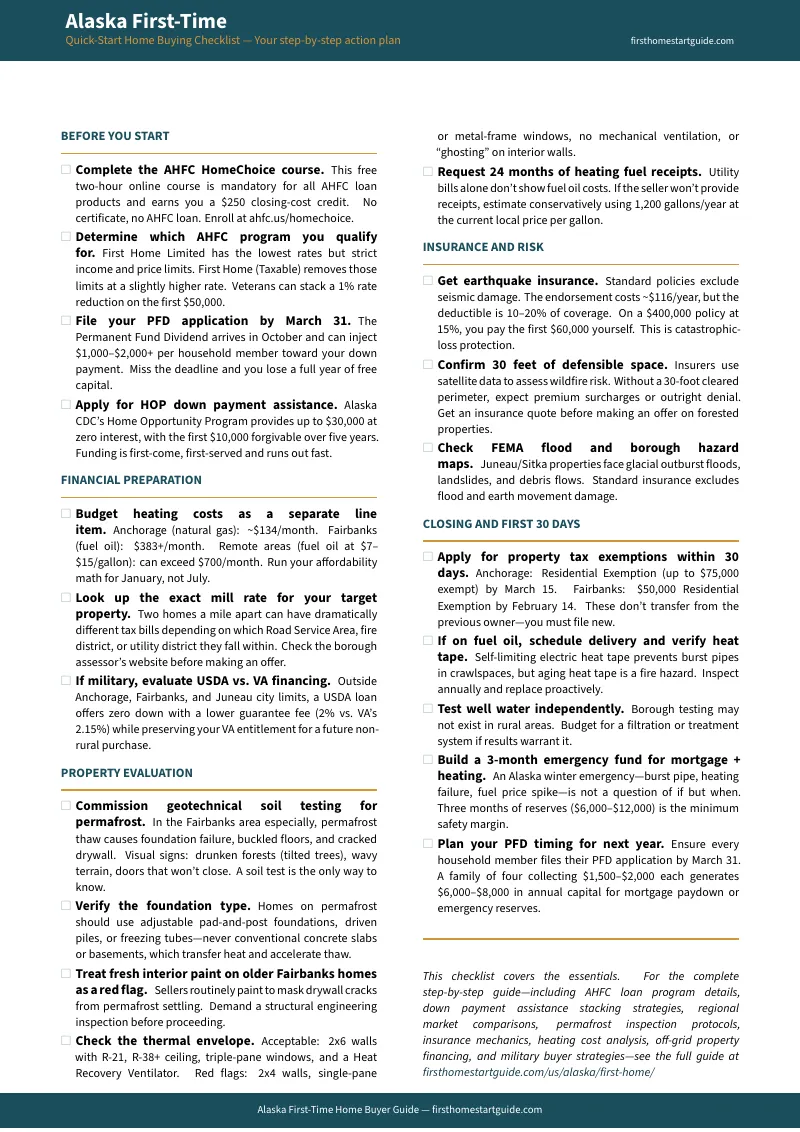
Download the free Alaska Quick-Start Home Buying Checklist to see the 20-item framework covering AHFC program selection, financial preparation, permafrost evaluation, insurance essentials, and closing priorities. When you are ready for the complete guide with full chapter breakdowns, regional market comparisons, heating cost analysis, loan program comparison tables, and military buyer strategies, the full toolkit is here.
Alaska rewards buyers who understand the Last Frontier's rules. This guide makes sure you do.
Frequently Asked Questions
What if the rules change after I buy?
We update the guide when the rules change. Email us any time, even years later, and we'll send you the current edition free.