
The Yields Look Great Until Alaska's Heating Laws, Borough Taxes, and Arctic Operations Rewrite Your Pro Forma
You found a duplex in Anchorage generating $2,800/month in military BAH-backed rent. Or a single-family home in the Mat-Su Valley with a 1.3% vacancy rate. Or a cabin near Denali pulling $390/night during peak summer season. The cap rate clears. The DSCR works. No state income tax, no capital gains tax, no transfer tax. You're ready to make an offer.
Then Alaska shows up. The Anchorage duplex's heating oil consumption runs $800 to $1,000/month through winter — and under AS 34.03.100, you are legally required to provide continuous, reliable heat. When the boiler fails at -40°F, pipes freeze and burst within hours. Your tenant invokes the statutory "repair and deduct" remedy, hires their own HVAC contractor at emergency rates, and deducts the full cost from next month's rent. A single frozen-pipe event in a poorly insulated building can cost $15,000 to $30,000 in water damage. The Mat-Su property saves you $2,332/year in property taxes versus Anchorage — but only if you understood that Anchorage's 15.79 mill rate is 73% higher than Mat-Su's 9.128 mills before you underwrote the deal. The Denali cabin earns spectacular summer revenue for five months, then sits empty for seven while you pay to keep it heated above freezing to prevent structural damage.
Here's the problem: Alaska combines the most favorable tax environment in the country with a statutory heating mandate that turns mechanical failures into five-figure emergencies, property tax mill rates that vary by 60% across adjacent boroughs, a military tenant base that requires precise BAH bracket pricing, short-term rental regulations that just changed in 2025, permafrost risks that can destroy a foundation, and earthquake insurance deductibles that leave you $60,000 out of pocket before the policy pays. Each of these has cost real investors thousands because the data existed — scattered across borough assessor portals, AHFC rental surveys, military pay tables, and municipal ordinance updates — but nobody had assembled it into a single underwriting system built for Alaska's operating environment.
The Alaska Investment Property Guide is an Arctic Investment Operations System — not a motivational overview of Last Frontier real estate, but a structured due diligence framework that maps every Alaska-specific tax structure, legal requirement, climate risk, and military housing dynamic into a process you work through before you wire earnest money. It replaces months of cross-referencing borough tax assessors, BAH rate tables, landlord-tenant statutes, and STR ordinances with a single reference that tells you exactly what to verify, exactly what the numbers should look like, and exactly where deals go wrong in this state.
What's Inside the Arctic Investment Operations System
A 10-chapter guide, a standalone 20-item due diligence checklist, and 8 printable reference worksheets — covering every stage from market selection through post-purchase winterization, built specifically for the climate risks, military dynamics, and regulatory complexity that make Alaska different from every other state:
Borough Property Tax Architecture and Mill Rate Arbitrage
Alaska has no statewide property tax — all taxation happens at the borough level, and the differences are dramatic enough to change whether a deal pencils. Anchorage charges approximately 15.79 mills (~1.58% effective), Mat-Su charges 9.128 mills (~0.99% effective), Fairbanks charges 10.620 mills, and Kenai Peninsula starts at 3.85 mills. On a $350,000 rental property, the annual tax difference between Anchorage and Mat-Su is $2,332 — that's $23,320 over a 10-year hold flowing directly to your net operating income. The guide walks through how each borough's mill rate breaks down, which service area levies apply, how assessments work, and the appeal process when your property is over-assessed. It also explains why the unorganized borough's zero-tax rate is almost always a trap.
Military BAH Rental Strategy
Thousands of military families at JBER (Anchorage) and Eielson/Fort Wainwright (Fairbanks) receive federally guaranteed Basic Allowance for Housing. For 2026, an E-5 with dependents at JBER receives $2,874/month — an E-7 receives $3,045. The Department of Defense's Individual Rate Protection policy means that once a service member locks in a BAH rate, it cannot be reduced even if local market rents decline. This creates a government-backed revenue floor that no civilian tenant pool can match. The guide provides complete BAH rate tables, shows you exactly how to price properties at 90-97% of target brackets for near-zero vacancy, and explains SCRA lease termination rights so you can plan for PCS-driven turnover instead of being blindsided by it.
Alaska Landlord-Tenant Law (AS 34.03) Compliance
Alaska has no rent control — landlords can charge market rates unrestricted. But the state's landlord-tenant law has provisions engineered specifically for extreme climate. Under AS 34.03.100, continuous reliable heat is a statutory life-safety mandate, not just a lease term. The security deposit rules include a critical exemption: the standard two-month maximum does not apply when monthly rent exceeds $2,000 — and since most Anchorage single-family homes rent above $2,800, you can secure larger deposits to buffer against winter damage risk. Eviction timelines are codified: 7-day notice for nonpayment, 10-day notice for lease violations, and a rapid 24-hour notice when tenants cause deliberate damage exceeding $400. The guide covers every statutory deadline, tenant remedy, and notice requirement.
Short-Term Rental Operations and Compliance
Alaska welcomed 2.7 million visitors in 2024 — a 22% increase over pre-pandemic levels. But STR seasonality is extreme: most revenue compresses into five months (May–September), and off-season heating costs erode summer profits if your pro forma doesn't account for them. Anchorage's new AO 2025-115(S-2) requires a $400 STR license (2-year validity), $500,000 in liability insurance, and a local 24/7 emergency contact. Unregistered units are barred from platform advertising after July 2026. Lodging taxes vary by municipality: 12% in Anchorage, 14% in Juneau, 5% bed tax in Mat-Su. The guide provides a full 12-month revenue model showing why pure STR strategies fail without hybrid approaches, and three strategies that actually generate positive annual cash flow in Alaska's seasonal market.
Climate Risk Underwriting and Winterization
This is where Alaska investing fundamentally separates from the Lower 48. Heating fuel in Interior Alaska runs $6.81/gallon — nearly double the national average of $3.67. Remote villages reach $13 to $15/gallon. In Fairbanks, permafrost beneath a building can thaw from the structure's radiated heat, causing catastrophic foundation settlement — remediation costs $2,840 to $21,300. Standard insurance excludes earthquake damage, and earthquake riders carry 10-20% percentage-based deductibles: on a $400,000 property with a 15% deductible, you absorb $60,000 before the policy pays anything. The guide provides heating fuel cost tables by region, a pre-winter inspection protocol, permafrost due diligence procedures, earthquake insurance economics, and a CapEx reserve table calibrated for Alaska's accelerated maintenance cycles.
Regional Market Analysis with 2025 Rental Survey Data
Four Railbelt markets analyzed with current contract rents, adjusted rents, vacancy rates, and acquisition cost data. Anchorage: 3BR SFH at $2,818 adjusted rent, 2.9% vacancy, driven by military and healthcare demand. Mat-Su Valley: $2,164 rent, an extraordinary 1.3% vacancy rate, the tax-arbitrage commuter market. Fairbanks: $2,572 SFH rent at 6.9% vacancy — viable for single-family, but apartments carry toxic 15-17% vacancy from transient student and oilfield populations. Kenai Peninsula: $1,834 rent, stable working-class demographics with summer tourism upside. Each section explains which investment strategy works in that market and which ones will destroy your cash flow.
Financing and Property Management at Scale
Conventional and DSCR loans for Railbelt properties (25-30% down), VA house-hacking for military buyers (0% down on fourplexes), and the harsh reality that bush properties are cash-only or owner-financed. AHFC programs are owner-occupied only — except for their Rural Non-Owner-Occupied Loan for rentals in small communities. Remote property management in Alaska is fundamentally different from the Lower 48: the guide covers fee structures, the caretaker model for remote properties, temperature monitoring systems that alert you before pipes freeze, and how to build an emergency vendor network that responds at -40°F when most contractors are hibernating.
Who This Guide Is For
This guide is for real estate investors targeting Alaska markets who:
- Are analyzing an Alaska property and need to verify whether the deal works once you account for actual heating costs, the correct borough mill rate, earthquake insurance deductibles, and the CapEx reserves required for arctic operations — not the generic Lower 48 underwriting model that ignores climate
- Are military families at JBER or Eielson planning a VA house-hack and need to understand how to price against specific BAH brackets, which property types align with military demand, and how to retain the asset as a cash-flowing remote rental after your next PCS
- Are North Slope oil workers with accumulated capital looking to deploy into hard assets during your off-rotation — you need the legal framework, tax structure, and management infrastructure to invest intelligently rather than guessing
- Are out-of-state investors drawn by Alaska's zero income tax and zero capital gains tax who need honest, localized risk assessment and underwriting parameters for a market you can't drive to
- Plan to operate short-term rentals in Anchorage, Denali, or Fairbanks and need to comply with the new municipal licensing requirements, model realistic seasonal revenue, and underwrite the off-season heating costs that most STR calculators ignore
- Want every Alaska-specific regulation, tax structure, BAH table, climate risk factor, and due diligence requirement in one reference — instead of assembling it from borough assessor websites, military pay tables, AHFC rental surveys, and Reddit threads that may predate the 2025 STR ordinance changes
Why Not Free Tools and Forums?
Free information on Alaska real estate investing exists across dozens of sources. Here's what it actually delivers:
- BiggerPockets and Reddit forums contain genuine experience reports from Alaska investors — mixed with advice that doesn't distinguish between Railbelt and bush properties, outdated heating cost estimates from before the 2024-2025 fuel price spikes, and eviction guidance that doesn't address the statutory heating mandate. The most dangerous advice comes from out-of-state investors who bought sight-unseen and learned about permafrost, earthquake deductibles, and -40°F boiler failures after closing.
- Alaska Housing Finance Corporation reports provide excellent rental survey data and housing market indicators. But AHFC data is institutional and statistical — designed for policy analysts, not individual investors who need to know whether a specific duplex in Wasilla pencils against E-5 BAH rates after heating costs.
- Military housing websites publish BAH tables but don't explain how Individual Rate Protection works, how to price against specific brackets, or what SCRA lease termination rights mean for your turnover model.
- Borough assessor portals show your property's assessed value and mill rate but don't compare tax burdens across boroughs or explain the $2,332/year arbitrage between Anchorage and Mat-Su that could fund your CapEx reserve.
The structural problem isn't that the information is wrong — it's that it's fragmented across sources that don't cross-reference. Heating costs affect your CapEx reserves. CapEx reserves affect your DSCR ratio. Your DSCR ratio determines your financing terms. Your financing terms determine whether the deal works. One wrong input propagates through the entire model. This guide connects the variables into a single framework built for Alaska's operating environment.
Satisfaction Guarantee
If the guide doesn't deliver the Alaska-specific underwriting data, regulatory clarity, and operational framework you need, email us within 60 days for a full refund. No forms, no questions. You either get the information edge you need to invest in Alaska with confidence, or you get your money back.
— Less Than One Hour of an HVAC Emergency Call
A single frozen-pipe repair in Alaska costs $15,000 to $30,000. A heating system audit you didn't know to order costs you the entire winter's heating budget. A property taxed at Anchorage rates instead of Mat-Su rates costs you $2,332 every year. The math on this guide isn't even close.
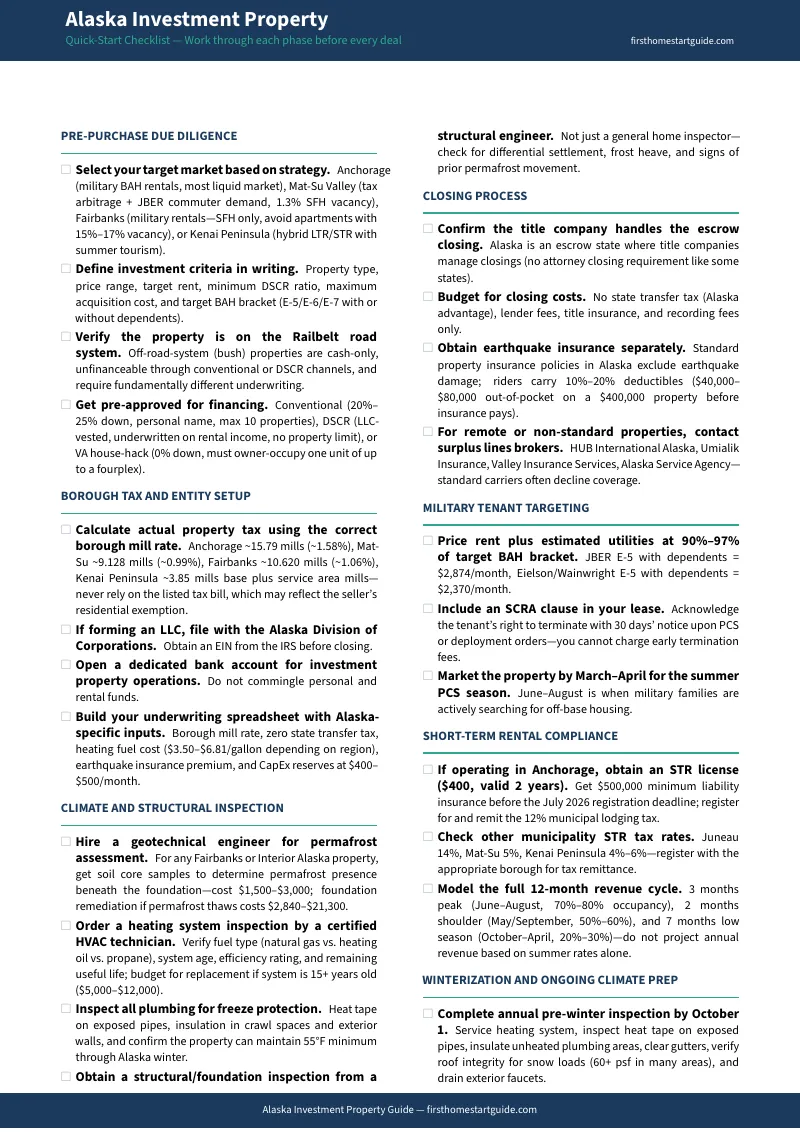
Start with the free Quick-Start Checklist — 20 Alaska-specific action items covering borough tax verification, heating system inspection, permafrost due diligence, and military BAH targeting. It gives you the pre-purchase framework immediately. When you're ready for the complete due diligence system — 10 chapters of regional market data, landlord-tenant law analysis, climate risk underwriting, and financing strategy — upgrade to the full guide.
Frequently Asked Questions
What if the rules change after I buy?
We update the guide when the rules change. Email us any time, even years later, and we'll send you the current edition free.