
Your Lender Will Pre-Approve You. Nobody Will Mention the Demand Charge That Adds $80 to Your Electric Bill.
You have browsed the Arizona IDA website and compared Home Plus rates. You have used a mortgage calculator to estimate monthly payments on a $607,000 Phoenix-area listing. You have probably scrolled through r/phoenix threads where someone asks whether demand charges are "predatory" and another poster warns you to never buy a pool home without checking the pump type. But nobody has explained why a single overlapping hour of AC, dryer, and oven during on-peak time creates a surcharge that applies to your entire monthly bill — or that the HOA resale disclosure packet you are legally entitled to can exceed 400 pages and contains financial red flags most buyers never learn to read.
Arizona is not a complicated state to buy a home in. It is a complicated state to buy a home in correctly. The market is shaped by a permanent influx of equity-rich California migrants who create a pricing floor that penalizes local earners, an extreme desert climate that turns electricity and pool maintenance into five-figure annual line items, the nation's highest HOA penetration rate at 99% of new builds, and a patchwork of state, county, and municipal DPA programs with overlapping eligibility rules and hidden interest rate penalties that no single resource explains together. Add Proposition 117's dual property tax system, the AAR contract's BINSR negotiation mechanism, community property rules that create phantom equity claims, and a monsoon season that drives termite swarms directly into residential foundations — and you have a state where the cost of not knowing one rule can exceed the price of learning them all.
Here's the core problem: Arizona layers extreme climate costs, HOA forensic accounting, five overlapping DPA programs, and desert-specific inspection requirements across state, county, and city jurisdictions — and the free resources that cover each topic are scattered across government portals, agent blogs, Reddit threads, and utility company websites that each explain one piece without connecting it to the rest. There is no single resource that maps how a demand charge interacts with your rate plan choice, how to read an HOA reserve study to detect underfunded communities before a special assessment hits, how to stack Home Plus with Home in Five or the WISH program's 4:1 matching grant, or how the BINSR process gives you a formal mechanism to negotiate $15,000 in HVAC credits. Until now.
The Arizona First-Time Home Buyer Guide is a Desert Buyer Navigation System — a structured decision framework that connects every Arizona-specific financial trap, climate cost, HOA red flag, and assistance program into a single step-by-step roadmap from pre-approval through key collection.
What's Inside the Desert Buyer Navigation System
The complete guide plus standalone printable worksheets — covering every stage from calculating your true Arizona borrowing power through closing day, plus fillable tools you print and bring to lender appointments, title company meetings, and property viewings:
Down Payment Assistance Program Matrix
Arizona offers five distinct DPA programs with overlapping geographies, different forgiveness rules, and different interest rate penalties — and most buyers learn about only one of them from their lender. Home Plus provides up to 4% statewide with 5-year forgiveness and income limits up to $155,386. Home in Five offers up to 6% in Maricopa County with accelerated 3-year forgiveness. The WISH program in the East Valley multiplies every $1 you save into $4 in matching funds, up to $32,099. Phoenix Open Doors provides up to 10% as a deferred loan within city limits. Arizona Is Home covers rural counties — but the 2026 version is non-forgivable, meaning the entire balance is due on sale or refinance. The guide maps every program, every income limit, every forgiveness structure, and the critical interest rate trade-off: DPA-linked mortgages carry rates 100-250 basis points above market. You will know whether to accept the higher rate, plan a refinance strategy, or bring your own down payment — before you sit down with a lender.
HOA Forensic Analysis Framework
With 99% of new Arizona homes inside an HOA, you are almost certainly buying into one. The guide teaches you to read the mandatory 400-page resale disclosure packet like a financial auditor. You will learn to detect the pattern that costs buyers the most money: shiny amenities paired with thin reserves — a community that looks spectacular today but has an empty bank account that guarantees a special assessment tomorrow. The framework covers reserve study analysis (what percentage funded is healthy, what is a red flag), how to read board meeting minutes for chronic repair deferment and high delinquency rates, the hidden transfer fees and capital contributions that add $500-$2,000 to your cash-to-close, and the 5-day cancellation right under A.R.S. Section 33-1806 that lets you walk away with your full earnest money after reviewing the packet — a secondary contingency most buyers never use.
Extreme Climate Cost Calculator
National mortgage calculators miss $4,700 per year in Arizona-specific carrying costs. Summer electric bills routinely hit $350-$450 per month. SRP and APS demand charges punish a single on-peak overlap with a $40-$80 surcharge that applies to the entire billing cycle. Pool maintenance runs $1,800-$4,000 annually when you factor in chemical burn-off, evaporation water replacement, and filtration pump electricity that accounts for 20-30% of your summer bill. The guide includes a true monthly cost formula that replaces the standard PITI calculation with Arizona reality — adding HOA fees, annualized utility costs, pool maintenance, and professional pest control — so you know your real budget before you start viewing homes, not after you have been living in one for a summer.
Desert-Specific Inspection Playbook
A generic home inspection is not sufficient in Arizona. The guide walks you through every specialized inspection you need within the 10-day AAR contract window: the HVAC temperature split test that reveals whether the system can actually survive a Phoenix summer, the roof underlayment assessment that catches invisible degradation behind pristine-looking tiles, the WDIIR termite inspection that is mandatory for VA loans and critical for all buyers during monsoon season, the sewer scope that reveals underground breaks in older homes, and the pool equipment audit that identifies single-speed pumps costing you hundreds per month in excess electricity. Each inspection includes what it costs, what it catches, and how to use the BINSR to negotiate credits or cancellation based on findings.
Submarket Decision Guide: East Valley vs. West Valley vs. Tucson
The East Valley (Gilbert, Chandler, Mesa, Tempe) commands premium prices with sub-2-month inventory and 25-day average market times — fierce competition but top school districts and tech employment. The West Valley (Surprise, Goodyear, Buckeye) offers more square footage at lower prices with 3.5-month inventory supply, giving DPA buyers breathing room to negotiate. Tucson provides the most accessible entry point with aggressive municipal programs like PimaTucson Lighthouse (4% forgivable DPA) and the Pathway to Purchase (up to $20,000). The guide breaks down each submarket with pricing data, inventory levels, competition intensity, and which DPA programs apply — plus specific warnings about Tucson "flipper specials" with botched HVAC duct routing and West Valley commute trade-offs.
Proposition 117 Property Tax Shield and Community Property Rules
Arizona's dual property tax system protects you from sudden spikes — the Limited Property Value can increase by no more than 5% per year under Prop 117, regardless of actual market appreciation. But Rule B resets the cap for newly built or renovated homes, causing a significant jump in your first tax bill that surprises uninformed buyers. Arizona is also a community property state. If one spouse secures the mortgage individually for a better rate, the non-borrowing spouse signs a Disclaimer Deed — but community funds used toward the mortgage still create a pro-rata equity interest enforced by Arizona courts. The guide explains both systems so you understand your tax trajectory and your ownership structure before closing.
Plus 4 Standalone Printable Worksheets
Print these and bring them to lender appointments, property viewings, and title company meetings:
- True Monthly Cost Calculator — Arizona-specific affordability worksheet adding HOA, annualized electricity, pool costs, and pest control to standard PITI — the real number your national calculator misses
- Closing Cost Estimator — line-by-line cost breakdown with DPA credit offsets, HOA transfer fees, and net cash-to-close calculation for Maricopa and Pima county customs
- DPA Program Eligibility Checker — side-by-side comparison of all five programs with income limits, credit requirements, geography, forgiveness rules, and assistance amounts — fill in your numbers and see which programs you qualify for
- Property Comparison Worksheet — side-by-side comparison of up to three properties tracking submarket, HOA fees, pool status, HVAC age, electricity provider, DPA eligibility, estimated summer electric bill, and total true monthly cost
Who This Guide Is For
This guide is for first-time buyers in Arizona who:
- Are relocating from out of state — particularly California or the Midwest — and need to understand how Arizona's extreme climate costs, HOA governance structure, and utility rate architecture will reshape their monthly budget in ways no national calculator captures
- Want to access DPA programs but need a clear map of which programs they qualify for, how the interest rate penalties compare, and whether the long-term cost of a higher rate exceeds the value of the grant they receive
- Are comparing East Valley vs. West Valley vs. Tucson and need to understand the trade-offs in pricing, competition, inventory, school quality, commute, and DPA availability across each submarket
- Are military families near Luke AFB or Fort Huachuca who want to combine a VA zero-down loan with state DPA programs and understand the BAH-to-mortgage alignment strategy
- Have found a property with a pool and need to model the true annual cost — maintenance, chemicals, evaporation, pump electricity — before an amenity they thought was a luxury becomes a financial burden
- Are buying into an HOA and need to know how to read the reserve study, detect underfunded communities, calculate the impact of transfer fees on their cash-to-close, and exercise the 5-day cancellation right if the packet reveals red flags
- Want every DPA program, every inspection requirement, every climate cost, every HOA forensic technique, and every closing deadline in one document — so they walk into lender meetings, title company closings, and property viewings knowing exactly what to expect at each stage
Why Not Free Resources?
Free information on buying your first home in Arizona is everywhere. Here's what each source actually delivers:
- Arizona Industrial Development Authority (azida.gov) lists Home Plus program parameters — loan types, income limits, assistance percentages. What it doesn't do: compare Home Plus against Home in Five, WISH, Phoenix Open Doors, and Arizona Is Home side by side, explain the interest rate premium you are trading for the grant, or tell you which programs can be combined. The eligibility rules are there. The strategy for choosing between them is not.
- SRP and APS utility websites describe their rate plans in technical detail — Time-of-Use schedules, demand charge formulas, solar export credits. What they don't do: explain in buyer-friendly language how a demand charge actually works against normal household behavior, why picking the wrong rate plan can add $80 per month to your bill, or how your home's orientation and HVAC age interact with your rate plan choice. The options are listed. The decision framework for choosing is not.
- Reddit (r/phoenix, r/tucson, r/FirstTimeHomeBuyer) is where real Arizona buyers share unfiltered experience — and where demand charge complaints from 2024 sit alongside current rates, where one poster's DPA success story applies to a program version that has since changed, and where "avoid HOAs at all costs" is treated as universal advice despite 99% of new builds requiring one. The signal is real. So is the noise.
- Local real estate agent blogs cover market conditions with genuine local insight — from the perspective of professionals who earn a commission when you buy. They will tell you to "get pre-approved early" and "make a strong offer" but will rarely walk you through the BINSR negotiation strategy, the HOA reserve study red flags, or the demand charge economics — because those topics slow deals down and don't generate referral fees.
This guide fills the navigation gap — the space between knowing Arizona has DPA programs, HOA requirements, climate costs, and desert inspection needs, and understanding how they all interact across a single home purchase. It's the analysis an independent advisor with no products to sell would give you, structured as a permanent reference you own.
— Less Than One Hour of a Home Inspector's Time
A standard Arizona home inspection costs $400-$600. A specialized HVAC diagnostic runs $150-$300 on top of that. A termite WDIIR adds $75-$150. Failing to model the demand charge on your electricity plan costs $40-$80 per month. An underfunded HOA reserve study that you never learned to read leads to a special assessment of $2,000-$5,000. Closing on a property without understanding the DPA interest rate trade-off can cost $100,000 in excess interest over 30 years.
This guide doesn't replace your lender, your title company, or your real estate agent. But it gives you the DPA program matrix, the HOA forensic framework, the climate cost calculator, the inspection playbook, and the submarket comparison that ensure you walk into every appointment knowing exactly what to ask, exactly what to inspect, and exactly what to negotiate — instead of discovering expensive traps in real time.
If it prevents a single HOA special assessment surprise, catches one demand-charge rate plan mistake, or helps you access one additional DPA program you didn't know you qualified for, it pays for itself before you've finished reading it.
Money-back guarantee, no time limit. If the guide doesn't make your Arizona home buying process clearer and your financial position stronger, you pay nothing.
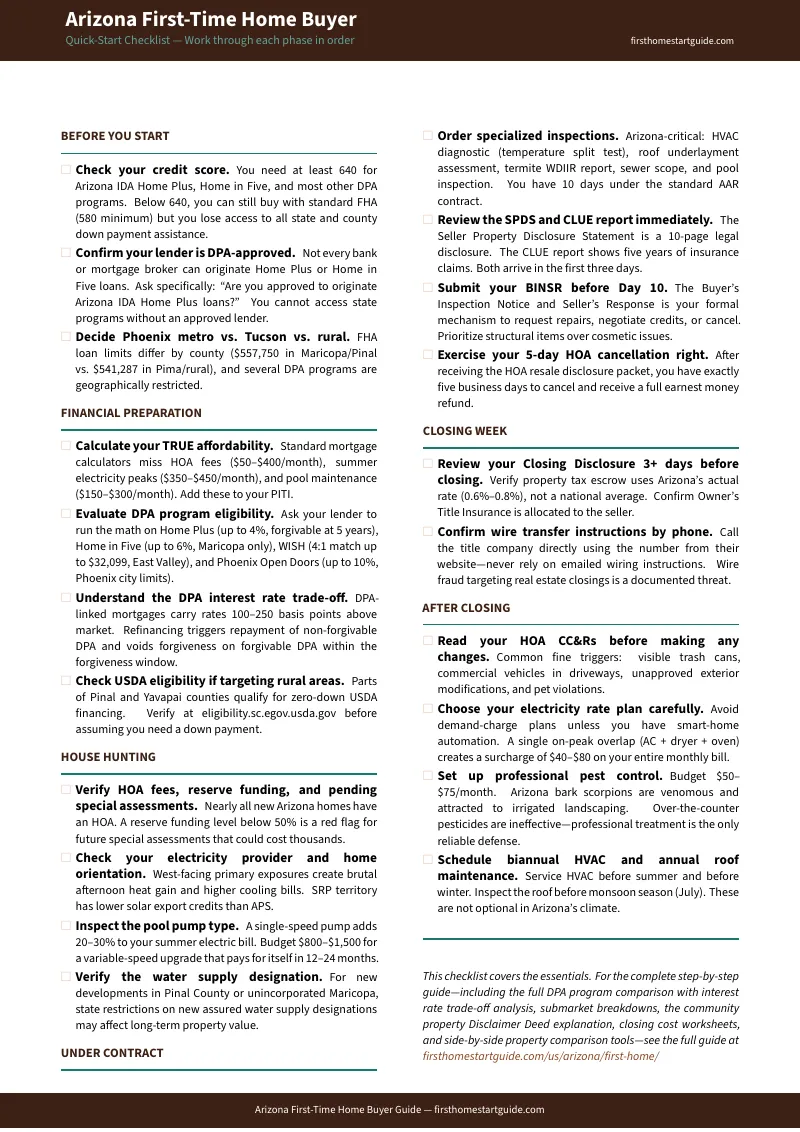
Download the free Arizona Quick-Start Checklist to see the step-by-step action plan covering DPA eligibility, HOA evaluation, climate cost estimation, and desert-specific inspections. When you're ready for the full navigation system — complete with program matrices, cost worksheets, HOA forensic tools, and the closing timeline — the complete guide is here.
The desert rewards buyers who do their homework. Make sure you're one of them.