
You Found the House. But the ADFA Down Payment Assistance Isn't a Grant, Centerton Lost USDA Eligibility Last Year, and the Title Company Can't Actually Answer Your Legal Questions.
You found a three-bedroom in Pea Ridge projecting $1,600/month PITI with a USDA zero-down loan. Or a starter in Conway where the Faulkner County schools are top-rated and the commute to Little Rock is 35 minutes. Or a new-build in a Bentonville subdivision where the listing agent says $475,000 is "normal for NWA now" and you're wondering how a state everyone calls cheap got this expensive. You ran the numbers. You got pre-approved. You're ready to make an offer.
Then Arkansas happens. Your lender tells you the ADFA Down Payment Assistance is "basically free money" -- but it's actually a repayable second mortgage amortized over 10 years at the same interest rate as your primary loan, adding a permanent monthly payment that reduces how much house you qualify for. You target a subdivision in Centerton because your colleague bought there with a USDA loan in 2022 -- but Centerton was reclassified as ineligible after the 2020 Census, effective October 2023, and now you need 3.5% down for FHA instead of zero. You close on a home in Rogers and your title agent cheerfully walks you through the paperwork -- but when you ask whether the seller's easement language could affect your fence line, the agent says "I can't give legal advice." Because in Arkansas, title companies are strictly prohibited from drafting legal instruments or providing legal counsel under the state's Unauthorized Practice of Law rules. That question requires a licensed attorney at $500 to $1,250.
Here's what no single free resource explains: Arkansas layers a state-funded down payment assistance program that is widely marketed as a grant but is actually a repayable 10-year second mortgage, against a USDA eligibility map that quietly eliminated four of the state's most popular first-time buyer suburbs in 2023, against a dual-speed housing market where Northwest Arkansas median prices top $475,000 while Little Rock medians sit below $240,000, against a title-state closing system where title companies handle routine transactions but are legally barred from answering the legal questions that routinely arise during them, against a Homestead Property Tax Credit worth up to $600 annually that requires a specific filing deadline most buyers miss, against Amendment 79 assessment caps that protect NWA buyers from property tax spikes but only if you file the paperwork, against prepayment penalty protections under Arkansas Code 23-39-513 that give you a built-in refinance shield after 36 months, against tornado geology where limestone bedrock makes basements impossible and storm shelters cost $3,000 to $6,000. Each of these has cost real first-time buyers thousands of dollars because the information existed -- scattered across ADFA program PDFs, USDA eligibility maps, county assessor websites, Arkansas Supreme Court UPL opinions, and Reddit threads from buyers who learned the hard way -- but nobody had assembled it into a single decision system calibrated to how Arkansas actually works.
The Arkansas First-Time Home Buyer Guide is an Arkansas Home Buyer Navigation System -- not a motivational overview of the Natural State lifestyle, but a structured reference that maps every Arkansas-specific program, tax structure, USDA eligibility trap, legal boundary, and regional market dynamic into a process you work through before your earnest money is at risk. It replaces months of cross-referencing ADFA program matrices, USDA boundary maps, county millage rates, UPL case law, and forum posts with a single guide that tells you exactly what to verify, exactly what the numbers should look like, and exactly where deals go wrong in this state.
What's Inside the Arkansas Home Buyer Navigation System
A comprehensive guide, a quick-start checklist, and 8 standalone printable worksheets (10 PDFs) -- covering every stage from pre-approval through post-closing, built specifically for the programs, tax structures, eligibility traps, and regional dynamics that make Arkansas different from every other state:
ADFA Down Payment Assistance Decision Framework
Arkansas's primary assistance programs -- the ADFA StartSmart and Move-Up loans paired with Down Payment Assistance -- are genuinely helpful but widely misunderstood. The guide breaks down the two first mortgage options side by side: StartSmart (below-market rates, first-time buyer requirement, county-specific income limits) versus Move-Up (no first-time buyer requirement, flat $142,000 income cap, available to repeat buyers). It explains the DPA second mortgage in detail -- up to $15,000, repayable over 10 years at the same rate as your first mortgage, no prepayment penalty -- and shows how the monthly payment on that second mortgage affects your DTI and purchasing power. Then it covers the ADDI forgivable grant -- up to $25,000 at 0% interest with zero monthly payments, forgiven over 5 years if you stay in the home -- including the 8-hour HUD counseling requirement, the $500 minimum personal contribution, and the UPCS property inspection that ADFA dispatches at no cost. Plus the municipal programs in Little Rock (up to $10,000 forgiven after 5 years), Fort Smith (up to $5,000 DPA plus $14,999 in principal reduction), Jonesboro ($5,000 forgiven after 3 years), and Pine Bluff ($7,500 with recapture). The guide shows you how to stack these programs to get into a home with as little as $500 out of pocket.
The USDA Eligibility Trap -- Centerton, Cabot, Bryant
The single most common financing mistake first-time buyers make in Arkansas. After the 2020 Census, the USDA reclassified Centerton, Cabot, Bryant, and parts of Van Buren as no longer rural -- effective October 1, 2023. Many agents, marketing materials, and online resources still promote these areas as USDA-eligible. They are not. If you put an offer on a Centerton home expecting a zero-down USDA loan, you will scramble for FHA financing at 3.5% down late in the transaction. The guide maps every surviving USDA-eligible suburb near NWA employment centers -- Pea Ridge, Bella Vista, Prairie Grove, Elkins, Lowell -- and near Little Rock -- Greenbrier, Vilonia, Mayflower -- with median prices, distances to employment, and the income limits that apply ($119,850 for a 1-4 person household in most counties). It tells you to verify eligibility on the official USDA map before you make an offer, not after.
Northwest Arkansas vs. Central Arkansas Market Analysis
Arkansas operates as two fundamentally different housing markets. In Northwest Arkansas, Walmart, Tyson, and J.B. Hunt have driven median home prices in Bentonville to $475,000-$501,000 and Fayetteville to $371,000. Homes sell in 33-47 days at 98% of list price. Starter home inventory under $250,000 has been virtually eliminated by builders pivoting to luxury construction and investors converting older homes to rentals. In Central Arkansas, Little Rock metro medians sit between $185,000 and $240,000. Properties stay on market 40-58 days. Buyer negotiations are routine. The guide covers both markets in detail -- plus Jonesboro, Hot Springs, and rural Arkansas -- so you understand the competitive dynamics, negotiation leverage, and financing strategy for your specific target area.
Arkansas Property Tax Mechanics and the Homestead Credit
Arkansas property taxes use a 20% assessment ratio -- a $200,000 home has an assessed value of $40,000. Millage rates vary across 75 counties, with effective tax rates ranging from 0.49% in Washington County to 0.81% in Pulaski County. The guide includes the calculation formula, county-by-county rate comparisons for major markets, and worked examples. It covers the Homestead Property Tax Credit -- up to $600 off your annual tax bill starting in 2026, filed at your county assessor's office by October 15. And it explains Amendment 79's assessment caps: your homestead assessment cannot increase more than 5% per year regardless of market appreciation, protecting NWA buyers from the property tax spikes that would otherwise follow the region's rapid home value growth. The guide tells you exactly how to file for both protections before the deadline.
Legal Boundaries at the Closing Table
Arkansas is a Title State -- title companies handle routine closings without an attorney present. But the Arkansas Supreme Court enforces strict Unauthorized Practice of Law rules. Title agents cannot draft deeds, promissory notes, or mortgages. They cannot provide legal advice. They can only fill in pre-approved standardized forms. If your transaction involves easements, title defects, complex vesting, seller financing, or non-standard addenda, you need a licensed Arkansas real estate attorney ($500 to $1,250). The guide covers the specific UPL boundaries, explains dower and curtesy rights (your married spouse has an automatic interest in your property even if they're not on the title), and walks through the closing timeline from contract to recording.
Prepayment Penalty Protection -- Your Built-In Refinance Shield
Under Arkansas Code 23-39-513, prepayment penalties are completely prohibited after 36 months. During the first three years, penalties are capped on a declining scale -- 3% in year one, 2% in year two, 1% in year three. This means if you buy during a high-interest-rate environment, you have a statutory right to refinance after three years with zero penalty. FHA, VA, and USDA loans prohibit prepayment penalties entirely under federal law. The guide explains how this protection works and how to plan your refinance timeline around it.
Tornado Preparedness and Storm Shelter Planning
Arkansas sits in Dixie Alley. Most homes lack basements because the state's shallow limestone bedrock makes excavation prohibitively expensive ($30,000-$50,000). Storm shelters -- in-ground steel or fiberglass ($3,000-$6,000) or above-ground safe rooms ($6,000-$12,000) -- are a practical necessity. The guide covers shelter types and costs, explains why municipal tornado sirens are outdoor-only and will not wake you, and details the warning system you actually need (NOAA weather radio plus smartphone alerts). It also covers insurance considerations -- separate wind/hail deductibles, flood insurance requirements, and earthquake endorsements for the New Madrid Seismic Zone.
Builder Quality and New Construction
If you're buying new construction in NWA, the guide covers the builder quality landscape -- including the consistent criticism of specific regional production builders for construction quality and communication -- and gives you a verification protocol: visit completed homes, talk to recent buyers, check the Arkansas Contractors Licensing Board, and get an independent inspection even on new construction. It explains the warranty structure (1-year workmanship, 2-year systems, 10-year structural) and what Arkansas common law does and does not guarantee about implied habitability.
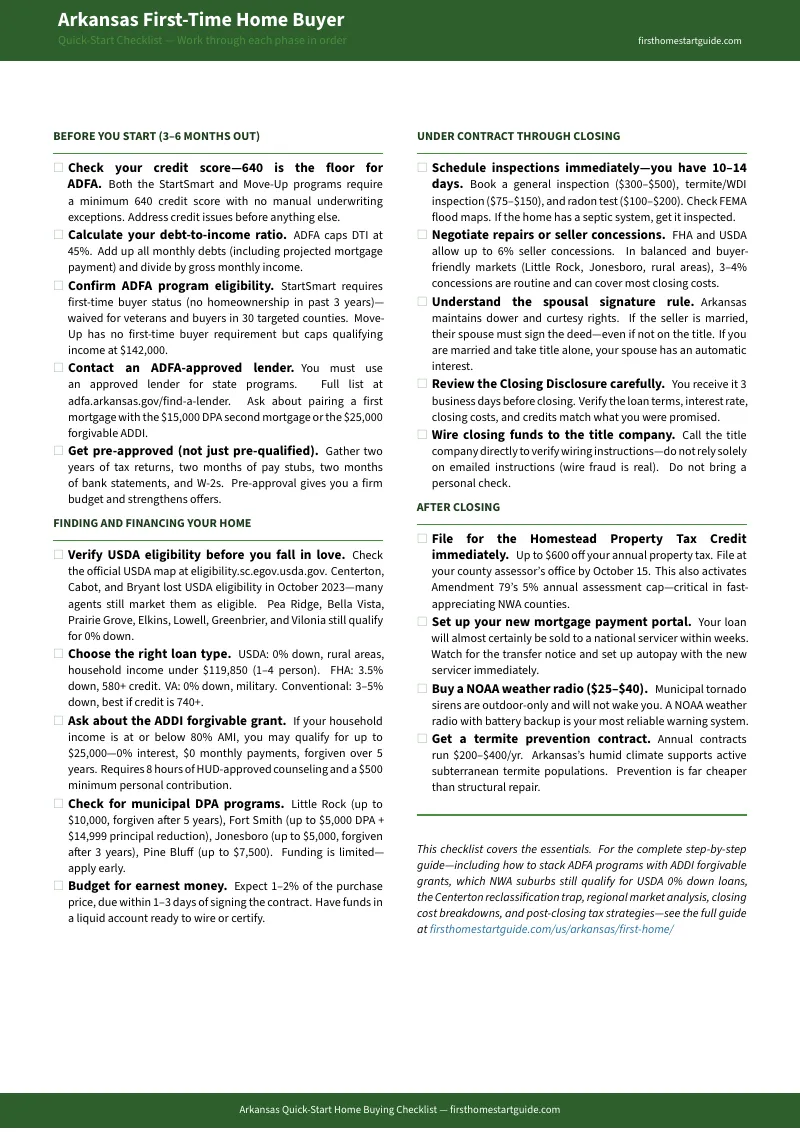
Quick-Start Checklist
A structured checklist covering four phases -- before you start, finding and financing, under contract through closing, and after closing -- with the specific Arkansas deadlines, program requirements, and verification steps you need at each stage. Print it and check items off as you go.
8 Standalone Printable Worksheets
Print these and bring them to your lender meeting, home inspection, or closing table:
- ADFA Program Comparison -- StartSmart vs. Move-Up side by side, DPA second mortgage mechanics, ADDI forgivable grant details, and program stacking strategy
- USDA Eligibility Reference -- Ineligible suburbs (Centerton, Cabot, Bryant) and every surviving USDA-eligible suburb near NWA and Little Rock with median prices and commute distances
- Closing Cost Calculator -- Fillable worksheet for estimating your Arkansas-specific closing costs including transfer tax, recording fees, title insurance, and seller concession limits by loan type
- Inspection Checklist -- Room-by-room walkthrough checklist with Arkansas-specific items: termite/WDI inspection, radon test, septic check, FEMA flood map verification, and storm shelter assessment
- Homestead Credit Guide -- One-page reference for the $600/year tax credit, October 15 filing deadline, Amendment 79 assessment caps, and county tax rates
- Tornado Preparedness -- Storm shelter options and costs, NOAA weather radio setup, insurance considerations, and termite prevention
- Regional Market Comparison -- NWA vs. Little Rock vs. Jonesboro vs. rural Arkansas at a glance with prices, days on market, USDA eligibility, and negotiation dynamics
- Municipal DPA Reference -- Little Rock, Fort Smith, Jonesboro, and Pine Bluff programs compared with eligibility, amounts, and forgiveness terms
Who This Guide Is For
This guide is for first-time home buyers in Arkansas who:
- Are relocating to Northwest Arkansas for a corporate role with Walmart, Tyson, J.B. Hunt, or their supplier network -- and need to understand why "affordable Arkansas" now means $475,000 medians in Bentonville, which suburbs still qualify for USDA zero-down loans, and how to navigate a competitive market where starter homes under $250,000 are scarce
- Are renting in Fayetteville or Rogers and watching their rent climb toward mortgage-payment territory -- and need to know whether buying makes financial sense right now, how to pair ADFA programs with ADDI forgivable grants to get in with as little as $500 out of pocket, and which nearby towns offer more house for the money
- Are buying in Little Rock or Central Arkansas as a public-sector employee, healthcare worker, or military veteran near Little Rock Air Force Base -- and want the balanced-market strategies, VA loan parameters, seller concession tactics, and USDA-eligible bedroom communities that make this region one of the most accessible first-time buyer markets in the country
- Are a first-generation buyer in rural Arkansas navigating FHA or USDA financing for the first time -- and need to understand the property condition requirements that can derail your loan, the down payment assistance programs that can cover your entire cash-to-close, and the post-closing tax protections that keep your costs predictable for years
- Want every Arkansas-specific program, tax structure, USDA eligibility trap, legal boundary, and closing cost in one reference -- instead of assembling it from ADFA program sheets, USDA eligibility maps, county assessor websites, Arkansas Supreme Court UPL opinions, and Reddit threads designed to vent frustration, not structure a transaction
Why Not Free Tools and Forums?
Free information on buying a home in Arkansas exists. Here's what it actually delivers:
- ADFA's website publishes program guidelines and interest rate sheets. It doesn't explain why the DPA is a repayable second mortgage (not a grant), doesn't show how the monthly payment on that second mortgage affects your DTI and purchasing power, and doesn't compare the stacking strategy with ADDI to show you can get in with $500 out of pocket. You get the program specs without the decision framework.
- Zillow and Realtor.com show estimated monthly payments using national-average tax rates. Arkansas's 20% assessment ratio and county-specific millage rates make those estimates unreliable. No listing platform shows which suburbs lost USDA eligibility in 2023, which ones still qualify, or whether the property in the listing meets federal condition standards for government-backed loans. You get a number that looks affordable and may not be.
- Real estate agent blogs highlight affordability, quality of life, and Crystal Bridges. They don't explain the UPL boundaries that prevent your title agent from answering legal questions at closing, don't mention that your mortgage will be sold to a national servicer within weeks, and never cover the builder quality issues that NWA buyer communities discuss in detail. The content generates leads. It doesn't identify reasons to slow down.
- Reddit threads (r/NorthwestArkansas, r/Fayetteville) contain genuine buyer experiences -- builder horror stories, lender comparisons, sticker shock from coastal transplants. But advice from 2022 doesn't reflect the Centerton USDA reclassification, current ADFA income limits, or the 2026 Homestead Credit increase to $600. Sorting current from outdated takes longer than reading a guide that has already done it.
This guide fills the Arkansas-specific gap -- the space between knowing how to buy a house in general and knowing how to buy one in a state where down payment assistance is a repayable loan (not a grant), where the most popular USDA suburbs were quietly delisted, where your title agent cannot answer the legal questions that will come up at closing, where property taxes use a 20% assessment ratio that makes national calculators wrong, and where limestone bedrock means you need a storm shelter budget instead of a basement. It's the analysis that would take an ADFA-approved lender, an Arkansas real estate attorney, and a regional market analyst to assemble -- structured as a reference you own permanently.
-- Less Than One Hour With a Real Estate Attorney
An Arkansas real estate attorney charges $500 to $1,250 for a closing review. A storm shelter installation runs $3,000 to $6,000. Choosing the wrong ADFA program or missing the ADDI forgivable grant can mean paying $15,000 out of pocket that you could have received at 0% interest with zero monthly payments. Making an offer in Centerton with a USDA pre-approval means scrambling for FHA financing and coming up with 3.5% down payment you hadn't budgeted. Missing the October 15 Homestead Credit filing deadline means losing $600 in annual tax relief and Amendment 79's 5% assessment cap.
This guide doesn't replace your real estate agent or your lender. But it gives you the ADFA program analysis, USDA eligibility map, closing cost breakdown, property tax calculations, legal boundary guidance, and storm preparedness protocol that ensure you identify every Arkansas-specific risk before your earnest money is committed -- instead of discovering them on your first tax bill, your first servicing transfer notice, or your first conversation with a title agent who can't answer your question.
If it catches a single ADFA repayment surprise, prevents a single USDA eligibility mistake, or saves you from missing $25,000 in forgivable assistance you qualified for, it pays for itself before you've finished reading it.
Money-back guarantee, no time limit. If the guide doesn't sharpen your decision-making and protect your investment in Arkansas's unique real estate landscape, you pay nothing.
Download the free Arkansas Quick-Start Home Buying Checklist to see the action plan covering pre-qualification, house hunting, offer strategy, closing preparation, and post-closing protection. When you're ready for the full ADFA decision framework, USDA eligibility map, regional market analysis, closing cost calculator, and post-closing tax strategy, the complete guide is here.
The house looks perfect on Zillow. This guide tells you whether Arkansas agrees.