
The Yields Are Real. The Regulatory Traps Are Invisible.
You found a Fayetteville fourplex near the University of Arkansas delivering 8% gross yield backed by 27,000 students competing for off-campus housing every year. Or a Bentonville SFR at $425,000 where 1,280 Walmart supplier offices within a 27-mile radius create a captive demographic of high-income corporate tenants with excellent credit. Or a Hot Springs cabin pulling $275/night ADR in a market with 2,440 active vacation rentals and strong year-over-year revenue growth. The spreadsheet works. The cap rate clears your threshold. You're ready to wire earnest money.
Then you run the real numbers. You discover that Arkansas taxes your rental income at up to 3.9% regardless of where you live — and if you're from Texas, Florida, or Tennessee, that state income tax bill is a surprise you didn't model. You plan to charge a $5,000 security deposit on a premium rental — but once you own six units or hire a property manager, the statutory cap kicks in at two months' rent. You buy a rural property at auction from the Commissioner of State Lands for a fraction of market value — but the Limited Warranty Deed doesn't extinguish federal tax liens, no title company will insure it, and clearing the title requires a Quiet Title Action that costs $4,500+ and takes 6 to 12 months. You renovate a Little Rock duplex to force appreciation — but your $30,000 rehab exceeded 25% of the property's base value, stripping Amendment 79's assessment cap and triggering an immediate reassessment at full post-renovation value. Your property tax bill doubles in one year.
Here's what no single resource explains: Arkansas layers a criminal failure-to-vacate statute that exists nowhere else in the nation but has been ruled unconstitutional in multiple circuit courts, a security deposit exemption that evaporates the moment your portfolio crosses six units, a non-resident income tax that catches investors from no-tax states off guard through automatic IRS-to-state flagging, an Amendment 79 property tax cap that disappears entirely when renovations exceed 25% of base value, a Hot Springs STR licensing cap of 400 residential permits with no waitlist and no exceptions, and a Commissioner of State Lands auction system that delivers properties at extreme discounts but with title defects that take months and thousands of dollars to resolve — into an operating environment that rewards investors who understand Arkansas-specific law and punishes everyone who assumes generic real estate rules apply. Every one of these has cost real investors five figures because the information existed — scattered across Arkansas Code annotated sections, BiggerPockets forum debates, county assessor notices, and municipal zoning ordinances — but nobody had assembled it into a single investment framework.
The Arkansas Investment Property Guide is a Regulatory Arbitrage System — not a motivational overview of Southern real estate investing, but a structured due diligence framework that maps every Arkansas-specific tax advantage, landlord-tenant statute, licensing requirement, and submarket opportunity into a process you work through before you wire earnest money. It replaces months of cross-referencing the Arkansas Real Estate Commission, county assessor databases, DFA nonresident tax forms, Hot Springs zoning maps, and university enrollment reports with a single reference that tells you exactly what the numbers should look like, exactly what the legal requirements are, and exactly where deals go wrong when generic assumptions meet Arkansas law.
What's Inside the Regulatory Arbitrage System
A 13-chapter guide, a quick-start checklist, and 7 standalone printable tools — covering every stage from submarket selection through exit strategy, built specifically for the regulatory quirks and micro-market dynamics that make Arkansas a fundamentally different investment jurisdiction:
Five Submarket Deep-Dives with Real Numbers
Arkansas is not one market — it is five distinct markets with radically different risk-return profiles. Northwest Arkansas (Bentonville, Rogers, Fayetteville, Springdale) delivers appreciation and corporate rentals backed by Fortune 500 headquarters and 1,280 supplier offices, with multifamily occupancy at 94.7% and effective rents at $1,177. Fayetteville produces higher cap rates through the student housing deficit — 42,507 enrolled students against 6,300 on-campus beds, with pre-leasing hitting 97.2% a full year before the academic term. Little Rock offers recession-resistant yields at median prices of $274,950, anchored by state government and UAMS healthcare. Hot Springs drives STR revenue at $275/night ADR but imposes a hard 400-license residential cap. Rural corridors along the Buffalo National River deliver 10.5% gross yields but crater to $1,825/month revenue in winter. The guide maps each submarket's price points, vacancy rates, demand drivers, and the specific strategy that works there.
The Pro-Landlord Framework: Evictions, Deposits, and Habitability
Arkansas is among the most landlord-friendly states in the country — but not in the way most out-of-state investors assume. Civil eviction via unlawful detainer takes 3 to 4 weeks from notice to lockout, with no obligation to let the tenant cure the default. The criminal failure-to-vacate statute (Ark. Code § 18-16-101) technically makes nonpayment a misdemeanor — but multiple circuit courts have declared it unconstitutional, and most prosecutors refuse to prosecute. Professional operators rely exclusively on the civil path. The security deposit cap of two months' rent only applies once you own six or more units or use a property manager — below that threshold, there is no cap. Tenants cannot withhold rent or use repair-and-deduct strategies. The guide walks through both eviction pathways with exact timelines, day counts, filing fees, and the specific evidence each requires — plus the legal risks of the criminal route that forums rarely mention.
The Non-Resident Tax Trap: AR1000NR and Automatic Flagging
Investors from no-income-tax states discover too late that Arkansas taxes all rental income earned within its borders regardless of residence. Non-residents must file Form AR1000NR with Schedule AR4, reporting Arkansas-sourced rental and business income at rates up to 3.9%. If the IRS discovers unreported Arkansas-sourced income during a federal audit, the EOAD system automatically flags the discrepancy with the Arkansas Department of Finance and Administration. The guide provides the complete rate table, filing requirements, and the 50% long-term capital gains exclusion that drops the effective state tax on property sales held over one year to just 1.85% — the single most powerful tax advantage Arkansas offers investors.
Amendment 79: The Property Tax Cap That Disappears
Property taxes in Arkansas are calculated on only 20% of appraised market value, multiplied by local millage rates ranging from 46.8 mills (Benton County) to 58.4 mills (Pulaski County). Amendment 79 of the Arkansas Constitution caps annual assessment increases at 10% for investment properties. This sounds like permanent protection — until your renovation exceeds 25% of the property's base value. At that point, the cap vanishes entirely, and the county reassesses at full post-renovation value with no limit. A $25,000 rehab on an $80,000 property can trigger immediate reassessment to $140,000+. The guide shows you exactly how to model this threshold, phase improvements across assessment cycles, and structure rehab budgets to preserve cap protection.
Hot Springs STR: The 400-License Wall
The broader Hot Springs market has 2,440 active vacation rental properties generating strong revenue. But the City of Hot Springs enforces a hard cap of 400 STR licenses in residential zones — and that cap has been met in full. There is no waitlist. Buying a residential property and planning to operate it as a vacation rental means buying a property you cannot legally license. The only path for new STR investors is acquiring properties in non-residential zones (C-TR, CN, CMU, CG, CBD, IL, IH, IMU), which are entirely exempt from the cap. The guide covers the complete zoning map, the licensing process, the annual fee structure ($50 per authorized bed, $200 minimum), and the four-layer tax stack (state sales 6.5% + tourism 2% + STR 1% + local lodging tax) that totals 12.5% on all gross booking receipts in Hot Springs.
Student Housing Investment: The 27,000-Student Deficit
The University of Arkansas enrollment hit 42,507 students with only 6,300 on-campus beds. Purpose-built complexes (Atmosphere, Locale, The Cottages on Hollywood, Alight) achieve 97.2% pre-leasing a full year before the academic term. For private investors and parent-buyers, the guide covers the guarantor qualification structure (income verification, SSN, credit check), alternative pathways (Guarantor Waiver Programs, self-qualification at 3x rent, lease prepayment), the pre-leasing calendar you must follow, and the Fayetteville property management firms that specialize in student housing operations.
Distressed Assets: Foreclosures, Tax Sales, and Heirs' Property
Arkansas's non-judicial foreclosure process takes approximately 120 days from initiation to auction, creating a predictable pipeline for investors monitoring county records. Commissioner of State Lands tax sales offer properties at fractions of market value — but with a 10-business-day redemption window, a 90-day litigation challenge period, and title defects that require a Quiet Title Action ($4,500+, 6-12 months) before you can refinance or resell. Rural Arkansas has a high prevalence of heirs' property — land fragmented among dozens of relatives with no clear title. The guide covers the Uniform Partition of Heirs Property Act, the adverse possession threshold (7 years of open occupation plus tax payments), and the specific legal mechanics required to consolidate fractional ownership into a clear deed.
Closing Mechanics, LLC Formation, and 1031 Exchanges
Arkansas is a title company state — attorneys are not required for residential closings. Buyer closing costs average just 0.84% to 1.24% of purchase price, among the lowest in the nation. There is no mortgage recording tax. The transfer tax of $3.30 per $1,000 is customarily paid by the seller, and transfers into a newly formed LLC are exempt. The guide covers the complete closing cost table for both buyers and sellers, LLC formation (no franchise tax, $150 annual filing fee), the 1031 exchange process with Arkansas-specific advantages, and the insurance stack every investor should carry.
Standalone Printable Tools (included with the full guide)
- Investment Due Diligence Worksheet — 6-stage checklist covering title, inspection, environmental, zoning, financial underwriting, and legal structure. Fill in per property before making an offer.
- Amendment 79 Rehab Calculator — Model the 25% substantial improvement threshold, project post-renovation assessments, and calculate the property tax impact before committing renovation capital.
- Arkansas Submarket Comparison — Side-by-side data for all five investment zones: NWA, Fayetteville, Little Rock, Hot Springs, and rural corridors. Median prices, cap rates, vacancy, demand drivers, and the specific strategy for each.
- Eviction Timeline — Step-by-step civil unlawful detainer process with day counts, filing fees, and the criminal pathway warning.
- STR Tax Calculator — Four-layer tax stack worksheet for short-term rental operators, plus Hot Springs licensing rules and rural seasonality data.
- Closing Costs Worksheet — Fillable buyer and seller cost tables with Arkansas-specific rates, the LLC transfer exemption, and transaction summary.
- Arkansas Investor Statute Reference Card — All key statutes and tax rates on a single page. Keep at your desk for quick reference.
Who This Guide Is For
This guide is for real estate investors targeting the Arkansas market who:
- Are an out-of-state investor attracted to Arkansas's landlord-friendly reputation and need to understand the complete regulatory framework before deploying capital — the AR1000NR non-resident tax, the security deposit threshold that shifts at six units, the dual eviction pathways and their legal risks, the Amendment 79 rehab trap, and the closing mechanics of a title company state
- Are a Northwest Arkansas resident sitting on home equity from the 2020-2023 appreciation cycle and want to recycle that equity into rental properties — but need to know whether the market is normalizing or peaking, which NWA corridors still produce acceptable cap rates, and how to underwrite deals when median prices in Bentonville have hit $573,800
- Are a parent of a University of Arkansas student spending $12,000+/year on off-campus rent and want to explore buying a property near campus — but need the guarantor structures, pre-leasing timeline, management options, and financial model to determine whether ownership pencils out over a four-year academic horizon
- Are targeting Hot Springs short-term rentals and need to verify zoning eligibility before making an offer — because buying a residential property in a market where all 400 STR licenses are taken means buying a property you cannot legally operate
- Are a value-add investor hunting distressed assets through tax sales, foreclosures, or heirs' property acquisitions and need the quiet title process, UPHPA partition mechanics, and Amendment 79 exposure modelled before you commit renovation capital
- Are comparing Arkansas yields to other landlord-friendly states and need the tax-adjusted analysis — because the 3.9% non-resident income tax, the Amendment 79 rehab threshold, and the four-layer STR tax stack can each independently change whether a deal creates wealth or destroys it
Why Not Free Tools and Forums?
Free information on Arkansas real estate investment exists across dozens of sources. Here's what it actually delivers:
- Arkansas Real Estate Commission and state government sites provide regulatory requirements in dense bureaucratic language — licensing rules, statutory text, and administrative forms. They tell you what Form AR1000NR is, not how to model the tax hit against your pro forma. They explain the eviction statute exists, not that multiple circuit courts have ruled it unconstitutional. An investor must already know exactly what they're looking for to find the right page, and a first-time Arkansas investor will miss the interplay between Amendment 79, contractor licensing thresholds, and COSL title defects entirely.
- BiggerPockets and Reddit forums are where out-of-state investors debate whether NWA is still a good market, local operators share anecdotal cap rates, and everyone argues about self-management vs. property management. Experience reports from 2022 sit alongside questions from 2026 — and the regulatory environment has changed. Tax threads reference "no state income tax" without clarifying that this applies to residents of other states, not to income earned in Arkansas. Someone posts that there's "no security deposit cap" without mentioning the six-unit threshold. Sorting current from obsolete, accurate from incomplete, takes longer than reading a guide that has already done it.
- National real estate investing courses teach cap rate analysis, BRRRR mechanics, and portfolio scaling that assume standardized legal environments. They don't cover Arkansas's criminal eviction anomaly, the Amendment 79 substantial improvement trap, the COSL auction system and its 90-day litigation window, the Hot Springs 400-license residential cap, or the UPHPA partition process for heirs' property. Applying generic frameworks to Arkansas-specific regulatory friction is how investors lose five figures on their first deal.
- Local real estate agents and property managers know their submarkets intimately but cover one piece of the puzzle — market pricing, not tax strategy; tenant placement, not title law; listing data, not foreclosure mechanics. No single local professional has the cross-disciplinary view that spans landlord-tenant law, non-resident taxation, STR zoning, contractor licensing, distressed asset acquisition, and student housing operations.
This guide fills the Arkansas-specific gap — the space between knowing how to analyse a rental property in general and knowing how to underwrite one in a jurisdiction where a 3.9% non-resident income tax, an Amendment 79 property tax cap that disappears on rehabs over 25% of base value, a 400-license STR cap with no waitlist, a criminal eviction statute that prosecutors won't touch, a COSL auction system that delivers properties without insurable title, and a 27,000-student housing deficit that fills 97% of units a year before move-in can each independently determine whether a deal creates wealth or destroys it. It's the analysis that would take an Arkansas real estate attorney, a CPA with non-resident state tax expertise, a Fayetteville property manager, and a Hot Springs zoning consultant to assemble — structured as a reference you own permanently.
— Less Than One Tax Miscalculation
A single acquisition modelled without the AR1000NR non-resident income tax understates your annual cost by hundreds to thousands of dollars for every year you hold the property. A rehab that unknowingly crosses the Amendment 79 substantial improvement threshold can double your property tax bill in a single reassessment. A Hot Springs residential purchase made without verifying zoning produces a property you cannot legally license as an STR — and the cap has no waitlist, no timeline for reopening. A COSL tax sale property purchased without budgeting for a Quiet Title Action locks your capital for 6 to 12 months before you can refinance or sell. A student housing lease signed without guarantor structures exposes you to the primary default risk that Fayetteville landlords eliminated years ago.
This guide doesn't replace your Arkansas real estate attorney, your CPA, or your property manager. But it gives you the submarket data, tax modelling, eviction pathways, STR zoning rules, contractor licensing thresholds, distressed asset mechanics, and student housing operations framework that ensure you identify every Arkansas-specific risk and opportunity before you're contractually committed — instead of discovering them on your first AR1000NR filing, your first reassessment notice, or your first licensing rejection.
If it catches a single Amendment 79 miscalculation, prevents a single unlicensable STR purchase, or surfaces the non-resident tax obligation before the IRS does, it pays for itself before you've finished reading it.
Money-back guarantee, no time limit. If the guide doesn't sharpen your underwriting and protect your capital in Arkansas's regulatory environment, you pay nothing.
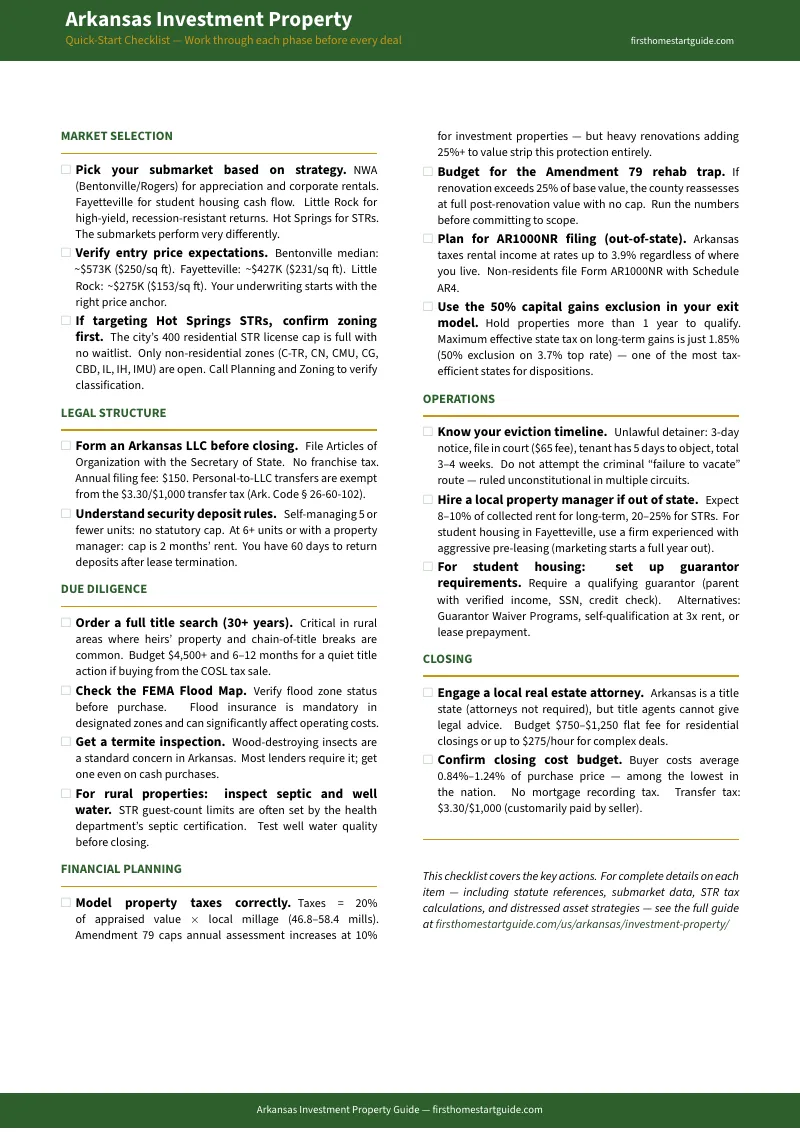
Download the free Arkansas Quick-Start Home Buying Checklist to see the due diligence framework covering submarket selection, zoning verification, tax modelling, and legal structuring. When you're ready for the full 13-chapter guide with submarket deep-dives, eviction pathways, STR licensing analysis, and distressed asset mechanics, the complete guide is here.
The yields are real. This guide tells you which ones survive Arkansas law.