
You Earn $250,000 a Year and You Still Cannot Figure Out How to Buy a Home in California
You have read the CalHFA website. You have scrolled through Reddit threads where Bay Area tech workers earning $300,000 debate whether they can afford a $1.2 million townhouse. You may have seen the post about a buyer who thought they had secured both Dream For All and MyHome assistance — only to watch their financing collapse during final underwriting because CalHFA prohibits that specific combination. Or the thread about someone who lost their $25,000 deposit because they assumed their inspection contingency expired automatically on day 17, not realizing that California requires them to actively sign a removal form — and that not signing it was the one thing protecting their money.
The problem is not a lack of information. CalHFA publishes income limits. The California Association of Realtors publishes contract guides. CalFire publishes fire hazard zone maps. But no single resource explains how a $250,000 household income qualifies for state down payment assistance in San Francisco but not in Fresno, how to layer a CalHFA first mortgage with a $500,000 San Francisco DALP grant without triggering a stacking conflict, how to check whether a property is insurable on the private market before you pay for an appraisal and enter escrow, or why a $1,000-per-month insurance surprise in a fire zone kills your loan approval by blowing past your debt-to-income ratio.
The California First-Time Home Buyer Guide is a California Transaction Navigation System — a single structured reference that maps every CalHFA program, every local DPA opportunity, every contractual trap, every tax calculation, and every insurance hazard into a step-by-step process you work through before you sign a contract. It replaces months of cross-referencing government portals, forum panic threads, and generic national advice with a reference that tells you exactly what you qualify for, exactly what you will pay, and exactly where California-specific transactions fall apart.
What's Inside the California Transaction Navigation System
A comprehensive 12-chapter guide, a quick-start checklist, and standalone worksheets and reference cards — covering every stage from calculating your true California affordability through to collecting your keys, built specifically for the programs, hazards, and legal frameworks that make buying in California different from every other state:
CalHFA Programs and the Stacking Trap That Kills Deals
The California Housing Finance Agency offers the most powerful down payment assistance programs in the country — MyHome (up to 3.5% of the purchase price as a deferred second mortgage), CalPLUS with ZIP (below-market first mortgage plus a zero-interest closing cost loan), and Dream For All (up to 20% of the purchase price, capped at $150,000, as a shared appreciation loan). But the eligibility matrices are baffling. CalHFA income limits stretch to $325,000 in Bay Area counties, yet most qualifying buyers self-disqualify because they assume state assistance is for low-income households. And the stacking rules are lethal: MyHome cannot be combined with a Dream For All Conventional first mortgage. Buyers who miss this restriction build financing models that collapse during final underwriting. The guide walks through every eligibility rule, every income limit by county, every stacking prohibition, and every combination that actually works — so you know your financing structure is valid before you enter escrow.
DPA Layering Blueprints — The Municipal Programs Nobody Tells You About
While buyers obsess over CalHFA, they massively underestimate the power of city and county down payment assistance. San Francisco's DALP offers up to $500,000. Alameda County's AC Boost provides $160,000 to $210,000 in shared appreciation assistance. Santa Clara County's Empower Homebuyers SCC covers up to 17% of the purchase price. San Mateo County's HEART provides up to $182,025 as a 15-year second lien. Oakland's MAP offers up to $75,000. San Diego's city program combines a $40,000 deferred loan with a $10,000 closing cost grant. The guide maps every major local program, shows you which ones can legally layer on top of CalHFA first mortgages, and walks through specific stacking combinations — because the difference between a buyer who uses only CalHFA and a buyer who layers CalHFA with a local DPA program can be $100,000 or more in upfront assistance.
Active Contingency Removal — The California Contractual Trap
In 49 states, if your inspection contingency deadline passes and you do nothing, the contingency expires and your deposit is at risk. In California, the opposite is true. Your contingency stays alive until you explicitly sign a Contingency Removal form. This protects you — but it creates a tactical chess match most first-time buyers lose. A panicked buyer signs the CR on day 17 because they fear losing their deposit, then their loan gets denied on day 20 and the deposit is gone. A cautious buyer lets the deadline pass, then ignores the seller's Notice to Buyer to Perform, and the seller cancels the contract within 48 hours. The guide explains the active removal mechanism, the NBP countdown, the liquidated damages clause (which caps deposit forfeiture at 3% of the purchase price), and the exact sequence of decisions that protect both your deposit and your deal.
The Wildfire Insurance Crisis — Check Before You Offer
Major private carriers — State Farm, Allstate, Farmers — have pulled out of large parts of California. Over 590,000 residential properties are now on the California FAIR Plan, the state's insurer of last resort. But the FAIR Plan is fire-only coverage. It does not cover theft, liability, or water damage. You need a separate Difference in Conditions (DIC) wraparound policy to satisfy your mortgage lender. Combined FAIR Plan plus DIC costs run $8,000 to $15,000 per year — compared to $1,800 to $2,800 for a standard policy in a low-risk zone. That $800-to-$1,200 monthly premium destroys your DTI ratio mid-escrow. The guide includes a pre-offer insurance protocol: how to check the CalFire Fire Hazard Severity Zone map, how to contact surplus line brokers before you submit an offer, and how to calculate the true DTI impact of fire-zone insurance so you never discover your dream home is unfinanceable after you have already paid for inspections and an appraisal.
City Transfer Tax Matrices — The Closing Cost Shock
Every California county charges $1.10 per $1,000 in documentary transfer tax. Many cities layer on additional taxes that can add $10,000 to $25,000 to your closing costs. Berkeley charges 1.5% on properties up to $1.7 million and 2.5% above that — a $1.7 million home generates $25,500 in city transfer tax alone. Oakland charges 1.5% for properties between $300,000 and $2 million. San Francisco charges 0.75% for properties between $1 million and $5 million. Los Angeles adds Measure ULA on top of its base 0.45% city tax. The guide includes city-by-city transfer tax tables with worked examples at multiple price points, so you know your exact closing cost exposure before you make an offer — not when the closing disclosure arrives.
Proposition 13, Proposition 19, and the Tax Clock
Proposition 13 caps your property tax base at the purchase price and limits increases to 2% per year — permanently. Every year you delay buying, you miss establishing a lower tax base that compounds in your favor for decades. A homeowner who bought in 1990 for $200,000 might pay $4,000 a year in property tax on a home now worth $1.4 million. You will pay $15,000 to $17,500. Proposition 19 eliminated the old rules that let children inherit investment properties at their parents' low tax base. If you are counting on inheriting a family home or rental property as a wealth-building shortcut, Prop 19 has already closed that door — unless you move into the property as your primary residence within one year and the value stays within the exclusion cap. The guide breaks down both propositions with dollar-for-dollar calculations showing what they mean for your purchase timeline and your family's real estate strategy.
Five Regional Market Strategies
Bay Area buyers competing against all-cash RSU liquidation offers need different strategies than Sacramento buyers navigating the remote-worker price surge, San Diego buyers leveraging VA loans near military bases, LA buyers dodging Measure ULA's ripple effects on inventory, or Central Valley buyers accessing USDA zero-down loans. The guide covers each market's price dynamics, competitive pressure, loan limit differences, and which DPA programs are available — because advice that works in San Jose does not work in Fresno.
Rent-vs-Buy Math at 2026 Interest Rates
At 6% interest rates, a $650,000 Los Angeles purchase looks $1,300 per month more expensive than $3,000 rent — until you factor in the mortgage interest deduction ($640/month tax shield at a 24% bracket), property tax deductions, PMI deductibility, and $550/month in forced equity accumulation. Net effective cost of ownership: $2,926 — less than the rent payment. Break-even horizons range from 4 to 5 years in the Central Valley to 7 to 8 years on the coast. The guide runs these calculations at multiple price points and interest rate scenarios so you can see where the math tips in your favor for your specific market and income.
Mortgage Options, Escrow Process, and Closing Costs
FHA versus Conventional versus VA versus USDA — which loan type works for your situation and your CalHFA program choice. The pre-approval process and why a fully underwritten TBD approval lets you compete with cash offers. The escrow timeline (30 to 45 days in California). Closing cost breakdowns by region — including the north/south customs split on who pays for title insurance, escrow fees, and county transfer tax. Supplemental property tax bills that arrive 2 to 4 months after closing and can run $5,000 to $15,000 on homes with long-held Prop 13 bases. The Homestead Declaration that protects $300,000 to $600,000 of equity from creditor judgments for a $10 to $20 filing fee.
Who This Guide Is For
- Bay Area tech workers earning $200,000 to $350,000 who assume they earn too much for state assistance — and have not checked that CalHFA income limits in their county go up to $325,000
- LA and Orange County buyers navigating variable income (entertainment, freelance, gig economy) who need to understand how project-based earnings affect underwriting and which city boundaries trigger aggressive transfer taxes
- San Diego buyers leveraging VA loans near Camp Pendleton or Naval Base San Diego who want to know how city versus county DPA programs work across the San Diego Housing Commission boundary
- Sacramento remote workers who moved inland to escape coastal prices and now face their own competitive bidding wars from imported coastal capital
- Central Valley buyers in Fresno, Bakersfield, or Stockton who want to explore USDA zero-down financing and need the rent-vs-buy math at sub-$500,000 price points
- Dream For All lottery registrants who need to understand the first-generation homebuyer requirement, the documentation burden, the shared appreciation repayment terms, and what to do if they do not receive a voucher
- Buyers looking at properties in fire-prone areas who need to know how to check insurability before making an offer — not after paying for inspections and an appraisal
- Anyone buying their first home in California who has realized that generic national advice does not cover active contingency removal, CalHFA stacking rules, Proposition 13 lock-in incentives, or the insurance crisis
Why Not Free Resources?
Free information on buying your first home in California exists across dozens of government websites. Here is what it actually delivers:
- CalHFA's website publishes income limits, program descriptions, and approved lender directories. It does not explain the stacking prohibition between MyHome and Dream For All Conventional — the restriction that causes real financing to collapse in underwriting. It does not show you how to layer CalHFA programs with massive local DPA grants. You get the individual program rules without the integration strategy that makes them usable together.
- The California Association of Realtors publishes the RPA contract template and general guides on contingencies. It does not walk through the two specific failure modes of active contingency removal — the panic waiver and the NBP collapse — that cost first-time buyers their deposits. You get the form without the tactical playbook for when to sign it and when to wait.
- CalFire publishes Fire Hazard Severity Zone maps. It does not explain how to translate a FHSZ designation into a monthly insurance cost, how to find a surplus line broker, or how to calculate whether a FAIR Plan plus DIC wraparound will blow your DTI ratio. You get the hazard data without the financial analysis that determines whether you can actually afford to buy there.
- Reddit and real estate forums contain real buyer experiences mixed with outdated program rules, incorrect stacking assumptions, and advice that applies to passive-contingency states. Sorting current California-specific information from dangerous misinformation takes longer than reading a guide that has already done it.
This guide fills the California-specific gap — the space between knowing you want to buy a home and knowing how to navigate a state where six-figure assistance is available but hidden behind eligibility matrices, where contingencies work backward from the rest of the country, where the insurance market is in systemic crisis, and where city-level transfer taxes can add $25,000 to your closing costs without warning.
— Less Than One Home Inspection
A home inspection in California costs $400 to $800. A sewer lateral inspection in EBMUD territory costs $200 to $400, with repairs running $5,000 to $15,000. A supplemental property tax bill on a home with a long-held Prop 13 base can hit $15,000. Combined FAIR Plan and DIC insurance in a fire zone costs $8,000 to $15,000 per year. Losing a $25,000 deposit because you misunderstood active contingency removal costs $25,000. Missing a city transfer tax that adds $10,000 to $25,000 to your closing costs means scrambling for cash at the closing table.
This guide does not replace your real estate attorney or CalHFA-approved lender. But it gives you the DPA stacking blueprints, the insurance pre-check protocol, the contingency removal playbook, the transfer tax matrices, the Prop 13 and Prop 19 calculations, and the regional market strategies that ensure you identify every California-specific risk and opportunity before you sign a contract — not when the underwriter flags a stacking conflict, the insurance quote arrives, or the closing disclosure reveals a five-figure transfer tax you did not budget for.
If it saves you from a single stacking conflict that collapses your financing, a single fire-zone purchase where insurance destroys your DTI, or a single premature contingency removal that forfeits your deposit, it pays for itself before you finish reading it.
Money-back guarantee, no time limit. If the guide does not sharpen your due diligence and protect your deposit in California's real estate market, you pay nothing.
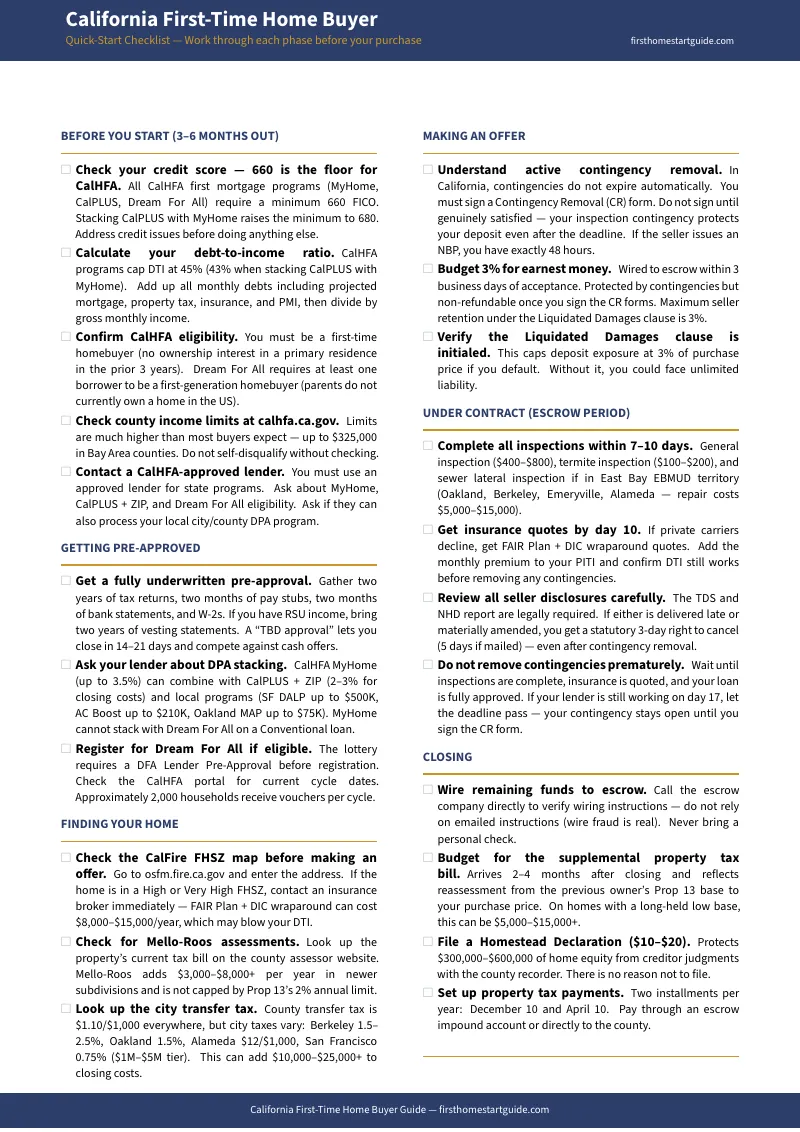
Download the free California Quick-Start Home Buying Checklist to see the step-by-step framework covering CalHFA eligibility, pre-approval, fire zone checks, contingency management, and closing. When you are ready for the full DPA layering blueprints, insurance crisis playbook, transfer tax matrices, and active contingency removal walkthroughs, the complete guide is here.
The assistance is generous. The traps are real. This guide makes sure you claim the first without falling into the second.
Frequently Asked Questions
What if the rules change after I buy?
We update the guide when the rules change. Email us any time, even years later, and we'll send you the current edition free.