
The Cap Rate Looks Great. The Mill Rate, the UST, and the Six-Month Eviction Say Otherwise.
You found a four-unit in Waterbury throwing off 9% gross yield on a $180,000 acquisition. Or a fix-and-flip in Fairfield County where the ARV supports a $65,000 spread. Or a triplex in New Britain where per-unit rents pencil to $4,200 in gross monthly income against a $230,000 purchase price. The numbers work. The cap rate is solid. You're ready to wire earnest money.
Then you run the real numbers. The Waterbury four-unit sits in a town with a 60.29 mill rate applied to 70% of assessed value — not the 2% effective tax rate you modeled from a national calculator. On a $180,000 property, that's $7,597 in annual taxes instead of the $3,600 you budgeted. Your Fairfield County flip has cut copper pipes protruding from the basement wall — the hallmark of an abandoned underground heating oil tank that nobody disclosed. You skipped the $300 GPR sweep to keep your bid competitive, and now DEEP is requiring soil remediation at $38,000 because the tank leaked into the groundwater. The New Britain triplex came with inherited tenants who stopped paying rent the month after closing. You issued a 30-day notice based on forum advice, but Connecticut's eviction process takes five to six months through a backlogged housing court system — and the tenants just got appointed free legal counsel through the state's Right to Counsel program. You're looking at $8,000 in lost rent and $2,000 in legal fees before you regain possession of your own property.
Here's what no single resource explains: Connecticut layers a 169-town municipal governance structure where mill rates range from 11 to 74 mills — creating 40% property tax cliffs between neighboring towns — a 70% assessment ratio that makes national tax calculators useless, a tiered conveyance tax system that charges Targeted Investment Communities an extra 0.25% and proposed legislation (SB 266) that would penalize LLC purchasers with rates nearly triple the individual baseline, underground storage tank regulations bifurcated by DEEP at exactly five residential units with zero state funding for residential remediation, lead paint thresholds dropping to 3.5 micrograms per deciliter in 2025 triggering mandatory epidemiological investigations of rental properties, an eviction timeline that functionally runs five to six months while tenants receive state-funded legal representation, Fair Rent Commissions with binding authority to freeze rent increases in any town over 25,000 population, and Just Cause protections that proposed legislation would expand to all tenants in buildings with five or more units — into a regulatory environment that punishes investors who apply national assumptions to Connecticut-specific problems. Every one of these has cost real investors five to six figures because the information existed — scattered across 169 municipal assessor databases, DEEP environmental bulletins, DPH lead paint mandates, Connecticut General Statutes, and BiggerPockets threads from 2023 — but nobody had assembled it into a single underwriting system.
The Connecticut Investment Property Guide is a Connecticut Municipal Due Diligence System — not a motivational overview of real estate investing, but a structured due diligence framework that maps every Connecticut-specific financial trap, regulatory restriction, and environmental liability into a process you work through before you wire earnest money. It replaces months of cross-referencing 169 municipal mill rate tables, DEEP tank regulations, DPH lead paint mandates, Connecticut General Statutes on eviction and Just Cause, Fair Rent Commission ordinances, and conveyance tax schedules with a single reference that tells you exactly what to verify, exactly what the numbers should look like, and exactly where deals go wrong.
What's Inside the Connecticut Municipal Due Diligence System
An 18-chapter guide with appendices, a quick-start checklist, and standalone printable worksheets — covering every stage from municipal market selection through exit strategies, built specifically for the financial traps and regulatory complexity that make Connecticut different from every other state:
Mill Rate Mechanics and Municipal Property Tax Analysis
Connecticut's 169 municipalities each set their own mill rate, creating extreme tax variation invisible to investors using state-level averages. The guide maps the complete mill rate landscape — from towns under 15 mills to Waterbury's 60.29 and Hartford's 68.95 — and walks through the mandatory 70% assessment ratio that applies statewide. It covers Hartford's unique dual-assessment structure where residential properties (one to three families) are assessed at 36.75% instead of 70%, the revaluation cycle that can spike your tax burden when the town adjusts assessed value to match your purchase price, and the exact math to calculate annual property tax on any Connecticut property: assessed value (70% of appraised FMV) multiplied by mill rate divided by 1,000. On a $250,000 property, the annual tax difference between a 15-mill suburb and a 60-mill urban center is $7,875 — which translates to a $131,250 gap in implied asset valuation at a 6% cap rate.
Conveyance Tax and Closing Cost Engineering
Connecticut's tiered conveyance tax system charges 0.75% on the first $800,000, 1.25% from $800,000 to $2.5 million, and 2.25% above that — paid by the seller but reflected in negotiated purchase prices. The guide covers the municipal conveyance tax that adds 0.25% in most towns but doubles to 0.50% in the 18 Targeted Investment Communities that include every major cash-flow market: Bridgeport, Hartford, New Haven, Waterbury, New Britain, and Meriden. It details proposed SB 266, which would impose 1.75% on the first $800,000 for any purchaser "not an individual" — meaning LLCs, the standard asset protection vehicle for real estate investors — forcing a choice between personal liability exposure and a closing cost penalty that can exceed $10,000 on a single transaction. The guide models the exact breakeven analysis for entity-versus-individual purchasing in each Targeted Investment Community.
Underground Storage Tank Due Diligence Protocol
Connecticut's pre-1978 housing stock means thousands of properties still sit above abandoned heating oil tanks — and DEEP's regulatory framework creates a liability trap that catches investors at the worst possible moment. The guide maps the critical regulatory split: DEEP heavily regulates commercial tanks (five or more residential units) with double-wall mandates, annual fees, and continuous monitoring, but does not regulate residential tanks (one to four units) for installation or removal. This lack of regulation is the trap — DEEP absolutely requires reporting and immediate cleanup of any leakage, with zero state funding for residential remediation. Tank removal runs $1,600 to $3,200 for a clean pull. If the tank leaked, soil remediation escalates to $5,000 to $45,000 or more. A ground-penetrating radar (GPR) sweep costs $250 to $400 and takes one afternoon. The guide provides the step-by-step GPR inspection protocol, explains why DEEP does not issue closure letters for residential cleanups (leaving the liability chain permanently murky), and models the expected remediation cost at each contamination level so you can make the kill-or-proceed decision during due diligence — not after closing.
Lead Paint Compliance and Abatement Cost Modeling
With some of the oldest housing stock in the nation, Connecticut's lead paint liability is not theoretical — it is actuarial. The guide covers the 2025 reduction of the elevated blood lead level (EBLL) threshold from 10 to 3.5 micrograms per deciliter, which dramatically expands the number of routine pediatric visits that trigger mandatory epidemiological investigations of rental properties. It details the cascade from investigation to mandatory abatement order: local health department inspection, hazard identification, remediation timeline, and the $15,000 to $30,000 cost of full abatement that can destroy a flipper's ARV margins. EPA RRP certification requirements for any renovation of pre-1978 properties are covered, including containment protocols, certified contractor requirements, and the penalties for non-compliance. The guide models lead paint risk by property age, unit count, and renovation scope so you can price abatement into your acquisition analysis — not discover it during demolition.
Eviction Process, Timeline, and Financial Impact
Connecticut's statutory eviction timeline suggests four to seven weeks. The practical reality is five to six months through a backlogged housing court system that is heavily weighted against landlords. The guide maps the complete process: formal Notice to Quit (3 to 30 days depending on grounds), state marshal service ($35 to $45), tenant Answer filing (up to 30 days), court hearing and judgment (2 to 3 months due to backlog), and Order for Removal execution. Total financial exposure: $5,000 to $10,000 in lost rent during the holdover period, $175 court filing fee, $1,500 to $2,000 for an eviction attorney, plus the risk of malicious property damage during the extended timeline. The guide covers Connecticut's Right to Counsel expansion that provides tenants with free legal representation to contest evictions, the filing strategies that experienced landlords use to minimize delays, and the tenant screening framework built specifically for Connecticut's risk profile.
Just Cause Protections and Security Deposit Legislation
Current law under C.G.S. 47a-23c mandates Just Cause eviction protections for tenants over 62 or with qualifying disabilities in buildings with five or more units — meaning you cannot evict these tenants simply because a lease expired. Proposed SB 257 would expand this protection to all tenants who have resided in a five-plus unit building for at least twelve months, effectively eliminating the value-add strategy of non-renewing undermarket leases to renovate and re-lease at market rates. The guide covers both existing and proposed protections, the specific statutory causes that still permit eviction, and the underwriting adjustment you must make when acquiring a building with long-tenure tenants in units of five or more. It also covers HB 5257, which would cap security deposits at one month's rent — eliminating the standard two-month deposit that currently serves as the primary financial buffer against tenant damage and delinquency.
Fair Rent Commissions: Connecticut's Municipal Rent Control
Connecticut does not have statewide rent control, but it empowers municipalities to impose localized price controls through Fair Rent Commissions — and any municipality with a population exceeding 25,000 is mandated to establish one. These commissions possess binding authority to investigate tenant complaints and halt, phase in, or deny rent increases deemed "harsh and unconscionable" based on 13 statutory criteria including tenant income, property condition, operating costs, and comparable housing availability. The guide identifies which municipalities have active Fair Rent Commissions, explains the 13-criteria evaluation framework, covers the provision that allows commissions to suspend rent entirely for properties with unresolved code violations, and models the financial impact on value-add strategies where the entire pro forma depends on raising below-market rents after renovation. If your acquisition thesis relies on rapid rent escalation in a municipality with an active commission, this chapter tells you whether that thesis survives scrutiny — before you close.
Entity Structuring, Tax Strategy, and SALT Bypass
Connecticut LLC formation costs $120 plus an $80 annual report — but the real value is in the tax strategy. The guide covers the C.G.S. 12-498 property tax exemption framework, the Pass-Through Entity Tax (PTET) election that allows LLCs and S-corps to pay state income tax at the entity level and claim a federal deduction — effectively bypassing the $10,000 SALT deduction cap for investors in high-tax brackets. It details capital gains treatment (Connecticut taxes capital gains at 6.99% as ordinary income with no preferential rate), 1031 exchange compliance, Form OP-236 filing requirements for nonresident sellers, and FIRPTA withholding obligations for foreign investors. The entity structuring chapter models the after-tax return difference between individual ownership, single-member LLC, multi-member LLC, and S-corp election — accounting for the PTET benefit, the potential SB 266 conveyance tax penalty, and the annual compliance costs.
Six Market Strategies for Connecticut
Connecticut operates as a fragmented market where a single state-level strategy fails. The guide dissects six distinct approaches: (1) Inland multi-family in Targeted Investment Communities — high cap rates in Waterbury, New Britain, and Bridgeport offset against crushing mill rates, high conveyance taxes, and tenant management intensity. (2) Fairfield County fix-and-flip — Greenwich-to-Stamford corridor appreciation plays where environmental due diligence (USTs, lead paint, asbestos) is the primary risk and renovation timelines are the primary cost driver. (3) Coastal short-term rental — seasonal yield optimization in Milford, Madison, and Stratford, navigating the patchwork of municipal STR ordinances and zoning restrictions. (4) Section 8 multi-family — guaranteed rental income through Housing Choice Vouchers, balanced against DPH lead paint inspections, local code enforcement, and the operational demands of voucher compliance. (5) House hacking — owner-occupied multi-family acquisition in Hartford and New Haven counties using FHA or conventional financing, with the owner-occupancy exemption from certain landlord regulations. (6) BRRRR in post-industrial urban centers — the buy-rehab-rent-refinance-repeat cycle where the refinance appraisal must account for Connecticut's 70% assessment ratio and the mill rate impact on comparables.
Due Diligence Toolkit
Printable checklists and worksheets covering the complete Connecticut due diligence process: municipal mill rate verification, conveyance tax calculation by town, UST inspection protocol with GPR scheduling, lead paint risk assessment by property age, DEEP database cross-reference for registered commercial tanks, Connecticut Judicial Branch Case Lookup for tenant screening, Fair Rent Commission status by municipality, and closing cost estimation with attorney fees, title search, and recording costs. Each worksheet is designed to be completed on a specific property during the due diligence window — not as a theoretical exercise.
Who This Guide Is For
This guide is for real estate investors targeting Connecticut markets who:
- Are underwriting a multi-family in Waterbury, Bridgeport, Hartford, or New Haven and need the exact mill rate, the 70% assessment calculation, and the Targeted Investment Community conveyance tax surcharge to determine whether the cap rate survives the actual holding costs — not the generic 2% property tax assumption from a national calculator
- Are evaluating a pre-1978 property for acquisition or flip and need to model the lead paint abatement cost, the EPA RRP certification requirement, and the financial exposure from the 2025 EBLL threshold reduction to 3.5 micrograms per deciliter — before the local health department triggers a mandatory investigation
- Are an out-of-state investor — particularly from New York or Massachusetts — comparing Connecticut yields against your home state and need every municipal-level tax calculation, environmental regulation, and tenant protection mapped in one reference instead of assembling it from 169 town assessor websites, DEEP bulletins, and forum threads that may have been accurate two legislative sessions ago
- Are acquiring a property with existing tenants and need to understand the practical five-to-six-month eviction timeline, the Just Cause protections under C.G.S. 47a-23c, the Right to Counsel expansion, and the Fair Rent Commission's authority to freeze your planned rent increases — before you model rental income based on market-rate assumptions
- Are pursuing a BRRRR or value-add strategy and need to know whether proposed SB 257 (Just Cause expansion) and HB 5257 (security deposit cap) will eliminate your ability to non-renew undermarket leases and use two-month deposits as a financial buffer against tenant risk
- Have a property under contract and just discovered cut copper pipes in the basement, and need immediate clarity on DEEP's residential UST regulations, GPR sweep protocols, remediation cost ranges, and the liability chain for residential tank cleanups that DEEP refuses to close with a formal closure letter
Why Not Free Tools and Forums?
Free information on Connecticut real estate investing exists across dozens of sources. Here's what it actually delivers:
- BiggerPockets forums are where someone in a 2023 thread asks about cap rates in Waterbury, gets a response warning about high taxes and difficult tenants, and nobody quantifies whether the deal actually works after applying the 70% assessment ratio to a 60-mill-rate town. Hartford threads discuss cash flow in general terms but don't model the dual-assessment structure where residential properties are assessed at 36.75% instead of 70%. Eviction threads describe the process but don't calculate the $5,000 to $10,000 in lost rent during the five-to-six-month practical timeline. You'll find genuinely useful experience reports mixed with advice predating the EBLL threshold reduction, the SB 257 Just Cause expansion proposal, and the SB 266 LLC conveyance tax penalty. Sorting current from outdated takes longer than reading a guide that has already done it.
- CTPOA (Connecticut Property Owners Alliance) provides legislative updates, fair housing compliance guides, and eviction defense resources for its $99 annual membership. It tells you how to survive an eviction but doesn't tell you how to model the probability of one into your acquisition underwriting. It covers existing landlord obligations but doesn't provide the pre-acquisition financial analysis — mill rate impact on NOI, conveyance tax modeling by municipality, UST remediation cost ranges, or entity structuring for SALT bypass — that determines whether you should buy the property in the first place.
- DoorLoop and national property management platforms publish Connecticut landlord guides that cover the basics: security deposit limits, notice periods, habitability standards. They treat Connecticut as a single entity with one set of rules. They don't mention the 169-town mill rate variation, the Targeted Investment Community conveyance tax surcharge, the DEEP residential-versus-commercial UST regulatory split, or the Fair Rent Commission's authority to freeze rent increases in municipalities over 25,000 population. Applying their generic Connecticut overview to a specific deal in a specific municipality is how investors discover $7,000 annual tax discrepancies after closing.
- State government websites — DEEP, DPH, OPM, the Judicial Branch — provide the raw statutory and regulatory data. DEEP will tell you the rules for commercial UST compliance. DPH will outline lead paint abatement mandates. OPM publishes mill rates by municipality. The Judicial Branch offers housing court docket access. None of these sources connect the regulatory requirement to the investment decision. A government website defines how to calculate a mill rate but doesn't show you how that mill rate destroys a property's cap rate relative to the next town over. It tells you the law, but not how to invest around it.
This guide fills the Connecticut-specific gap — the space between knowing how to analyze a rental property in general and knowing how to underwrite one in a state where 169 independent mill rates, the 70% assessment ratio, Targeted Investment Community conveyance tax surcharges, DEEP's bifurcated UST regulations, a 3.5-microgram lead paint threshold, five-to-six-month evictions with state-funded tenant counsel, and Fair Rent Commissions with binding authority to freeze your rents can each independently turn a profitable deal into a losing one. It's the analysis that would take a Connecticut real estate attorney, an environmental consultant, and a municipal tax specialist to assemble — structured as a reference you own permanently.
— Less Than One Month of Lost Rent
A single mill rate miscalculation on a $250,000 Waterbury property — modeling at a 2% effective rate instead of the actual 70%-assessment-times-60-mills formula — understates your annual holding costs by $4,000 or more. A waived GPR sweep on a property with an abandoned heating oil tank can trigger $15,000 to $45,000 in DEEP-mandated soil remediation. A contested eviction that drags five to six months through housing court costs $5,000 to $10,000 in lost rent before you factor in attorney fees and property damage. A conveyance tax you didn't model — because you didn't know Bridgeport charges 0.50% municipal on top of 0.75% state — adds $2,250 to your closing costs on a $300,000 acquisition. A rent increase that a Fair Rent Commission freezes after you've already closed on a value-add pro forma can eliminate your entire projected return.
This guide doesn't replace your Connecticut real estate attorney or your environmental inspector. But it gives you the mill rate analysis, conveyance tax schedules, UST inspection protocol, lead paint risk model, eviction timeline projection, Fair Rent Commission map, and entity structuring framework that ensure you identify every Connecticut-specific risk before you're contractually committed — instead of discovering them on your first tax bill, your first remediation invoice, or your first housing court appearance.
If it catches a single mill rate error you didn't model, prevents a single environmental liability you didn't inspect for, or saves you from underestimating a single eviction timeline, it pays for itself before you've finished reading it.
Money-back guarantee, no time limit. If the guide doesn't sharpen your underwriting and protect your capital in Connecticut's regulatory environment, you pay nothing.
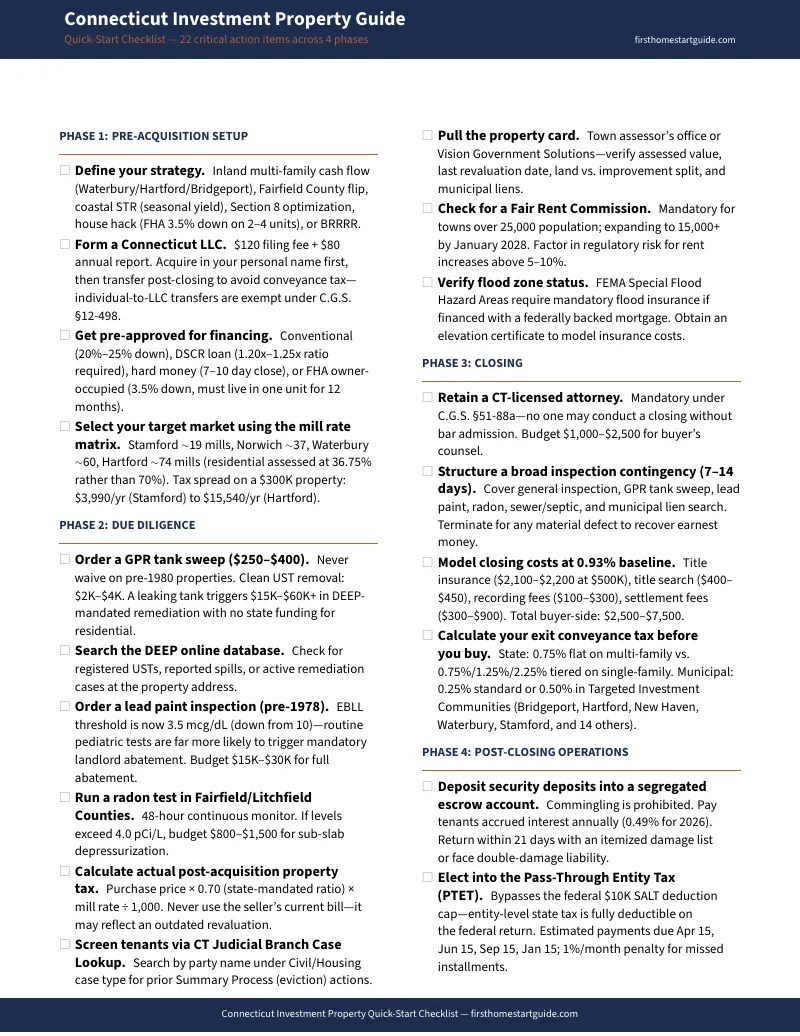
Download the free Connecticut Quick-Start Checklist to see the due diligence framework covering municipal tax verification, UST inspection protocol, lead paint risk assessment, eviction timeline modeling, and closing cost estimation. When you're ready for the full mill rate analysis, conveyance tax engineering, environmental compliance system, tenant law navigator, and 18-chapter investment system, the complete guide is here.
The deal looks good on the spreadsheet. This guide tells you whether Connecticut agrees.
Frequently Asked Questions
What if the rules change after I buy?
We update the guide when the rules change. Email us any time, even years later, and we'll send you the current edition free.