Delaware Looks Like a Tax Haven. Then Closing Day Arrives.
You ran the numbers on a Wilmington duplex throwing off 6% gross yield. Or a Newark townhome where four student tenants at $650/room cover the mortgage twice over. Or a Sussex County beach house with $45,000 in projected Airbnb revenue from Memorial Day through Labor Day. No state sales tax. Property taxes at 0.35% in Sussex County. The spreadsheet says wire the earnest money.
Then reality appears on the closing disclosure. The transfer tax is 4% of the purchase price --- not the discounted first-time buyer rate you assumed, because that exemption does not apply to investment properties. Your $350,000 duplex just added $7,000 in acquisition costs you never modeled. The Newark townhome sits two blocks outside the grandfathered zoning boundary, so the city hard-caps occupancy at three unrelated tenants --- not four --- and 25% of your projected revenue vanishes overnight. The Sussex County rental owes 4.5% to the state plus 7% to Rehoboth Beach, stacking to 11.5% total lodging tax that was never in your cash flow projections. And the septic system that "passed inspection" ten years ago just failed the mandatory DNREC Class H transfer inspection --- because 60.6% of Delaware septic systems fail --- and you're looking at a $20,000 replacement before the property can legally change hands.
Here's what no single resource explains: Delaware layers a 4% transfer tax with an investor-exclusion trap, a Justice of the Peace Court eviction system that dismisses cases over minor procedural errors (including accepting a partial rent payment without a written reservation of rights), municipality-by-municipality STR lodging taxes reaching 11.5%, rigid student housing density zoning, mandatory septic inspections with a 60.6% failure rate, security deposit escrow requirements in Delaware-only banks, and a brand-new Lead-Safe Housing Act that will require certification on every pre-1978 rental unit in the state. Every one of these has cost real investors thousands to tens of thousands of dollars because the information existed --- scattered across Title 25 of the Delaware Code, municipal ordinance PDFs, DNREC portal databases, and JP Court form instructions --- but nobody had assembled it into a single compliance system.
The Delaware Investment Property Guide is a Delaware Investor Compliance System --- not a motivational overview of real estate investing, but a structured regulatory and due diligence framework that maps every Delaware-specific financial trap, procedural hazard, and compliance requirement into a process you work through before you wire earnest money. It replaces months of cross-referencing state statutes, municipal rental ordinances, DNREC regulations, and forum threads from investors who learned these lessons the expensive way, with a single reference that tells you exactly what to verify, exactly what the numbers should look like, and exactly where deals go wrong in the First State.
What's Inside the Delaware Investor Compliance System
A 10-chapter guide, 8 standalone printable tools, and an 18-item due diligence checklist --- 10 PDFs in total --- covering every stage from acquisition mechanics through post-purchase compliance, built specifically for the regulatory traps and procedural hazards that make Delaware deceptively complex beneath its tax-haven surface:
Transfer Tax and the First-Time Buyer Exclusion
The single most common closing-day shock for Delaware investors. The state imposes a 4% realty transfer tax split 2% buyer, 2% seller by market convention. First-time homebuyers get a credit on the first $400,000 --- but investors do not qualify, regardless of whether it is their first Delaware purchase. The guide breaks down the exact mechanics, the 1% anti-flipping penalty triggered by selling improved property within 365 days, and how to properly underwrite a hard 2.0% acquisition cost that has zero available exemptions. On a $350,000 duplex, that is $7,000 in cash at settlement that routinely blindsides out-of-state buyers when it appears on the closing disclosure.
JP Court Eviction System and Procedural Hazards
Delaware evictions are adjudicated exclusively through the Justice of the Peace Court, and the system punishes minor procedural errors with immediate case dismissals. The guide covers the exact statutory requirements for 5-day non-payment notices and 7-day lease violation notices, the reservation of rights protocol that prevents accepting partial rent from voiding your entire eviction case, the mandatory Residential Eviction Diversion Program that adds a required mediation layer before the court will schedule a hearing, and the Form 50 certification that every LLC must file annually with the Chief Magistrate's Office before it can appear in JP Court at all. Missing any one of these means your case is dismissed, your non-paying tenant stays, and you restart a timeline that can stretch months.
Sussex County STR Tax and Licensing Matrix
Delaware's new 4.5% state lodging tax stacks on top of existing municipal taxes that range from 3% in Dewey Beach to 7% in Rehoboth Beach and Bethany Beach --- creating total tax burdens of 7.5% to 11.5% depending on municipality. The guide maps every town's exact lodging tax rate, annual license fees ($100 to $150), occupancy limits (Rehoboth enforces 2 per bedroom plus 2, with a carve-out for children under six), the 24/7 local contact person requirement, the Accommodations Intermediary license for platforms, and the critical distinction between incorporated municipalities and unincorporated Sussex County where different rules apply entirely. Underpricing your nightly rate because you modeled only the municipal tax and missed the state levy is how STR operators get audited.
Newark Student Housing Zoning Deep Dive
Newark restricts single-family rentals to a maximum of three unrelated tenants. Specific blocks adjacent to the University of Delaware campus carry historical exemptions allowing four tenants --- and those grandfathered properties command massive valuation premiums because the fourth tenant generates a 33% increase in gross rent on the same physical asset. The guide identifies the exempt zones, explains how to verify grandfathered status through the city's zoning office, covers annual rental license and IPMC inspection requirements, and details the enforcement consequences: lease termination, mandatory eviction, and potential license revocation. Out-of-state buyers who purchase assuming they can partition a living room and lease to four students routinely receive cease-and-desist orders that permanently cap their revenue.
Property Tax Reassessment and the New Tax Landscape
Delaware just completed its first comprehensive property reassessment in over 40 years across all three counties. Historical assessments were based on decades-old valuations that bore no relationship to current market values. The guide explains how the reassessment fundamentally alters holding costs for every parcel in the state, the revenue-neutral mill rate adjustments that are supposed to offset higher assessments (and why they may not fully protect investors in practice), and the formal appeal process. If you are underwriting a Delaware deal using the old assessed value from the listing, your property tax projections are wrong.
DNREC Septic Inspection and Environmental Due Diligence
Any Delaware property on a septic system must be pumped out and inspected by a Class F and Class H licensee before the sale is finalized. The baseline cost is $500+, but the catastrophic risk is in the failure rate: 60.6% of inspected systems are found unsatisfactory, with another 13.5% presenting concerns. Traditional cesspools cannot be certified for transfer under any circumstances, guaranteeing a mandatory replacement. The guide covers how to structure septic inspections as non-negotiable contract contingencies, how to negotiate seller-funded remediation, and how to avoid inheriting a condemned system that injects $15,000 to $30,000 in unmodeled capital expenditures.
Landlord-Tenant Compliance and Security Deposits
Delaware's security deposit rules are among the strictest in the country. Deposits must be held in a dedicated escrow account at a federally insured bank with a physical office in Delaware --- out-of-state accounts are prohibited. Landlords have exactly 20 days to return deposits or provide itemized deductions; failure triggers double-damage liability. The guide also covers the one-month deposit cap, tenant early termination rights for serious illness, the 60-day notice requirement for month-to-month lease terminations, the implied warranty of habitability, and the Lead-Safe Housing Act (HB 70) that mandates lead-free or lead-safe certification for all pre-1978 rental units beginning March 2028.
Regional Market Analysis and Financing Strategies
Four distinct Delaware submarkets dissected: Wilmington urban multi-family (cash flow and forced appreciation in old housing stock with lead paint risk), Newark student housing (captive university tenant base with strict density zoning), Dover/Kent County (military and government workforce housing with affordable entry points), and Sussex County coastal STR (seasonal yields offset by layered taxation and regulatory complexity). Plus financing strategies from conventional and FHA house-hack through DSCR and hard money, tax optimization including 1031 exchanges and the state capital gains phase-down from 4.0% to 3.0% by 2030, and LLC structuring with Form 50 compliance.
Who This Guide Is For
This guide is for real estate investors targeting Delaware markets who:
- Are analyzing a Delaware property and need to verify whether the deal actually works once you account for the 2% transfer tax, the post-reassessment property tax liability, septic inspection risk, and municipality-specific STR tax burdens --- not the generic low-tax assumptions that attracted you to Delaware in the first place
- Are investing from Pennsylvania, New Jersey, or Maryland and want to capture the massive property tax arbitrage (0.35% Sussex County vs. 4.73% in parts of Pennsylvania) without getting blindsided by Delaware's procedural regulations that operate nothing like your home state
- Are under contract and the title search just revealed a septic system that requires a Class H inspection, a property in a non-grandfathered Newark zoning district, or a transfer tax bill $7,000 higher than expected --- and need to understand the financial implications before your inspection contingency expires
- Plan to operate short-term rentals in Sussex County beach towns and need the exact lodging tax rate, licensing fees, occupancy limits, and platform requirements for your specific municipality before underwriting a deal whose entire ROI depends on STR revenue
- Own rental property in Wilmington or Newark and need to navigate JP Court evictions without having your case dismissed because of a defective 5-day notice, a missing Form 50, an accepted partial payment without a reservation of rights, or a skipped step in the mandatory Eviction Diversion Program
- Want every Delaware-specific regulation, tax calculation, and compliance requirement in one reference --- instead of piecing it together from Title 25 of the Delaware Code, DNREC databases, municipal ordinance PDFs, and BiggerPockets threads that may predate the 2024 reassessment, the new state lodging tax, and HB 70
Why Not Free Tools and Forums?
Free information on Delaware real estate investing exists across dozens of sources. Here's what it actually delivers:
- BiggerPockets and Reddit forums are where someone in 2022 says investors qualify for Delaware's first-time buyer transfer tax exemption, someone in 2024 corrects them, and a third poster links to a statute that has since been amended. You will find genuinely useful experience reports mixed with advice that predates the statewide property reassessment, the new 4.5% state lodging tax, and the Lead-Safe Housing Act. Sorting current from outdated requires reading the same statutes this guide has already synthesized.
- The Delaware Code (Title 25) and Attorney General summaries give you the full text of the Landlord-Tenant Code. They do not explain that accepting a $100 partial rent payment from a desperate tenant instantly voids your pending eviction unless accompanied by a written reservation of rights drafted with specific statutory language. They do not map the complete eviction timeline including the mandatory Eviction Diversion Program. They explain what the law says, not how it destroys your cash flow when you get a procedural detail wrong.
- Municipal portals in Wilmington, Newark, and Rehoboth Beach list their rental registration processes and fee schedules. They do not calculate how their requirements interact with state-level regulations, compare compliance costs across municipalities, or flag the enforcement patterns that determine which violations actually get prosecuted. You get the data for one jurisdiction without the cross-municipality analysis that determines where your capital is best deployed.
- National investing courses and books teach cap rate, DSCR, and 1031 mechanics that apply everywhere. They do not mention Delaware's 4% transfer tax with no investor exemption, the 1% flipping penalty, Form 50 for LLC representation in JP Court, the reservation of rights trap, Newark's 3-unrelated-persons zoning, the 60.6% septic failure rate, or the in-state-bank-only security deposit escrow requirement. Applying national frameworks to Delaware-specific problems is how investors lose five figures on their first deal.
This guide fills the Delaware-specific gap --- the space between knowing how to analyze a rental property in general and knowing how to underwrite one in a state where the transfer tax alone can add $7,000 to $10,000 in unmodeled closing costs, where a single accepted partial rent payment can void an eviction, and where 60.6% of septic systems fail their mandatory transfer inspection. It is the compliance analysis that would take a Delaware real estate attorney, a settlement agent, and a property tax consultant to assemble --- structured as a reference you own permanently.
--- Less Than One Transfer Tax Surprise
A single misunderstood transfer tax exemption adds $7,000 to $10,000 in unmodeled closing costs on a standard acquisition. A dismissed JP Court eviction because of a missing Form 50 or a defective 5-day notice costs months of lost rent and legal fees to restart. A failed DNREC Class H septic inspection on a property you already committed to purchase injects $15,000 to $30,000 in remediation costs. A fourth student tenant in a non-grandfathered Newark property generates a cease-and-desist that permanently reduces gross revenue by 25%.
This guide does not replace your settlement attorney or your CPA. But it gives you the transfer tax underwriting framework, eviction compliance protocols, STR tax matrix, and environmental due diligence checklist that ensure you identify every Delaware-specific risk before you are contractually committed --- instead of discovering them on your closing disclosure, your first JP Court appearance, or your first lodging tax audit.
If it catches a single transfer tax miscalculation, prevents a single eviction dismissal, or saves you from closing on a property with a condemned septic system, it pays for itself before you have finished reading it.
Money-back guarantee, no time limit. If the guide does not sharpen your underwriting and protect your capital in Delaware's regulatory environment, you pay nothing.
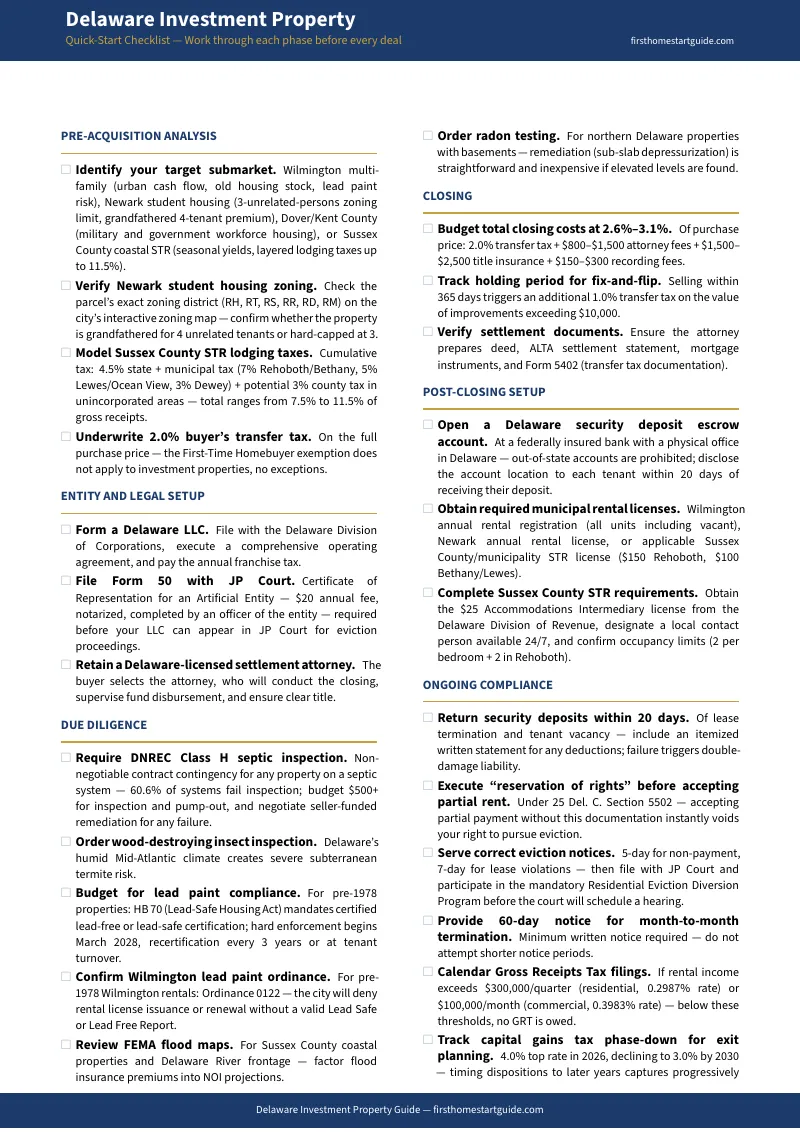
Download the free Delaware Quick-Start Home Buying Checklist to see the 18-item due diligence framework covering pre-acquisition analysis, entity and legal setup, due diligence, closing, and ongoing compliance. When you are ready for the full transfer tax analysis, JP Court eviction protocols, STR regulatory matrix, 8 standalone printable tools, and 10-chapter compliance system, the complete guide is here.
The spreadsheet says Delaware is a tax haven. This guide tells you what the spreadsheet missed.
Frequently Asked Questions
What if the rules change after I buy?
We update the guide when the rules change. Email us any time, even years later, and we'll send you the current edition free.