
You Ran the Numbers on a Decatur Rental. But You Didn't Know the Intangible Recording Tax Hits You on Every BRRRR Refinance, That DeKalb County's Millage Rate Creates a $4,000 NOI Gap Against Forsyth on an Identical Property, or That Atlanta's Primary Residence Requirement Bars Absentee Investors from Short-Term Rentals Entirely.
You found a duplex in East Atlanta Village projecting 7.1% gross yield against a tenant pool that doubled since 2018. Or a four-unit in Macon where the acquisition price is half the metro Atlanta median and the rent-to-price ratio looks like 2015. Or a turnkey rental in Gwinnett County where institutional investors are paying 95 cents on the dollar because the school district drives demand they can underwrite at scale. You ran the deal analyzer. You lined up DSCR financing. You're ready to wire earnest money.
Then Georgia happens. You close on the East Atlanta duplex with a $280,000 DSCR loan and pay $840 in intangible recording tax -- $3.00 per $1,000 of the mortgage amount, a cost that doesn't exist in most states. Eight months later you refinance through BRRRR at $340,000 and pay another $1,020 in intangible tax on the new loan. The same-lender refinance loophole that could have eliminated that second charge? Your mortgage broker never mentioned it, and your attorney didn't flag it because it requires proving continuous lien under the same secured creditor -- a technical argument most closing attorneys don't raise unless you ask. You acquire the Macon four-unit and discover that Bibb County's total millage rate produces an annual property tax bill 40% higher than what an identical property would generate in Houston County fifteen minutes south -- and Georgia offers zero homestead exemption for investment properties, so there's no offset. You plan to Airbnb a condo in Midtown Atlanta and discover that the city's short-term rental ordinance requires the property to be your primary residence. Absentee investors cannot operate STRs in Atlanta. Period. The 31-day mid-term rental workaround exists, but it cuts your nightly rate by 35% and your occupancy model collapses. Meanwhile, the crawl space under your East Atlanta duplex -- the one the home inspection noted as "moisture present, recommend further evaluation" -- needs full encapsulation at $12,000 to $23,500 because Georgia's red clay soil and subtropical humidity create conditions that destroy floor joists, breed mold behind vapor barriers, and void your homeowner's insurance if left unaddressed.
Here's what no single free resource explains: Georgia layers an intangible recording tax of $3.00 per $1,000 that hits your mortgage amount on every acquisition and every refinance unless you navigate the same-lender loophole or the HB 586 62-month exemption against a county millage rate system where DeKalb at 1.25% versus Forsyth at 0.68% creates a $4,000 annual NOI swing on identical properties with no homestead exemption for investors against an attorney-closing requirement where a licensed attorney must supervise every real estate transaction and out-of-state investors routinely discover this at the closing table against an eviction system where the statutory process is 30 days but Fulton and DeKalb County courts run 6-to-8-month backlogs on 144,000-plus annual filings against an Atlanta STR primary residence rule that categorically bars absentee investors against a Savannah STVR 20% ward cap with perpetual waitlists once saturated against institutional investor competition where Invitation Homes alone holds 72,000 properties in metro Atlanta against a non-resident withholding of 3% of gross sale price that ties up capital until you file IT-AFF2 to convert to net gain against climate-driven CapEx where HVAC units last 10-12 years instead of the 15-20 that northern investors budget for, termite bonds are mandatory annual costs, and clay soil foundation movement creates repair bills that out-of-state buyers never model. Each of these has cost real Georgia investors tens of thousands because the information existed -- scattered across county tax assessor websites, Georgia DOR filing requirements, Atlanta Municipal Code Chapter 150, Savannah STVR ordinance documents, Georgia landlord-tenant code Title 44 Chapter 7, and BiggerPockets threads from investors who learned after closing -- but nobody had assembled it into a single investment framework calibrated to how Georgia actually works in 2026.
The Georgia Investment Property Guide is a Georgia Investor Compliance Engine -- not a motivational overview of Peach State real estate, but a structured reference that maps every Georgia-specific tax formula, county variation, regulatory mechanism, and operational reality into a process you work through before your earnest money is at risk. It replaces months of cross-referencing county tax assessor millage tables, Georgia DOR intangible tax instructions, Atlanta and Savannah STR ordinances, Georgia landlord-tenant statutes, and Reddit threads with a single guide that tells you exactly what to verify, exactly what the numbers should look like, and exactly where deals go wrong in this state.
What's Inside the Georgia Investor Compliance Engine
A comprehensive guide, a quick-start checklist, and standalone worksheets and reference cards -- printable PDFs covering every stage from pre-purchase due diligence through post-closing operations, built specifically for the taxes, county-level variations, regulations, and market dynamics that make Georgia unlike any other state:
Intangible Recording Tax Navigator
Georgia's intangible recording tax is the single most misunderstood closing cost for investors operating across state lines. At $3.00 per $1,000 of the mortgage amount -- not the purchase price, the mortgage amount -- it adds $900 to a $300,000 loan and $1,200 to a $400,000 loan at every closing. For BRRRR investors, this means you pay it on acquisition and again on every refinance. The guide maps the complete intangible tax framework: the standard calculation, the same-lender refinance loophole (where refinancing with your existing lender on a continuous lien can eliminate the tax on the new loan amount), the HB 586 62-month exemption for refinances within 62 months of the original recording, the interaction between intangible tax and the separate real estate transfer tax ($1.00 per $1,000 of sale price), and how to model the cumulative impact on your cash-on-cash return across a multi-property portfolio where each refinance triggers a new tax event. It covers why most closing attorneys don't proactively raise the same-lender loophole -- and the specific language you need in the loan documents to preserve it.
County Millage Rate Comparator
Georgia has 159 counties -- more than any state except Texas -- and each one sets its own millage rate independently. The difference between DeKalb County (effective rate approximately 1.25%) and Forsyth County (approximately 0.68%) on a $350,000 property is roughly $2,000 per year in property tax -- on an identical house with identical rents. Over a 10-year hold, that's $20,000 in NOI destroyed by county selection alone. The guide provides a comparative framework for the 25 most investor-relevant Georgia counties: Fulton (split city/county millage with Atlanta overlay), DeKalb (highest combined rate in metro Atlanta), Gwinnett (institutional investor corridor with moderate rates), Cobb (Marietta city millage on top of county), Clayton (highest gross yields, highest effective tax rates), Chatham (Savannah city plus county plus school), Bibb (Macon-Bibb consolidated government), Richmond (Augusta), and the outer suburban counties where millage rates run 30-40% below metro Atlanta. Each county profile includes the current millage rate, the assessment ratio (40% of fair market value in Georgia), how to calculate the actual tax bill, and the critical fact that Georgia offers zero homestead exemption, zero assessment cap, and zero tax freeze for investment properties.
Atlanta and Savannah STR Regulatory Map
Atlanta's short-term rental ordinance (Municipal Code Chapter 150) requires every STR operator to obtain an annual license -- and the license requires the property to be the operator's primary residence. Absentee investors cannot legally operate short-term rentals in the City of Atlanta. This single rule eliminates the entire Airbnb arbitrage strategy for non-owner-occupied properties within city limits. The guide covers the 31-day mid-term rental workaround (minimum 31-night stays avoid the STR classification), its impact on revenue models (35-40% lower nightly rates, fundamentally different tenant pool), and the unincorporated Fulton/DeKalb loophole where properties technically outside Atlanta city limits but inside the metro area operate under county regulations that currently lack STR restrictions. For Savannah, the guide maps the STVR tiered permit system: the citywide cap, the 20% ward-level saturation threshold that creates perpetual waitlists in the Historic District and Victorian District, the distinction between residential and commercial STVR permits, and why investors who assume they can convert a Savannah purchase to short-term rental income need to verify ward capacity before making an offer -- not after.
Georgia Attorney-Closing Protocol
Georgia is one of roughly 20 attorney-closing states. A licensed Georgia attorney must supervise every real estate closing -- this is not optional, not waivable, and not something a title company can substitute for. Out-of-state investors buying Georgia property for the first time routinely discover this requirement during the transaction, after selecting a title company, and then scramble to engage a closing attorney within their contract timeline. The guide covers how attorney closings differ from title-company closings (the attorney reviews the title, prepares the closing documents, supervises the signing, and disburses funds through their escrow account), what "supervise" means under Georgia law (physical or virtual presence at closing, not just a rubber stamp), typical attorney closing fees ($800-$1,500 for standard residential transactions, higher for commercial or multi-unit), and why the attorney selection matters for investors specifically -- because the closing attorney is also the person who should be flagging the intangible tax loopholes, verifying the title for liens and code violations, and confirming that the property's zoning permits your intended use.
Eviction Timeline and Court Backlog Analysis
Georgia's statutory eviction process looks fast on paper. The landlord files a dispossessory affidavit, the tenant has 7 days to answer, and if the tenant fails to answer the court enters a default judgment followed by a writ of possession. On paper, this is a 14-to-21-day process. In reality, Fulton County Magistrate Court and DeKalb County Magistrate Court -- which handle the vast majority of metro Atlanta evictions -- carry backlogs that stretch the process to 6-8 months from filing to physical set-out. With 144,000-plus eviction filings per year statewide, Georgia's courts are overwhelmed. The guide covers the complete eviction timeline by county: the dispossessory affidavit filing ($75-$120 depending on county), the 7-day answer period, the hearing scheduling gap (2-4 weeks in suburban counties, 8-16 weeks in Fulton and DeKalb), the appeal window (7 days from judgment, during which the tenant remains in possession), the writ of possession (tenant has 7 days to vacate after writ is issued), and the marshal set-out scheduling delay. It includes realistic carrying cost calculations for the gap between filing and recovery of possession -- mortgage payments, insurance, property taxes, and lost rent during 3-8 months of zero income.
Non-Resident Withholding Framework
If you live outside Georgia and sell a Georgia property, the buyer's closing attorney is required to withhold 3% of the gross sale price -- not 3% of your profit, 3% of the entire sale price -- and remit it to the Georgia Department of Revenue. On a $350,000 sale, that's $10,500 withheld at closing regardless of whether you made money on the deal. The guide covers the IT-AFF2 affidavit process that converts the withholding from gross-based to net-gain-based (potentially reducing or eliminating the withholding if your basis is close to or above the sale price), the timeline for filing and receiving the refund, the interaction between Georgia's non-resident withholding and federal capital gains tax, and why failing to plan for the 3% withholding creates a cash flow gap that disrupts 1031 exchange execution -- because the withheld funds are not available for your replacement property acquisition within the 180-day window.
Climate-Driven CapEx Modeling
Georgia's subtropical climate creates a CapEx profile that out-of-state investors -- particularly those from the Northeast and Midwest -- systematically underestimate. HVAC systems in Georgia run 8-10 months per year under heavy cooling load and last 10-12 years, not the 15-20 years that northern budgets assume. A replacement unit for a 2,000 square foot rental runs $6,000-$12,000 depending on system type and efficiency rating. Termite risk is year-round: annual termite bonds ($200-$400 per property) are a mandatory operating cost, and termite damage repair averages $3,000-$7,000 when caught early, far more when it reaches structural members. Crawl space encapsulation -- the process of sealing the crawl space with vapor barriers, dehumidification, and drainage -- runs $8,000-$23,500 and is effectively mandatory in Georgia's clay soil and high-humidity environment. The guide provides a Georgia-calibrated CapEx reserve model: the percentage of gross rent to set aside monthly, the replacement timelines for HVAC, roof (15-20 years with Georgia's hail and storm exposure), water heater (8-12 years), and the crawl space inspection schedule that prevents a $2,000 moisture problem from becoming a $20,000 structural repair.
Institutional Investor Competition Analysis
Metro Atlanta is the largest institutional single-family rental market in the United States. Invitation Homes alone holds approximately 72,000 properties in the Atlanta MSA. Progress Residential, American Homes 4 Rent, and Pretium Partners collectively control tens of thousands more. These operators bid with all-cash offers, close in 14 days, waive inspections, and accept cap rates that individual investors cannot match. The guide covers the specific submarkets where institutional competition is heaviest (Gwinnett, south Fulton, Clayton, Henry, Douglas), the neighborhoods where institutional buyers have largely exited due to code enforcement costs and tenant management complexity (parts of south DeKalb, Clayton County unincorporated areas), the acquisition strategies that individual investors can use to compete (off-market deals, seller financing, properties below the $200,000 threshold that institutional algorithms skip), and why the institutional concentration actually creates opportunity in adjacent markets where individual investors face less competition for tenant demand.
Who This Guide Is For
This guide is for real estate investors targeting Georgia rental or flip properties who:
- BRRRR investors running the buy-rehab-rent-refinance-repeat strategy in metro Atlanta -- who need to model the intangible recording tax on every refinance, understand the same-lender loophole that can eliminate it, budget crawl space encapsulation into their rehab scope, and calculate realistic cash-on-cash returns that account for Georgia's county-level millage rate variations rather than using a single statewide average
- Out-of-state investors deploying capital into Georgia from California, New York, Illinois, or Texas -- attracted by rent-to-price ratios that no longer exist in their home markets but who have never navigated an attorney-closing state, don't know that Georgia withholds 3% of gross sale price on non-resident dispositions, have never budgeted for annual termite bonds, and are using HVAC replacement timelines calibrated to northern climates that will underestimate their CapEx by 30-40%
- STR and mid-term rental operators targeting Atlanta or Savannah vacation rental income -- who need to verify Atlanta's primary residence requirement before acquiring a non-owner-occupied property, understand the 31-day mid-term workaround and its revenue implications, check Savannah's ward-level STVR saturation caps before assuming permit availability, and evaluate the unincorporated county loophole for properties technically outside city limits
- Metro Atlanta value-add investors pursuing duplex and small multifamily conversions in East Atlanta, Westside, Reynoldstown, or Macon -- who need realistic eviction timelines that account for Fulton and DeKalb court backlogs rather than the 14-21 day statutory process, who need to model the institutional competition from Invitation Homes and Progress Residential in their target submarkets, and who need climate-calibrated CapEx reserves that reflect Georgia's HVAC cycles, termite exposure, and crawl space requirements
Why Not Free Tools and Forums?
Free information on Georgia real estate investing exists. Here's what it actually delivers:
- BiggerPockets forums contain hundreds of threads from investors buying Atlanta rentals -- posts about "Georgia being landlord-friendly" that cite the 7-day eviction answer period without mentioning the 6-8 month Fulton County court backlog, threads recommending BRRRR strategies that never calculate the intangible recording tax on the refinance, and analysis that uses a single metro-wide cap rate without adjusting for the $2,000-$4,000 annual property tax swing between adjacent counties. The enthusiasm about Georgia's investor appeal is real, but the county-level tax analysis, the intangible tax loophole navigation, and the realistic eviction timeline modeling are consistently missing. You get the thesis without the underwriting.
- The Georgia DCA Landlord-Tenant Handbook is a free publication from the Department of Community Affairs that covers Georgia landlord-tenant law at the statutory level. It explains what a dispossessory affidavit is. It does not tell you that Fulton County takes 8-16 weeks to schedule the hearing after your tenant files an answer, that the total carrying cost during that gap on a $1,800/month rental with a $1,400 mortgage payment is $11,200 in lost rent alone, or that the appeal window adds another 7 days of guaranteed possession after judgment. The Handbook gives you the law. The guide gives you the operational reality of enforcing it.
- National "landlord-friendly state" listicles rank Georgia in the top 10 based on the statutory eviction timeline, the absence of rent control, and the relatively low state income tax rate. They are correct on the statute. They are completely silent on the court-level enforcement backlog, the intangible recording tax, the county millage rate dispersion, the attorney-closing requirement, the non-resident withholding, the Atlanta STR restriction, and every other Georgia-specific mechanism that determines whether your deal actually produces the returns their ranking implies.
- County government websites publish property tax data, millage rates, and assessment information for their individual county. No county website compares its rates to adjacent counties. No county website models the NOI impact of its millage rate versus the county next door. The information is accurate and completely siloed. Comparing Fulton County's split-rate system (city of Atlanta overlay versus unincorporated Fulton) against DeKalb's unified rate against Gwinnett's institutional-investor-corridor rate against Clayton's high-yield-high-tax profile requires pulling data from 159 separate tax assessor websites and normalizing it into a comparable format. The guide has already done this for the 25 counties that matter.
- Reddit r/Atlanta and r/realestateinvesting surface genuine investor experiences -- landlords posting about $12,000 crawl space encapsulation bills they didn't budget for, BRRRR investors discovering the intangible tax on their refinance, out-of-state buyers who didn't know Georgia requires an attorney at closing, and STR operators who listed a Midtown condo on Airbnb without knowing about the primary residence requirement. The experiences are real, but the advice is contradictory, the tax information is often wrong (confusing intangible tax with transfer tax, misquoting millage rates), and the threads are scattered across years of posts mixing pre-2024 and post-2024 regulations. Assembling current Georgia investment law from Reddit takes longer than reading a guide that has already done it.
This guide fills the Georgia-specific gap -- the space between knowing how to analyze a rental property in general and knowing how to invest in a state where the intangible recording tax adds $3.00 per $1,000 to every mortgage and every refinance, where county millage rates create $4,000 annual NOI swings between adjacent jurisdictions, where the statutory eviction timeline bears no resemblance to the court-level reality, where Atlanta bars absentee STR investors entirely, where non-residents forfeit 3% of gross sale price at closing, and where the climate destroys HVAC units and crawl spaces on a schedule that northern CapEx models don't account for. It's the analysis that would take a Georgia real estate attorney, a CPA familiar with intangible tax and non-resident withholding, a property manager who knows the actual Fulton County eviction timeline, and an inspector who understands Georgia's climate-driven maintenance cycle to assemble -- structured as a reference you own permanently.
-- Less Than One Hour of a Georgia Real Estate Attorney
A Georgia real estate closing attorney charges $800 to $1,500 for a standard residential transaction. Missing the same-lender intangible tax loophole on a single BRRRR refinance costs $900 to $1,200 in unnecessary tax. Choosing DeKalb County over Forsyth County without comparing millage rates costs $2,000 to $4,000 per year in excess property tax on an identical property. Acquiring an Atlanta property for STR income without verifying the primary residence requirement means your entire revenue model is invalid and you're stuck with a long-term rental yielding 2% less than projected. Budgeting HVAC replacement at 15-year intervals instead of Georgia's actual 10-12 year cycle means your CapEx reserve runs dry five years early. Underwriting Fulton County evictions at the 14-21 day statutory timeline instead of the 6-8 month court reality means your carrying cost model is off by $8,000 to $14,000 per nonpaying tenant. Not planning for the 3% non-resident withholding at sale means $10,500 is locked at the Georgia DOR when you need it for your 1031 exchange replacement property.
This guide doesn't replace your Georgia real estate attorney or your tax advisor. But it gives you the intangible tax navigator, county millage rate comparator, Atlanta and Savannah STR regulatory map, attorney-closing protocol, eviction timeline analysis, non-resident withholding framework, climate-driven CapEx model, and institutional competition analysis that ensure you identify every Georgia-specific risk before your earnest money is committed -- instead of discovering them on your closing statement, your first refinance, your first eviction filing, or your first HVAC replacement.
If it catches a single intangible tax loophole you didn't know about, prevents a single county selection that costs you $4,000 per year in excess property tax, or keeps you from acquiring an Atlanta property for STR income that you legally cannot operate, it pays for itself before you've finished reading it.
Money-back guarantee, no time limit. If the guide doesn't sharpen your underwriting and protect your investment in Georgia's regulatory environment, you pay nothing.
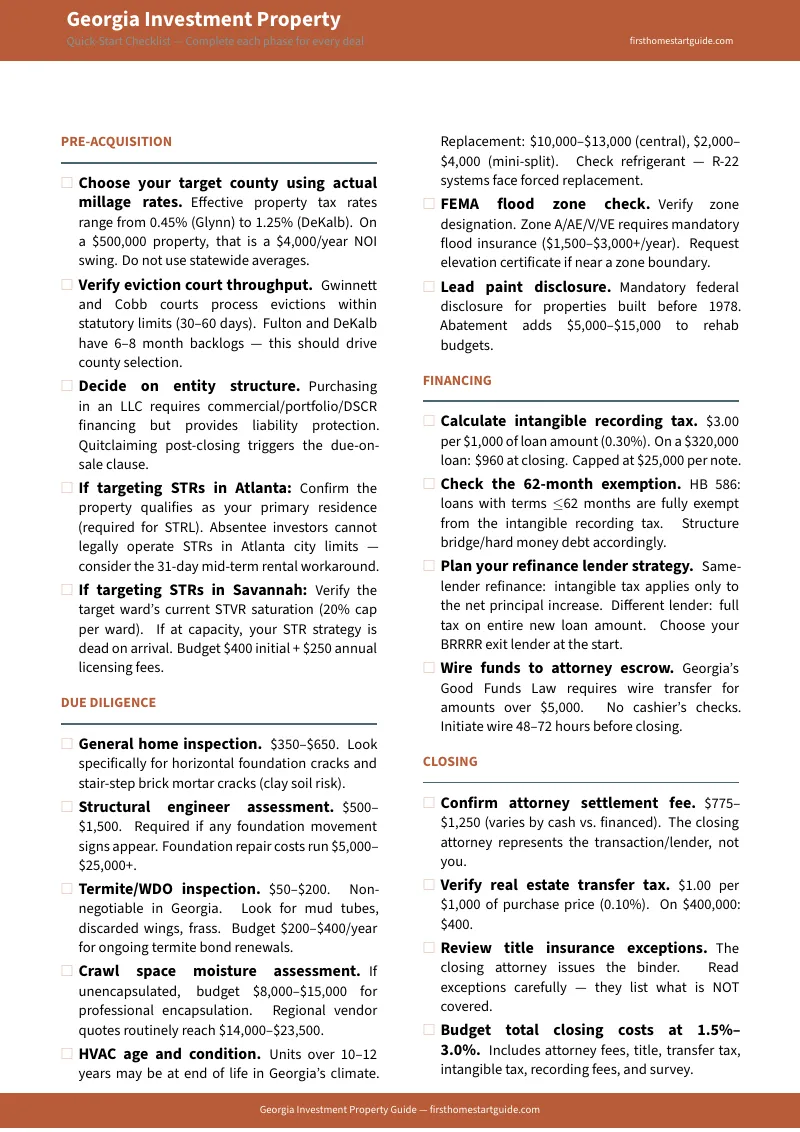
Download the free Georgia Quick-Start Home Buying Checklist to see the action plan covering pre-purchase research, county tax comparison, due diligence, and post-purchase compliance. When you're ready for the full intangible tax navigator, county millage rate comparator, STR regulatory map, eviction timeline analysis, and climate-driven CapEx model, the complete guide is here.
The deal pencils out on the spreadsheet. This guide tells you whether Georgia agrees.