You Found a $350,000 Condo in Honolulu and You Cannot Figure Out Why It Is So Cheap
You have scrolled through the listings. You have seen the median single-family home price push past $1 million on Oahu. You may have found the post from the military buyer who purchased a "bargain" leasehold condo near Pearl Harbor — only to discover two years later that the land lease had 28 years remaining, no lender would touch a refinance, and the property had depreciated to the point where selling it would cost more in transfer taxes and commissions than the equity it contained. Or the thread from the local family who bought into an aging Waikiki high-rise and got hit with a $45,000 special assessment for concrete spalling repairs because the AOAO board had kept monthly dues artificially low for a decade to appease investor-owners.
The problem is not a lack of information. The HHFDC publishes income limits. The Hawaii HomeOwnership Center runs a 9-hour course. The USGS publishes lava hazard zone maps. But no single resource explains why that affordable listing is leasehold and what happens when the lease expires, how to layer a Hale Kama'aina first mortgage with an HHOC deferred loan and a Honolulu County $40,000 DPA without triggering a stacking conflict, how to read an AOAO reserve study and spot a catastrophic special assessment before you close, or why a $350,000 Big Island home in Lava Zone 1 is effectively unfinanceable through FHA and carries $6,000 per year in mandatory HPIA insurance that destroys your DTI ratio.
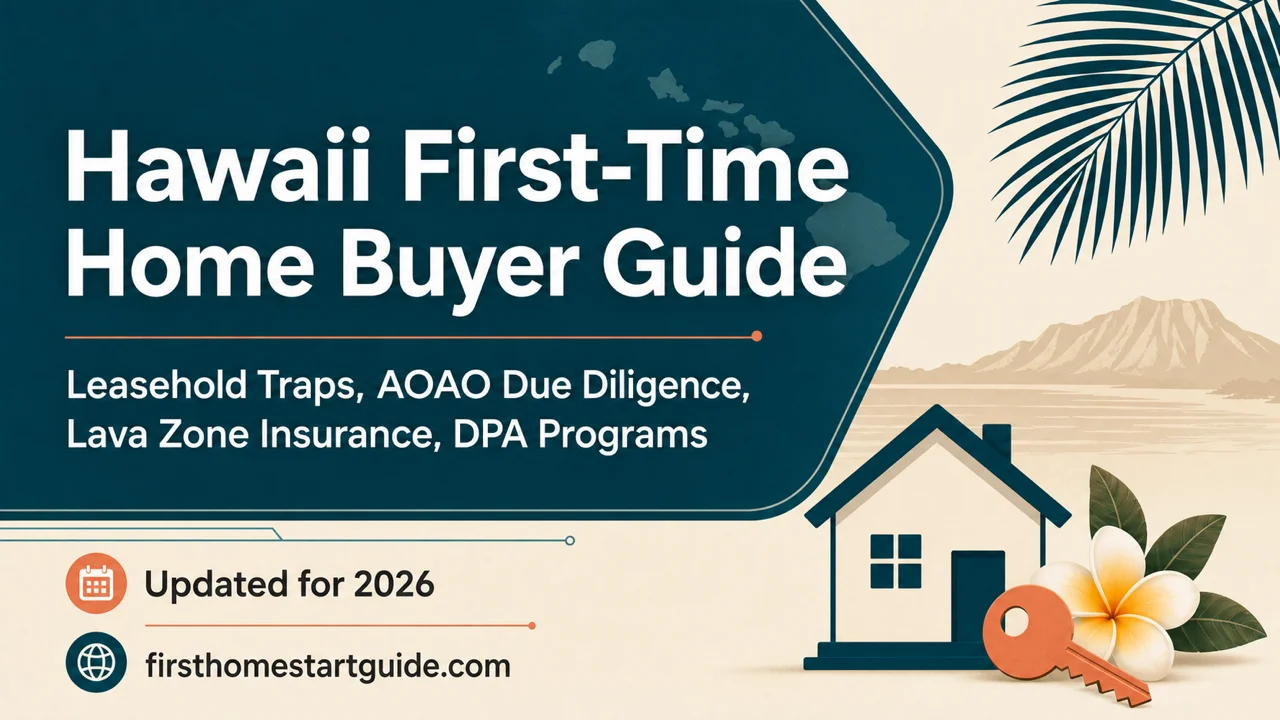
The Hawaii First-Time Home Buyer Guide is an Island Transaction Defense System — a single structured reference that maps every state program, every land tenure trap, every island-specific insurance requirement, every condo due diligence document, and every county-level tax calculation into a step-by-step process you work through before you sign a contract. It replaces months of cross-referencing government portals, military housing forums, and generic mainland advice with a reference that tells you exactly what you qualify for, exactly what you will pay, and exactly where Hawaii-specific transactions fall apart.
What's Inside the Island Transaction Defense System
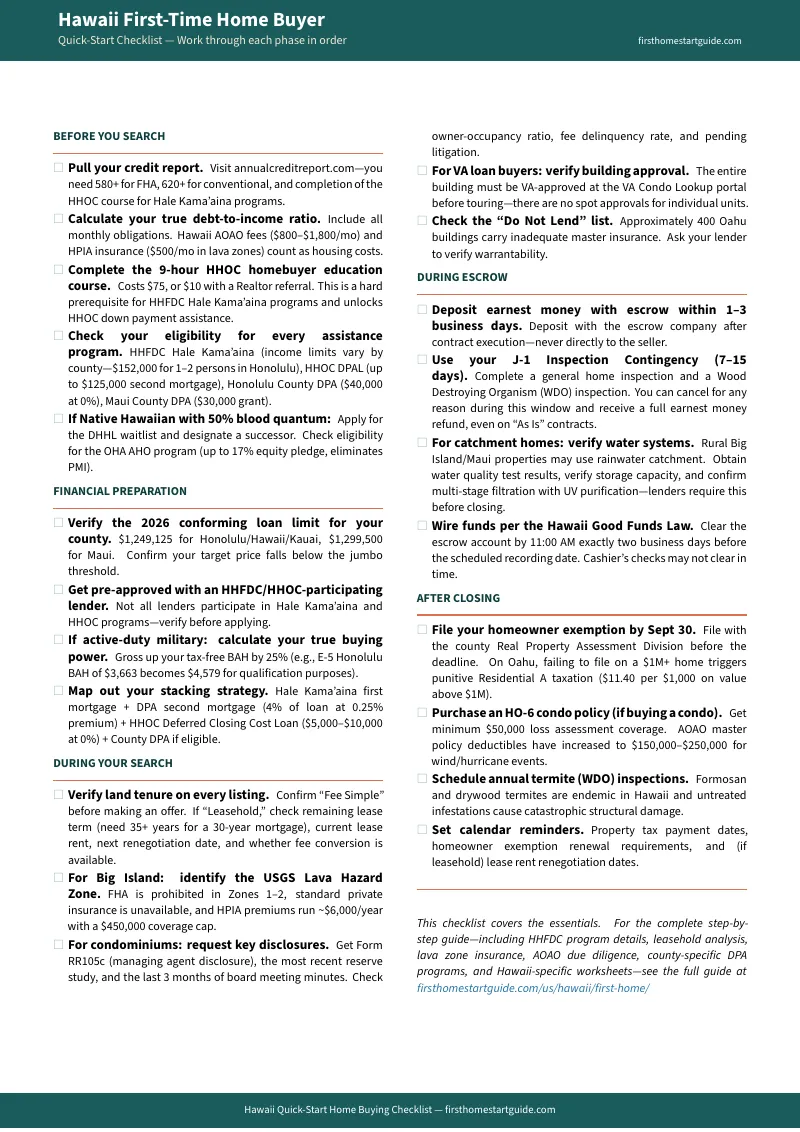
A comprehensive 13-chapter guide, a quick-start checklist, and standalone worksheets and reference cards — covering every stage from calculating your true Hawaii affordability through to collecting your keys, built specifically for the programs, hazards, and legal frameworks that make buying in Hawaii different from every other state:
Fee Simple vs. Leasehold — The Most Dangerous Decision in Hawaii Real Estate
That suspiciously affordable listing you found is almost certainly leasehold. You would be buying the structure while renting the land underneath it from a lessor who controls the lease rent renegotiation schedule. When lease rents reset to market rates every 10 to 20 years, they routinely double or triple overnight — turning a $400/month lease rent into $1,200/month with no recourse. Worse, lenders require the remaining lease term to extend at least 35 years past the loan maturity. Below 30 years remaining, the IRS no longer considers the property real estate — no 1031 exchanges, no standard refinancing, and a buyer pool that shrinks to cash-only. The guide maps the five-year financing trap, the lease rent renegotiation problem, and the exact four questions you must answer before making an offer on any leasehold property — so you never confuse a $350,000 listing price with a bargain.
HHFDC Hale Kama'aina and the Down Payment Assistance Stack
The Hawaii Housing Finance and Development Corporation offers below-market 30-year fixed rates — 4.650% for FHA/VA loans, 4.950% for conventional — plus an optional 4% down payment assistance second mortgage. But the DPA triggers a permanent 0.25% rate premium. Income limits vary wildly by county: $152,000 for 1-2 persons in Honolulu, $161,520 in Maui, $123,000 on the Big Island. The guide walks through every eligibility rule, the 9-hour HHOC course requirement, and how to layer Hale Kama'aina with the HHOC Deferred Payment Assistance Loan (up to $125,000), the Honolulu County 0% interest DPA loan ($40,000), and the Maui County grant ($30,000) — including which combinations work and which trigger stacking conflicts that collapse your financing in underwriting.
The Condominium Playbook — AOAO Fees, Reserve Studies, and the Special Assessment Trap
On Oahu, condominiums are the default entry point for first-time buyers. AOAO fees range from $800 to over $1,800 per month — covering master hurricane insurance, elevator maintenance, central chiller systems, security, and pest control for buildings constructed during the 1970s development boom. When these 50-year-old buildings need concrete spalling mitigation, roof replacement, or cast-iron pipe replacement and the reserve fund is underfunded, the AOAO levies special assessments of $20,000 to $50,000 per unit. The guide teaches you to read Form RR105c (managing agent disclosure), analyze reserve study funding ratios, review board meeting minutes for pending assessment discussions, check owner-occupancy ratios for lender approval, and verify the building is not on the approximately 400-building Oahu "Do Not Lend" list — because the time to discover a building's financial health is before you make an offer, not when your lender rejects it.
Big Island Lava Zones and the Insurance Crisis
Properties in Puna district — Pahoa, Kea'au — offer some of the most affordable acreage in the state. But USGS Lava Hazard Zones 1 and 2 carry three deal-killing restrictions: standard private insurance is completely unavailable, FHA financing is prohibited, and the state's HPIA insurer of last resort caps coverage at $450,000 while charging approximately $6,000 per year. That $500/month insurance premium directly attacks your debt-to-income ratio, often disqualifying buyers who assumed they could afford the low sticker price. Rural properties with unpermitted structures or rainwater catchment systems add additional lender requirements for water quality testing and building permits. The guide maps all nine hazard zones, explains the exact DTI impact of HPIA premiums, and includes a pre-offer checklist for Big Island properties — so you know whether a property is financeable before you spend money on inspections.
Military Buyers — VA Loans, BAH Gross-Ups, and Condo Approvals
Active-duty personnel at Pearl Harbor-Hickam, Schofield Barracks, and Kaneohe Bay have massive purchasing power through the VA loan's zero-down-payment structure and the 25% BAH gross-up mechanism. An E-5 with dependents in Honolulu receives $3,663 in tax-free BAH — which lenders treat as $4,579 of qualifying income after the gross-up. But that purchasing power gets killed by one critical misconception: the VA does not perform spot approvals for individual condo units. The entire building must be formally VA-approved before any unit can be financed with a VA loan. If the AOAO has inadequate reserves, excessive renter ratios, or pending litigation, the VA rejects the building and your deal dies. The guide lists the VA condo approval lookup process, explains the PCS rental conversion strategy, and identifies the leasehold traps that military buyers fall into most often.
Native Hawaiian Pathways — DHHL and OHA
For buyers with 50% Native Hawaiian blood quantum, the Department of Hawaiian Home Lands offers 99-year residential leases at $1 per year, exempt from property tax. But waitlists span decades. The guide maps the waitlist strategy — how families designate 18-year-old successors to inherit senior waitlist positions — and the OHA Access to Home Ownership program, which pledges up to 17% equity as a deposit-backed guarantee, eliminating PMI and enabling 3% down payment purchases. These pathways exist outside the standard real estate market and require specialized legal and financial navigation that no mainland guide covers.
The Five-Island Market
Hawaii is five separate housing markets with different price dynamics, insurance requirements, and buyer demographics. The guide breaks down each island — Oahu's military-driven condo market, Maui's vacation rental phase-out (Bill 9 kills 7,000 STR permits), the Big Island's lava zone pricing trap, Kauai's inventory squeeze — with conforming loan limits, property tax rates, and county-specific DPA programs for each. Advice that works in Honolulu does not work in Pahoa.
Escrow Process, Taxes, and Closing
Hawaii is an escrow state — no closing table, no attorney requirement. A licensed escrow company holds your money while a chain of contractual deadlines plays out over 45 to 60 days. The Good Funds Law requires your wire to clear by 11:00 AM exactly two business days before recording, or the deal dies. The guide covers the dual land recording system (Regular vs. Land Court), the J-1 inspection contingency that lets you cancel for any reason during the first 7 to 15 days, the graduated conveyance tax (0.10% to 1.25% based on sale price), the county-by-county property tax rates and homeowner exemptions, and the General Excise Tax that hits real estate commissions. Every deadline, every form, every dollar amount is Hawaii-specific.
Who This Guide Is For
- Local professionals priced out of neighborhoods they grew up in who have not checked whether they qualify for Hale Kama'aina assistance — income limits in Honolulu reach $152,000, and most qualifying buyers never apply because they assume state programs are for low-income households
- Active-duty military PCSing to Oahu who want to build equity during a 3-to-4-year tour using their VA loan and BAH gross-up — and need to know which condo buildings are VA-approved and which leasehold properties will trap their investment
- Native Hawaiians navigating DHHL waitlists who need the successorship strategy, blood quantum verification process, and OHA financing options that exist outside the standard real estate system
- Mainland transplants and remote workers who are applying mainland real estate logic to a market where leasehold ownership, volcanic hazard zones, and $1,500/month AOAO fees make every assumption dangerous
- Big Island buyers attracted by affordable prices who need to verify lava zone designation, insurance availability, FHA eligibility, and catchment water requirements before committing to a property that looks affordable on paper but is unfinanceable in practice
- Maui buyers considering condo investments who need to understand how Bill 9's vacation rental phase-out affects their income projections and property values
- Anyone buying their first home in Hawaii who has realized that generic national advice does not cover leasehold financing traps, AOAO reserve study analysis, lava zone insurance crises, or the stacking rules for Hawaii's assistance programs
Why Not Free Resources?
Free information on buying your first home in Hawaii exists across government websites and military forums. Here is what it actually delivers:
- The HHFDC website publishes income limits, interest rates, and participating lender lists. It does not explain how to layer Hale Kama'aina with HHOC and county DPA programs without triggering a stacking conflict. It does not warn you that the MCC program is permanently closed despite dozens of websites still promoting it. You get the individual program rules without the integration strategy that makes them usable together.
- The Hawaii HomeOwnership Center runs a comprehensive 9-hour course covering budgeting, credit, mortgages, and home shopping. It does not teach leasehold financing traps, AOAO reserve study analysis, lava zone insurance requirements, or the military-specific BAH gross-up calculation. You get foundational education without the Hawaii-specific technical knowledge that prevents catastrophic mistakes.
- The USGS publishes lava hazard zone maps. It does not explain how Zone 1 or Zone 2 designation translates into FHA prohibition, mandatory HPIA coverage, $6,000 annual premiums, or a DTI ratio that kills your mortgage qualification. You get the hazard data without the financial analysis that determines whether you can actually buy there.
- Reddit and military forums contain real buyer experiences from Pearl Harbor personnel, Puna homesteaders, and local families. The signal is buried in threads where leasehold advice from 2019 contradicts current lending requirements, special assessment horror stories lack actionable prevention steps, and DHHL waitlist strategies are mixed with eligibility misinformation. Sorting current Hawaii-specific intelligence from dangerous outdated advice takes longer than reading a guide that has already done it.
This guide fills the Hawaii-specific gap — the space between knowing you want to buy a home and knowing how to navigate a state where leasehold properties depreciate to zero, AOAO special assessments run into the tens of thousands, volcanic hazard zones make entire districts unfinanceable, and six-figure down payment assistance exists but is hidden behind eligibility matrices and course requirements that most buyers never complete.
— Less Than One Termite Inspection
A Wood Destroying Organism (WDO) inspection in Hawaii costs $250 to $500. A general home inspection costs $400 to $800. An AOAO special assessment for concrete spalling or pipe replacement can hit $20,000 to $50,000 per unit. HPIA insurance in a lava zone costs $6,000 per year. A leasehold renegotiation that triples your lease rent from $400 to $1,200 per month costs $9,600 per year for the rest of the lease term. Losing your earnest money because you wired funds one day late and violated the Good Funds Law costs you the entire deposit.
This guide does not replace your escrow company or HHFDC-approved lender. But it gives you the leasehold analysis framework, the AOAO due diligence checklist, the lava zone insurance protocol, the DPA stacking blueprints, the military VA loan playbook, and the escrow timeline that ensure you identify every Hawaii-specific risk and opportunity before you sign a contract — not when the managing agent disclosure reveals an underfunded reserve, the HPIA quote arrives, or the lease rent renegotiation notice shows up in your mailbox.
If it saves you from a single leasehold purchase that depreciates to zero, a single AOAO special assessment you did not see coming, or a single lava zone property that turns out to be unfinanceable, it pays for itself before you finish reading it.
Money-back guarantee, no time limit. If the guide does not sharpen your due diligence and protect your investment in Hawaii's real estate market, you pay nothing.
Download the free Hawaii Quick-Start Home Buying Checklist to see the step-by-step framework covering HHFDC eligibility, leasehold verification, AOAO due diligence, lava zone checks, and escrow timelines. When you are ready for the full DPA stacking blueprints, condominium playbook, military VA loan strategies, and island-by-island market analysis, the complete guide is here.
The assistance is generous. The traps are everywhere. This guide makes sure you claim the first without falling into the second.
Frequently Asked Questions
What if the rules change after I buy?
We update the guide when the rules change. Email us any time, even years later, and we'll send you the current edition free.