
The Gross Yield Looks Incredible. The 18.5% Tax-on-Tax Trap, Leasehold Renegotiation Cliffs, and Bill 9 Phase-Outs Will Destroy It.
You found a one-bedroom condo in Kihei projecting $80,000 in annual STR revenue with 82% occupancy. Or a Waikiki condotel in a Resort Mixed-Use building where the hotel desk handles everything. Or a single-family home on the Big Island's Hamakua Coast listed at half of Oahu prices in a neighborhood where long-term rents have climbed 20% in three years. The ADR works. The occupancy data is real. You're ready to wire earnest money.
Then you discover the Kihei condo sits on the Minatoya List — and Maui's Bill 9 forces all STR operations in South Maui to cease by December 31, 2030, converting your $80,000-a-year vacation rental into a $28,000 long-term rental or a distressed sale. The Waikiki unit is Category E apartment-zoned requiring a Nonconforming Use Certificate that must be renewed between September 1 and October 15 every year — and the seller let it lapse two years ago, permanently revoking the STR rights and vaporizing $200,000 in value. The Big Island home triggers Hawaii County's Bill 47, which eliminated the hosted rental exemption entirely and forces booking platforms to delist non-compliant properties within 10 days under $10,000-per-day fines.
Here's what no single resource tells you: Hawaii layers a gross receipts tax structure where the combined GET and TAT hit 17.75-18.5% of total revenue before a single dollar goes to your mortgage, a "tax-on-tax" compounding trap where failing to itemize GET and TAT separately on guest receipts inflates your liability by 15-18% above your projections, a leasehold tenure system where renegotiation dates can triple your ground rent overnight and leases below 30 years remaining are disqualified from 1031 exchanges by the IRS, island-by-island STR regulations so divergent that a legal rental on Oahu would be a criminal violation on Maui, a HARPTA withholding of 7.25% on gross sale price at closing that traps your capital for 12-18 months, and four separate county property tax systems with tiered rates that charge investment properties 2-4x the homeowner rate. Every one of these has cost real investors five to six figures because the information existed — scattered across DOTAX rate sheets, county planning department portals, Maui Council meeting minutes, BiggerPockets threads mixing 2019 advice with current law, and real estate broker marketing materials that never mention leasehold financing restrictions — but nobody had assembled it into a single underwriting system.
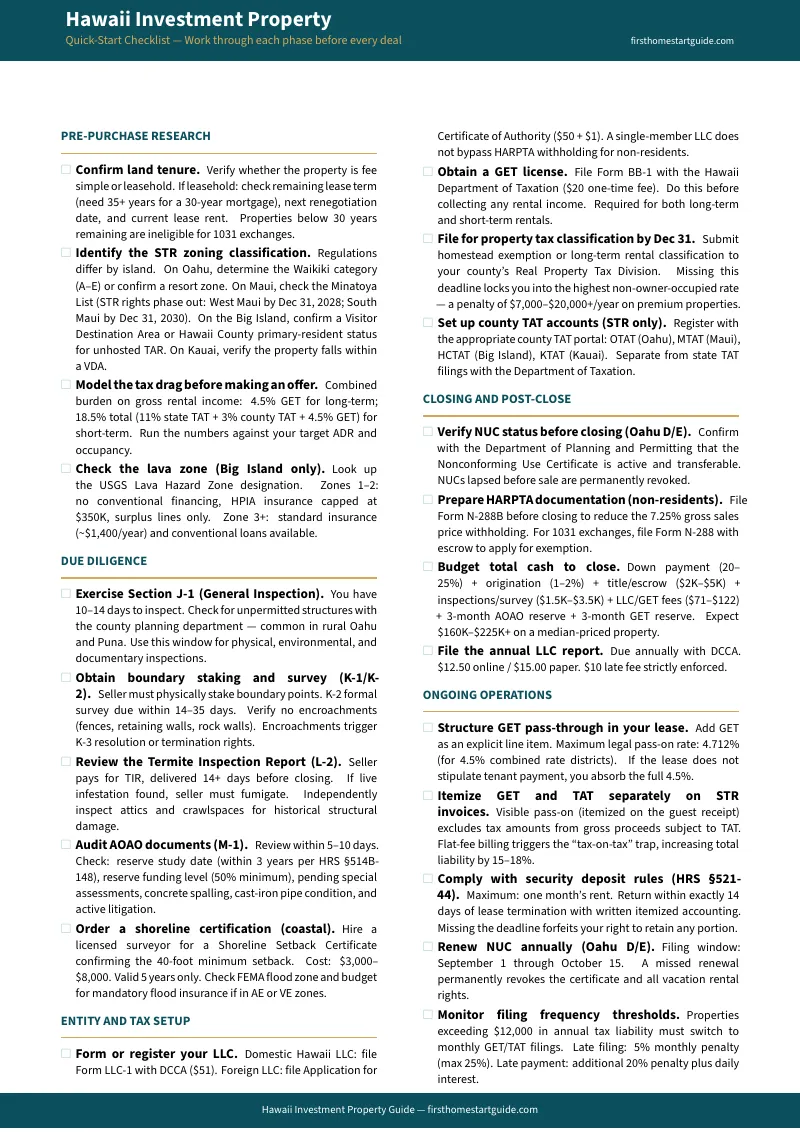
The Hawaii Investment Property Guide is a Hawaii Investor Regulatory Navigation System — not a motivational overview of island real estate, but a structured framework that maps every Hawaii-specific tax trap, land tenure risk, STR regulation, and compliance deadline into a process you work through before you wire earnest money. It replaces months of cross-referencing DOTAX forms, county planning portals, legislative session archives, and outdated forum posts with a single reference that tells you exactly what to verify, exactly what the numbers should look like, and exactly where deals go wrong.
What's Inside the Hawaii Investor Regulatory Navigation System
A multi-chapter guide and a quick-start due diligence checklist — covering every stage from pre-acquisition analysis through ongoing compliance, built specifically for the tax structures, land tenure complexities, and regulatory fragmentation that make Hawaii different from every other state:
GET/TAT Tax Architecture and the Tax-on-Tax Trap
Hawaii has no sales tax. Instead, operators face a General Excise Tax (GET) at 4.0-4.5% plus county surcharges, a state Transient Accommodations Tax (TAT) at 11.0% effective January 2026, and county TAT surcharges of 3.0% across all four counties — producing a combined gross receipts tax burden of 17.75-18.5%. The guide covers the exact combined rate by county, the "visible pass-on" requirement that determines whether tax amounts are excluded from the TAT base (failing to itemize GET and TAT separately on receipts triggers tax-on-tax compounding that inflates total liability by 15-18%), filing frequency thresholds ($12,000 annual liability triggers mandatory monthly filing), the penalty structure (5% monthly late-filing penalty capped at 25% plus a separate 20% late-payment penalty with daily-accruing interest), and a worked example showing how an $80,000 STR produces approximately $14,000 in GET/TAT before any operating expense is paid.
Fee Simple vs. Leasehold — The Renegotiation Cliff
Hawaii's dual-tenure system is the most common trap for mainland investors. Leasehold properties appear 30-50% cheaper on listing portals, but they carry severe structural risks the guide systematically decodes: renegotiation dates where ground rent resets to current land valuations and can triple overnight, the financing restriction where most lenders require at least 35 years remaining on the lease to issue a standard 30-year mortgage (25 years remaining limits you to a 20-year loan with drastically higher monthly payments), the IRS 1031 exchange disqualification below 30 years remaining (the leasehold is no longer classified as "real estate," trapping your capital gains), and the terminal reversion where the property reverts to the landowner at lease expiration with zero compensation. Plus a decision framework for evaluating fee-to-lease conversion opportunities offered by landowners.
Island-by-Island STR Regulations
The single greatest source of information asymmetry for mainland investors. The guide provides a complete island-by-island breakdown: Oahu's five Waikiki STR categories (A through E) with unit counts, legal status, and risk profiles — including why Category E's Nonconforming Use Certificate renewal window (September 1 to October 15) is a permanent-revocation trap if missed; Maui's Bill 9 (Ordinance 5909) Minatoya List phase-out with the West Maui deadline of December 31, 2028 and South Maui deadline of December 31, 2030, plus the failed H-3/H-4 rezoning attempt; Big Island's Bill 47 eliminating the hosted rental exemption and forcing platform compliance ($1,000 registration fee, monthly TMK reporting, $10,000 daily fines for non-compliant listings); and Kauai's Vacation Destination Area (VDA) permit system. Each island section includes a decision matrix telling you which property types can legally operate STRs and which are walking into a phase-out.
HARPTA, FIRPTA, and Exit Strategy
Hawaii imposes its own withholding tax at sale independent of FIRPTA. The guide covers HARPTA withholding at 7.25% of gross sale price for non-resident sellers (with the N-288B application process to reduce or eliminate withholding based on actual gain), FIRPTA withholding at 15% for foreign nationals, conveyance tax tiers graduated from 0.10% to 1.25% based on sale price, the 1031 exchange mechanics with Hawaii-specific timeline considerations, and strategic exit planning for properties caught in STR phase-outs (long-term rental conversion analysis, immediate liquidation vs. holding through the amortization period, and the valuation impact of losing TVR rights).
Financing and DSCR Challenges in Hawaii
Hawaii's compressed cap rates and high acquisition costs make conventional financing qualification difficult. The guide covers DSCR loan parameters with Hawaii-specific challenges (the 17.75-18.5% gross tax reduces NOI enough to push borderline ratios below the 1.0 threshold), hard money bridge loan terms for renovation plays, VA loan utilization for military buyers (the dominant financing mechanism on Oahu, with specific guidance on HOA rental cap verification and minimum-stay compliance upon PCS transfer), jumbo loan requirements in a market where the median Oahu condo exceeds $500,000, and the critical leasehold financing restrictions that limit loan terms based on remaining lease duration.
Property Tax by County — Four Systems, Four Rate Structures
Hawaii has no unified property tax code. Each of the four counties (Honolulu, Maui, Hawaii, Kauai) sets its own rates across multiple classification tiers. The guide includes the complete rate schedule by county and classification (homeowner, non-owner-occupied, hotel/resort, commercialized residential, short-term rental), the December 31 filing deadline trap for homestead exemptions and classification appeals that catches investors who close in Q4, the tiered rate differential where investment properties pay 2-4x the homeowner rate, and the specific classifications that apply to STR vs. LTR properties in each county.
Environmental Due Diligence — Lava Zones, SMA Permits, AOAO Reserves, Termites
Hawaii's geological and environmental risks are unlike any other US market. The guide covers Big Island lava zone classifications (Zones 1-9) with insurance availability and premium impacts for each zone, Special Management Area (SMA) permit requirements for coastal properties, AOAO reserve study analysis (monthly fees of $1,000-$2,000+ for resort-amenity buildings that most mainland investors never factor into cash flow projections), Formosan subterranean termite prevalence and mandatory inspection requirements, hurricane insurance in a state where standard policies exclude wind damage, and flood zone considerations for coastal investment properties.
Landlord-Tenant Law — HRS Chapter 521
Hawaii's landlord-tenant code under HRS Chapter 521 is tenant-protective with strict compliance requirements. The guide covers the 14-day security deposit return deadline (one of the shortest in the US), the habitability standards and tenant remedies, the eviction process and timeline, Act 278 mandatory mediation requirements before eviction proceedings, rent increase notice periods, prohibited lease provisions, and the specific operational requirements for managing long-term tenants that differ substantially from mainland norms — critical knowledge for investors converting STR properties to LTR in response to regulatory phase-outs.
Cash Flow Modeling — LTR and STR Worked Examples
Two complete worked examples showing true after-tax cash flow: an STR scenario with realistic occupancy, ADR, GET/TAT liability, AOAO fees, property management at 20-25%, property tax at the correct county classification rate, insurance, and mortgage service — producing the actual net yield, not the gross yield that listing portals advertise. And an LTR scenario showing the appreciation-focused model with the tighter but more predictable cash flow that experienced Hawaii investors actually target. Both examples include sensitivity analysis for occupancy drops, rate compression, and regulatory changes.
Plus 8 Standalone Printable Tools
Print these and keep them in your deal folder: a GET/TAT Combined Tax Calculator with the visible pass-on itemization template, an Island-by-Island STR Permissibility Matrix covering all four counties, a Leasehold Risk Assessment Worksheet (remaining term, renegotiation dates, financing eligibility, 1031 qualification), a Property Tax Classification Reference by county, a HARPTA Withholding Calculator with N-288B eligibility checklist, an Environmental Due Diligence Checklist (lava zones, SMA, AOAO, termites, hurricane/flood), a Cash Flow Projection Worksheet for both STR and LTR scenarios, and a Statute Quick Reference with every key HRS section, DOTAX form, and county ordinance.
Who This Guide Is For
This guide is for real estate investors targeting Hawaii markets who:
- Are analyzing a Hawaii property and need to verify whether the deal actually works once you account for the correct combined GET/TAT rate for the property's county, the AOAO fees that never appear in the seller's advertised cap rate, the property tax classification that applies to your intended use, and the insurance costs in a state where hurricane exclusions and lava zone surcharges are standard
- Are considering a Waikiki condo and need to determine its exact STR category (A through E), whether an active NUC exists and is transferable, and what happens to the property's value if you miss the September 1 to October 15 renewal window
- Are evaluating a Maui property and need to understand whether it sits on the Minatoya List, whether Bill 9's phase-out applies to it, what the specific deadline is for your district, and whether the H-3/H-4 rezoning proposal has any realistic chance of saving STR rights
- Are deploying capital from the mainland and need to understand HARPTA's 7.25% withholding on gross sale price at exit, the leasehold financing restrictions that can disqualify your mortgage, the 1031 exchange rules for properties with fewer than 30 years remaining on the lease, and the GET/TAT filing obligations that start the month you receive your first booking
- Are a military buyer on Oahu planning to convert your residence to a rental upon PCS transfer and need to know the HOA rental caps, the minimum-stay rules, the property tax reclassification that occurs when you stop occupying the unit, and the VA loan occupancy requirements you need to satisfy first
- Want every Hawaii-specific tax calculation, STR regulation, leasehold risk, environmental hazard, and compliance deadline in one reference — instead of assembling it from DOTAX rate sheets, county planning portals, Maui Council meeting minutes, BiggerPockets threads mixing pre-Bill 9 advice with current law, and broker marketing materials that never mention the leasehold renegotiation cliff
Why Not Free Tools and Forums?
Free information on Hawaii real estate investing exists across dozens of sources. Here's what it actually delivers:
- BiggerPockets and Reddit forums are where someone in a 2022 thread recommends buying a Kihei condo for the "guaranteed 82% occupancy and $300 ADR" without mentioning that Bill 9 phases out STR rights on that exact property by 2030. Someone else claims Hawaii's tax rate is "around 14%" without accounting for the 2026 TAT increase, county surcharges, or the tax-on-tax compounding that pushes actual liability to 18.5%. You'll find experienced local investors warning that Hawaii is "a primary market where cash flow is nearly impossible" alongside mainland newcomers projecting 8% cap rates using gross revenue numbers that ignore $14,000 in annual GET/TAT and $18,000 in AOAO fees. Sorting current island-specific regulations from outdated general advice takes longer than reading a guide that has already done it.
- Hawaii Department of Taxation (DOTAX) website publishes the GET and TAT rate schedules, filing forms, and administrative rules. The rates are there. What is not there is a combined calculator that models the tax-on-tax compounding trap, an explanation of how the visible pass-on requirement changes your total liability by thousands of dollars per year, or any guidance on how the combined 17.75-18.5% gross tax interacts with your DSCR loan qualification. You get the rates. You don't get the analysis that tells you whether the property still cash-flows after applying them.
- County STR registration portals tell you how to apply for a permit. They do not tell you whether the property you are buying is eligible for one, whether an existing NUC is transferable, whether the Minatoya List protection applies to the specific building, or whether Bill 47's new enforcement mechanism will delist your property from Airbnb within 10 days of non-compliance. You get the application packet. You don't get the due diligence framework that tells you whether to apply in the first place.
- National real estate investing courses teach cap rate, DSCR, and 1031 exchange mechanics that apply everywhere. They don't cover Hawaii's gross receipts tax structure (which taxes revenue, not profit), the leasehold system (which doesn't exist in 48 other states), the island-by-island STR regulatory fragmentation, HARPTA withholding, county-specific property tax classifications, or the environmental due diligence items unique to volcanic Pacific islands. Applying mainland frameworks to Hawaii-specific problems is how investors lose six figures on their first deal.
- Real estate broker marketing materials in Hawaii emphasize ADRs, occupancy rates, and gross yield projections. They never mention the combined GET/TAT burden that consumes 17.75-18.5% of that gross revenue, the leasehold renegotiation dates that can triple your ground rent, the AOAO reserve studies that reveal upcoming special assessments, or the STR phase-out timelines that will eliminate the rental income the projections are based on. You get the pitch. You don't get the underwriting.
This guide fills the Hawaii-specific gap — the space between knowing how to analyze a rental property in general and knowing how to underwrite one in a state where 18.5% gross taxation, leasehold renegotiation cliffs, island-by-island STR phase-outs, HARPTA withholding, and volcanic zone insurance restrictions can each independently turn a profitable deal into a losing one. It's the analysis that would take a Hawaii real estate attorney, a CPA with DOTAX specialization, and a local property manager to assemble — structured as a reference you own permanently.
— Less Than One Month's AOAO Fees
A tax-on-tax compounding error on an $80,000 STR produces $2,500 in unnecessary annual tax liability that accumulates every year you own the property. A single lapsed NUC renewal on a Waikiki Category E unit permanently revokes STR rights and eliminates $200,000 in property value. A leasehold purchase with 28 years remaining disqualifies you from 1031 exchanges and limits your financing to a 20-year term with crushing monthly payments. A missed HARPTA filing at exit traps 7.25% of your gross sale price for 12-18 months while the Department of Taxation processes your refund application.
This guide doesn't replace your Hawaii real estate attorney or your CPA. But it gives you the GET/TAT combined calculator, the island-by-island STR permissibility matrix, the leasehold risk assessment, the HARPTA withholding analysis, and the due diligence checklist that ensure you identify every Hawaii-specific risk before you're contractually committed — instead of discovering them on your first tax filing, your first NUC renewal deadline, or your first conversation with a lender who won't finance your leasehold.
If it catches a single tax-on-tax compounding error, prevents a single NUC lapse, or saves you from buying a leasehold with insufficient remaining term for 1031 eligibility, it pays for itself before you've finished reading it.
Money-back guarantee, no time limit. If the guide doesn't sharpen your underwriting and protect your capital in Hawaii's regulatory environment, you pay nothing.
Download the free Hawaii Quick-Start Home Buying Checklist to see the due diligence framework covering pre-acquisition verification, tax compliance, STR permissibility, and leasehold analysis. When you're ready for the full GET/TAT calculator, island-by-island STR matrix, leasehold risk assessment, and complete investment system, the complete guide is here.
The gross yield looks incredible. This guide tells you whether Hawaii's taxes, regulations, and land tenure system agree.
Frequently Asked Questions
What if the rules change after I buy?
We update the guide when the rules change. Email us any time, even years later, and we'll send you the current edition free.