
A $0.30 Accounting Error on a $3,000 Security Deposit Triggers $15,000 in Statutory Damages. That Is the Cost of Investing in Illinois Without Knowing the Rules.
You found a 3-flat in Logan Square. The numbers looked great on paper — gross rents of $6,500 per month against a $525,000 purchase price with 3.5% down through FHA. You spent three months searching, put in an offer, paid for the appraisal, and got a call from your loan officer: denied. The underwriter ran the FHA self-sufficiency test, subtracted the mandatory 25% vacancy factor from gross rents, compared the result against your PITI — and the property failed. Seventy-five percent of gross rents did not cover the mortgage in a market where property taxes alone consume a third of the payment. Nobody told you this test existed. Nobody told you it only applies to 3-unit and 4-unit buildings. Nobody told you that a 2-flat two blocks away would have been exempt entirely.
Or maybe you made it past closing. You bought a 2-flat in Irving Park, collected a $3,000 security deposit from your first tenant, deposited it into your personal checking account, and went on with your life. Seven months later, a tenant-side attorney filed suit. The deposit was not held in a separate, federally insured, interest-bearing account. The receipt did not include the exact bank name and address. The annual interest payment of $0.30 — mandated by the City Comptroller at 0.01% since 2015 — was never sent. The RLTO mandates statutory damages of two to three times the deposit, plus the deposit itself, plus the tenant's attorney fees. The judgment: $15,243. There is no judicial discretion to reduce it. There is no defense for honest mistakes. An entire cottage industry of Chicago law firms exists solely to take these cases on contingency.
Or maybe it is not the security deposit. Maybe it is the property tax bill that doubled in a reassessment year because the seller's trailing bill included a homeowner exemption you do not qualify for and the Cook County Assessor's triennial cycle hit your triad zone. Maybe it is the 120-day notice requirement under the Fair Notice Ordinance that destroyed your value-add timeline because your tenant had been in the unit for four years and you only gave 60 days. Maybe it is the Airbnb unit you underwrote at $200 per night that cannot legally operate because the condo association filed an affidavit on the Prohibited Buildings List and you never checked the Chicago Data Portal before closing.
The problem is not that Illinois is a bad investment market. The problem is that Illinois layers a security deposit regime where a $0.30 clerical error triggers $15,000 in mandatory damages, an FHA self-sufficiency test that kills 3-flat financing in high-tax neighborhoods, a triennial property tax reassessment cycle where bills double overnight in a single Cook County triad zone, a Fair Notice Ordinance that mandates 120 days' notice to raise rent on a long-term tenant, an eviction timeline in Cook County that averages 150 days in contested cases while the collar counties resolve the same process in 10 weeks, a suburban Cook County RTLO that most investors do not know exists, and a citywide ADU expansion effective April 2026 with aldermanic opt-in requirements and per-block permit caps — and no single resource maps all of these into an underwriting framework you can work through before you deploy capital.
The Illinois Investment Property Guide is a Cook County Compliance and Underwriting System — a structured walkthrough of every Illinois-specific tenant ordinance, property tax calculation, financing trap, zoning opportunity, and exit strategy that determines whether your investment property cash-flows or bankrupts you. It replaces months of cross-referencing the RLTO summary PDFs, the Cook County Assessor's valuation reports, the Chicago Data Portal, BiggerPockets threads full of contradictory advice, and the FHA handbook with a single reference that tells you exactly what to verify, exactly where the penalty exposure lives, and exactly how the numbers work in a market that punishes investors who assumed national rules of thumb applied to Cook County.
What's Inside the Cook County Compliance and Underwriting System
A 13-chapter guide, a quick-start checklist, and eight standalone printable tools — covering every stage from submarket selection through exit strategy, built specifically for the regulatory, tax, and financing structures that make Illinois unlike any other state. Each standalone tool is a self-contained PDF you can print individually and use during property research, inspections, and underwriting:
RLTO and RTLO Compliance Guide
The Chicago Residential Landlord and Tenant Ordinance is widely regarded as one of the most punitive municipal tenant-protection laws in the United States. The guide provides a complete walkthrough of the security deposit rules (separate federally insured interest-bearing account, 0.01% annual interest, 30-day payment window), the late fee caps ($10 for the first $500 of rent plus 5% on the remainder — a maximum of $60 on a $1,500 lease), tenant remedies including rent withholding and repair-and-deduct, and the move-in fee strategy that savvy Chicago investors use to sidestep the entire deposit regime. Then the guide covers the 2021 Cook County RTLO that extended sweeping protections to suburban Cook County — including a 1.5-month security deposit cap, "reasonable estimate" move-in fee restrictions that close the Chicago loophole, and anti-lockout provisions that apply even to otherwise exempt units. You will know exactly which ordinance applies to your property based on its address, and exactly how to structure your lease to stay compliant.
FHA Self-Sufficiency Test Calculator
This is the single most common financing failure for first-time Chicago investors. The guide explains how lenders calculate the Net Self-Sufficiency Rental Income — 75% of gross rents from all units (including the one you live in) compared against the total PITI. In Chicago's high-tax environment, most 3-flats fail this test. The guide shows you the exact math, explains why 2-flats are exempt and therefore the superior FHA house-hack target, and covers DSCR and conventional alternatives when a 3-flat genuinely pencils. FHA limits in Chicago: approximately $490,000 for a 2-unit, $590,000 for a 3-unit.
Cook County Property Tax Underwriting
Cook County is the only county in Illinois using a classified property tax system — residential properties assessed at 10% of fair market value, commercial at 25%, with a 2024 equalization factor of 3.0355. The guide walks through the triennial reassessment cycle (City of Chicago, Northern Suburbs, South and West Suburbs on rotating schedules), the Kaegi-to-Hynes assessor transition that introduces genuine uncertainty for income-producing properties, the homeowner exemption trap (it disappears when you buy as an investor, spiking your first tax bill), and the two-stage property tax appeal process through the Assessor's Office and Board of Review. During the 2023 reassessment cycle, successful Board of Review appeals reduced non-residential commercial assessed value by $950 million — an 18% reduction.
Fair Notice Ordinance Planning
Chicago's 2020 Fair Notice Ordinance mandates tiered notice periods for lease terminations and rent increases based on how long your tenant has lived in the unit: 30 days for tenancies under 6 months, 60 days for 6 months to 3 years, and 120 days for tenancies exceeding 3 years. Miss the deadline and the tenant stays at the prior rental rate until the required period expires. For value-add investors planning to renovate units with legacy tenants, the 120-day requirement can destroy your internal rate of return. Rent increases of 10% or more on tenancies exceeding three years may trigger relocation assistance obligations. The guide maps the notice math into your renovation timeline so you do not discover the delay after you have committed capital.
Submarket Analysis with Current Numbers
Detailed analysis of eight Chicago neighborhoods and three downstate markets with current rents, median prices, cap rates, and vacancy data. Logan Square 2-flats selling above $665,000 with compressed cap rates around 6% — an appreciation play, not cash flow. Avondale emerging as the next Logan Square with 2-bedroom rents averaging $2,206. Pilsen at $2,000 average rents, up 11% year-over-year. Bronzeville with more affordable entry points and upside from the Obama Presidential Center. Downstate: Peoria at 12.2% gross rental yield with a 4.6% vacancy rate, Rockford at 8.0% cap rates, Springfield at 8.4%. The guide frames the cash flow versus appreciation decision and shows how sophisticated Illinois investors hold both — a Chicago appreciation asset funded by downstate cash flow.
ADU Expansion Strategy
The September 2025 citywide ADU ordinance (effective April 2026) allows investors to add conversion units (basement/attic) and detached coach houses across Chicago for the first time since 1957. The guide covers the aldermanic opt-in requirement, zoning category pacing restrictions (one ADU permit per block per year in RS-1, two in RS-2, three in RS-3), apprenticeship mandates for contractors, and Department of Housing pre-certification. This is forced appreciation — increasing the gross rent multiplier through entitlement rather than market movement — but only if you understand the granular zoning constraints before committing capital.
Short-Term Rental Compliance
Chicago operates one of the most restrictive STR environments in the country. The guide covers the Shared Housing Registration Portal, the $250 Unit Operator License, the Prohibited Buildings List (over 2,400 buildings permanently banned from STR operation), Restricted Residential Zones where entire precincts have voted to bar short-term rentals, density caps for buildings with five or more units, the 2026 lodging tax remittance requirements, and single-night rental prohibitions. An investor who underwrites based on Airbnb revenue without checking both the Prohibited Buildings List and the restricted zone map faces catastrophic losses. The guide tells you exactly where to check before you model a single dollar of STR income.
Eviction Timeline Planning
Cook County contested evictions average roughly 150 days — five months of zero rental income plus potential property damage. DuPage County resolves the identical legal process in roughly 10 weeks. The guide walks through the seven-step Cook County eviction process (5-day notice through Sheriff's enforcement backlog), the self-help eviction prohibitions that carry severe penalties, and the strategic implications of county-line selection for risk-averse investors. This timeline difference is not trivial — a six-month vacancy routinely forces under-capitalized Cook County investors into foreclosure or distress sales.
1031 Exchange and Exit Strategy
Illinois fully conforms to federal 1031 exchange rules with no state clawback on cross-state exchanges — unlike California. The guide covers the 45-day identification and 180-day closing deadlines (absolute, no extensions), the distinction between investment property and fix-and-flip inventory, Delaware Statutory Trust exchanges for passive investors, cost segregation studies to accelerate depreciation against the 4.95% Illinois flat tax, and the cumulative exit tax burden that can exceed 30% of total capital gain when you stack state, federal, and depreciation recapture. The exit strategy you choose determines whether you keep your gains or donate them to three levels of government.
Due Diligence Protocol
A systematic walkthrough of every pre-closing check specific to Illinois investment properties: PIN research and tax assessment history across multiple PINs, Chicago Data Portal searches for open permits and zoning violations, the EMT conduit electrical mandate that makes all Chicago wiring cost significantly more than national averages (Romex is illegal), sewer scope inspections for Chicago's combined sewer system, lead paint liability under CDPH enforcement ($5,000 per day fines for first violations), PVC piping code updates that reduce plumbing rehab costs, and insurance checks for pre-war housing stock with knob-and-tube wiring. Each item connects directly to a cost exposure — so you know which checks are worth delaying closing over and which are not.
Who This Guide Is For
- First-time house-hackers targeting Chicago 2-flats and 3-flats who need to understand the FHA self-sufficiency test before spending three months searching for a property that will fail underwriting, the owner-occupied RLTO/RTLO exemption that disappears the moment you put the building in an LLC, and the security deposit strategy that avoids five-figure statutory damages
- Out-of-state investors targeting Chicago or downstate Illinois for yield who treat Chicago like a commoditized asset without factoring in Cook County property tax volatility, the RLTO and RTLO that apply to remote owners with full force, winterization costs on pre-war housing stock, and the 150-day Cook County eviction timeline that can wipe out a year of rental income
- South and West Side cash flow investors who need to model the triennial reassessment cycle before it doubles their tax bill, carry a six-month vacancy reserve for Cook County eviction exposure, and appeal assessments through the two-stage Board of Review process that reduced non-residential commercial assessed value by $950 million during the 2023 cycle
- Suburban Cook County investors who believe they have escaped Chicago's regulatory net and do not know the 2021 RTLO extended security deposit caps, late fee limits, "reasonable estimate" move-in fee restrictions, and anti-lockout provisions to almost all suburban rentals
- Value-add investors planning ADU conversions or unit additions who need to navigate the April 2026 citywide ADU expansion — aldermanic opt-in, zoning category permit caps, DOH pre-certification — before committing renovation capital to a property that may not qualify
- Investors comparing Illinois against Indiana and Wisconsin who need the honest framework: Illinois for appreciation and scale with high regulatory friction, Indiana for yield with lower barriers, and the capital allocation strategy that uses downstate cash flow to fund Chicago appreciation plays
Why Not Free Tools and Forums?
Free information on Illinois real estate investing exists. Here is what it actually delivers:
- The City of Chicago's RLTO summary PDFs give you the rules in bureaucratic language without context. They do not tell you that savvy investors have abandoned security deposits entirely in favor of move-in fees. They do not explain the late fee calculation formula. They do not warn you that an entire cottage industry of tenant-side attorneys exists to sue casual landlords over $0.30 interest payment failures. You get statute text without operational strategy.
- BiggerPockets and Reddit threads contain genuine experience reports mixed with dangerous misinformation. Users confuse the Chicago RLTO with the suburban Cook County RTLO, dispense illegal advice about eviction notices in municipalities covered by the RTLO, and recommend raising rents aggressively on long-term tenants without mentioning the 120-day Fair Notice Ordinance requirement. Sorting current law from outdated anecdote across these platforms takes longer than reading a guide that already did it.
- The Cook County Assessor's website provides Valuation Reports and raw assessment data without teaching you how to connect that data to your underwriting. It does not explain how the equalization factor transforms your assessed value into your tax bill, does not warn you about the exemption trap that spikes first-year taxes for investors, and does not walk you through the two-stage appeal process that reduced assessed values by $950 million in the 2023 cycle.
- National real estate investing courses and podcasts teach you the 1% rule, the 50% rule, and cap rate analysis. None of these account for the FHA self-sufficiency test that kills 3-flat financing in Chicago, the classified property tax system unique to Cook County, the $15,000 penalty for a security deposit technicality, or the 150-day eviction timeline that makes vacancy reserves a survival necessity rather than a conservative assumption.
This guide fills the Illinois-specific gap — the space between knowing how to invest in real estate in general and knowing how to invest in a state where a $0.30 interest payment failure triggers $15,000 in statutory damages, where property taxes double overnight in reassessment years, where a 3-flat that looks perfect on paper fails FHA underwriting due to a test most investors have never heard of, and where the tenant ordinance that governs your suburban Cook County rental is one that most suburban landlords do not know exists. It is the analysis that would take a Chicago real estate attorney, a property tax consultant, an FHA underwriter, and a zoning specialist to assemble — structured as a reference you own permanently.
— Less Than One Hour of Attorney Time
A real estate attorney in Cook County charges $750 to $1,500 for a residential closing. One RLTO security deposit violation triggers $15,000 in statutory damages. A triennial reassessment you did not model adds thousands to your annual property tax bill. An FHA denial on a 3-flat you spent months pursuing wastes your appraisal fee, your inspection costs, and your time. A 150-day Cook County eviction you did not reserve for can force you into a distress sale. Not knowing about the ADU expansion means missing forced appreciation opportunities that are now legal citywide for the first time since 1957.
This guide does not replace your real estate attorney, your lender, or your property manager. But it gives you the compliance checklists, underwriting calculations, submarket data, and regulatory maps that ensure you identify every Illinois-specific trap and opportunity before your earnest money is at stake — instead of discovering them at underwriting, during your first tenant dispute, or on your first reassessed property tax bill.
If it catches a single RLTO violation before you collect your first security deposit, prevents a single FHA denial by steering you toward a 2-flat instead of a 3-flat, saves you from buying in a reassessment year without modeling the spike, or connects you to the property tax appeal process that reduced assessed values by $950 million in Cook County, it pays for itself before you have finished reading it.
Money-back guarantee, no time limit. If the guide does not sharpen your Illinois investment property analysis and protect your capital, you pay nothing.
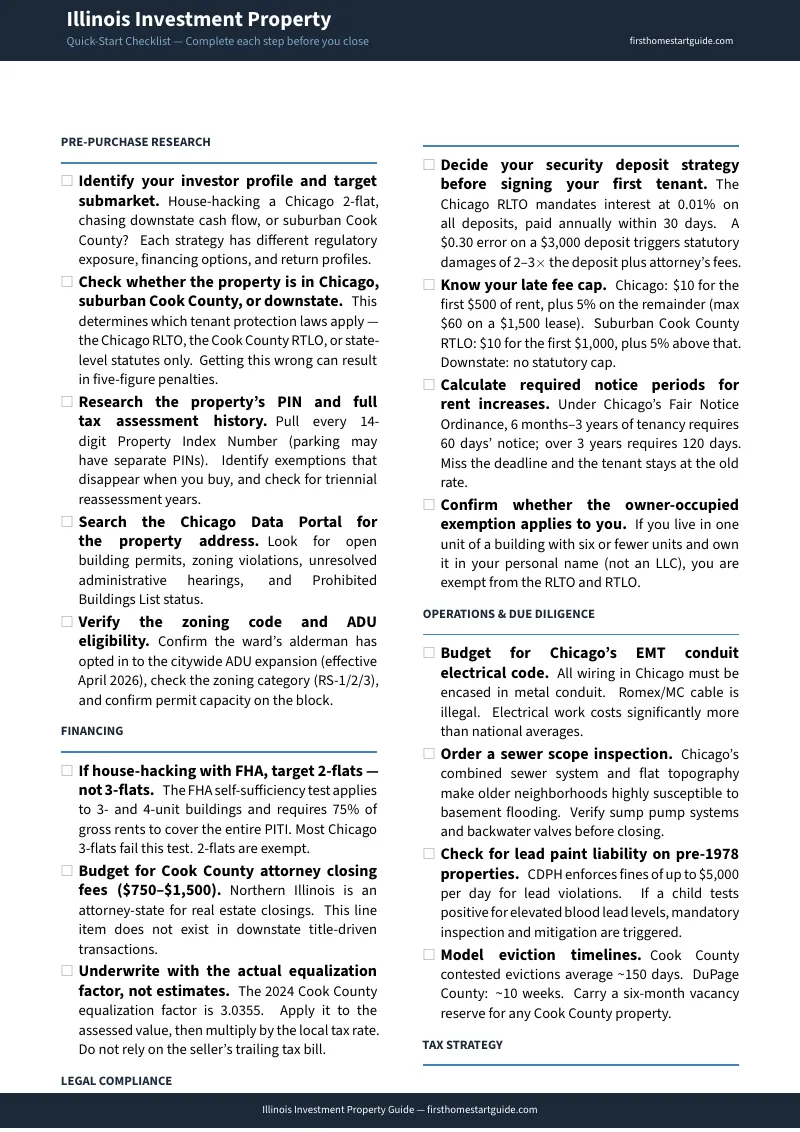
Download the free Illinois Quick-Start Home Buying Checklist to see the step-by-step framework covering investor profile selection, regulatory jurisdiction identification, financing strategy, RLTO/RTLO compliance, property tax research, due diligence, and exit planning. When you are ready for the full compliance guide, submarket analysis, FHA calculator, ADU strategy, eviction timeline planning, and the complete underwriting system, the full toolkit is here.
Illinois rewards investors who master the regulatory friction. The ones who cannot handle the RLTO, the property tax system, and the eviction timeline self-select out — reducing competition for those who can. This guide makes sure you are one of the ones who can.