
Indiana's Property Tax Revolution Just Made Buying Your First Home a Math Problem. Here's the Answer Key.
Your lender said you're approved. Zillow shows a $250,000 house with "estimated taxes" of $2,100. You budget around that. Then you close, and three things happen that nobody warned you about.
First, you miss the January 15th homestead deduction filing deadline with the county auditor — because nobody told you it doesn't apply automatically. Your property gets taxed at the non-homestead rate. You lose the $48,000 standard deduction. Your annual tax bill jumps by $2,000 or more. Your escrow account craters, and your monthly payment spikes overnight.
Second, you discover that the "1% constitutional property tax cap" your agent mentioned has a massive asterisk: local school referendums are exempt. Between 2008 and 2018, Indiana voters approved 63% of 188+ school referenda. If your district has active referendum levies, your effective rate is 1.2%, 1.4%, or higher — and no online calculator warned you.
Third, Senate Enrolled Act 1 — the most significant property tax overhaul since 2008 — is phasing out the flat $48,000 standard homestead deduction entirely by 2031 and replacing it with a percentage-based supplemental deduction. The break-even point sits at roughly $102,740 in assessed value. If you're buying an entry-level home below $150,000, your property tax burden will actually increase over the next five years. The legislation that was marketed as "tax relief" mathematically penalizes starter homes.
Meanwhile, Indiana offers 5+ down payment assistance programs — IHCDA First Step, Next Home, H2O, Hoosier Homes, INHP — each with different forgiveness terms, credit score thresholds, income limits, and stacking rules. Your agent doesn't know the difference. IHCDA.gov hasn't updated its participating lender list. And the program that would give you 6% forgivable DPA (Hoosier Homes through Club 720) isn't even mentioned in most national home buying guides.
The Indiana First-Time Home Buyer Guide is a Hoosier Buyer System — a structured walkthrough that takes you from credit score preparation through post-closing tax filings with every program compared, every deadline mapped, every cost calculated using actual 2025/2026 Indiana figures. Not a generic "how to buy a house" checklist. A process that prevents the exact mistakes that cost Indiana first-time buyers thousands of dollars every year across Marion, Allen, Monroe, and St. Joseph counties.
What's Inside the Hoosier Buyer System
Thirteen chapters covering the complete Indiana buying process plus seven printable tools (closing cost worksheet, DPA comparison chart, SEA 1 tax projection calculator, inspection checklist, post-closing actions timeline, and homestead filing guide) — from affordability reality check through post-closing strategy, with the real numbers and the real programs:
The DPA Decision Engine
Five state and regional programs compared side by side: IHCDA First Step (5% non-forgivable), Next Home (up to 3.5% non-forgivable), H2O (up to 3.5% true grant — never repaid), Hoosier Homes (up to 6% forgivable through Club 720), and INHP (up to $24,999 in Marion County). Each program's credit score minimum, income limit, forgiveness timeline, and optimal buyer profile mapped so you pick the right program for your holding horizon — not whichever one your lender happens to know about.
The SEA 1 Property Tax Projection
Year-by-year breakdown of the six-year phase-in from 2026 through 2031. Standard deduction drops from $48,000 to $0. Supplemental deduction rises from 40% to 66.7%. Worked examples at multiple price points showing exactly which homes see tax increases and which see relief. Plus the referendum exception that the 1% constitutional cap doesn't cover — and how to look up active levies for any property before you make an offer.
The Grant Stacking Playbook
Five specific financing combinations that maximize capital leverage: VA + IHCDA First Step (0% down plus 5% DPA toward closing costs), FHA + Hoosier Homes (3.5% down fully covered by 6% forgivable DPA), FHA + H2O (down payment covered by a true grant with zero secondary debt), Conventional + Next Home + MCC ($2,000/year federal tax credit stacked on top of DPA), and USDA + MCC (0% down with ongoing tax credits in eligible rural areas).
The IDA Matched Savings Calculator
If you're 1-3 years out from buying, the Indiana Individual Development Account gives you a 3-to-1 state match on your savings — invest $1,500 over three years and walk away with $6,000 in liquid capital. The guide covers eligibility, the deposit schedule, the financial training requirement, and how to time IDA completion with your pre-approval window.
The Radon and Foundation Inspection Protocol
Indiana sits in EPA Radon Zone 1 — roughly one in three homes has indoor radon levels above the 4.0 pCi/L action threshold. A standard home inspection does not test for it. The guide covers the 48-hour continuous test ($100), what elevated readings mean, active sub-slab depressurization mitigation ($800-$1,500), and how to spot bad previous mitigation work. Plus basement moisture from Indiana's expansive clay soils — the cracking patterns, sump pump backup requirements, and the $3,000-$15,000 waterproofing costs that catch unprepared buyers mid-transaction.
The IAR Purchase Agreement Decoder
Nearly every Indiana residential transaction uses the standardized Indiana Association of Realtors forms. The timelines are rigid — miss your inspection response window by one day and you lose your right to negotiate repairs or recover your earnest money. The guide walks through every critical deadline: earnest money deposit (24-48 hours), inspection period (7-10 days), financing contingency (14-30 days), and the appraisal gap options that protect you in a competitive market.
The Closing Cost Estimator (Printable Worksheet)
Line-by-line breakdown of every cost on your Closing Disclosure: lender origination (0.5-1.5%), appraisal ($400-$550), title search ($250-$300), settlement fee, recording fees, escrow pre-payment — and the $0 state transfer tax line that saves you thousands compared to Illinois, Michigan, and Ohio. Plus DPA credits and seller concession offsets so you know your actual cash-to-close before you make an offer.
Regional Market Intelligence
Five distinct Indiana markets analysed: Indianapolis metro (northern suburbs vs. urban core vs. western/southern suburbs), Fort Wayne ($214,000 median, 7% annual growth), Bloomington (university-inflated pricing plus the $10,000 HAND program), South Bend/Notre Dame corridor, and northwest Indiana's low-entry industrial cities. Each market with its specific DPA programs, inspection risks, and competitive dynamics — because buying in Carmel is nothing like buying in Gary.
Who This Guide Is For
This guide is for first-time home buyers in Indiana who:
- Got pre-approved and assumed property taxes would be straightforward — then discovered the 1% cap has referendum exceptions, the $48,000 deduction is being phased out under SEA 1, and the homestead filing deadline is a manual process with the county auditor that nobody does for you
- Know IHCDA offers down payment assistance but can't figure out whether First Step, Next Home, or H2O is better for their situation — or whether Hoosier Homes' 6% forgivable DPA through Club 720 beats all of them
- Are buying in the Indianapolis metro and need to know whether their budget works in Fishers (it probably doesn't), Brownsburg (probably), or Crown Hill with INHP Anchor Housing DPA (definitely — if they can handle 100-year-old housing stock)
- Are buying in a USDA-eligible exurban area like Fortville or Pendleton and want to stack 0% down with a $2,000/year Mortgage Credit Certificate — but don't know the eligibility maps or the well and septic inspection requirements that USDA mandates
- Haven't thought about radon testing because their real estate agent never mentioned it — and don't realize that skipping a $100 test in a Zone 1 state is gambling with their family's respiratory health and a potential $1,500 mitigation cost they could have negotiated as a seller credit
- Are relocating from Illinois, Michigan, or Ohio and want to understand exactly how much Indiana's $0 transfer tax, lower effective property tax rate, and aggressive DPA programs save them compared to what they'd pay back home
Why Not Free Resources?
Free information about buying property in Indiana is everywhere. Here's what it actually delivers:
- IHCDA.gov publishes program summaries, income limits, and a participating lender directory. It does not compare programs against each other, model the financial difference between forgivable and non-forgivable DPA over your holding period, or mention Hoosier Homes and Club 720 — a competing program that offers up to 6% forgivable assistance to households earning up to 140% of AMI. IHCDA's job is to administer its own programs, not to tell you which program is mathematically optimal for your profile.
- Zillow and Realtor.com show "Estimated Taxes" on every listing. Those figures reflect the previous owner's historical bill — not yours. They don't model the homestead deduction you must file for manually, the referendum levies that push rates above 1%, or the SEA 1 phase-in that will shift your tax formula every year through 2031. They are listing portals. Their tax estimates are backward-looking, not forward-looking.
- National home buying guides from BiggerPockets and NerdWallet provide solid general frameworks for DTI ratios, inspection checklists, and agent selection. They systematically fail on Indiana-specific mechanics: the IAR purchase agreement's rigid deadline structure, the MCC stacking strategy, the IDA 3:1 matched savings program, the radon reality across 92 counties, and the property tax bureaucracy that involves four separate county offices (Assessor, Auditor, DLGF, Treasurer) — each handling a different piece of your bill.
- Reddit and Facebook groups (r/indianapolis, r/Indiana, r/FirstTimeHomeBuyer) contain genuinely useful peer experience — buyers sharing specific IHCDA lender names, radon test results, and escrow shortage stories. Mixed in are answers from 2022 that still reference the mortgage deduction repealed in 2023, pre-SEA 1 tax calculations, and program terms that have since changed. Sorting current from outdated takes longer than reading a guide that uses the actual 2025/2026 figures.
This guide fills the neutral advisory gap — the space between government agencies that administer their own programs, listing portals that show historical data, and national guides that skip every Indiana-specific mechanic. It covers the complete process from pre-approval through post-closing tax strategy, using every current figure, in one structured resource that no single free tool provides.
— Less Than the Cost of the Radon Test You Shouldn't Skip
A standard home inspection in Indiana runs $350-$425. A radon test adds $100. A missed homestead deduction filing costs $2,000+ per year. An escrow shortage from unbudgeted referendum levies increases your monthly payment by hundreds of dollars. Choosing the wrong DPA program — non-forgivable when you could have had forgivable — means handing back 5-6% of your home's value when you sell in five years.
This guide doesn't replace your lender or your agent. It ensures you walk into every meeting knowing which DPA program fits your profile, which tax deductions you must file for manually, which inspection tests to order beyond the standard, and which closing costs are negotiable — instead of discovering each gap as an invoice or a missed deadline.
If it prevents a single missed homestead filing, catches a single radon issue before closing, or steers you toward forgivable DPA instead of non-forgivable, it pays for itself before you finish Chapter 3.
Money-back guarantee, no time limit. If the guide doesn't make your Indiana home buying process clearer and your financial position stronger, you pay nothing.
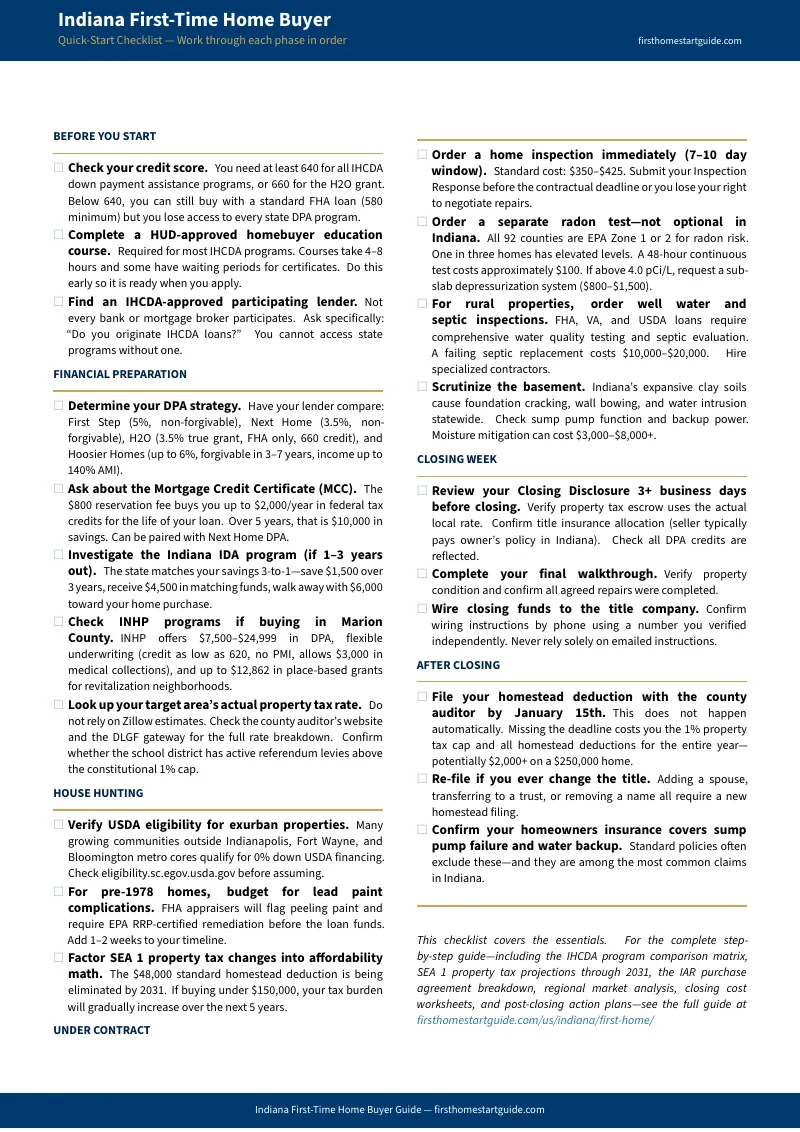
Download the free Indiana Quick-Start Home Buying Checklist to see the step-by-step action plan covering credit preparation, DPA eligibility, and property tax awareness. When you're ready for the full Hoosier Buyer System — with the DPA decision engine, SEA 1 tax projections, grant stacking playbook, and regional market intelligence — the complete guide is here.
You've got the pre-approval. Now build the system that gets you the keys without leaving thousands of dollars on the table.
Frequently Asked Questions
What if the rules change after I buy?
We update the guide when the rules change. Email us any time, even years later, and we'll send you the current edition free.