
You Got Pre-Approved. But the Lender Didn't Mention That Iowa Banned Title Insurance, That 72% of Homes Fail the Radon Test, or That the Subdivision Is Built on Top of Drainage Tiles That Can Flood Your Basement If You Install a Fence.
You found a three-bedroom in Waukee projecting $1,800/month PITI. Or a starter home outside Iowa City where your USDA loan covers 100% of the purchase. Or a bungalow in Ankeny where the listing says "move-in ready" and you already ran the numbers on the IFA grant. You're pre-approved. You're ready to make an offer.
Then Iowa happens. Your closing attorney hands you a heavy, bound book — the abstract of title — and tells you this is how Iowa does property ownership instead of title insurance, because the state banned commercial title insurance in 1947. The seller's previous attorney can't find the original abstract, and recreating it from county records costs $750 to $1,500 and delays your closing by three weeks. Your closing disclosure shows a $28,000 cash-to-close figure on a $260,000 house, and your lender explains that Iowa property taxes are paid in arrears — so the seller is crediting you for a full year of taxes they haven't paid yet, while your lender simultaneously requires you to fund your escrow account upfront. You move in, and three months later a radon test reveals levels of 12.3 pCi/L — more than three times the EPA action level — because Iowa law doesn't require sellers to test for radon, only to disclose results if they already tested. And that new subdivision you loved? It was built on former farmland laced with subterranean drainage tiles. Your neighbor installs a fence, crushes one, and your basement floods because the upstream agricultural water has nowhere to go — and under Iowa law, whoever damages a drainage tile is liable for double damages.
Here's what no single free resource explains: Iowa layers the only state in the nation to ban commercial title insurance against the highest radon levels in the country (8.5 pCi/L state average — six times the national average, 71.6% of homes above the EPA action level) against a property tax arrears system that makes closing disclosures look inflated by thousands of dollars against the July 1 Homestead Exemption deadline that costs you a full year of tax savings if you miss it against agricultural drainage tiles under suburban developments that create double-damages liability if disturbed against an IFA down payment assistance program where the $2,500 grant versus the 5% second loan decision determines whether you carry a silent lien for decades. Each of these has cost real Iowa buyers thousands because the information existed — scattered across the Iowa Finance Authority website, county assessor offices, drainage district maps, EPA radon zone designations, and Reddit threads from buyers who learned the hard way — but nobody had assembled it into a single decision system calibrated to how Iowa actually works.
The Iowa First-Time Home Buyer Guide is an Iowa Risk Navigation System — not a motivational overview of Midwest affordability, but a structured reference that maps every Iowa-specific program, tax mechanism, legal anomaly, environmental hazard, and closing cost line item into a process you work through before your earnest money is at risk. It replaces months of cross-referencing IFA program sheets, county tax tables, abstract of title procedures, radon zone maps, drainage district records, and forum posts with a single guide that tells you exactly what to verify, exactly what the numbers should look like, and exactly where deals go wrong in this state.
The complete guide, a quick-start checklist, and 8 standalone printable tools — covering IFA down payment assistance and stacking strategies, Iowa's abstract of title system, radon risk assessment, agricultural drainage tile liability, closing cost breakdown, tax credits and exemptions, regional market analysis, and your week-by-week closing timeline. Ten printable files:
- guide.pdf — The full guide covering every chapter
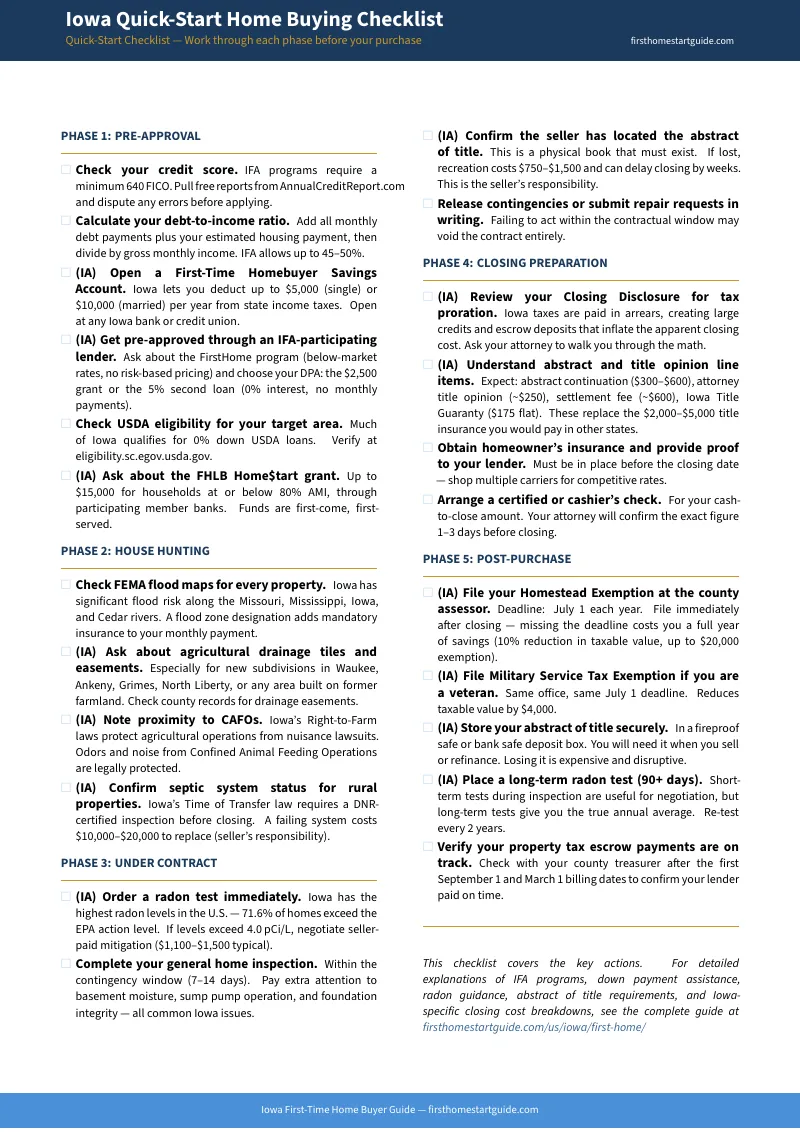
- checklist.pdf — Quick-start home buying checklist
- dpa-worksheet.pdf — IFA FirstHome grant vs. 5% second loan, FHLB Home$tart, Military $5K grant, USDA stacking, and a fillable DPA calculator
- abstract-of-title-reference.pdf — Iowa's ban on commercial title insurance explained, the 6-step closing process, cost comparison vs. other states, lost abstract procedures, and storage checklist
- radon-action-checklist.pdf — Iowa's EPA Zone 1 stats, pre-purchase testing protocol, negotiation strategies, mitigation system overview, and post-purchase maintenance schedule
- drainage-tile-checklist.pdf — Suburban tile risk, double-damages liability under Iowa Code Chapter 468, 5-point due diligence checklist, and what NOT to do
- closing-cost-worksheet.pdf — Line-by-line buyer and seller closing costs, transfer tax calculator, and the arrears-based tax proration explainer
- tax-credits-reference.pdf — Homestead Exemption (SF 2472), Military Service Tax Exemption, MCC, FTHSA, and the July 1 filing deadline
- regional-market-reference.pdf — Des Moines Metro, Iowa City, Cedar Rapids, Quad Cities, Ames, and rural Iowa at a glance with pricing and USDA eligibility
- closing-timeline.pdf — Your 30-to-45-day roadmap from offer to keys with Iowa's abstract-driven timeline
What's Inside the Iowa Risk Navigation System
A comprehensive guide with a quick-start checklist — covering every stage from pre-approval through post-closing, built specifically for the programs, legal structures, environmental risks, and tax mechanisms that make Iowa different from every other state:
IFA Down Payment Assistance Decision Framework
Iowa's primary assistance program — the IFA FirstHome program — offers two down payment assistance options that cannot be combined, and the choice between them fundamentally alters your financial trajectory. The guide breaks down the $2,500 grant (free money, no repayment, applied to down payment and closing costs) versus the 5% second loan (up to 5% of the purchase price, 0% interest, no monthly payments — but repaid in full when you sell, refinance, or pay off the first mortgage). It covers the income limits by county (ranging from $99,800 to $173,460 depending on family size and location), the $544,000 purchase price cap ($665,000 in targeted census tracts), the mandatory homebuyer education requirement, the 640 minimum credit score with no risk-based pricing above that floor, the free Iowa Title Guaranty certificate issued at closing, and the Homes for Iowans program for repeat buyers. Plus the IRS Recapture Tax that can apply if you sell within nine years at a significant profit — and the IFA's pledge to reimburse the actual tax amount if triggered.
The Abstract of Title System Explained
Iowa is the only state that prohibits commercial title insurance, relying instead on a system dating to the 1947 Iowa Code amendment (§515.48) after a wave of title insurance company bankruptcies left buyers unprotected. The guide walks you through the entire process: the physical abstract document (a bound chronological history of every deed, mortgage, lien, and easement since the property was first recorded), the abstractor continuation ($300-$600 to update the abstract with recent transactions), the attorney title opinion (~$250 for a licensed Iowa real estate attorney to certify the title is clear and marketable), and the Iowa Title Guaranty certificate (a $175 flat fee that functions as the state's equivalent of title insurance, protecting you and your lender against covered title defects). It covers the lost abstract crisis — what happens when the seller can't locate the physical book, how much recreation costs ($750-$1,500), and why this is the seller's responsibility. And it explains why the total cost of Iowa's system ($725-$1,525) is typically lower than the $2,000-$5,000 you would pay for commercial title insurance in other states.
Iowa Radon Risk Assessment
Every one of Iowa's 99 counties is classified EPA Zone 1 — the highest risk designation. The state average indoor radon level is 8.5 pCi/L (the national average is 1.3 pCi/L), and 71.6% of Iowa homes test above the EPA action level of 4.0 pCi/L. Iowa law does not require sellers to test for radon — only to disclose results if a test was previously conducted, creating a perverse incentive for sellers to remain willfully ignorant. The guide covers the testing options (certified tester vs. DIY continuous monitor), how to request radon testing during the inspection contingency window, how to negotiate seller-paid mitigation if results exceed 4.0 pCi/L, what active soil depressurization mitigation systems involve (PVC piping from the basement slab through the roof, continuously running fan), the typical installation cost ($1,100-$1,500), and why long-term post-purchase retesting every two years is essential.
Agricultural Drainage Tiles: The Suburban Risk
Over 10 million acres of Iowa contain subterranean clay and plastic drainage tiles — infrastructure originally installed to convert marshy wetlands into arable farmland. As suburbs expand into Waukee, Ankeny, Grimes, North Liberty, and Tiffin, residential subdivisions are being built directly on top of these tile networks. The guide explains why this matters to buyers who think suburban new-construction is risk-free: crushing a tile while installing a fence, pool, or landscaping cuts off upstream agricultural water, flooding your property and your neighbors'. Under Iowa Code Chapter 468, drainage districts enjoy broad sovereign immunity, and anyone who damages a tile is liable for double damages. Connecting a residential sump pump or septic system to a drainage tile — a mistake sometimes made by rogue contractors — violates DNR regulations and triggers severe environmental fines. The guide covers how to check county records for drainage easements, what to look for in property disclosures, and which questions to ask your inspector.
Iowa Property Tax Mechanics: The Arrears Shock
Iowa property taxes are paid in arrears — you are always paying for the previous fiscal year (July 1 through June 30), with bills due in two installments on September 1 and March 1. At closing, the seller provides a tax proration credit covering the period they occupied the home before the official tax bill was issued. Simultaneously, your lender requires you to fund your escrow account upfront to cover the massive upcoming tax bills. The guide explains why this creates closing disclosures that show $28,000+ cash-to-close on a $260,000 home — and why the net cost is much lower than the gross figures suggest. It includes the proration calculation method, the Real Estate Transfer Tax ($0.80 per $500 of value, first $500 exempt, customarily paid by the seller), and the specific Iowa closing cost line items that confuse every first-time buyer.
Homestead Exemption and the July 1 Deadline
Iowa's Homestead Exemption (restructured under SF 2472) reduces the taxable value of your primary residence by up to $20,000 in assessed value, saving hundreds per year in property taxes. The catch: you must file your application with the county assessor by July 1 of the year you first claim it. Miss the deadline by a single day and you lose an entire year of savings — the benefit won't appear on your tax statement until over two years later. The guide also covers the Military Service Tax Exemption ($4,000 in taxable value for eligible veterans), the expanded senior exemption ($6,500+ for claimants 65 and older), the First-Time Homebuyer Savings Account ($5,000/$10,000 annual deduction from state income taxes), and the Mortgage Credit Certificate (50% of annual mortgage interest as a federal tax credit, up to $2,000/year).
Regional Market Profiles
Iowa's housing markets vary dramatically by region. The guide covers four distinct buyer profiles: Des Moines Metro (insurance and financial services professionals, student debt barriers, rapidly appreciating suburbs), Iowa City and Ames (university-driven markets with the highest property values in the state, income limits up to $173,460 for IFA programs), Rural Iowa (USDA zero-down financing, septic Time of Transfer inspections, drainage tile exposure, CAFO proximity), and Davenport/Quad Cities (manufacturing workforce, aggressive DPA stacking strategies, the $15,000 FHLB Home$tart grant for households at 80% AMI). Each profile includes the programs, financing strategies, and local risks specific to that market.
20-Item Quick-Start Checklist
A structured checklist covering five phases — pre-approval, house hunting, under contract, closing preparation, and post-purchase — with every Iowa-specific deadline, program requirement, and verification step. Items marked with an Iowa flag highlight steps that will not appear on any generic national checklist: abstract confirmation, radon testing, drainage tile checks, CAFO proximity, tax proration review, and the July 1 Homestead filing deadline.
Who This Guide Is For
This guide is for first-time home buyers in Iowa who:
- Are buying their first home anywhere in Iowa and need to understand how IFA down payment assistance works — including the $2,500 grant versus the 5% silent second loan, the income limits that vary by county, the mandatory homebuyer education, and the IRS Recapture Tax that most lenders forget to mention
- Need to understand Iowa's abstract of title system before they hit the closing table — what the abstract is, what happens if it's lost, what the attorney title opinion covers, and how Iowa Title Guaranty replaces commercial title insurance at a fraction of the cost
- Are buying anywhere in Iowa and need to understand radon — why the state leads the nation, why sellers have no legal obligation to test, how to negotiate seller-paid mitigation during the inspection window, and what ongoing retesting looks like
- Are looking at properties in new suburbs (Waukee, Ankeny, North Liberty, Grimes) and need to understand how agricultural drainage tiles can destroy a basement and trigger double-damages liability — even in a brand-new subdivision
- Are confused by a closing disclosure that shows $25,000-$30,000 in closing costs on a $250,000-$280,000 home and need someone to explain how Iowa's arrears-based tax proration actually works
- Want every Iowa-specific program, tax exemption, legal process, and environmental risk in one reference — instead of assembling it from the IFA website, county assessor offices, EPA radon maps, drainage district records, and Reddit threads from people who already made the expensive mistakes
Why Not Free Tools and Forums?
Free information on buying a home in Iowa exists. Here's what it actually delivers:
- The IFA website (opportunityiowa.gov) publishes program parameters, income limits, and purchase price caps. It doesn't explain why the $2,500 grant is almost always the better choice for buyers who might move within 10 years, doesn't compare the two DPA options with specific financial impact scenarios, and doesn't cover the FHLB Home$tart grant stacking strategy. You get the program specs without the decision framework.
- Zillow and Realtor.com show estimated monthly payments using national-average property tax calculations. Iowa's arrears system, county-specific rates, and massive closing-day proration credits make those estimates misleading. And no listing platform flags radon zones, drainage tile networks, or abstract of title requirements. You get a number that looks right and isn't.
- Real estate agent blogs highlight Iowa's affordability, low cost of living, and friendly communities. They don't explain the abstract system, rarely mention radon beyond a passing note, never cover agricultural drainage tile liability, and don't walk through the arrears-based tax proration that makes closing disclosures look terrifying. The content is designed to generate leads, not to identify reasons to slow down and verify.
- Reddit threads (r/Iowa, r/DesMoines, r/FirstTimeHomeBuyer) contain real buyer panic — screenshots of $30,000 closing cost estimates, posts from people who discovered radon levels of 16 pCi/L after moving in, and questions about what an abstract of title even is. The experiences are genuine, but the advice is fragmented, often outdated, and contradictory. Sorting current from obsolete takes longer than reading a guide that has already done it.
This guide fills the Iowa-specific gap — the space between knowing how to buy a house in general and knowing how to buy one in a state where commercial title insurance is illegal, where 72% of homes fail the radon test, where property taxes are paid for last year not this year, where drainage tiles under your subdivision can trigger double-damages liability, and where a single missed July 1 deadline costs you a full year of tax savings. It's the analysis that would take an Iowa real estate attorney, an IFA-approved lender, and a radon mitigation specialist to assemble — structured as a reference you own permanently.
— Less Than One Radon Mitigation Quote
A professional radon test runs $150 to $300. A mitigation system costs $1,100 to $1,500 installed. Recreating a lost abstract of title costs $750 to $1,500 and delays your closing by weeks. Missing the July 1 Homestead Exemption deadline costs you an entire year of property tax savings. Choosing the wrong IFA DPA option — the 5% second loan instead of the $2,500 grant — means carrying a silent lien that's repaid from your equity when you sell. A crushed drainage tile triggers double-damages liability under Iowa law.
This guide doesn't replace your real estate attorney or your lender. But it gives you the IFA program analysis, abstract of title walkthrough, radon assessment protocol, drainage tile risk checklist, closing cost breakdown, and tax exemption filing instructions that ensure you identify every Iowa-specific risk before your earnest money is committed — instead of discovering them on your closing disclosure, your first radon test, or your first flooded basement.
If it catches a single lost-abstract delay, prevents a single radon surprise, or saves you from missing the July 1 Homestead deadline, it pays for itself before you've finished reading it.
Money-back guarantee, no time limit. If the guide doesn't sharpen your decision-making and protect your investment in Iowa's unique real estate landscape, you pay nothing.
Download the free Iowa Quick-Start Home Buying Checklist to see the 20-item action plan covering pre-approval, house hunting, inspection contingency, closing preparation, and post-purchase protection. When you're ready for the full IFA decision framework, abstract of title walkthrough, radon assessment guide, drainage tile risk analysis, and closing cost breakdown, the complete guide is here.
The house looks perfect on Zillow. This guide tells you whether Iowa agrees.