
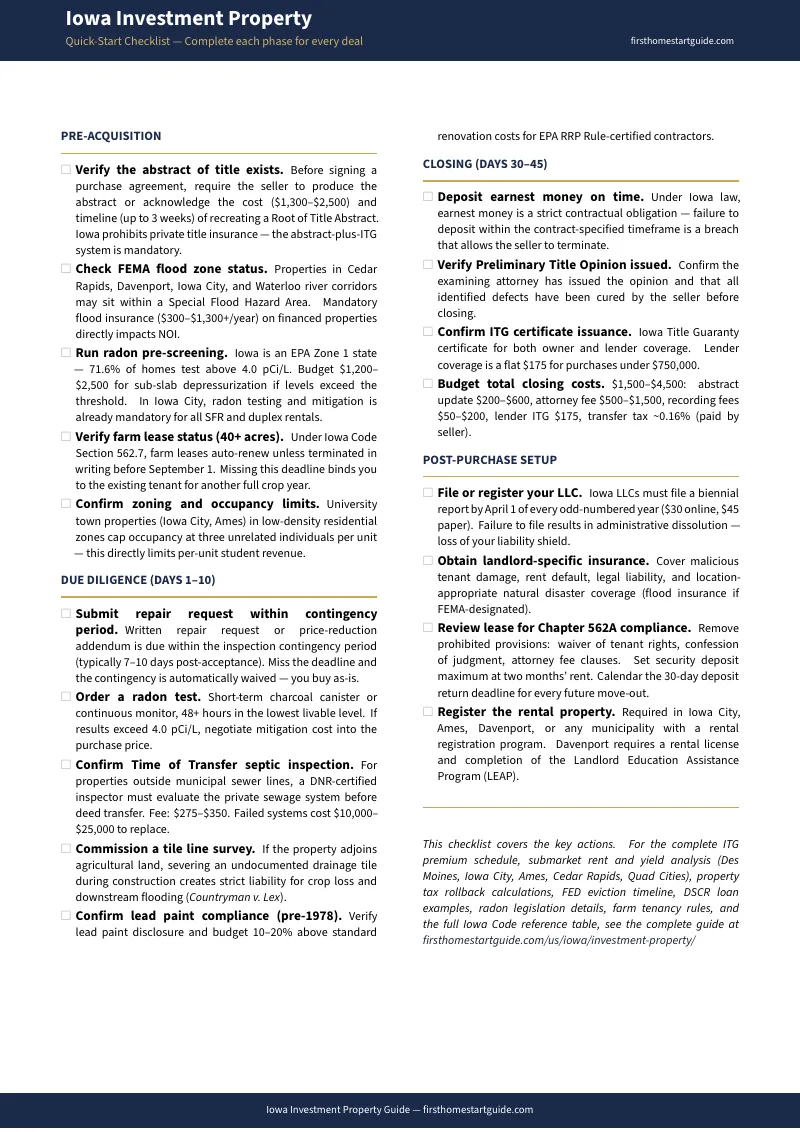
The Numbers Work. Iowa's Title System, Radon Law, and Farm Tenancy Rules Will Make Sure They Don't.
You found a duplex in Des Moines throwing off 9% gross yield. Or a student rental near the University of Iowa with guaranteed demand every August. Or a deeply discounted fourplex in Davenport that pencils at 11% cap rate because the Illinois investors can't compete on property taxes. The numbers clear. You're ready to wire earnest money.
Then you discover Iowa is the only state in the country that prohibits private title insurance. Since 1947, under Iowa Code Section 515.48, you cannot order a title policy and close in two weeks like every other market you've invested in. Instead, you need to locate a physical abstract of title — a historical document that may not exist — have it updated by a certified abstractor, examined by an Iowa-licensed attorney, and cleared through the state-run Iowa Title Guaranty program. If the abstract is lost, recreating it costs $1,300 to $2,500 and takes three weeks. Your 1031 exchange timeline is now in jeopardy. Or you close on a rental and your tenant mails you a radon test showing 8.5 picocuries per liter — double the EPA action level, and the state average. Under advancing legislation (HF 700), you now have exactly 90 days to install a certified mitigation system or the tenant can terminate the lease and demand back all prepaid rent and the full security deposit. Or you acquire a rural property with 60 acres of tillable land and discover that under Iowa Code Section 562.7, the existing farm lease auto-renewed on September 1 because nobody terminated it in writing — and you're now bound to the current tenant for an entire additional crop year at below-market rates.
Here's what no single resource tells you: Iowa layers the only state-level ban on private title insurance (requiring an abstract-attorney-ITG workflow that adds 2–4 weeks to every closing), advancing radon legislation that creates a 90-day tenant-initiated mitigation mandate backed by immediate lease termination rights, a unique property tax rollback system where residential property is taxed on only 86.25% of assessed value (making tax comparisons to other states systematically wrong), farm tenancy auto-renewal rules that bind buyers to existing agricultural leases they didn't know existed, university town occupancy caps limiting revenue in Iowa City and Ames, and Quad Cities flood zone risks with $3.9 million in annualized losses across 1,100+ properties in Scott County alone. Every one of these has cost real investors real money because the information existed — scattered across county recorder databases, Iowa Code chapters, FEMA flood maps, and BiggerPockets threads from 2019 — but nobody had assembled it into a single underwriting system.
The Iowa Investment Property Guide is an Iowa Investor Due Diligence System — not a motivational overview of Midwest real estate investing, but a structured underwriting framework that maps every Iowa-specific financial trap, regulatory restriction, and environmental risk into a process you work through before you wire earnest money. It replaces months of cross-referencing Iowa Code chapters, county assessor portals, ITG procedures, radon databases, and forum threads with a single reference that tells you exactly what to verify, exactly what the numbers should look like, and exactly where deals go wrong.
What's Inside the Iowa Investor Due Diligence System
A 16-chapter guide, a quick-start due diligence checklist, and 8 standalone printable reference cards and worksheets — covering every stage from market selection through post-purchase operations, built specifically for the financial traps and regulatory complexity that make Iowa different from every other state:
Iowa's Unique Title System and the Abstract of Title Workflow
The single most procedurally disorienting aspect of Iowa real estate for out-of-state investors. Iowa Code Section 515.48 has banned private title insurance since 1947 — the only state with this prohibition. Instead, every transaction requires locating and updating the property's abstract of title (a chronological record of every deed, mortgage, lien, and easement), having it examined by an Iowa-licensed attorney who issues a Preliminary Title Opinion, curing all identified defects, and obtaining an Iowa Title Guaranty certificate. If the abstract is lost or was never created (common with older rural properties and quitclaim transfers), a new Root of Title Abstract must be generated under the Forty Year Marketable Record Title Act — $1,300 to $2,500 and up to three weeks. Routine continuations cost $175 to $200, and lender ITG coverage is a flat $175 for purchases under $750,000. The guide covers the complete workflow, timeline expectations, common defects, attorney coordination, and the specific strategies for keeping 1031 exchanges on track despite this sequential process.
The Flat 3.8% Tax Advantage and Capital Gains Treatment
Iowa completed its transition from a progressive income tax (historical top rate: 8.53%) to a flat 3.8% individual income tax for the 2025 tax year. The critical nuance: Iowa does not offer a preferential rate for long-term capital gains — all gains are taxed as ordinary income. But because the ordinary income rate is now 3.8%, this is entirely irrelevant. The absolute ceiling on state tax liability for any liquidity event — selling a single rental or liquidating a multi-family portfolio — is 3.8% regardless of holding period. This is lower than Nebraska (5.84%), Wisconsin (~5.36% effective), Illinois (4.95%), and far below California (13.3%). An investor exiting a $500,000 gain pays $19,000 to Iowa versus $66,500 to California. The guide covers the full tax transition mechanics, how outdated forum advice citing the old 8.53% rate causes massive miscalculations, and how to model true after-tax yields using the current rate structure.
Radon Legislation and the 90-Day Landlord Mandate
Iowa averages 8.5 picocuries per liter of radon — more than double the EPA's recommended action level of 4.0 pCi/L. Seven out of ten Iowa homes exceed federal guidelines. Under advancing legislation (HF 700, originally introduced as HF 377), tenants can conduct their own radon tests or hire certified professionals. If results equal or exceed the action level, the tenant provides written notice and the landlord has a strict 90-day window to install a certified mitigation system. If the landlord fails or a subsequent test still exceeds the threshold, the tenant holds the right to terminate the lease immediately — and the landlord must return all prepaid rent and the full security deposit. Iowa City has already enacted mandatory testing and mitigation for all single-family and duplex rentals (effective July 2021). Mitigation costs range from $800 to $2,500 per property. The guide covers pre-acquisition screening strategies, mitigation system specifications, Iowa City's existing ordinance, and how to budget for compliance across a portfolio.
The Property Tax Rollback System
Iowa uses a unique "rollback" system that limits the taxable value of residential property to approximately 86.25% of assessed value. This means your property tax bill is calculated on roughly 86% of what the county assessor says your property is worth — not the full assessed value. Out-of-state investors consistently overestimate their tax liability by applying published levy rates to full assessed value rather than the rolled-back taxable value. The guide explains the rollback calculation, how it interacts with county levy rates, the assessment appeal process, and how Iowa's effective 1.43% rate (already post-rollback) compares to Nebraska (1.50%) and Wisconsin (1.51%) on an apples-to-apples basis.
University Town Investment Strategies
Iowa City (University of Iowa, ~33,000 students) and Ames (Iowa State University, ~30,000 students) offer dense renter pools with guaranteed annual demand. But regulatory complexity is extreme. Low-density residential zones cap occupancy at three unrelated individuals per unit — directly limiting per-unit revenue regardless of bedroom count. Both cities require rental registration and routine inspections. The student rental cycle operates on a 10-month academic year with July/August turnover. The guide covers joint and several liability lease structuring, semester-based payment collection, the competitive dynamics that make "anything with 4 walls and a roof" trade at razor-thin margins in these markets, strategies for generating positive returns within the 3-occupant limit, and how to navigate the rental registration programs that add compliance costs to every unit.
Quad Cities Cross-Border Arbitrage and Flood Risk
The Quad Cities metro spans the Iowa-Illinois border, and savvy investors systematically favor the Iowa side (Davenport, Bettendorf) for lower property taxes, landlord-friendly law, and no rent control. But Davenport has its own regulatory layer: mandatory rental licenses, the Landlord Education Assistance Program (LEAP) training requirement, and rigorous property maintenance inspections evaluating granular details like minimum bedroom square footage (70 sq ft for habitable rooms) and address number visibility. Furthermore, Scott County faces $3.9 million in annualized flood losses across 1,100+ properties. The guide covers the cross-border tax and regulatory comparison, Davenport's specific compliance requirements, floodplain development permits, base flood elevation requirements, and how to identify properties where deeply discounted prices in river corridors actually reflect permanently elevated carrying costs rather than opportunity.
Farm Tenancy Auto-Renewal Trap
Under Iowa Code Section 562.7, farm leases automatically renew for an additional year unless terminated in writing before September 1. This catches investors who acquire properties with tillable acreage (common in Iowa, even in suburban-fringe areas) without realizing that the existing agricultural tenant's lease has already auto-renewed. Missing the termination deadline binds the new owner to the tenant for a full additional crop year — at whatever rate the previous owner negotiated. The guide covers how to identify properties subject to farm tenancy rules, the September 1 termination calendar, the distinction between farm tenancies and standard residential leases, and the agricultural capital gains exclusion mechanics.
Submarket Analysis with Realistic Cap Rates
Five Iowa submarkets dissected with entry-level prices, rental yields, vacancy rates, demand drivers, flood exposure, and strategy alignment: Des Moines metro (Polk County) — balanced appreciation and cash flow, $195,000–$270,000 entry, 7–10% gross yields on well-positioned multifamily. Iowa City and Ames — university-driven demand, regulatory density, 10-month lease cycles. Quad Cities (Davenport/Scott County) — cross-border arbitrage, flooding risk, $100,000–$180,000 entry on duplexes. Cedar Rapids (Linn County) — $1.96 million annualized flood losses across 2,500 properties, post-2008 recovery economics. Rural markets — extreme affordability, low turnover, abstract and title complications, farm tenancy exposure. Know which game you're playing before you deploy capital.
Iowa Landlord-Tenant Law and Eviction Framework
Iowa Code Chapter 562A (Uniform Residential Landlord and Tenant Law) governs the relationship. Security deposits are capped at two months' rent with a strict 30-day return timeline. Bad-faith retention triggers two months' rent in punitive damages. Leases cannot contain waiver of tenant rights, confession of judgment, or attorney fee clauses — these are void under Iowa law. The 3-day notice to pay or quit initiates eviction for non-payment. The rent control prohibition under Iowa Code Section 364.3(12)(a) is an active statewide ban, not merely the absence of rent control. The guide covers the complete statutory framework, eviction timelines, prohibited lease provisions, and the specific operational protocols that keep you compliant.
Standalone Printable Tools (Included)
Eight ready-to-print reference cards and worksheets you can bring to closings, attorney meetings, and property viewings:
- Abstract of Title Workflow — the sequential process, ITG pricing, timeline expectations, and a pre-offer checklist
- Closing Cost Worksheet — every line item with payor conventions, estimated ranges, and a transfer tax calculator
- Property Tax Rollback Worksheet — step-by-step calculation so you never overestimate Iowa taxes
- Radon Compliance Reference — HF 700 timeline, mitigation costs, Iowa City ordinance, and pre-acquisition protocol
- Market Comparison Reference — Iowa vs. Nebraska, Wisconsin, Illinois, and Minnesota on every investment factor
- Submarket Analysis Reference — five Iowa markets with rents, yields, entry prices, and risk ratings
- Farm Tenancy Reference — September 1 deadline, service methods, exceptions, and due diligence checklist
- Financing Comparison — DSCR vs. conventional vs. cash with calculation examples
Who This Guide Is For
This guide is for real estate investors targeting Iowa markets who:
- Are analyzing an Iowa property and need to understand the abstract of title system before committing to a timeline — particularly if you're relying on a 1031 exchange that requires closing within a strict identification or purchase window and cannot tolerate a 3-week abstract reconstruction delay
- Are under contract on a rental property and need to understand your radon exposure — the pre-screening protocols, HF 700 compliance timeline, mitigation costs, and Iowa City's existing mandatory testing ordinance — before the inspection contingency expires
- Are comparing Iowa to Illinois, Nebraska, or Wisconsin and need an objective framework that accounts for the 3.8% flat tax advantage, rent control prohibition, property tax rollback, and landlord-tenant law differences — not the oversimplified "Iowa is cheap" narrative from forum threads
- Are targeting university towns (Iowa City, Ames) and need to underwrite based on the 3-occupant zoning limit, 10-month lease cycles, and rental registration requirements — not the 5-bedroom revenue model that assumes you can pack a house with students
- Are acquiring property with tillable acreage (even suburban-fringe parcels in Iowa often include agricultural land) and need to know whether a farm lease has already auto-renewed before closing
- Want every Iowa-specific regulation, tax calculation, title procedure, and environmental risk in one reference — instead of assembling it from Iowa Code chapters, county assessor databases, ITG procedures, and forum threads that may predate the flat tax transition
Why Not Free Tools and Forums?
Free information on Iowa real estate investing exists across dozens of sources. Here's what it actually delivers:
- BiggerPockets forums are where someone in a 2019 thread says Iowa is "the best-kept secret in the Midwest" with no mention of the abstract system delays, where someone asks about Davenport and gets told "just buy on the Iowa side for lower taxes" without any discussion of the mandatory LEAP training, rental licensing, or flood zone carrying costs, and where the most-upvoted advice on Iowa taxes cites the old 8.53% top rate because nobody has updated their models since the flat tax transition. You'll find genuinely useful local knowledge mixed with advice that predates HF 700, the flat tax implementation, and the Iowa City radon ordinance.
- Iowa Association of Realtors provides standardized purchase agreement forms and market statistics. It does not provide investor-specific underwriting tools, abstract system guidance, or analysis of how Iowa's unique title procedure affects acquisition timelines, 1031 exchanges, or out-of-state investors accustomed to 14-day escrow closings. Their materials assume you already understand how Iowa closings work.
- Iowa Secretary of State and county recorder databases maintain deed records, but do not explain the abstract of title workflow, the examining attorney's role, or what happens when an abstract is missing. The Iowa Title Guaranty website explains their certificate program but doesn't address the operational friction that catches investors who expect a national-style title insurance workflow.
- Iowa Code online gives you raw statutory text — Chapter 562A for landlord-tenant law, Section 364.3 for rent control prohibition, Section 562.7 for farm tenancy. But statutes without operational context don't tell you that the 30-day deposit return deadline triggers two months' punitive damages for bad-faith retention, or that the September 1 farm lease termination date means you need to close before late August if you want control of tillable acreage in the first year.
- National investing courses teach cap rate, DSCR, and general landlord-tenant frameworks. They don't cover the abstract of title system, the ITG process, Iowa's property tax rollback, the HF 700 radon mandate, farm tenancy auto-renewal, university town occupancy caps, or the Quad Cities flood zone economics. Applying national frameworks to Iowa-specific problems is how investors budget two weeks for closing and discover they need six.
This guide fills the Iowa-specific gap — the space between knowing how to analyze a rental property in general and knowing how to underwrite one in a state where the title system adds weeks to every closing, radon legislation creates enforceable tenant remedies, farm tenancy rules bind you to existing leases, and university town zoning caps your revenue regardless of bedroom count. It's the analysis that would take an Iowa real estate attorney, a local property manager, and a certified radon specialist to assemble — structured as a reference you own permanently.
— Less Than One Abstract Continuation
A missing abstract you didn't verify before making an offer delays closing by three weeks and costs $1,300 to $2,500 — potentially killing a 1031 exchange. A radon mitigation system you didn't budget for costs $800 to $2,500 per property — and under HF 700, failure to install one within 90 days means losing the tenant, the prepaid rent, and the full security deposit. A farm lease that auto-renewed on September 1 because you closed in October binds you to a below-market agricultural tenant for an entire additional year. A university town property you underwrote assuming five tenants per unit produces revenue for three — because zoning caps occupancy at three unrelated individuals and nobody mentioned it until after closing.
This guide doesn't replace your Iowa real estate attorney or your examining title attorney. But it gives you the abstract system workflow, radon compliance protocol, property tax rollback calculations, and university town underwriting framework that ensure you identify every Iowa-specific risk before you're contractually committed — instead of discovering them after your earnest money becomes non-refundable.
If it catches a single abstract problem before you commit to a timeline, prevents a single radon compliance failure, or saves you from underwriting a university rental at five occupants when zoning allows three, it pays for itself before you've finished reading it.