
Your Lender Said You're Approved. But Nobody Mentioned That Five Cities Are Excluded From the State's Best Down Payment Program, Your Property Tax Is Calculated on 11.5% of Appraised Value Times a Mill Levy That Zillow Doesn't Know, and the Average Kansas Home Tests Above the EPA's Radon Action Level.
You found a three-bedroom ranch in Overland Park with a fenced yard and a 10-minute drive to the Sprint Campus. Or a move-in-ready split-level near Fort Riley where the monthly payment fits inside your BAH. Or a renovated bungalow in Topeka's NOTO district where the listing price is $168,000 and you're wondering why nobody else is buying. You got pre-approved, you ran the numbers through a mortgage calculator, and you're ready to submit an offer.
Then Kansas happens. The KHRC First Time Homebuyer Program offers a 15% or 20% forgivable loan at 0% interest -- the most generous down payment assistance in the region. But your target home is in Wichita. Or Kansas City. Or Lawrence. Or Topeka. Or Johnson County. All five are excluded from KHRC because they administer their own federal HOME funds, and each city runs a completely different program with different income limits, different property restrictions, and different counseling requirements. You spend three weeks applying to the wrong program. Meanwhile, your mortgage calculator estimated property taxes by applying the national-average effective rate to the listing price. Kansas doesn't work that way. The state assesses residential property at exactly 11.5% of the county-appraised fair market value, then multiplies that assessed value by a composite mill levy set by your specific city, county, and school district. A $250,000 home assessed at $28,750 with a 130-mill levy generates a $3,737 annual tax bill -- and the county appraiser is legally required to reassess annually based on recent comparable sales. The tax bill you saw on the listing? That was the seller's assessment. Yours will be higher.
Here's what no single free resource explains: Kansas layers a down payment assistance landscape where the state's best program excludes its five largest cities and each excluded city runs its own program with different rules, against a property tax system where the 11.5% fractional assessment ratio and hyper-local mill levies produce tax bills that national calculators consistently underestimate, against an EPA Zone 1 radon classification where the statewide average indoor test result of 5.4 pCi/L exceeds the federal action level and mitigation systems cost $700 to $2,100, against a homeowners insurance market where wind and hail damage carries a separate percentage-based deductible of 1% to 2% of dwelling coverage -- meaning $4,000 to $8,000 out of pocket before your policy pays a cent after the next spring hailstorm, against a military housing market where VA loans require a statewide Wood-Destroying Insect inspection regardless of county and the state does not offer the full disabled veteran property tax exemption that buyers from Texas and Florida assume exists, against a Kansas-vs-Missouri border decision where the absence of a Kansas transfer tax and the 11.5% assessment ratio look favorable on paper until you compare Johnson County's 138-mill levy against Jackson County's lower assessment rate on the Missouri side. Every one of these has cost real Kansas buyers thousands of dollars because the information existed -- scattered across KHRC program PDFs, county appraiser mill levy tables, EPA radon zone maps, insurance broker disclosure forms, VA regional loan center bulletins, and r/kansascity threads from 2023 -- but nobody had assembled it into a single decision system calibrated to how Kansas actually works.
The Kansas First-Time Home Buyer Guide is a Sunflower State Ownership Cost Calculator -- not a motivational overview of Kansas housing affordability, but a structured reference that maps every Kansas-specific down payment program, property tax calculation, environmental risk, insurance trap, and military buyer requirement into a process you work through before your earnest money is at risk. It replaces months of cross-referencing KHRC program guidelines, county appraiser websites, EPA zone maps, insurance deductible disclosures, and VA regional requirements with a single guide that tells you exactly what to verify, exactly what the numbers should look like, and exactly where deals go wrong in this state.
What's Inside the Sunflower State Ownership Cost Calculator
A comprehensive guide, a quick-start checklist, and standalone printable worksheets and reference cards -- covering every stage from pre-approval through post-closing, built specifically for the financial traps and environmental realities that make Kansas different from every other state:
Down Payment Assistance Navigator: KHRC, KHAP, FHLBank, and Local Programs
Kansas has the most generous -- and most confusing -- down payment assistance landscape in the Midwest, and the number one reason buyers fail to capture it is applying to the wrong program. The KHRC First Time Homebuyer Program offers a 0% interest forgivable loan for 15% or 20% of the purchase price -- fully forgiven after 10 years of owner occupancy. But it explicitly excludes homes inside Wichita, Kansas City, Lawrence, Topeka, and Johnson County. Buyers in those five areas waste weeks before discovering they need entirely different programs: Wichita's HOMEownership 80 (newly built homes from designated CHDOs only, under 80% AMI), Topeka's Opportunity to Own ($5,000 DPA plus up to $30,000 in forgivable rehab loans, but only on homes under $75,000), or the city-specific HOME programs in KC and Lawrence. The guide maps every program by geography and income bracket, explains the truly statewide options -- KHAP (3% to 5% cash grant, incomes up to $121,240 in some MSAs) and FHLBank Topeka's HSP ($15,000 grant at 80% AMI) and HOPE ($5,000 grant at 115% AMI for the "missing middle") -- and shows you how to stack these grants with FHA, VA, USDA, and conventional loans. It covers the KHRC $10,000 liquid asset spend-down rule, the 1% minimum buyer investment, the FHLBank five-year Real Estate Retention Agreement, and the specific participating lenders you must use to access FHLBank funds.
Property Tax Calculator: The 11.5% Assessment and Mill Levy System
Every national mortgage calculator gets Kansas property taxes wrong. They apply an average effective rate to the listing price. Kansas uses a fractional assessment system where residential property is assessed at exactly 11.5% of its county-appraised fair market value, and the resulting assessed value is then multiplied by a composite mill levy that varies by the specific intersection of your city, county, and school district. The guide walks through the exact calculation: a $250,000 home at 11.5% assessment produces a $28,750 assessed value; at a 130-mill levy, that generates $3,737.50 in annual taxes. It explains the statewide 20-mill school levy and the $20,000 appraised value exemption that produces a flat $46 reduction -- a number buyers frequently mistake for a meaningful property tax break. Most critically, it covers the annual reassessment trap: county appraisers are required by Kansas statute to revalue every property annually based on recent comparable sales. The seller's tax bill reflected a lower historical valuation. Your post-purchase reassessment will reflect your actual acquisition price, and your escrow payment will spike accordingly. The guide includes a worksheet for calculating your true first-year and second-year tax liability -- not the number from Zillow.
Radon Risk Assessment: EPA Zone 1 Reality
Kansas sits squarely in EPA Radon Zone 1 -- the highest risk classification -- across the vast majority of its populated counties, including Johnson, Wyandotte, Shawnee, Riley, and Sedgwick. The statewide average indoor radon test result is 5.4 pCi/L, which exceeds the EPA's recommended action level of 4.0 pCi/L. During the inspection period, the optional $150 radon test looks like an unnecessary expense. It is the single most cost-effective inspection add-on you can purchase. If elevated levels are detected post-closing, installing an active soil depressurization mitigation system costs $700 to $2,100 -- entirely out of your pocket, with zero negotiating leverage. The guide covers how to include radon testing in your inspection contingency, how to negotiate seller-funded mitigation when levels exceed 4.0 pCi/L, and the county-by-county risk profiles that determine whether you're looking at a formality or a near-certainty.
Wind and Hail Insurance: The Percentage Deductible Trap
Kansas sits in the core of severe convective storm territory. Out-of-state buyers expect a standard flat-dollar deductible on their homeowners insurance. What they get is a separate, percentage-based wind and hail deductible -- typically 1% to 2% of the dwelling's total coverage amount. On a $400,000 home, a 1% wind/hail deductible means $4,000 out of pocket before the insurer pays anything on a hail-damaged roof. At 2%, that's $8,000. The guide explains how to read the deductible structure in your insurance quote, how supplemental deductible buy-down policies (like SOLA, which pays based on National Weather Service data without an adjuster) can convert a variable catastrophic risk into a fixed cost, and how to evaluate a home's existing roof condition and material (impact-resistant shingles rated under UL 2218 can reduce premiums by 15% to 28%). It covers the KDEM Sunflower-safe Residential Safe Room Rebate Program -- a FEMA-backed initiative that reimburses 75% of the cost of installing a residential storm shelter, capping at $3,500 -- and explains why evaluating a property's suitability for a safe room during the initial inspection is far easier than retrofitting after closing.
Military Buyer Playbook: Fort Riley and Fort Leavenworth
Kansas hosts two major military installations, and service members stationed at either face a unique set of VA loan pitfalls and property tax misconceptions that can cost thousands. The guide covers the mandatory statewide Wood-Destroying Insect (WDI) inspection required on every VA loan purchase in Kansas -- regardless of county, regardless of the age of the home -- and the timeline pressure it creates within the 60-day closing window. It walks through the VA Minimum Property Requirements (MPRs) that derail transactions in older Kansas housing stock: peeling paint on pre-1978 homes (lead paint flag), major roof deficiencies, nonfunctional heating systems, and exposed electrical components. It addresses the dangerous property tax myth head-on: Kansas does not offer a full property tax exemption for disabled veterans. Instead, the K-40SVR program provides a tax freeze mechanism for veterans with 50% or greater permanent service-connected disability and household income under $58,041 -- not the Texas-style 100% waiver that military buyers from other states expect. The guide includes the BAH-to-PITI comparison framework for the rent-vs-buy calculation on a 3-year PCS timeline, the rental conversion checklist for service members who PCS and want to hold the property, and the SCRA lease termination provisions that protect military tenants.
Kansas vs. Missouri Border Analysis
Buyers in the KC metro face a genuine financial fork: Kansas or Missouri? The guide breaks down the actual economic comparison that r/kansascity debates endlessly but never resolves. Kansas advantages: no state real estate transfer tax (saving hundreds to thousands at closing), no earnings tax equivalent to Kansas City MO's 1% E-tax. Missouri advantages: Jackson County's lower fractional assessment rate versus Johnson County's 138+ mill levy, and lower effective property tax rates in certain municipalities. The guide shows how to calculate the total cost of ownership on both sides of the state line for your specific income, purchase price, and target neighborhood -- because the answer changes depending on where exactly you're buying, where you work, and how long you plan to hold. It covers the school district quality premium in Prairie Village, Overland Park, and Shawnee Mission versus comparable Missouri suburbs, and the impact of Missouri's higher state income tax rate against Kansas's moderately lower rate.
Rural Kansas: Well, Septic, and Land Use Due Diligence
Buyers looking at acreage outside the metros face entirely different infrastructure hurdles. Instead of city water and sewer, they're evaluating private well water quality and residential septic system compliance. The guide covers the KDHE septic regulations -- 10-foot setback from foundations, 50-foot setback from water sources, no placement in the 100-year floodplain -- and the access port requirement (within 12 inches of final surface grade) that frequently requires immediate riser extension installation. It walks through the bacteriological water testing protocol for private wells, the coliform and E. coli risk in agricultural counties, the disinfection and retest procedure if a well fails during inspection, and the USDA Rural Development loan eligibility requirements that provide 100% financing for qualifying rural properties.
Quick-Start Checklist
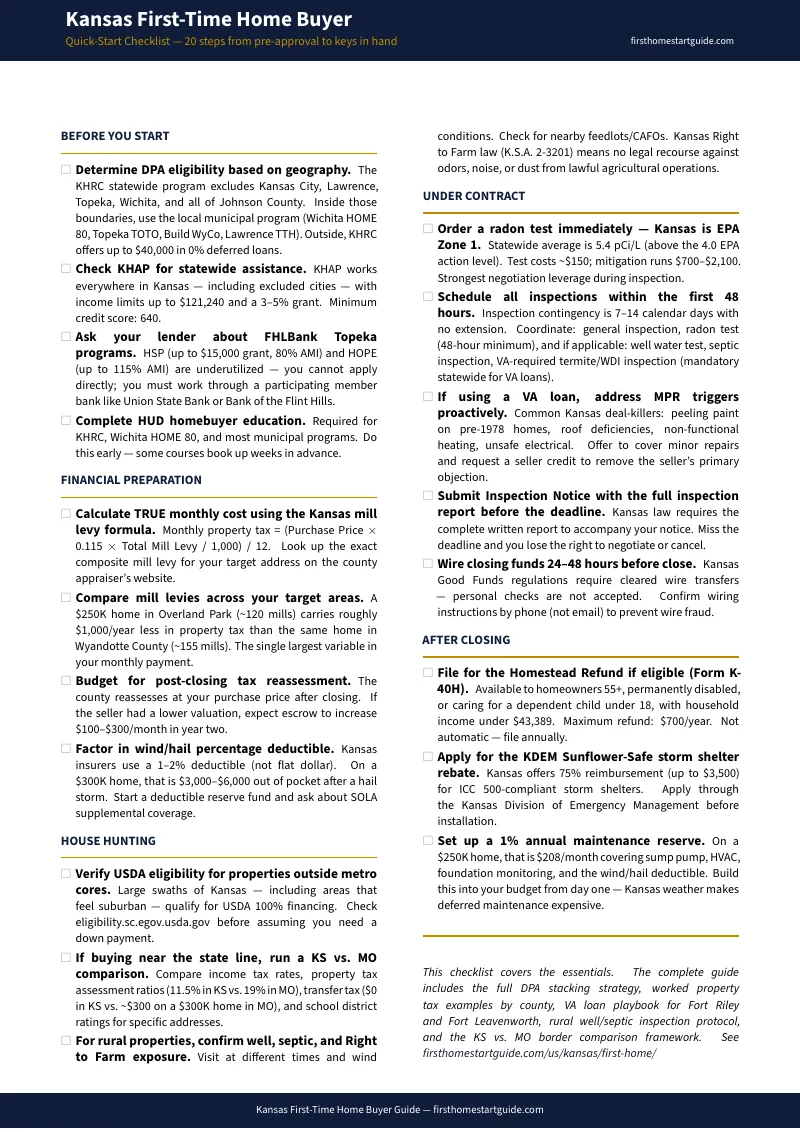
A structured checklist covering every phase of the Kansas home buying process -- from DPA program identification and pre-approval through inspection contingencies, insurance verification, and post-closing tax setup. Kansas-specific verification steps at each stage: KHRC geographic eligibility check, mill levy lookup for target address, radon zone verification, wind/hail deductible confirmation, and WDI inspection scheduling for VA buyers. Print it and check items off as you go.
Standalone Printable Worksheets and Reference Cards
Print-ready tools you can bring to lender meetings, property showings, inspections, and closing appointments:
- Property Tax Calculator Worksheet -- Fillable worksheet for the 11.5% assessment ratio calculation, mill levy lookup by address, annual reassessment projection, and first-year vs. second-year escrow comparison
- DPA Program Decision Matrix -- Side-by-side comparison of KHRC, KHAP, FHLBank HSP, FHLBank HOPE, and local municipal programs with geographic eligibility, income limits, and stacking rules
- Closing Cost Calculator -- Line-by-line fillable worksheet covering title insurance, lender fees, prepaid items, DPA credits, inspection costs, and Kansas-specific line items (no transfer tax confirmation, radon testing, WDI inspection)
- Inspection Contingency Checklist -- Standard items plus Kansas-specific checks for radon testing, WDI inspection (VA mandatory), wind/hail roof assessment, foundation inspection, and rural well/septic evaluation
- Insurance Deductible Comparison Card -- Wind/hail percentage deductible calculation, buy-down policy options, impact-resistant shingle premium discounts, and KDEM safe room rebate eligibility
- KS vs. MO Border Comparison Worksheet -- Total cost of ownership calculator for both sides of the state line: property tax, income tax, transfer tax, earnings tax, and school district quality metrics
Who This Guide Is For
This guide is for first-time home buyers in Kansas who:
- Are buying their first home anywhere in Kansas and need to understand which down payment assistance programs they actually qualify for -- before wasting weeks applying to KHRC only to discover their target city is excluded, or missing the FHLBank HOPE program because they assumed they earn too much for state aid
- Are calculating their monthly payment and need the actual property tax number -- not the national-average estimate from Zillow, but the 11.5% fractional assessment times their specific city/county/school district mill levy, with the post-purchase reassessment factored in
- Are active-duty military at Fort Riley or Fort Leavenworth using a VA loan and need to know about the mandatory statewide termite inspection, the MPR triggers that derail closings on older housing stock, and the property tax benefit limitations before they commit to buying on a 3-year PCS timeline
- Are relocating from out of state and bought the myth that "Kansas is cheap -- there isn't much to know" -- and need to understand the radon risk, the wind/hail deductible exposure, the property tax reassessment spike, and the DPA program fragmentation before their earnest money is committed
- Are house hunting in the KC metro and need to resolve the Kansas vs. Missouri decision with actual numbers -- transfer tax savings, property tax comparison, income tax rates, school district quality, and earnings tax implications for their specific income and purchase price
- Are looking at rural property and need the well water testing protocol, septic compliance requirements, KDHE setback regulations, and USDA Rural Development loan parameters in one reference instead of scattered across county health department websites
- Want every Kansas-specific DPA program, property tax calculation, environmental risk, insurance structure, military buyer requirement, and border comparison in one reference -- instead of piecing it together from KHRC PDFs, county appraiser databases, EPA zone maps, insurance disclosures, and Reddit threads from buyers who learned the hard way
Why Not Free Tools and Forums?
Free information on buying a home in Kansas exists. Here's what it actually delivers:
- KHRC's website publishes program guidelines, income limits, and lender directories. It doesn't tell you upfront that homes in Wichita, Kansas City, Lawrence, Topeka, and Johnson County are excluded -- you discover that after navigating dense PDF documents and bureaucratic language. It doesn't compare KHRC against KHAP, FHLBank HSP, or FHLBank HOPE with a side-by-side decision matrix. It doesn't explain that you cannot apply to FHLBank directly -- you must find a participating local member bank. You get program specifications without the geographic eligibility map or the stacking framework.
- Zillow, Bankrate, and national mortgage calculators estimate your monthly payment using a national-average property tax rate applied to the listing price. They don't use the 11.5% fractional assessment ratio, don't look up your specific city/county/school district mill levy, don't account for the statewide 20-mill school levy exemption, and don't project the post-purchase reassessment that will spike your escrow in year two. The monthly payment they show can be $200 to $400 lower than reality.
- Real estate agent blogs and lender websites mention KHRC assistance and Kansas's lack of a transfer tax. They don't disclose the five-city KHRC exclusion, don't explain the wind/hail percentage deductible that creates $4,000 to $8,000 out-of-pocket exposure on a single claim, don't mention that the statewide average radon test exceeds the EPA action level, and don't warn military buyers that Kansas does not offer the full disabled veteran property tax exemption. The content is designed to generate leads, not to quantify the hidden costs that arrive after closing.
- Reddit threads (r/kansascity, r/kansas, r/MilitaryFinance) contain genuine buyer experiences -- people sharing property tax reassessment shock, wind/hail deductible surprises, and the Kansas-vs-Missouri debate. But the advice is fragmented, contradictory, and dated. One thread says "Kansas taxes are low." Another thread says "my taxes jumped 30% after I bought." Nobody reconciles the two with the actual 11.5% assessment math. Sorting current from outdated across multiple subreddits takes longer than reading a guide that has already done it.
- The EPA's radon zone map classifies most of Kansas as Zone 1 -- highest risk. It doesn't tell you the statewide average test result is 5.4 pCi/L, doesn't quote the $700 to $2,100 mitigation cost range, and doesn't explain how to negotiate seller-funded mitigation during the inspection period. You get a color-coded map without the financial implications or the negotiation playbook.
This guide fills the Kansas-specific gap -- the space between knowing how to buy a house in general and knowing how to buy one in a state where the best DPA program excludes five cities, where property taxes are calculated using a fractional assessment ratio that no national calculator replicates, where the average home tests above the EPA radon action level, where wind and hail deductibles create thousands in out-of-pocket exposure, and where military buyers lose money on property tax misconceptions imported from other states. It's the analysis that would take a Kansas real estate attorney, a KHRC program specialist, an insurance broker, and a radon mitigation contractor to assemble -- structured as a reference you own permanently.
-- Less Than One Property Tax Reassessment Surprise
A single year of property taxes modeled from the seller's historical assessment instead of your post-purchase reassessment understates your escrow by hundreds of dollars -- and the bill arrives whether you budgeted for it or not. Applying to KHRC for a home inside one of the five excluded cities wastes weeks and delays your closing while the house you wanted goes to another buyer. Waiving the $150 radon test to make your offer more competitive leaves you paying $700 to $2,100 for mitigation with zero negotiating leverage. Accepting your insurance quote without understanding the wind/hail percentage deductible means discovering your $4,000 to $8,000 out-of-pocket exposure on the day a hailstorm hits. A military buyer from Texas who assumes Kansas offers a full disabled veteran property tax exemption miscalculates their housing budget by thousands per year.
This guide doesn't replace your real estate agent, your lender, or your insurance broker. But it gives you the DPA program navigator, the property tax calculator, the radon risk assessment, the insurance deductible analysis, the military buyer playbook, and the KS-vs-MO border comparison that ensure you identify every Kansas-specific financial risk before your earnest money is committed -- instead of discovering them on your first escrow adjustment, your first insurance claim, or your first radon test after you've already closed.
If it catches a single DPA program mismatch, prevents a single property tax miscalculation, or saves you from one unbudgeted wind/hail deductible, it pays for itself before you've finished reading it.
Money-back guarantee, no time limit. If the guide doesn't sharpen your decision-making and protect your investment in Kansas's unique property tax, assistance program, and environmental landscape, you pay nothing.
Download the free Kansas Quick-Start Home Buying Checklist to see the action plan covering DPA program identification, property tax verification, radon risk assessment, insurance deductible analysis, and inspection contingency preparation. When you're ready for the full DPA stacking framework, mill levy calculator, military buyer playbook, and KS-vs-MO border comparison, the complete guide is here.
The house looks affordable on Zillow. This guide tells you whether Kansas's mill levy, radon levels, and insurance deductibles agree.