The Listing Says 26% Yield. Louisiana's Civil Law, Termite Bonds, and STR Lottery Say Otherwise.
You found a short-term rental in the Warehouse District throwing off $197,000 gross annual revenue. Or a student rental duplex near LSU where the price-to-rent ratio screams cash flow. Or an inherited double shotgun in the Bywater listed at $185,000 where the rehab math works and the neighborhood is gentrifying. The numbers look right. The cap rate is solid. You're ready to wire earnest money.
Then you run the real numbers. The Warehouse District rental requires an NSTR permit, but the property is in your LLC's name -- LLCs are completely ineligible for residential short-term rental permits in New Orleans. The only alternative is a CSTR permit, but the city imposed a complete moratorium on new commercial STR applications in June 2023 and it remains in effect. The Bywater double was inherited by the seller's mother, who died three years ago with a 21-year-old son from a prior marriage. No succession was filed. Under Louisiana's forced heirship rules, that son is a forced heir entitled to a statutory share of the estate -- and he can file a clawback action against you up to five years after the succession opens, even though you already own the property. The LSU duplex closes clean, but three months later you discover the seller's termite bond lapsed at closing because nobody submitted the transfer paperwork within the seven-day window. The pest control company won't honor the warranty. Six months in, you find Formosan termite carton nests in the attic. Repair estimate: $38,000.
Here's what no single resource explains: Louisiana layers a civil law property system where titles split into usufruct and naked ownership and forced heirs can unwind a sale years after closing, a Formosan termite environment where a single colony of 10 million insects can consume 1,000 pounds of wood per year and a lapsed bond voids all structural damage coverage, a New Orleans STR regime where residential permits require personal ownership with a homestead exemption and a quarterly block lottery while commercial permits are frozen indefinitely, FEMA Risk Rating 2.0 flood insurance that now models premiums on individual property characteristics instead of broad zone maps pushing annual costs past $4,000, and a Healthy Homes Ordinance with anti-retaliation rules that give tenants a six-month window where any eviction or rent increase is presumed retaliatory after a complaint -- into a regulatory environment that punishes investors who apply common law assumptions to the only civil law state in the country. Every one of these has cost real investors five to six figures because the information existed -- scattered across parish conveyance records, the Orleans Parish One Stop App, FEMA flood map portals, LSU AgCenter termite research, and BiggerPockets threads from 2023 -- but nobody had assembled it into a single due diligence system.
The Louisiana Investment Property Guide is a Louisiana Civil Law Investment Navigator -- not a motivational overview of Southern real estate investing, but a structured due diligence framework that maps every Louisiana-specific legal trap, environmental risk, regulatory restriction, and tax calculation into a process you work through before you wire earnest money. It replaces months of cross-referencing parish conveyance records, municipal STR portals, FEMA flood maps, pest control databases, and succession court filings with a single reference that tells you exactly what to verify, exactly what the numbers should look like, and exactly where deals go wrong in the only state where the legal system is fundamentally different from every other.
What's Inside the Louisiana Civil Law Investment Navigator
A 13-chapter guide, 8 standalone printable worksheets and reference tools, and a quick-start due diligence checklist -- covering every stage from market selection through post-purchase operations, built specifically for the civil law traps, environmental hazards, and regulatory complexity that make Louisiana different from every other state:
Civil Law Property Primer: Forced Heirship, Usufruct, Succession, and Redhibition
The foundation chapter that separates Louisiana from the other 49 states. Louisiana's civil law system -- derived from the French, Spanish, and Roman legal traditions -- fundamentally changes how property is owned, transferred, and inherited. The guide walks through usufruct and naked ownership (the split between the right to use property and the right to sell it, which occurs automatically when a spouse dies intestate), forced heirship (children under 24 or permanently disabled children of any age are guaranteed a statutory share of the estate and can file reduction actions against purchasers for up to five years), the Judgment of Possession requirement (inherited property cannot be sold with clear title until a judge signs a formal court order identifying the rightful heirs), the "fictitious add-back" (gifts made within three years of death are added back to the estate value for forced portion calculations, meaning a property you bought from someone who received it as a gift can be challenged by the donor's forced heirs), the notarial Act of Sale closing process (closings are conducted by Louisiana notaries public, not title companies), and redhibition (the seller implicitly warrants against latent defects -- the opposite of "buyer beware"). This chapter turns the most dangerous blind spot in Louisiana investing into a title clearance protocol you can run on every deal.
New Orleans Short-Term Rental Regulations: NSTR Lottery, CSTR Moratorium, and the 31-Day Strategy
New Orleans' STR regime is the most restrictive in the South. Non-Commercial Short-Term Rental permits require the property to be in the owner's personal name (not an LLC), the owner must hold an active homestead exemption proving primary residence, only one NSTR is permitted per city square block, and if multiple eligible owners apply the city holds a quarterly lottery. Commercial STR applications have been frozen since June 2023. The combined lodging tax burden exceeds 25% of gross receipts. The guide covers the only two viable paths to sub-31-day rental income (the NSTR lottery for owner-occupants and acquiring an existing LLC with a grandfathered CSTR permit following the Fifth Circuit ruling striking down the corporate ownership ban), the 31-day mid-term rental strategy that completely bypasses all STR regulation (targeting traveling nurses, corporate relocations, medical residents, and insurance adjusters), common application pitfalls that trigger instant rejection (open permits, density cap violations, missing the five-day payment window after lottery selection), and a neighborhood-by-neighborhood revenue analysis covering the Warehouse District ($197,812 average annual STR revenue), Leonidas (26.45% gross yield at $219,000 median), Bywater, Treme, Mid-City, and Lakeview.
Environmental Due Diligence: Formosan Termites, Subsidence, Mold, and Flood Risk
Louisiana's subtropical environment creates physical risks that are far more severe than national averages. Formosan subterranean termites -- colonies of 1 to 10 million insects that consume wood at ten times the rate of native species -- cause over $300 million in property damage annually across the state. Repair bills for compromised foundations and load-bearing columns routinely exceed $25,000 to $100,000. The guide provides the complete termite bond transfer protocol (request WDIR, verify transferability and damage repair coverage, submit transfer paperwork within seven days of closing, budget $185-$350 annual renewal), subsidence analysis for New Orleans (0.4 inches/year average, 0.8+ inches/year in Lakeview, the Metairie-Gentilly Ridge dividing two distinct subsurface risk zones), mold inspection requirements (infrared thermal imaging, moisture meters, airborne spore counts), FEMA Risk Rating 2.0 flood insurance modeling (premiums now calculated on individual property characteristics, not broad zone maps), the policy assumption strategy (assume the seller's NFIP policy at closing to keep premium increases on a capped glidepath), and the 50% substantial damage rule that can force you to physically elevate an entire structure after a flood or hurricane.
Tax Strategy: Assessment Ratios, Millage Rates, Historic Tax Credits, and 1031 Exchanges
Louisiana's property tax system uses a 10% assessment ratio on residential property -- your $250,000 investment is taxed on $25,000 of assessed value. But investment properties don't qualify for the $7,500 homestead exemption that owner-occupied properties receive, so you pay tax on 100% of assessed value while the owner-occupied house next door gets a substantial reduction. Millage rates vary dramatically by parish: 154.1 mills in Orleans, 114.5 mills in East Baton Rouge, 103.3 mills in Jefferson. The guide covers parish-by-parish millage comparisons with worked tax calculations, the 20% State Historic Tax Credit for qualifying rehabilitation expenditures (a genuine competitive advantage for investors targeting historic housing stock), 1031 exchange mechanics with the community property complication (both spouses must participate in all exchange stages if the property is community property), cost segregation strategies, and the 4.25% state income tax on capital gains treated as ordinary income.
Closing Costs and the Notarial Process
Louisiana closings work differently from every other state. The notary public -- not a title company -- drafts and executes the Act of Sale as an authentic act before two witnesses. The guide details the full 30-to-45-day closing timeline, the Public Records Doctrine (any unrecorded instrument is completely ineffective against third parties), title insurance rates ($5.75 per $1,000 of purchase price), the critical importance of owner's title insurance given civil law title risks (forced heirship claims, unrecorded usufructs, missing succession clearances), spousal concurrence requirements (both spouses must sign the mortgage deed for community property even if only one is the borrower), and complete closing cost scenarios ranging from 3.0% to 5.0% of purchase price.
Financing and Entity Structuring
Conventional investment loans requiring 20-25% down, DSCR financing for portfolio scaling (the primary vehicle for investors who want to bypass conventional loan limits), hard money for fix-and-flip rehabilitation in historic metro areas, and USDA rural development programs for small-parish acquisitions. LLC formation through the geauxBIZ portal with the community property structuring protocol -- because LLC membership interests acquired during a marriage are community property by default, married investors must document separate capital contributions, define management restrictions, and establish explicit buyout protocols in the operating agreement to insulate the entity from marital complications.
Landlord-Tenant Law Under Civil Law
Louisiana's eviction process is one of the fastest in the country -- a 5-business-day Notice to Vacate followed by a Rule for Possession filing with hearings typically scheduled within days. No statewide rent control, no municipal preemption allowing local rent caps. No statutory maximum on security deposits. But Louisiana's civil law creates unique exposure: the synallagmatic lease contract imposing reciprocal obligations, the lessor's privilege (a statutory lien on tenant property that must be enforced through judicial sequestration -- not self-help), the "waiver of the waiver" trap (sending any written notice mentioning "notice to vacate" after a lease violation can force you to wait the full five-day period even if the lease includes a waiver), and the Healthy Homes Ordinance anti-retaliation rules that create a six-month presumption window after tenant complaints.
Six-Market Investment Playbook
Shreveport ($189,000 median, 18.4 price-to-rent ratio -- the best cash-flow market in the state), Lake Charles ($241,500 median, LNG and gaming-driven demand), Baton Rouge ($269,900 median, 88-94% occupancy from LSU, state government, and the petrochemical corridor), Lafayette ($259,000 median, healthcare and university demand), Monroe (strong cash flow with limited competition), and New Orleans ($325,000 median, highest ceiling but heaviest regulation). Each market analyzed by median price, rent, price-to-rent ratio, economic drivers, and the specific strategy that works -- with a direct comparison to Texas and Florida showing how Louisiana's lower acquisition costs, no transfer tax, and lower property tax rates offset the 4.25% state income tax for cash-flow investors.
8 Standalone Printable Worksheets and Reference Tools
Every worksheet is a self-contained PDF you can print and use on every deal -- no need to flip through the full guide at the closing table or during due diligence:
- Civil Law Title Clearance Checklist -- forced heirship screening, usufruct verification, Judgment of Possession confirmation, spousal concurrence, and redhibition waiver requirements organized by phase (pre-offer, under contract, at closing)
- Termite Bond Transfer Checklist -- step-by-step protocol for verifying, transferring, and maintaining Formosan termite bonds including the critical 7-day post-closing deadline
- Flood Insurance Worksheet -- fillable worksheet for modeling premiums under FEMA Risk Rating 2.0, elevation certificate analysis, NFIP policy assumption strategy, and the 50% substantial damage rule
- Closing Cost Worksheet -- fillable calculation for notary/settlement fees, title insurance, parish recording fees, and prepaids with Louisiana-specific reference scenarios
- Property Tax Worksheet -- parish-by-parish millage rate comparison and fillable calculation using the 10% assessment ratio, with the investment property penalty and reassessment calendar
- Financing Comparison -- side-by-side comparison of conventional, DSCR, hard money, and USDA financing with Louisiana-specific notes on spousal concurrence and community property
- Market Comparison Reference Card -- all six Louisiana metros compared by price, rent, yield, drivers, and strategy plus Louisiana vs. Texas vs. Florida cost comparison
- STR Regulatory Matrix -- NSTR vs. CSTR vs. 31-day mid-term rental vs. Baton Rouge STR rules side by side -- permits, fees, taxes, and the regulatory bypass strategy
Who This Guide Is For
This guide is for real estate investors targeting Louisiana markets who:
- Are analyzing a Louisiana rental property and need to understand how civil law title risks -- usufruct splits, forced heirship claims, missing succession proceedings -- affect whether you're actually buying clear, insurable title or inheriting a lawsuit
- Are evaluating a New Orleans short-term rental and need to know exactly which permit type applies, whether the property qualifies (LLCs are completely ineligible for residential permits), how the quarterly block lottery works, and whether the 31-day mid-term rental strategy is the better play for your situation
- Are an out-of-state investor from Texas, California, or the Northeast attracted by Louisiana's high gross yields and need every Louisiana-specific regulatory trap, environmental risk, and civil law complication in one reference before you deploy capital in the only state where your common law assumptions are wrong
- Are purchasing inherited property and need to verify that a proper Judgment of Possession has been recorded, that no forced heirs were excluded from the succession, and that the title is free of usufruct or naked ownership complications that could surface years after closing
- Are a fix-and-flip investor targeting historic New Orleans neighborhoods and need to understand HDLC approval timelines, Formosan termite inspection protocols, subsidence risk by neighborhood, and the 20% State Historic Tax Credit that can generate upfront equity for your renovation
- Are a Baton Rouge or Shreveport buy-and-hold investor who needs the parish-by-parish property tax analysis, termite bond transfer protocol, flood insurance modeling under Risk Rating 2.0, and landlord-tenant law framework specific to Louisiana's civil law system
Why Not Free Tools and Forums?
Free information on Louisiana real estate investing exists across dozens of sources. Here's what it actually delivers:
- BiggerPockets forums are where experienced local investors warn out-of-state buyers that New Orleans' NSTR rules require a homestead exemption and personal ownership, but the threads don't explain how to legally acquire a grandfathered CSTR permit through an LLC purchase following the Fifth Circuit ruling, don't cover the 31-day mid-term strategy with specific target tenant categories, and mix current regulatory information with advice that predates the CSTR moratorium. You'll find genuinely useful experience reports surrounded by outdated guidance that takes longer to verify than reading a guide that has already done it.
- The Orleans Parish One Stop App is where you file STR permit applications, renovation permits, and Healthy Homes registrations. The interface is difficult to navigate, it provides no guidance on resolving open building violations that trigger instant rejection, doesn't explain the block lottery mechanics or density cap verification, and offers no strategic advice on structuring a mid-term rental portfolio to avoid the STR apparatus entirely. You get the compliance portal without the investor-specific interpretation.
- The LSU AgCenter Termite Portal offers excellent scientific research on Formosan termite biology, colony behavior, and baiting systems. It provides no commercial guidance on evaluating pest control contracts, no step-by-step protocol for transferring termite bonds at closing within the seven-day window, no advice on negotiating price reductions when a property lacks an active bond, and no connection between termite risk and your deal economics. You get the science without the investment due diligence.
- Parish assessor websites and clerk of court portals show you property deeds, tax assessments, and conveyance records. They don't explain the civil law implications of usufruct or naked ownership splits visible in the records, don't flag potential forced heirs who could assert clawback claims, don't calculate your actual tax liability using the correct assessment ratio and millage rate for investment property, and don't connect what you find in the records to whether you should proceed with the deal. You get raw data without the analysis that determines whether the title is actually clear.
This guide fills the Louisiana-specific gap -- the space between knowing how to analyze a rental property in general and knowing how to underwrite one in a state where civil law title risks, Formosan termite exposure, restrictive STR permitting, Risk Rating 2.0 flood insurance, and a completely different closing process can each independently turn a profitable deal into a losing one. It's the analysis that would take a Louisiana civil law attorney, a pest control specialist, an insurance broker, and a municipal regulatory consultant to assemble -- structured as a reference you own permanently.
-- Less Than One Termite Bond Transfer Fee
A single forced heirship claim you didn't uncover can cloud your title for years and cost tens of thousands in legal fees. A termite bond that lapses because nobody submitted transfer paperwork within seven days of closing voids all structural damage coverage -- and Formosan termite repairs routinely exceed $25,000 to $100,000. A New Orleans STR purchased under an LLC that can't qualify for a residential permit leaves you with a property that can only generate long-term rental income in a market where STR revenue is three to four times higher. A flood insurance policy you didn't model under Risk Rating 2.0 adds $4,000+ to your annual carrying costs. A Healthy Homes complaint that triggers the six-month anti-retaliation window locks you into a tenancy you can't legally modify.
This guide doesn't replace your Louisiana civil law attorney or your CPA. But it gives you the title clearance protocol, termite bond transfer checklist, STR compliance framework, flood insurance model, and parish-by-parish tax analysis that ensure you identify every Louisiana-specific risk before you're contractually committed -- instead of discovering them in a forced heir's attorney letter, a pest inspector's damage report, or a permit rejection notice.
If it catches a single title defect you didn't uncover, prevents a single termite bond lapse, or saves you from a single STR permit mistake, it pays for itself before you've finished reading it.
Money-back guarantee, no time limit. If the guide doesn't sharpen your underwriting and protect your capital in Louisiana's civil law environment, you pay nothing.
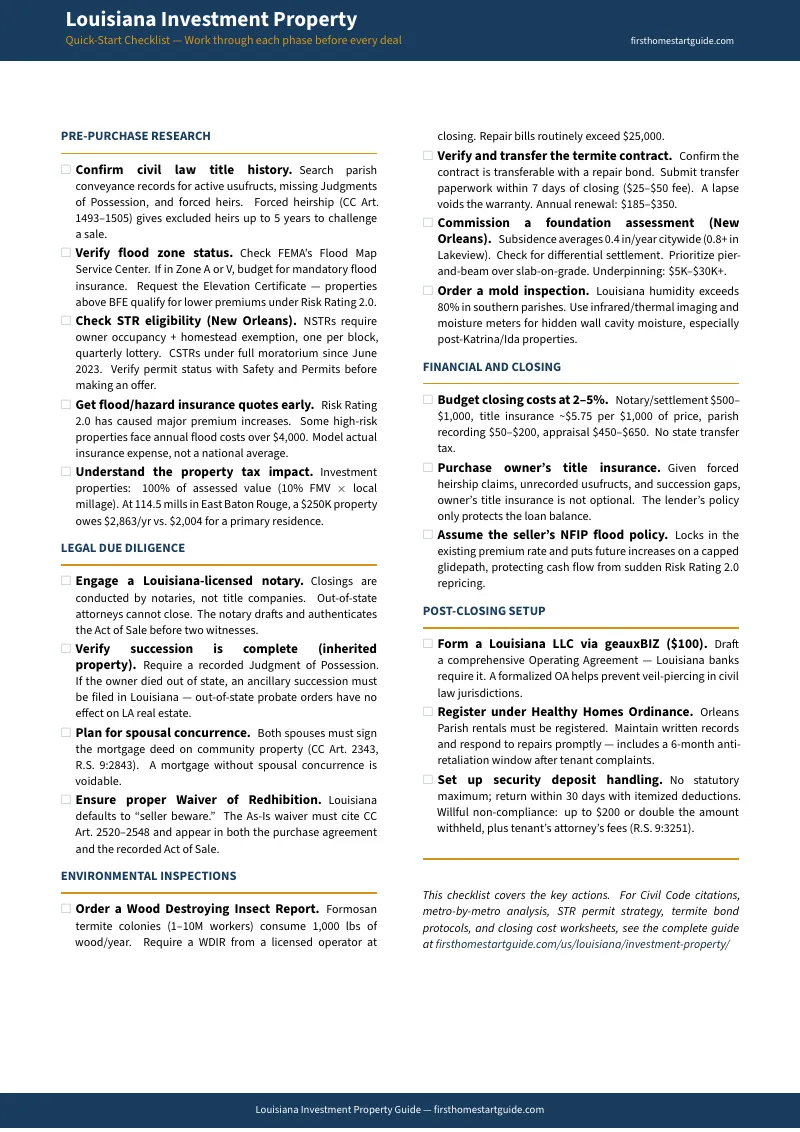
Download the free Louisiana Quick-Start Checklist to see the due diligence framework covering civil law title verification, environmental inspections, STR compliance, and closing steps. When you're ready for the full civil law property primer, termite bond protocol, STR playbook, and 13-chapter investment system, the complete guide is here.
The deal looks good on the spreadsheet. This guide tells you whether Louisiana's civil law agrees.