You Have Run the Numbers on a Maine Investment Property. You Cannot Figure Out Whether the Oil Tank Kills the Deal, Whether the STR License Survives the Sale, or What Portland Rent Control Does to Your Year-Three Proforma.
You have found a listing that looks right — maybe a coastal cottage near Bar Harbor with strong trailing Airbnb income, a Portland triplex with a cap rate that exceeds anything in Boston, or a lakefront cabin in the Moosehead region that could print cash from June through September. You have browsed BiggerPockets threads where investors debate whether Maine's yields justify the heating costs. You have read a few state government pages about transfer taxes and zoning. And you are stuck — because nothing connects the environmental inspection results to the offer contingency language, the STR cap to the license transferability rules, or the 2.5% withholding to the 1031 exchange filing sequence.
The problem is specific to Maine. This is an attorney-closing state where three out of five homes heat with fuel oil stored in underground tanks that can leak petroleum into fractured bedrock aquifers and generate remediation bills exceeding $100,000. The real estate transfer tax is split 50/50 between buyer and seller — and a November 2025 surcharge on properties above $1 million nearly triples the rate on the excess. Coastal STR licenses vary so drastically from one town to the next that a profitable strategy in Bar Harbor is illegal in Ogunquit, and a license that generates $80,000 per year in Kennebunkport vanishes the moment the deed transfers to a new owner. Portland caps rent increases at 2.2% while your property taxes, insurance, and heating costs climb at 5% or more.
The Maine Investment Property Guide is a Maine Acquisition Defense System — a single reference that maps every environmental liability, municipal regulation, tax trap, and landlord obligation into the exact sequence you encounter them: market selection, due diligence, offer structuring, closing, operations, and eventual disposition. It replaces the weeks you would spend cross-referencing DEP soil sampling rules, municipal STR ordinance PDFs, Portland Rent Board FAQs, and Maine Revenue Services withholding forms with a document that tells you exactly what to check, what the numbers should be, and where Maine-specific deals fall apart.
What's Inside the Maine Acquisition Defense System
A comprehensive guide, a quick-start checklist, and 4 standalone printable worksheets (6 PDFs total) — covering every stage from county-level market selection through to 1031 exchange planning, built specifically for the environmental, regulatory, and tax landscape that makes investing in Maine fundamentally different from every other Northeast market:
County-by-County Yield Analysis — Where the Cash Flow Actually Lives
Maine is not one market. Cumberland County (Portland metro) commands $575,000–$615,000 median listing prices with $2,295–$2,375 monthly rents — strong demand but compressed yields, further suppressed by rent control. Penobscot County (Bangor) and Androscoggin County (Lewiston/Auburn) offer entry prices under $375,000 with median rents above $1,500 and no municipal rent caps, producing the strongest DSCR math in the state. Hancock County (Downeast, near Acadia) lists at $524,950 but only generates $1,600 in long-term rents — numbers that only pencil out as seasonal STRs. The guide maps all four market segments with median prices, rents, and the acquisition strategy that fits each one.
Underground Oil Tanks — The Due Diligence Minefield
Roughly 60% of Maine homes heat with fuel oil. A ground-penetrating radar tank sweep costs $300 to $450. A clean removal runs $1,500 to $4,000. But those numbers assume no contamination. When the mandatory DEP soil sampling comes back positive — which happens frequently with steel tanks over 20 years old — remediation starts at $15,000 and routinely hits $55,000. In Maine's thin-topsoil, fractured-bedrock geology, petroleum migrates rapidly through preferential pathways into drinking water aquifers, triggering cleanups exceeding $100,000. The guide shows you how to structure your MAR purchase offer contingency so the seller bears the entire remediation risk during escrow — and why an in-use underground tank permanently limits your resale buyer pool.
Well Water Contamination — Arsenic, Radon, and Your Legal Obligations
Maine's bedrock is laced with naturally occurring arsenic and radon. Landlords must test for arsenic every five years (Title 22, §2660-Y) and notify tenants within 10 days of receiving results. Radon testing is required every two years (Title 22, §785). Lab costs run $70 to $120, with arsenic speciation tests adding $45 to $75. If contamination exceeds safe levels, whole-house filtration systems cost $1,000 to $5,000. Manganese produces a brown film that permanently stains STR fixtures. The guide covers the testing mandates, the filtration costs, the MaineHousing abatement grants (up to $15,000, income-restricted), and how to budget these capital reserves into your acquisition proforma.
Shoreland Zoning — The Waterfront Renovation Trap
Every waterfront flip buyer plans a major renovation. The Mandatory Shoreland Zoning Act stops most of them. Structures within 250 feet of great ponds, rivers, or coastal wetlands can only expand by 30% of the footprint and volume that existed on January 1, 1989 — cumulative over the lifetime of the structure. Expansion toward the water is absolutely prohibited. Vegetation clearing within the buffer zone is limited to 40% of timber volume over 10 years. The guide walks you through how to pull municipal permit history to determine remaining expansion allowance, what Code Enforcement Officers actually look for, and the fines and mandatory tear-downs that follow violations.
Short-Term Rental Regulations — Town by Town
Bar Harbor: VR-1 (owner-occupied, 2-night minimum) and VR-2 (non-owner-occupied, 4-night minimum), $250 annual fee, mandatory safety inspection, strict 9% cap on total dwelling units. Kennebunkport: annual licensing ($325–$575), hard cap at 9.5% of units, 7–15 new licenses per year through attrition — and licenses do not transfer upon sale. Buy an active STR and you start over on a waiting list while carrying the mortgage. Portland: non-owner-occupied STRs capped at 1.5% of long-term units — 293 licenses citywide for 2026, fees up to $4,000/year. Ogunquit: 7-day minimum stay, eliminating the weekend market entirely. The guide provides the complete regulatory matrix for every major coastal market, with the specific question to ask the town clerk before making any offer.
Portland Rent Control — The Complete Breakdown
Portland caps annual rent increases at 2.2% for 2026, tied to the CPI-U for the greater Boston metro. Increases can occur only once per year with 90 days written notice. Banked rent — unused allowable increases from prior years — exists but is capped at 10% in any single raise. Just cause eviction protections mean you cannot refuse to renew a lease without a legally approved reason. Terminating a no-cause tenancy requires 90 days notice, or 60–89 days with a one-month rent penalty, or 30–59 days with two months' rent. The critical exemption: owner-occupied buildings with four or fewer units are completely exempt — the basis of the house-hacking strategy that lets you bypass the Rent Board entirely. The guide includes the documented 3.2%–5.4% property value suppression, how to adjust cap rate expectations, and the $10.6 million annual tax burden shift onto non-controlled properties.
Tax Strategy — Because Maine Taxes Capital Gains as Ordinary Income
Maine does not offer a preferential capital gains rate. All gains — short-term or long-term — are taxed as ordinary income at progressive rates up to 7.15%, plus a 2% surcharge above $1.5 million (joint filers), producing an effective top rate of 11.15%. For non-residents, Maine withholds 2.5% of the gross sale price (not the gain) at closing via Form REW-1. On a $1 million property with $900,000 in debt, the $25,000 withholding can consume nearly all closing equity. The guide covers the REW-5 waiver process (file at least 5 business days before closing), the 1031 exchange REW trap (withholding triggers even during fully deferred exchanges — you need a Certificate of Exemption), depreciation add-backs, and the Maine Capital Investment Credit.
Landlord-Tenant Law — Habitability, Deposits, and Eviction
Maine law requires landlords to maintain 68°F indoors when outside temperatures drop to -20°F (14 M.R.S. §6021). Security deposits are capped at two months' rent, must be stored in a separate bank account, and returned within 30 days with itemized deductions — violation penalty is double the wrongfully withheld amount plus attorney fees. Eviction (Forcible Entry and Detainer) requires a 7-day notice, $100 FED filing, sheriff service, court hearing, 7-day post-judgment wait, and 48-hour writ of possession. LLCs cannot represent themselves in court — budget for attorney fees on every eviction. The guide covers every timeline, every fee, and every compliance trap.
Entity Structure and Financing
A Maine domestic LLC costs $175 to form and $85/year for the annual report due June 1. Out-of-state LLCs (Delaware, Wyoming) must foreign-qualify: $250 filing plus $150/year. Operating without qualification strips your ability to file evictions or enforce contracts in Maine courts. DSCR loans are essential for seasonal STR underwriting because conventional lenders struggle with compressed-season income. Local portfolio lenders hold debt on their own balance sheets and can underwrite properties that fail standard Fannie/Freddie appraisals — mixed-use, unpermitted additions, private dirt roads. Down payments: 20%–25%.
Operations — Heating Retrofits, Winterization, and Property Management
Efficiency Maine offers commercial HVAC rebates: $1,000 per outdoor unit for heat pumps, $125–$168 per MBH for VRF systems. Converting from oil to heat pumps reduces operating costs, tenant complaints, and resale friction from oil tank liability. Seasonal winterization — blowing out plumbing lines in unheated STRs — prevents catastrophic pipe bursts during sub-zero cold snaps. Property management runs 8%–12% of gross rent for long-term rentals and 20%–25% for STRs. Self-managing from out of state is risky when a furnace failure in January requires same-day response under the habitability mandate.
Who This Guide Is For
- Out-of-state investors from Boston, New York, and the Northeast corridor chasing better yields than what is available in their home markets, who need to understand the environmental liabilities, transaction costs, and regulatory landscape that make Maine fundamentally different from the markets they know
- Coastal vacation rental investors targeting Bar Harbor, Kennebunkport, or the Midcoast who need to verify STR licensing caps, minimum stay rules, and license transferability before modeling revenue on trailing income that may vanish at closing
- Portland multi-family investors who need to model yields under the 2.2% rent cap, understand banked rent mechanics and just cause eviction protections, and determine whether the owner-occupied exemption fits their strategy
- Waterfront fix-and-flip operators who plan to renovate lakefront cabins or coastal cottages and need to know the shoreland zoning expansion limits, setback requirements, and vegetation clearing restrictions before committing capital
- Non-resident investors who need to structure their entities and tax planning to avoid the 2.5% gross withholding trap, execute compliant 1031 exchanges, and navigate a state that taxes all capital gains as ordinary income
Why Not Free Resources?
Free information on Maine investment property exists across government websites, municipal portals, and investor forums. Here is what it actually delivers:
- The Maine DEP publishes underground storage tank removal guidelines and Shoreland Zoning Act regulations. It does not teach you how to structure a purchase offer contingency that forces the seller to complete tank removal and deliver a clean soil report before closing — the specific strategy that shifts a potential $55,000 liability from your balance sheet to the seller's.
- Municipal websites publish their STR ordinances and rental licensing requirements. They do not warn you that buying an active STR in Kennebunkport revokes the license and puts you on a waiting list, or that Portland's 293-unit citywide cap means your non-owner-occupied STR application faces a multi-year queue. You get the regulation without the buyer-side risk assessment.
- The Portland Rent Board publishes allowable increase percentages, FAQs, and complaint forms. It does not explain the documented 3.2%–5.4% suppression of taxable property values, how banked rent interacts with the 10% ceiling, or why the owner-occupied 4-unit exemption makes house-hacking the only scalable strategy for new investors in the city.
- Maine Revenue Services publishes REW withholding forms and 1031 exchange guidelines. It does not explain the REW trap during a fully deferred 1031 exchange — where withholding triggers even when no tax is owed — or how to file the Certificate of Exemption to prevent $25,000 in capital from being trapped at closing.
- BiggerPockets and Reddit threads contain real investor experiences mixed with advice from other jurisdictions. A poster discussing oil tank removal in New Jersey has different cost benchmarks, different soil sampling requirements, and different liability transfer rules than Maine. Sorting Maine-specific intelligence from generic advice takes longer than reading a guide that has already done it.
This guide fills the Maine-specific gap — the space between knowing you want to invest in Maine real estate and knowing how to navigate a state where an oil tank can generate a six-figure environmental liability, a profitable STR license can disappear at closing, rent control suppresses property values, and capital gains are taxed at ordinary income rates with a 2.5% gross withholding trap for non-residents.
— Less Than a Single Oil Tank Sweep
A ground-penetrating radar tank sweep costs $300 to $450. Oil tank remediation starts at $15,000. A single misunderstanding about Kennebunkport's non-transferable STR licenses can destroy the entire revenue model behind a $500,000 acquisition. The 2.5% REW withholding on a $1 million sale is $25,000 — money trapped at closing because you did not file the right form five business days in advance. Losing a $30,000 banked rent increase because you missed the 90-day notice requirement is not a rounding error.
This guide does not replace your real estate attorney or tax advisor. But it gives you the environmental inspection protocols, offer contingency language, STR regulation matrices, rent control calculations, tax planning sequences, and entity structuring guidance that ensure you identify every Maine-specific risk before you sign a purchase agreement — not when the soil samples come back, the STR application is denied, the Rent Board rejects your increase, or the closing attorney withholds $25,000 you needed for your 1031 replacement property.
If it saves you from a single contaminated oil tank, a single non-transferable STR license, or a single REW withholding trap, it pays for itself before you finish reading it.
Money-back guarantee, no time limit. If the guide does not sharpen your due diligence and protect your capital in Maine's investment property market, you pay nothing.
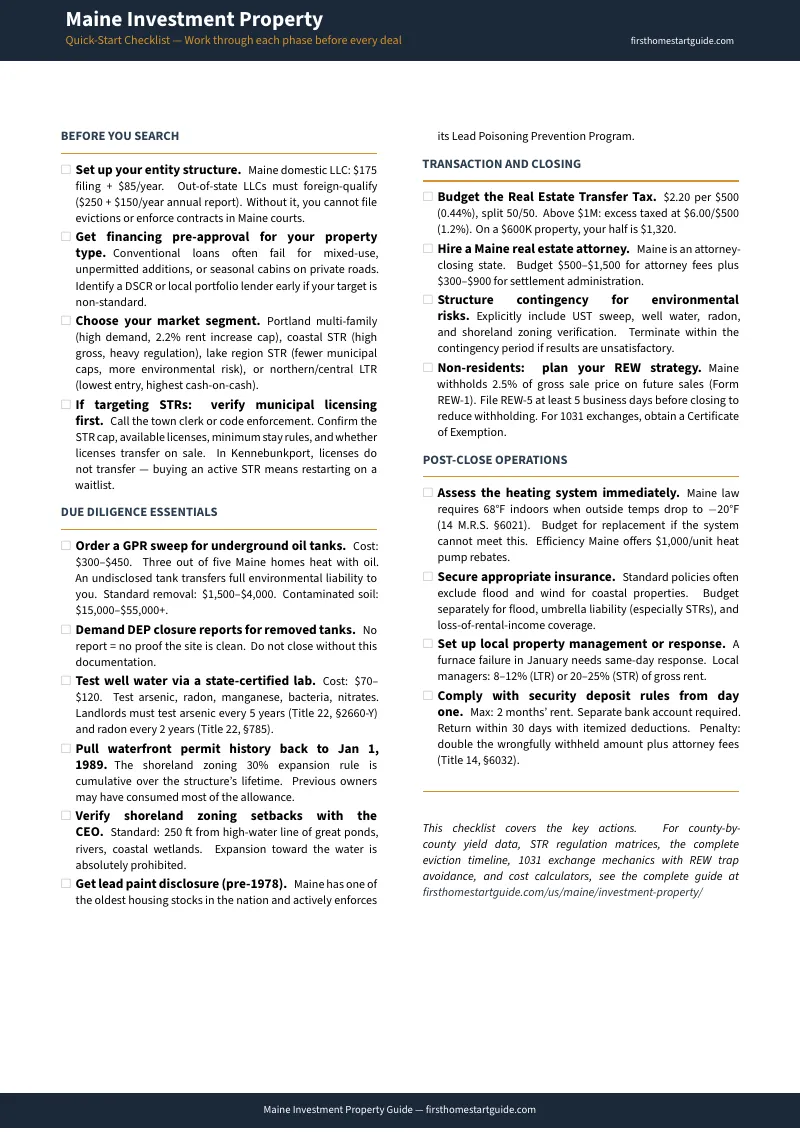
Download the free Maine Quick-Start Home Buying Checklist to see the step-by-step framework covering entity setup, environmental due diligence, transaction planning, and post-close operations. When you are ready for the full county-by-county yield data, STR regulation matrices, tax planning sequences, and oil tank contingency strategies, the complete guide is here.
The yields are real. The liabilities are hidden. This guide makes sure you capture the first without being caught by the second.
Frequently Asked Questions
What if the rules change after I buy?
We update the guide when the rules change. Email us any time, even years later, and we'll send you the current edition free.