The Numbers Work Until Maryland's Compliance Stack Proves They Don't.
You found a rowhouse in Baltimore's Remington neighborhood with a 6.2% cap rate. Or a three-unit in Prince George's County near Joint Base Andrews where government-employed tenants keep vacancy near zero. Or a seasonal condo in Ocean City with $45,000/year in projected rental income. The cash flow works on a spreadsheet. You're ready to make an offer.
Then Maryland's regulatory stack reveals itself. The Baltimore rowhouse comes with a ground rent — a feudal-era land lease where someone else owns the dirt beneath your building. Your lender flags it: unregistered ground rents destroy Fannie Mae and Freddie Mac eligibility, and the SDAT redemption process takes 100+ days with a formula that varies by the original lease creation date (4%, 6%, or 12% capitalization rate). Meanwhile, the property was built in 1928, which triggers MDE lead paint compliance — not just a disclosure form, but mandatory registration, XRF testing, Full Risk Reduction Standard certification, and unlimited liability in Baltimore City if a tenant's child tests positive. The remediation estimate comes in at $7,200. The PG County triplex has its own surprise: transfer tax applies to both the sale price and the mortgage amount, creating a double-taxation event that depletes $4,800 more in closing capital than you budgeted. The Ocean City condo requires a city-specific STR license that restricts rental frequency and imposes occupancy caps you never modeled.
Here's what no single resource explains: Maryland layers an attorney-state settlement requirement, three levels of transfer taxation (state, county, and municipal — with PG County's mortgage-amount double-taxation trap), a ground rent system unique in the United States, the strictest lead paint compliance regime of any state (proactive certification, not just disclosure), the 2024 Renters' Rights and Stabilization Act (security deposit caps, rent stabilization, tenant right of first refusal), and a 2025 capital gains surcharge that creates a cliff effect at $350,000 AGI — all into a compliance environment that punishes investors who apply national assumptions to Maryland-specific problems. Every one of these has cost real investors five to six figures because the information existed — scattered across the MDE portal, SDAT registry, county code enforcement databases, and the Comptroller's office — but nobody had assembled it into a single compliance framework.
The Maryland Investment Property Guide is a Maryland Investor Compliance System — not a motivational overview of real estate investing, but a structured due diligence and compliance framework that maps every Maryland-specific financial trap, regulatory requirement, and operational risk into a process you work through before you wire earnest money. It replaces months of cross-referencing the SDAT ground rent registry, MDE lead paint portal, county transfer tax schedules, and eviction procedure requirements with a single reference that tells you exactly what to verify, exactly what the numbers should look like, and exactly where deals go wrong.
What's Inside the Maryland Investor Compliance System
A 12-chapter guide, 7 standalone printable reference tools, and a 20-item due diligence checklist — covering every stage from submarket selection through post-purchase landlord operations, built specifically for the financial traps and regulatory complexity that make Maryland different from every other state:
County-by-County Transfer Tax Analysis
Maryland has three layers of transfer taxation — state (0.5%), county (varies by jurisdiction), and municipal (where applicable) — and investors are ineligible for every owner-occupant exemption. Baltimore City charges 3.0% total (3.75% on sales above $1 million). But Prince George's County contains the single most expensive trap: transfer tax applies to the mortgage amount in addition to the sale price, creating a double-taxation event that can deplete $3,000 to $8,000 more in closing capital than a standard transfer tax calculation predicts. The guide includes a county-by-county tax table covering all major investment markets so you calculate true acquisition cost before you make an offer — not after settlement.
Ground Rent Mechanics and Redemption
Ground rent is a Maryland institution that exists almost nowhere else in the United States. It's a bifurcated ownership structure where you own the building but someone else owns the land beneath it — and if the ground rent is unregistered with SDAT, your property loses Fannie Mae and Freddie Mac mortgage eligibility. Redemption (buying out the ground rent) is possible, but the formula varies by when the original lease was created: pre-1884 leases capitalize at 4%, 1884-1969 at 6%, and post-1969 at 12%. The SDAT registry process takes 100+ days. Meanwhile, predatory ground rent collection practices can escalate an $80/year lease into thousands in fees. The guide covers how to search the SDAT registry, calculate redemption costs by lease era, timeline the process so it doesn't delay closing, and identify ground rent properties to avoid entirely when speed matters.
Lead Paint Compliance System
Maryland doesn't just require lead paint disclosure — it mandates proactive certification before you can legally rent a pre-1978 property. MDE registration, XRF testing by a certified inspector, and either Full Risk Reduction Standard compliance or Lead-Free certification are prerequisites to obtaining a rental license. In Baltimore City, landlord liability for lead paint exposure is unlimited — a single tenant claim can exceed the property's value. XRF testing plus abatement typically runs $5,000 to $12,000. And here's the trap most investors miss: if your unit is in a condo or townhome with shared exterior surfaces, the HOA controls the exterior paint — and if the HOA won't remediate, your individual unit can't achieve Lead-Free certification, blocking your rental license entirely. The guide walks through the MDE registration process, testing requirements, remediation cost ranges, relocation liability during abatement, and the HOA bottleneck that has stalled rental licenses on otherwise compliant units.
Submarket Investment Analysis
Seven Maryland investment submarkets dissected with specific risk profiles and strategy alignment: Baltimore City (highest yields, highest regulatory burden — lead paint, ground rent, and code enforcement density), Prince George's County (government-tenant stability but DPIE licensing and rent stabilization), Montgomery County (appreciation market with rent stabilization caps), Anne Arundel County (military and airport demand, moderate regulation), Howard County (highest median income, tight inventory), Ocean City (seasonal STR with city-specific licensing), and Washington and Carroll Counties (rural cash flow with lowest entry points). Each submarket profile maps the specific regulations, tax rates, and operational requirements that determine whether your strategy is viable — not just whether the cap rate looks right.
RRSA 2024 Landlord Operations Framework
The 2024 Renters' Rights and Stabilization Act restructured Maryland landlord-tenant law. Security deposits are capped at one month's rent. PG County and Montgomery County impose rent stabilization. Tenants in buildings of one to three units have right of first refusal when you sell. And the eviction process has a specific procedural requirement that causes more case dismissals than any substantive defense: the 10-day notice must use the DC-CV-115 form and be served via USPS Certificate of Mailing — not certified mail, not first-class mail. If the notice was sent by certified mail, the case is dismissed and you restart the clock. The guide covers security deposit handling, rent increase compliance by jurisdiction, the eviction procedure step by step, and the tenant right of first refusal process so you budget accurate holding costs and vacancy periods into your underwriting.
Tax Strategy and Capital Gains Surcharge
Maryland's 2025 capital gains surcharge adds 2% on AGI exceeding $350,000 — with a cliff effect, not a graduated bracket. An investor who sells two properties in the same tax year and crosses the $350,000 AGI threshold faces a combined state and local marginal rate up to 11.8%, compared to 5.75% just below the cliff. The guide covers 1031 exchange mechanics to defer recognition, Form MW506AE withholding requirements for non-resident sellers (mandatory 8.25% withholding at closing), the Community Investment Tax Credit for qualifying rehab projects, and cost segregation strategies that accelerate depreciation to reduce current-year AGI. The difference between crossing the $350,000 cliff and staying below it on a $500,000 gain is over $10,000 in additional state tax — timing and structuring matter.
Due Diligence Checklist and Inspection Protocol
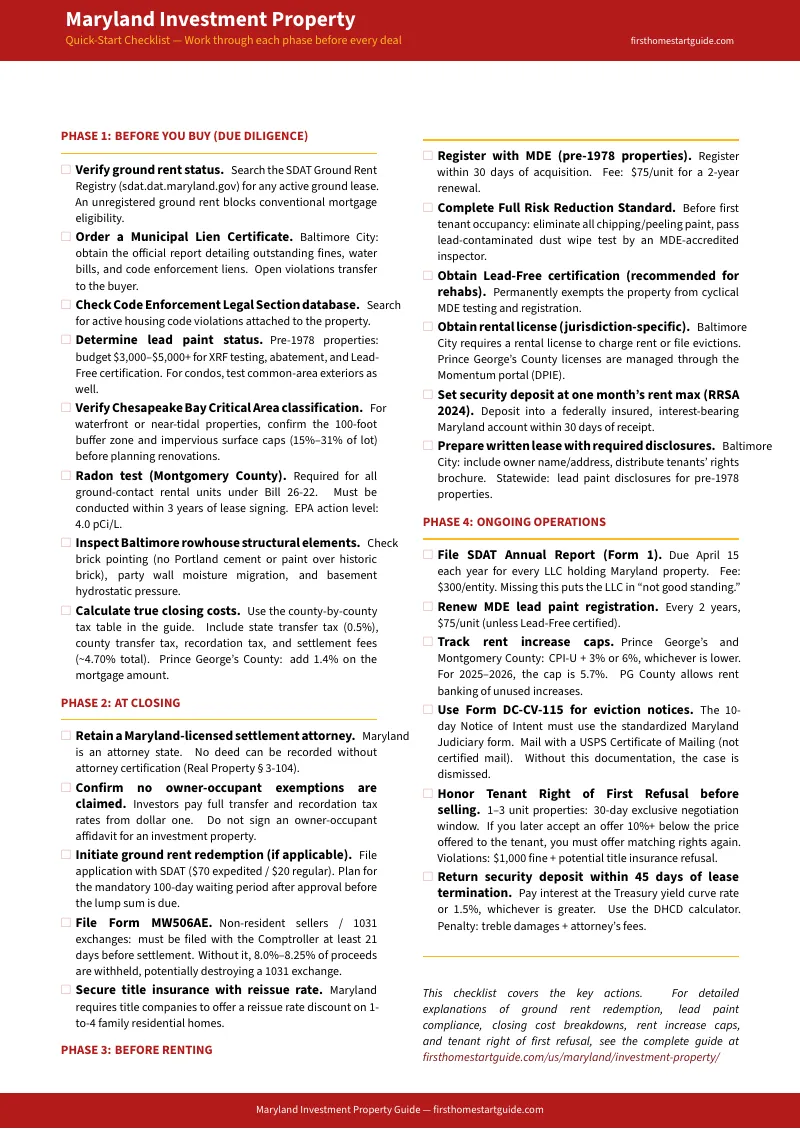
A standalone 20-item checklist organized across four phases — Before You Buy, At Closing, Before Renting, and Ongoing — covering the Maryland-specific verification steps that most investors either skip or discover after they've committed capital. Municipal lien certificates, code enforcement database searches, Chesapeake Bay Critical Area verification, radon testing, Baltimore rowhouse structural inspection, SDAT ground rent registry searches, MDE lead paint registration, settlement attorney coordination, and RRSA compliance. Print it, run it on every deal, and catch the compliance gaps before they become five-figure problems.
7 Standalone Printable Reference Tools
- County-by-County Transfer Tax Table — All 23 counties plus Baltimore City with recordation, local transfer, and state transfer rates. Includes Montgomery County tiered schedule and the PG County double-taxation trap calculation.
- Ground Rent Redemption Reference Card — SDAT registry search, redemption formula by lease creation era (4%, 6%, or 12% cap rate), the 5-step redemption process, and timeline warnings for hard money loan holders.
- Lead Paint Compliance Checklist — Step-by-step MDE registration, XRF testing, Full Risk Reduction Standard, and Lead-Free certification with cost ranges and the HOA exterior paint bottleneck warning.
- Eviction Process Quick Reference — The 6-step Summary Ejectment procedure with the Certificate of Mailing requirement that causes more case dismissals than any substantive defense.
- RRSA 2024 Landlord Quick Reference — Security deposit rules, rent stabilization caps by county, tenant right of first refusal process, and Baltimore City additional requirements.
- Maryland vs. D.C. vs. Virginia Comparison — Side-by-side analysis across 13 factors so you deploy capital where the regulatory environment matches your strategy.
- Key Contacts and Resources — Every government agency, registry, and form you need — organized by workflow stage. Print it and keep it in your deal folder.
Who This Guide Is For
This guide is for real estate investors targeting Maryland markets who:
- Are analyzing a Maryland property and need to verify whether the deal actually works once you account for three layers of transfer taxation, ground rent obligations, lead paint compliance costs, and RRSA 2024 operational requirements — not the generic assumptions that work in Virginia or Pennsylvania
- Are under contract on a Baltimore rowhouse and the title search just revealed an unregistered ground rent that threatens mortgage eligibility — and need to understand the SDAT redemption process, timeline, and cost formula before your contingency period expires
- Completed renovations on a pre-1978 property and discovered you can't obtain a rental license without MDE Full Risk Reduction certification — XRF testing, possible abatement, and relocation liability that wasn't in your rehab budget
- Are investing in Prince George's County and need to navigate DPIE rental licensing, the mortgage-amount transfer tax trap, and rent stabilization rules that cap your ability to adjust rents to market
- Filed an eviction and the case was dismissed because you used certified mail instead of USPS Certificate of Mailing with the DC-CV-115 form — and need the correct procedure to avoid restarting the clock again
- Want every Maryland-specific regulation, tax calculation, and compliance requirement in one reference — instead of assembling it from SDAT, MDE, county code enforcement databases, and the Comptroller's office across a dozen browser tabs
Why Not Free Tools and Forums?
Free information on Maryland real estate investing exists across dozens of sources. Here's what it actually delivers:
- BiggerPockets forums are where someone in a 2022 thread says ground rent is "no big deal, just budget $100/year," someone else says their lender refused to close because the ground rent was unregistered, and a third poster recommends a redemption strategy that predates the current SDAT registry rules. You'll find useful Baltimore neighborhood analysis mixed with advice predating RRSA 2024 (security deposit caps, rent stabilization, tenant right of first refusal), the 2025 capital gains surcharge, and current MDE lead paint enforcement. Sorting current from outdated takes longer than reading a guide that has already done it.
- County websites and the MDE portal give you individual data points — a transfer tax rate here, a lead paint registration form there. They don't tell you that PG County double-taxes mortgages, don't explain how the SDAT ground rent redemption formula varies by lease creation date, and don't connect MDE registration to the HOA exterior paint bottleneck that blocks condo rental licenses. You get the data without the analysis that determines whether the deal works.
- National investing books and courses teach cap rate, DSCR, and 1031 mechanics that apply everywhere. They don't mention ground rent, lead paint proactive certification, three-tier transfer taxation, the DC-CV-115 eviction form requirement, or Maryland's capital gains cliff at $350,000 AGI. Applying national frameworks to Maryland-specific problems is how investors lose five figures on compliance gaps they never knew existed.
- Real estate agent advice focuses on getting the deal closed, not on protecting your post-purchase economics. Your agent won't calculate the true cost of ground rent redemption by lease era, won't model lead paint remediation into your rehab budget, and won't tell you that the eviction process requires a specific mailing method that most landlords get wrong on their first filing.
This guide fills the Maryland-specific gap — the space between knowing how to analyze a rental property in general and knowing how to underwrite one in a state where ground rent mechanics, lead paint proactive certification, triple-layer transfer taxation, and RRSA 2024 operational requirements can each independently turn a profitable deal into a losing one. It's the analysis that would take a Maryland real estate attorney, a lead paint consultant, and a tax advisor to assemble — structured as a reference you own permanently.
— Less Than One Transfer Tax Surprise
A single PG County transfer tax miscalculation — forgetting that the tax applies to the mortgage amount — depletes $3,000 to $8,000 in closing capital you budgeted for rehab. A ground rent redemption you didn't account for costs $1,500 to $5,000 and delays closing by 100+ days. An MDE lead paint remediation on a pre-1978 property runs $5,000 to $12,000. A dismissed eviction because you used certified mail instead of USPS Certificate of Mailing adds two to three months of lost rent at $1,500 to $2,500/month.
This guide doesn't replace your settlement attorney or your CPA. But it gives you the county-by-county transfer tax analysis, ground rent redemption framework, lead paint compliance system, and RRSA 2024 operations guide that ensure you identify every Maryland-specific risk before you're contractually committed — instead of discovering them at the settlement table, on your first MDE inspection, or in your first eviction filing.
If it catches a single transfer tax miscalculation, prevents a single lead paint compliance gap, or saves you from a dismissed eviction case, it pays for itself before you've finished reading it.
Money-back guarantee, no time limit. If the guide doesn't sharpen your underwriting and protect your capital in Maryland's compliance environment, you pay nothing.
Download the free Maryland Quick-Start Home Buying Checklist to see the 20-item due diligence framework covering pre-purchase verification, closing, pre-rental compliance, and ongoing operations. When you're ready for the full ground rent analysis, lead paint compliance system, transfer tax tables, and 12-chapter investment framework, the complete guide is here.
The deal looks good on the spreadsheet. This guide tells you whether Maryland agrees.
Frequently Asked Questions
What if the rules change after I buy?
We update the guide when the rules change. Email us any time, even years later, and we'll send you the current edition free.