
The Spreadsheet Says 7% Cap Rate. McCarthy v. Tobin, Chapter 93A Treble Damages, and the Millionaire's Surtax Say Otherwise.
You found a triple-decker in Worcester throwing off $4,800/month gross rent. Or a Cape Cod cottage where the Airbnb calendar is booked solid from Memorial Day through Labor Day. Or a Gateway City duplex in Holyoke where the rent-to-price ratio looks like 2019 Cleveland. The numbers work. The cap rate clears your threshold. You're ready to make an offer.
Then you learn how Massachusetts actually works. The Worcester triple-decker has knob-and-tube wiring in the walls and lead paint on every interior surface -- it was built in 1923, and Massachusetts General Laws Chapter 111 Section 197 imposes strict liability on owners of pre-1978 rental housing: you have 90 days from acquisition to abate or contain all lead paint hazards, and a single violation exposes you to criminal penalties plus civil liability with no negligence requirement. The Cape Cod cottage sits in a town that layers a 2.75% community impact fee on top of the state's 5.7% room occupancy tax and the county's 6% convention center surcharge -- your effective STR tax rate is 14.45% before you account for the local seasonal rental registration, mandatory safety inspections, and the town-by-town occupancy limits that vary from Provincetown to Chatham to Barnstable. The Holyoke duplex's septic system hasn't been inspected since 2019, and Massachusetts Title V requires the seller to pass a septic inspection within two years of transfer -- but if it fails, the $30,000-$70,000 replacement cost becomes a negotiation variable that can kill the deal or hand you massive leverage, depending on whether you know the rules.
Here's what no single resource explains: Massachusetts layers a binding Offer to Purchase contract under McCarthy v. Tobin that commits you before you've completed due diligence unless your attorney structures the contingencies correctly, Chapter 93A treble damages that turn a $50 security deposit accounting error into a $4,500 judgment plus the tenant's attorney fees, an 8.5% short-term capital gains rate that drops to 5.0% if you hold one day past 365 days, a 4% Millionaire's surtax on taxable income exceeding $1.08M that pushes the combined rate to 12.5% on a single profitable flip, mandatory Chapter 21E environmental due diligence on any property with a history of commercial or industrial use, and a Title V septic system that can either kill your deal or give you $50,000 in negotiation leverage depending on whether you understand the transfer inspection timeline. Every one of these has cost real investors five to six figures because the information existed -- scattered across Mass.gov regulatory pages, MassLandlords.net forums, municipal STR ordinance databases, and attorney blog posts -- but nobody had assembled it into a single investment framework.
The Massachusetts Investment Property Guide is a Massachusetts Compliance Shield -- not a motivational overview of New England real estate, but a structured due diligence system that maps every Massachusetts-specific legal trap, tax threshold, environmental liability, and landlord obligation into a process you work through before you sign the Offer to Purchase. It replaces months of cross-referencing MGL chapters, municipal zoning bylaws, DEP brownfield databases, and lead paint compliance manuals with a single reference that tells you exactly what to verify, exactly what the numbers should look like, and exactly where deals blow up.
What's Inside the Massachusetts Compliance Shield
A 12-chapter guide, appendices, a due diligence checklist, and 8 standalone printable tools -- covering every stage from market selection through post-purchase operations, built specifically for the legal traps and regulatory complexity that make Massachusetts different from every other state:
McCarthy v. Tobin and the Binding OTP Trap
The single most dangerous moment in a Massachusetts real estate transaction for out-of-state investors. Unlike most states where a letter of intent or purchase agreement comes with a standard inspection contingency and attorney review period, Massachusetts follows the McCarthy v. Tobin doctrine: the Offer to Purchase is a binding, enforceable contract the moment both parties sign. If your OTP doesn't include properly drafted contingencies for financing, inspection, and environmental review, you're legally committed. The guide walks through exactly how to structure the OTP with the contingency language that protects you, the timeline for each contingency, and the specific scenarios where investors from other states lose their deposits because they treated the OTP like a non-binding letter of intent. Massachusetts is an attorney-closing state for a reason -- this chapter explains what your attorney should be doing and what you need to verify they actually did.
Chapter 93A Treble Damages and Security Deposit Compliance
Massachusetts General Laws Chapter 93A is the most aggressive consumer protection statute in the country for landlord-tenant disputes. A security deposit violation -- failing to hold the deposit in a separate interest-bearing account, failing to provide the bank name and account number within 30 days, failing to return the deposit with 5% annual interest within 30 days of lease termination, or deducting for damages without an itemized written statement -- exposes you to treble damages (three times the deposit amount) plus the tenant's attorney fees. On a $3,000 security deposit, a procedural error turns into a $9,000 judgment before legal costs. The guide covers every requirement under Chapter 186 Section 15B, the exact steps for compliant deposit handling, the last month's rent interest rules, the itemized deduction statement format, and the Billings v. Wilson owner-occupant exemption that shields house-hackers from Chapter 93A liability in their own building. Get this wrong once and the legal fees exceed the deposit many times over.
Lead Paint Strict Liability and the 90-Day Abatement Window
Massachusetts has the strictest lead paint law in the nation. Under Chapter 111 Section 197, any owner of residential property built before 1978 where a child under six resides -- including a tenant's child -- must abate or contain all lead paint hazards. The liability is strict: no negligence required. You have 90 days from the date of acquisition to complete the work, and the penalties include criminal fines, civil liability, and the inability to evict a tenant who withholds rent due to lead paint violations. Professional deleading costs $8,000-$15,000 per unit for a typical triple-decker apartment. Interim containment (encapsulation) runs $3,000-$5,000 per unit but must meet specific DEP standards. The guide covers the full compliance framework: when abatement is required versus containment, the licensed deleader requirement, the Letter of Compliance you need from a licensed inspector, insurance implications, and how to model deleading costs into your acquisition analysis so a pre-1978 property is priced correctly from day one.
Capital Gains Architecture: The 365-Day Line and the Millionaire's Surtax
Massachusetts taxes short-term capital gains (assets held one year or less) at 8.5% and long-term capital gains (held more than one year) at 5.0%. One day makes the difference: selling on day 365 triggers the 8.5% rate; selling on day 366 triggers the 5.0% rate. On a $150,000 gain from a flip, that single day saves you $5,250 in state tax. But the real trap is the Millionaire's surtax -- a 4% surcharge on all taxable income exceeding $1,082,000 (indexed annually for inflation). If you flip a high-value property in Boston or Cambridge and your total taxable income crosses that threshold, the combined Massachusetts rate on the gain above the threshold is 12.5% for short-term or 9.0% for long-term. The guide models the tax architecture with worked examples for flippers, buy-and-hold investors, and 1031 exchange strategies that defer the state-level gain entirely.
Environmental Due Diligence: Chapter 21E and Title V
Massachusetts Chapter 21E imposes strict, joint, and several liability for environmental contamination on current property owners -- regardless of who caused the contamination. If you buy a former gas station, dry cleaner, or industrial property (or a residential property adjacent to one) and the soil or groundwater is contaminated, you're liable for cleanup costs that routinely run $50,000-$500,000. An underground oil tank removal alone averages $10,000-$70,000 depending on whether contamination has migrated. The guide covers how to search the DEP's Bureau of Waste Site Cleanup database, how to read a Phase I Environmental Site Assessment, when to require a Phase II with soil borings, and the Bona Fide Purchaser defense under 21E(f) that protects you if you conduct proper pre-acquisition due diligence. Title V septic systems add another layer: the seller must pass a Title V inspection within two years of transfer, and a failed system creates $30,000-$70,000 in replacement costs that become your negotiation leverage if you understand the process.
Asset Class Analysis: Triple-Deckers, Gateway Cities, and Cape Cod STRs
Three asset classes dominate Massachusetts investment strategy, each with distinct risk-reward profiles. Triple-deckers -- the three-unit buildings that define Worcester, Springfield, and Somerville -- deliver 6-8% cap rates in Gateway Cities but come with pre-1978 lead paint exposure, aging mechanical systems, and shared-wall fire code requirements. Gateway Cities (the 26 mid-size municipalities designated under MGL Chapter 23A) offer the highest yields in the state, with median prices 40-60% below Greater Boston, but require understanding of the local economic base, tenant demographics, and municipal inspection regimes. Cape Cod short-term rentals generate strong seasonal revenue but face the STR tax stack (5.7% state + 6% county + up to 5.75% municipal, totaling up to 17.45%), town-by-town registration requirements, seasonal occupancy limits, and Title V septic systems that serve as the binding constraint on bedroom count and therefore revenue capacity. The guide dissects each asset class with median prices, yield ranges, regulatory requirements, and the specific due diligence items that determine whether the deal actually works.
Eviction Timeline, Financing, Insurance, and Ongoing Compliance
Massachusetts eviction takes 3-6 months through Housing Court, with the 14-Day Notice to Quit for non-payment, the Summary Process summons and complaint, and the mandatory Answer period. The guide covers the full timeline, the "pay and stay" right that lets tenants cure during the notice period, the just-cause eviction requirements for subsidized tenancies, and the retaliatory eviction defense under Chapter 186 Section 18 that bars eviction within six months of a tenant's code complaint. Financing strategies for Massachusetts investors -- conventional, DSCR, FHA house-hacking on two-to-four-unit properties, hard money for flips, and MassHousing programs. The residential exemption paradox: when you stop owner-occupying a property in a city that offers a residential exemption (Boston's is worth over $3,600/year in tax savings), your property tax bill jumps by exactly that amount. Insurance requirements including the FAIR Plan for properties that can't get private coverage, flood insurance in coastal zones, and the lead paint liability rider you need on pre-1978 rentals.
8 Standalone Printable Tools
Print these and use them on every deal -- each extracts a critical workflow from the guide into a standalone reference you can bring to a property visit, hand to your attorney, or pin above your desk:
- OTP Contingency Framework -- every contingency that must be in your Offer to Purchase, the 30-60 day closing timeline, and municipal compliance steps
- Security Deposit Compliance Checklist -- the MGL c. 186 s. 15B gauntlet step by step, from escrow account setup through lease-termination return
- Lead Paint Compliance Tracker -- 90-day timeline with deleading vs interim control costs, tax credits, and contractor scheduling
- Environmental Screening Checklist -- oil tank searches, Chapter 21E database checks, Title V septic, BANRT assessment, and submetering compliance
- Capital Gains Reference Card -- rate tables, 366-day savings calculator, Millionaire's surtax examples, 1031 exchange clawback rules
- Property Analysis Worksheet -- fillable pro-forma with all nine Massachusetts-specific adjustments, cap rate, cash-on-cash, and DSCR
- Gateway City Comparison -- side-by-side market data for Worcester, Springfield, Lowell, Brockton, Cape Cod STR tax stack, and triple-decker submarkets
- Statute and Cost Reference -- 14 key statutes, 4 landmark cases, and 20 investor cost items with current dollar ranges
Who This Guide Is For
This guide is for real estate investors targeting Massachusetts markets who:
- Are analyzing a Massachusetts rental property and need to understand how McCarthy v. Tobin makes the Offer to Purchase a binding contract -- not a negotiation starting point -- and how to structure contingencies that protect your deposit and your due diligence timeline
- Are buying a pre-1978 triple-decker or multi-family and need the full lead paint compliance framework: strict liability trigger, 90-day abatement window, deleading costs per unit, interim containment standards, and how to model these costs into your acquisition price
- Are planning a flip and need to calculate the exact holding period that saves you 3.5% in state capital gains tax -- plus the Millionaire's surtax threshold that could push your combined rate to 12.5% if the profit is large enough
- Are an out-of-state investor from New York, Connecticut, or California evaluating Gateway City yields and want every Massachusetts-specific legal trap, environmental liability, and landlord obligation in one reference before you deploy capital in a state where a security deposit error triggers treble damages and attorney fees
- Are a Cape Cod or Islands STR investor who needs the exact tax stack (up to 17.45%), the town-specific registration and inspection requirements, the Title V septic constraints on bedroom count, and the seasonal revenue modeling that determines whether the deal actually cash-flows after the full regulatory burden
- Are a Massachusetts homeowner buying your first rental property and need to understand how losing the residential exemption increases your property tax, how Chapter 93A applies to your security deposit handling, and whether the Billings v. Wilson owner-occupant exemption covers your house-hack
Why Not Free Tools and Forums?
Free information on Massachusetts real estate investing exists across dozens of sources. Here's what it actually delivers:
- BiggerPockets forums are where someone in a thread recommends collecting last month's rent upfront in Massachusetts without mentioning that it must be held in a separate interest-bearing account and returned with 5% annual interest under Chapter 186 Section 15B -- or that failure to do so exposes you to treble damages under Chapter 93A. You'll find genuinely useful experience reports from Worcester and Springfield landlords mixed with advice from investors in landlord-friendly states who don't realize Massachusetts security deposit law can turn a $50 procedural error into a $4,500 judgment. Sorting Massachusetts-specific from nationally-generic takes longer than reading a guide that has already done it.
- MassLandlords.net provides excellent landlord education and advocacy, but its content is organized by topic across hundreds of articles, webinars, and policy updates. It doesn't deliver a single structured investment framework that walks you from market selection through acquisition, financing, tax optimization, and operations. You get deep expertise in fragments -- the security deposit article doesn't connect to the lead paint article, which doesn't connect to the capital gains analysis, which doesn't connect to the Gateway City yield comparison. Assembling it into an investment system is the work this guide has already done.
- Mass.gov regulatory pages publish the full text of Chapter 111 (lead paint), Chapter 21E (environmental liability), Chapter 186 Section 15B (security deposits), and Title V septic regulations. They don't explain what these statutes mean for an investor evaluating a specific property, don't model the financial impact of compliance costs on your cap rate, don't tell you which contingencies to include in your OTP, and don't connect environmental liability to your acquisition negotiation strategy. You get the law without the investment analysis.
- National investing courses and podcasts teach cap rate analysis, BRRRR strategy, and 1031 exchanges that apply everywhere. They don't mention McCarthy v. Tobin, Chapter 93A treble damages, the 90-day lead paint abatement window, the 365-day capital gains line, the Millionaire's surtax, Chapter 21E strict liability, or the residential exemption paradox. Applying national frameworks to Massachusetts-specific problems is how investors lose five figures on their first deal in this state.
This guide fills the Massachusetts-specific gap -- the space between knowing how to analyze a rental property in general and knowing how to underwrite one in a state where a binding OTP can trap you before due diligence, a security deposit error triggers treble damages, lead paint liability is strict from day one of ownership, and a one-day difference in holding period saves you thousands in capital gains tax. It's the analysis that would take a Massachusetts real estate attorney, a DEP environmental consultant, a lead paint inspector, and a tax advisor to assemble -- structured as a reference you own permanently.
-- Less Than One Security Deposit Mistake
A single Chapter 93A security deposit violation on a $2,500 deposit triggers treble damages of $7,500 plus the tenant's attorney fees -- for a procedural error like failing to provide the bank account number within 30 days. Lead paint deleading on one unit of a triple-decker runs $8,000-$15,000, and strict liability means there's no defense if you didn't complete it within 90 days. A flip sold on day 365 instead of day 366 costs you 3.5% of your gain in unnecessary state tax -- $5,250 on a $150,000 profit. A Chapter 21E environmental cleanup on a property you bought without a Phase I assessment can run $50,000-$500,000. A Title V septic failure you didn't negotiate before closing drops $30,000-$70,000 on your side of the ledger.
This guide doesn't replace your Massachusetts real estate attorney or your CPA. But it gives you the OTP contingency framework, the security deposit compliance checklist, the lead paint cost model, the capital gains holding period analysis, and the environmental due diligence process that ensure you identify every Massachusetts-specific risk before you're contractually committed -- instead of discovering them in a Chapter 93A demand letter, a DEP enforcement notice, or a tax bill that's 3.5% higher than it needed to be.
If it catches a single security deposit compliance gap, prevents one lead paint liability exposure, or saves you from a single capital gains timing error, it pays for itself before you've finished reading it.
Money-back guarantee, no time limit. If the guide doesn't sharpen your underwriting and protect your capital in Massachusetts's regulatory environment, you pay nothing.
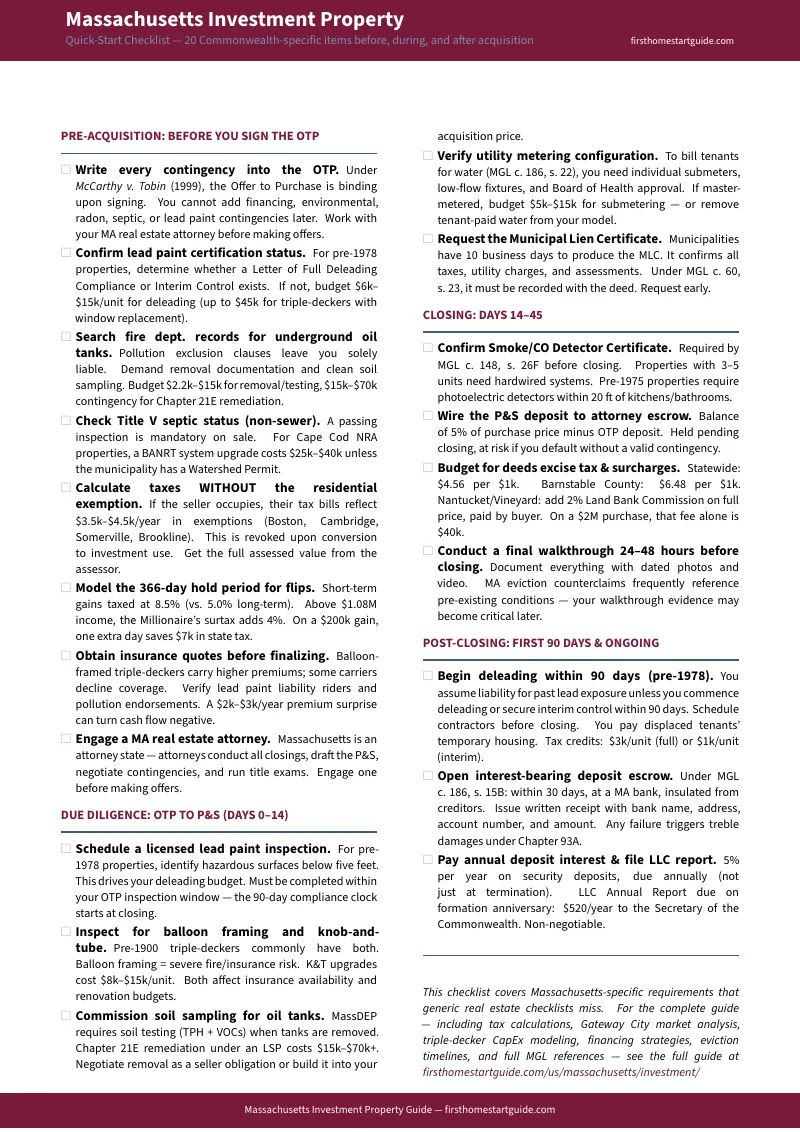
Download the free Massachusetts Quick-Start Checklist to see the due diligence framework covering pre-purchase research, financial analysis, under-contract inspections, closing, and post-purchase setup. When you're ready for the full Chapter 93A compliance system, capital gains architecture, environmental due diligence framework, and 12-chapter investment guide, the complete guide is here.
The deal looks good on the spreadsheet. This guide tells you whether Massachusetts agrees.