
The Cap Rate Clears at 14%. Michigan's Tax Uncapping, LLC Transfer Trap, and Detroit's Certificate of Compliance Will Correct That.
You found a Detroit duplex listed at $65,000 with tenants paying $1,800 combined. Or a Grand Rapids single-family renting at $1,500 against a $230,000 purchase price. Or a Wayne County tax auction parcel where you can acquire a habitable structure for $3,000 and project $900/month in Section 8 rent. The spreadsheet clears. Detroit metro vacancy sits at 3.7% in the cash-flow corridors. Grand Rapids multifamily vacancy is 5.8% with 3.2% annual rent growth. Net in-migration from coastal states is accelerating. You are ready to deploy capital.
Then Michigan's regulatory reality arrives. The seller's property tax bill shows $1,200 per year. You close, and Proposal A's uncapping statute (MCL 211.27a) resets the Taxable Value to match the State Equalized Value in the calendar year following your purchase. Simultaneously, the property loses the Principal Residence Exemption, subjecting it to the non-homestead millage — an additional 18 mills on top of the base rate. On a $75,000 Taxable Value, that is $1,350/year in taxes the previous owner-occupant was not paying. Your actual Year 2 tax bill bears no resemblance to what the seller was paying. You hold the property individually and decide to transfer it into an LLC for asset protection, following advice from a national podcast. In Michigan, the Court of Appeals decision in Puppy's Cubby v City of Farmington Hills established that transferring from a husband-and-wife tenancy by the entireties to a single-member LLC constitutes a transfer of ownership — triggering a full tax uncapping. The error is irreversible. That Wayne County tax auction win? The quit-claim deed provides whatever title the Foreclosing Governmental Unit held at the time of sale. Title insurance companies refuse to insure it. Until you execute a judicial quiet title action under MCL 600.2932 — $1,500 to $5,000 and four to six months minimum — you cannot refinance, cannot obtain a line of credit, and cannot sell with marketable title.
Here is what no single free resource explains: Michigan combines some of the highest gross cap rates in the United States with a Proposal A property tax system where the uncapping on transfer can double or triple the seller's published tax bill and the non-homestead millage adds 18 mills that only investors pay, against an LLC transfer framework where the Puppy's Cubby precedent turns a routine asset protection step into an irreversible tax event, against a Detroit municipal compliance regime where operating without a Certificate of Compliance (BSEED 15-point inspection plus lead clearance for pre-1978 properties) makes it legally impossible to collect rent or process evictions, against a 36th District Court eviction system where the Right to Counsel program provides full legal representation to 53% of tenants and overall eviction filings have dropped by one-third, against water bill liens that survive the transfer of ownership and can exceed $50,000 on a single multifamily property, against a Section 8 Housing Choice Voucher system where Detroit Housing Commission administrative delays stretch initial direct deposit setup to six months. Each of these has destroyed real capital because the information existed — scattered across MCL statutes, Michigan State Tax Commission guidelines, BSEED municipal codes, and years of BiggerPockets and Reddit threads — but nobody had assembled it into a single underwriting system calibrated to Michigan.
The Michigan Investment Property Guide is a Michigan Investor Tax & Compliance System — not a motivational overview of Midwest real estate, but a structured risk-assessment framework that maps every Michigan-specific financial trap, regulatory restriction, and tax structuring mechanic into a process you work through before you commit capital. It replaces months of cross-referencing local assessor databases, Michigan State Tax Commission bulletins, BSEED compliance portals, and forum posts with a single reference that tells you exactly what to verify, exactly what the numbers should look like, and exactly where deals go wrong in this state.
What's Inside the Michigan Investor Tax & Compliance System
A comprehensive 12-chapter guide, a 20-item quick-start checklist, and 8 standalone printable tools — covering every stage from sub-market selection through disposition, built specifically for the regulatory mechanics and tax structures that make Michigan different from every other state:
Property Tax Uncapping, Non-Homestead Millage, and the LLC Transfer Trap
Proposal A of 1994 caps annual Taxable Value increases at the lesser of 5% or inflation — but on transfer of ownership, that cap resets to the full State Equalized Value. Out-of-state investors who underwrite using the seller's artificially low, capped tax bill routinely discover their actual tax liability is two to three times higher in Year 2. The guide walks through worked calculation examples at every price point investors target ($50K, $100K, $250K), the complete non-homestead millage breakdown showing exactly how the 18-mill surcharge applies, the Puppy's Cubby precedent and when LLC transfers do and do not trigger uncapping, the entity structure decision tree (acquire directly in the LLC using DSCR or portfolio financing to avoid the trap entirely), Board of Review appeal procedures and deadlines, and the STAR program showing how Michigan's per-pupil school funding formula drives the non-homestead millage. You model your real tax liability before you sign — not when the February assessment notice arrives.
Wayne County Tax Auctions and Quiet Title Procedures
Tax auction properties are conveyed via quit-claim deed, which provides only whatever title interest the county held at the time of sale. Previous owners who can prove inadequate due-process notice can overturn the sale entirely. The guide covers the two-auction system (September minimum bid auction, October $500 auction), the title status of each deed type, the complete judicial quiet title process under MCL 600.2932, the expedited quiet title alternative through the Wayne County Land Bank under MCL 124.759 ($1,500 standard cost, 60–120 day timeline), how to budget acquisition price plus quiet title plus renovation plus four to six months of holding costs, and the circumstances under which title insurance becomes obtainable.
Detroit Rental Compliance — BSEED, Lead, and Certificate of Compliance
Detroit ties the legal right to collect rent directly to Certificate of Compliance status. The 2024 ordinance overhaul made this explicit: no valid certificate means no legal rent collection and no court-enforceable eviction. The guide covers the BSEED 15-point property condition inspection, lead inspection requirements for pre-1978 properties (the May 2025 visual-only inspection revision and when full dust-swipe assessments are still required), certified lead abatement contractor requirements, the eLAPs portal registration process, certificate renewal timelines, and the blight violation penalties for operating without one.
Land Contracts — Forfeiture, Foreclosure, and Due-on-Sale
Land contracts are disproportionately common in Michigan's distressed markets, where traditional financing is difficult to secure. The guide maps the complete legal distinction between forfeiture (District Court, 15-day notice to cure, fast repossession) and foreclosure (Circuit Court, balance acceleration, deficiency judgment permitted), the 11% statutory usury cap under MCL 438.31c, recording requirements with the county Register of Deeds, the catastrophic due-on-sale clause risk when executing a land contract on a property with an underlying mortgage, and buyer-side protections for equitable interest.
Evictions — 36th District Court and Right to Counsel
Detroit's 36th District Court processes more eviction cases than almost any District Court in the country. Statutory hearing timelines are five to ten days after complaint filing — but the Right to Counsel program, which provides full legal representation to covered low-income tenants, has fundamentally altered the operational landscape. Data shows 53% of represented tenants remain in their homes. Overall eviction filings have dropped by one-third. The guide covers the complete SCAO eviction form sequence, the 7-day and 30-day notice requirements under different grounds, the April 2025 source-of-income anti-discrimination law (five or more units), realistic timelines incorporating court backlogs and adjournments, and the attorney relationship you need before you close — not after your first non-paying tenant.
Section 8 Operations and Detroit Housing Commission
Section 8 Housing Choice Vouchers offer guaranteed government rent payments — on paper. The operational reality through the Detroit Housing Commission involves administrative delays that routinely stretch initial direct deposit setup to six months, protracted HAP contract processing, rent increase approval bottlenecks, and the requirement that tenants increasingly pay a portion of rent themselves. The guide covers the HQS inspection requirements, the Housing Assistance Payment calculation, realistic cash-flow projections that account for DHC delays, and the capitalization reserves you need to survive the gap between HAP approval and actual payment.
Sub-Market Analysis — Five Regions Mapped
The guide analyses Michigan's five primary investment markets: Detroit Metro cash-flow corridors (Wayne, Oakland, Macomb — acquisition at $30K–$80K, rents $800–$1,200, cap rates 12%–18% gross but with heavy compliance costs), Grand Rapids and Western Michigan (appreciation-focused, 6.5% cap rates, $1,504 average asking rent, 5.8% vacancy), Lansing/East Lansing (university-driven, Rental Restriction Overlay District warnings), Northern Michigan (Traverse City STR licensing, Petoskey annual application requirements, seasonal revenue modelling), and Flint/Saginaw (ultra-low entry, limited exit liquidity, thin tenant pools). Each market is mapped with current medians, vacancy rates, rental yields, tenant demographics, and the specific municipal compliance requirements that apply.
Standalone Printable Tools (Included)
In addition to the guide and checklist, you get 8 standalone PDFs — printable worksheets and reference cards you can use independently on every deal:
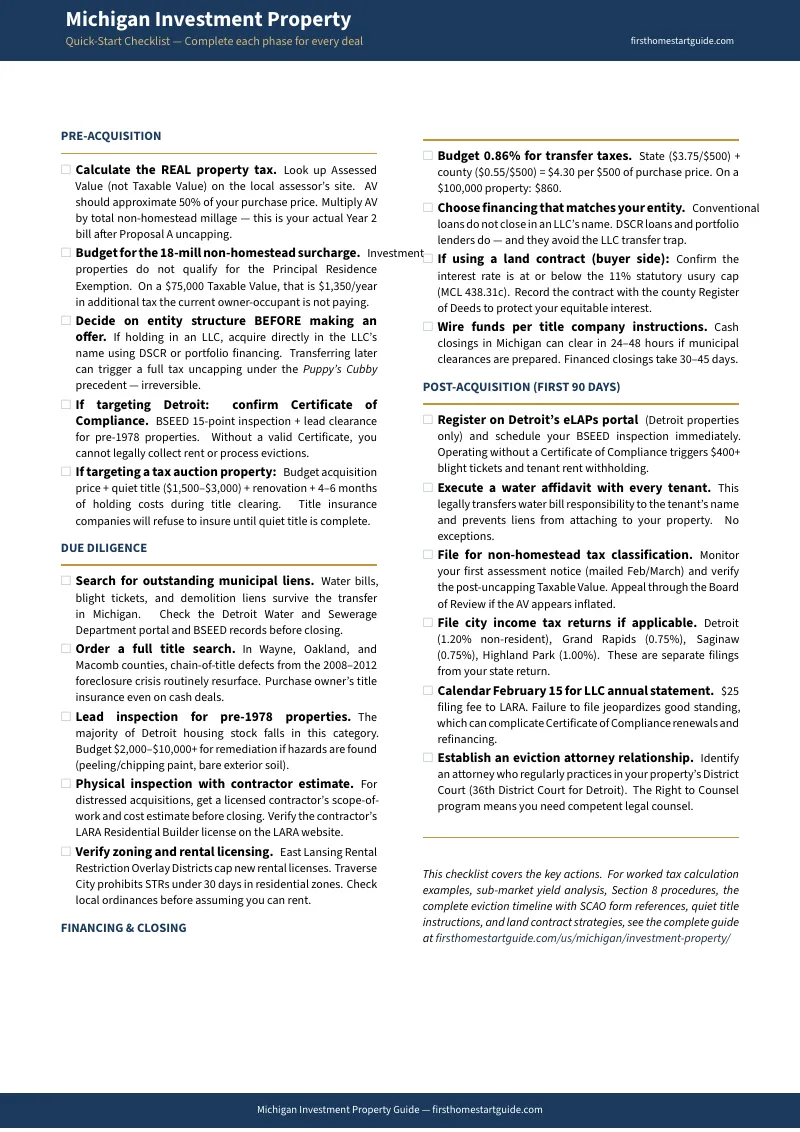
- Property Tax Worksheet — Fill-in worksheet for calculating post-uncapping, non-homestead tax liability with the 5-step formula and LLC transfer impact assessment
- Entity Structure Decision Tree — Visual flowchart showing which ownership transfers trigger irreversible tax uncapping under Puppy's Cubby and which are safe
- Tax Auction Budget Worksheet — Total capital budget template for Wayne County tax auction properties: acquisition through quiet title through stabilization
- BSEED Compliance Checklist — Detroit Certificate of Compliance step-by-step: eLAPs registration, 15-point inspection, lead requirements, water affidavit
- Eviction Process Quick Reference — One-page landscape card with the complete SCAO form sequence, notice timelines, and Right to Counsel considerations
- Financing Comparison — Side-by-side comparison of all five financing options with Michigan-specific notes on LLC compatibility and land contract risks
- Sub-Market Comparison — At-a-glance landscape reference comparing all five Michigan investment regions on cap rates, vacancy, rents, risks, and compliance
- Property Management Vetting Checklist — Interview questions, red flags, fee benchmarks, reference check script, and contract review for Michigan PMs
Who This Guide Is For
This guide is for real estate investors targeting Michigan markets who:
- Are evaluating Detroit's extreme affordability from out of state and need to understand how Proposal A tax uncapping, the 18-mill non-homestead surcharge, Certificate of Compliance requirements, water bill liens, and 36th District Court eviction timelines will transform that spreadsheet cap rate into an actual net operating income — before they deploy capital
- Are considering an LLC for asset protection and need to understand the Puppy's Cubby precedent before making an entity structuring decision that irreversibly triggers a full property tax uncapping in Michigan — a mistake that cannot be corrected after the transfer is recorded
- Are bidding on Wayne County tax auction properties and need the complete acquisition-through-marketable-title workflow — including realistic quiet title timelines, costs, the expedited Land Bank alternative, and the holding cost budget that keeps them solvent during title clearing
- Are building a Section 8 portfolio in Detroit and need honest operational guidance on Detroit Housing Commission administrative delays, HAP contract processing timelines, and the capitalization reserves required to survive six months between approval and actual payment
- Are evaluating Grand Rapids, Traverse City, or Lansing markets and need to understand how each municipality's specific zoning, licensing, and STR regulations affect rental strategy — including East Lansing's Rental Restriction Overlay Districts and Traverse City's residential-zone STR prohibition
- Want every Michigan-specific regulation, tax calculation, and compliance requirement in one reference — instead of assembling it from MCL statutes, Michigan State Tax Commission bulletins, BSEED portals, Wayne County Land Bank guides, and Reddit threads that may predate the 2025 source-of-income law or the Detroit Certificate of Compliance overhaul
Why Not Free Tools and Forums?
Free information on Michigan real estate investing exists. Here is what it actually delivers:
- BiggerPockets and Reddit (r/realestateinvesting, r/Detroit) contain genuinely useful investor experience reports mixed with advice that predates the 2024 Certificate of Compliance overhaul, the April 2025 source-of-income anti-discrimination law, and the May 2025 Detroit lead inspection revisions. A 2023 thread about LLC structuring may not reflect the Puppy's Cubby implications. Sorting current from outdated takes longer than reading a guide that has already done it — and a single outdated thread followed as gospel can cost tens of thousands in an irreversible tax uncapping.
- Local property management company blogs provide highly localized Detroit compliance content. They are also inherently top-of-funnel marketing designed to convince you that the environment is too complex to navigate without their proprietary management services. The content selectively highlights risks to sell a solution, not to give you the operational procedures to manage independently or evaluate managers critically.
- Michigan State Tax Commission and assessor databases give you the raw data — millage rates, Taxable Values, equalization ratios. They do not explain how uncapping works on transfer, do not compare individual versus LLC ownership with dollar-amount examples at different property values, and do not warn you about the Puppy's Cubby precedent. You get the inputs without the calculation framework that makes them usable for underwriting.
- Legal and tax firm bulletins provide technically precise articles on isolated statutes like MCL 211.27a. They are written in dense legalese, narrowly focused on a single issue, and do not connect the tax mechanics to the acquisition strategy, financing structure, and operational workflow that investors actually need. A five-page article on quiet title procedures is useful — but it does not tell you how to budget the entire tax-auction-to-rental-income timeline.
This guide fills the Michigan-specific gap — the space between knowing how to analyse a rental property in general and knowing how to underwrite one in a state where Proposal A uncapping can triple the seller's published tax bill on transfer, where the non-homestead millage adds 18 mills that only investors pay, where an LLC transfer following the Puppy's Cubby precedent triggers irreversible tax damage, where operating without a Certificate of Compliance makes rent collection legally unenforceable, where the Right to Counsel program means 53% of represented tenants stay, and where water bill liens survive ownership transfer and can exceed five figures. It is the analysis that would take a Michigan real estate attorney, a CPA who understands Proposal A, and a Detroit compliance consultant to assemble — structured as a reference you own permanently.
— Less Than a Single Tax Uncapping Mistake
A single property tax uncapping on a $200,000 property can increase your annual tax bill by $2,000 to $4,000 — permanently. An LLC transfer that triggers the Puppy's Cubby uncapping is irreversible. A quiet title action on a tax auction property runs $1,500 to $5,000 — and skipping it means you cannot sell, refinance, or insure the property. A water bill lien that was not caught before closing can exceed $50,000 on a multifamily property. A single BSEED blight violation for operating without a Certificate of Compliance starts at $400 and escalates with each citation.
This guide does not replace your real estate attorney or your CPA. But it gives you the tax uncapping calculation framework, the LLC structuring decision tree, the quiet title workflow, the BSEED compliance checklist, and the sub-market analysis that ensure you identify every Michigan-specific risk before you are contractually committed — instead of discovering them on your first assessment notice, your first eviction filing, or the day you try to refinance a tax-auction property with a clouded title.
If it catches a single tax uncapping miscalculation, prevents a single LLC transfer trap, or stops you from closing on a tax auction property without budgeting for quiet title, it pays for itself before you have finished reading it.
Money-back guarantee, no time limit. If the guide does not sharpen your underwriting and protect your capital in Michigan's regulatory environment, you pay nothing.
Download the free Michigan Quick-Start Investment Property Checklist to see the due diligence framework covering property tax uncapping, LLC structuring, municipal compliance, financing, and post-acquisition operations. When you are ready for the full tax calculation examples, sub-market analysis, quiet title procedures, and Section 8 operational guidance, the complete guide is here.
The cap rate clears at 14%. This guide tells you whether Michigan agrees.