
The Numbers Work Until St. Paul's 3% Rent Cap, the Mortgage Registry Tax on Every Refinance, and a 9.85% Capital Gains Bill Rewrite Them
You found a duplex in St. Paul throwing off 7% cap rates in a neighborhood with strong schools and a three-year tenant history. Or a four-unit in Minneapolis at $420,000 with projected cash flow that pencils out at 8%. Or a value-add triplex in Lakeville where the suburbs are free of rent control and lease renewals hit 63%. You formed a Minnesota LLC for $155 because it has zero annual fees. The spreadsheet looks airtight. You're ready to wire earnest money.
Then Minnesota shows up. The St. Paul duplex is subject to a hard 3% rent cap on occupied units, and your insurance just went up 7%. You can apply for the Reasonable Return Exception, but you need Base Year NOI calculations from 2019, a Maintenance of Net Operating Income worksheet, and a filing with the Department of Safety and Inspections — and if you're requesting more than 8%, it triggers a full staff determination with appeal rights to the City Council. The Minneapolis four-unit? You assumed it had rent control because both cities voted on ballot measures in 2021. It doesn't — Minneapolis Question 3 only authorized the City Council to regulate rents, and as of 2026, no ordinance has been enacted. You overpaid for a risk premium that doesn't exist yet. The Lakeville triplex goes through BRRRR perfectly — rehab, tenant placement, stabilization. Then you refinance, and the title company hits you with a $1,200 Mortgage Registry Tax on a $500,000 mortgage. You already paid MRT on the initial acquisition. The state doesn't care — any new debt triggers a fresh 0.24% assessment on the full principal. And when you sell in eight years? Minnesota treats your long-term capital gains as ordinary income. No preferential rate. The entire gain stacks on top of your W-2 income and gets taxed at up to 9.85%, plus a 1% surcharge if your net investment income exceeds $1 million. Your neighbor in Wisconsin gets a 30% exclusion. Your colleague in South Dakota pays zero.
Here's the problem: Minnesota combines one of the most tenant-protective regulatory frameworks in the country with capital gains taxation that treats a decade of appreciation as ordinary income at 9.85%, a Mortgage Registry Tax that adds 0.24% to every refinance and capital extraction event, a St. Paul rent cap that limits occupied-unit increases to 3% while operating costs inflate at 5-8%, a Minneapolis charter amendment that hasn't produced an ordinance but has already depressed asset valuations, a 14-day pre-eviction notice requirement that stretches actual recovery timelines to 45-60 days in Hennepin and Ramsey counties, security deposit rules requiring 1% annual interest and a strict 21-day return deadline with punitive damages for noncompliance, and 2024 contract for deed reforms that extended investor seller cancellation timelines to 120 days and imposed anti-churning restrictions. Each of these has cost real investors thousands — in compressed NOI, in unexpected MRT at the closing table, in deposit penalties in housing court, in capital gains bills that eliminated years of appreciation — because the information existed but was scattered across St. Paul DSI filings, the Minnesota Department of Revenue, BiggerPockets threads, and housing court data that may already be outdated.
The Minnesota Investment Property Guide is a Minnesota Regulatory Navigation System — not a motivational overview of Twin Cities investing, but a structured compliance and underwriting framework that maps every Minnesota-specific rent control mechanic, tax trap, MRT workaround, eviction timeline, and landlord-tenant deadline into a process you work through before you wire earnest money. It replaces months of cross-referencing St. Paul DSI exception applications, Department of Revenue MRT guidance, housing court filing data, and scattered forum threads with a single reference that tells you exactly which municipal boundary creates which obligation, exactly what the numbers look like after MRT and state capital gains, and exactly where deals go wrong in this state.
What's Inside the Minnesota Regulatory Navigation System
A 13-chapter guide, a 20-item due diligence checklist, and 6 standalone printable worksheets — covering every stage from submarket selection through entity structuring, financing, rent control compliance, taxation, landlord-tenant law, and exit strategy, built specifically for the regulatory bifurcations, punitive tax mechanics, and municipal-level compliance traps that make Minnesota different from every other Midwest market:
Six Investment Zone Analysis with Regulatory Risk Map
Minnesota is not one market — it is six fundamentally different investment environments separated by municipal boundaries that change the rules entirely. Suburban Twin Cities (Lakeville, Maple Grove, Apple Valley, Woodbury) offer 6-8% cap rates with zero rent control, no security deposit caps, and lease renewal rates hitting 63% — the path of least regulatory resistance. Urban Minneapolis offers higher paper yields (7-8% for Class C) but layers security deposit caps at one month's rent, 30-day pre-eviction notices (double the state mandate), mandatory pre-lease and post-lease disclosures, and just cause protections. Urban St. Paul operates the most stringent rent stabilization framework in the Midwest: a 3% hard cap on occupied units with a Reasonable Return Exception process that requires Base Year NOI calculations and DSI filings. Rochester captures the Mayo Clinic and $1.8 billion Destination Medical Center with inelastic demand for 30-to-90-day furnished rentals from traveling nurses — no rent control, no municipal deposit caps, steady appreciation. Duluth blends university-anchored demand with seasonal tourism. Lake cabin country offers strong seasonal STR income but navigates a fragmented patchwork of county-level licensing — Mille Lacs requires a Department of Health lodging license, Chisago County administers a 3% lodging tax, Prior Lake banned new STRs under 60 days. The guide maps which zones generate cash flow and which generate compliance overhead.
St. Paul Rent Control and the Reasonable Return Exception Process
No single issue dominates Twin Cities investor psychology more than rent control — and no single issue generates more confusion. The guide walks through the full statutory evolution: the original 2021 ballot measure with no vacancy decontrol and no new construction exemption, the January 2023 amendments introducing vacancy decontrol and a 20-year construction exemption, and the June 2025 permanent new construction exemption. Then it covers what actually matters for existing inventory owners: the Reasonable Return Exception, the only legal mechanism for bypassing the 3% cap on occupied units. The city presumes that your 2019 Base Year NOI provided a reasonable return. To justify an increase above 3%, you must demonstrate unavoidable changes in operating expenses, property tax increases, necessary capital improvements, or non-wear-and-tear deterioration using a Maintenance of Net Operating Income (MNOI) worksheet filed with the Department of Safety and Inspections. Self-certification handles increases between 3% and 8%. Increases above 8% require exhaustive staff determination with appeal rights to a hearing officer and ultimately the City Council. The guide details every qualifying factor, every filing step, and every audit risk — because mastering this process is a competitive advantage that most St. Paul landlords never develop.
Minneapolis: The Authorization Without the Ordinance
A massive information gap exists in the market. Because both cities passed ballot measures simultaneously in November 2021, a large contingent of investors falsely believe Minneapolis operates under an active 3% cap identical to St. Paul's. The legal reality: Minneapolis Question 3 merely approved a charter amendment authorizing the City Council to regulate rents. As of 2026, no ordinance has been enacted. Landlords operating in Minneapolis remain legally free to set rents at market rates. The psychological overhang is real — the looming threat of future regulation has pushed risk-averse capital toward the suburbs, creating localized pricing inefficiencies in Minneapolis multifamily that risk-tolerant buyers can exploit. The guide covers exactly what Minneapolis does enforce (security deposit caps, 30-day pre-eviction notices, mandatory disclosures, just cause protections, rental license tiers) and what it does not (rent caps), so you underwrite based on the actual regulatory environment rather than the perceived one.
The Mortgage Registry Tax and BRRRR Workarounds
The MRT is Minnesota's most insidious transactional cost — a 0.23% tax on every recorded mortgage, rising to 0.24% in Hennepin and Ramsey counties with the Environmental Response Fund surcharge. A $500,000 mortgage triggers $1,200 at the closing table. Investors executing BRRRR strategies assume the MRT was a one-time cost at acquisition. The Minnesota Department of Revenue says otherwise: any new debt triggers a fresh MRT calculation on the full principal amount. You pay down a $500,000 note to $250,000, refinance back to $500,000 to extract equity, and the new mortgage triggers MRT on the full $500,000 — not just the extracted equity. The guide covers the statutory exemptions that actually work: amendments that don't secure new debt, revolving lines of credit where readvances are treated as continuation of existing debt rather than new obligations, the multi-state limiting clause for institutional investors, and the HELOC acquisition strategy that cuts total MRT exposure in half by purchasing properties in cash and refinancing only once.
Capital Gains Taxation and the Border War
Minnesota's capital gains treatment is the single most significant structural headwind for real estate investors. The state taxes all capital gains as ordinary income — no preferential long-term rate. A decade of property appreciation stacks on top of your W-2 income and gets taxed at rates peaking at 9.85%. Starting in 2024, a 1% Net Investment Income Tax surcharge applies above $1 million, pushing the effective state rate to 10.85% on highly successful exits. Wisconsin offers a 30% exclusion on long-term gains. Iowa is transitioning to a flat 3.8% rate with total exclusions for 10-year business property. South Dakota has no state income tax whatsoever. The guide provides the comparative tax analysis that makes or breaks the capital allocation decision: exactly how much additional yield a Minnesota property must generate to offset the built-in tax disadvantage, the 1031 exchange mechanics that make tax deferral mandatory rather than optional, installment sale structuring via contract for deed to spread gains across tax years, and Delaware Statutory Trust exchanges for investors exiting active management.
Eviction Timelines, Security Deposits, and Landlord-Tenant Compliance
The 14-day pre-eviction notice requirement (effective January 2024) is the statewide baseline. Minneapolis doubles it to 30 days. Once the notice period expires, file with the county, obtain a summons, serve the tenant at least 7 days before the court date. Even after judgment, tenants can request 7 additional days. If they still refuse, you pay $200 for a County Sheriff Writ of Recovery granting 24 hours for final removal. From initial missed payment to physical recovery in Hennepin and Ramsey counties: 45 to 60 days of zero revenue. Eviction filings are surging — Hennepin County recorded 3,346 filings between January and April 2026, 10.8% above its recent average. Ramsey County recorded 1,631 filings, 18.1% above its three-year average. The guide covers the full statutory timeline, the security deposit rules (1% annual interest, 21-day return deadline, punitive damages for bad faith withholding including the withheld amount plus a $500 penalty), rent escrow mechanics, notice of entry requirements, and Section 8 source-of-income protections that prohibit voucher discrimination statewide.
Contract for Deed, Fix-and-Flip Licensing, and Tax Forfeiture
The 2024 contract for deed reforms are the most significant in four decades. Investor sellers now face a 30-day informal notice plus 90-day formal cancellation period (120 days total), a 10-day buyer rescission window, anti-churning provisions triggered by two or more terminations on the same property (or four across the portfolio within 48 months), and mandatory refund of any down payment portion exceeding 10% if terminated within 48 months. The guide covers all Chapter 559/559A requirements plus the strategic comparison to mortgage foreclosure (120-day CFD cancellation vs. 8-10 month foreclosure with 6-month redemption). For fix-and-flip investors, the DLI requires a Residential Building Contractor or Residential Remodeler license for speculative work — with a narrow $15,000 gross receipts exemption and penalties reaching $16,000 for unlicensed activity. The tax forfeiture chapter covers the post-Tyler v. Hennepin County framework: the 2024 legislative rewrite, mandatory auction with market-calibrated minimum bids, 6-month surplus equity claim period, and the extended title review timelines that now apply to every post-forfeiture acquisition.
Who This Guide Is For
This guide is for real estate investors targeting Minnesota markets who:
- Are analyzing a Twin Cities property and need to determine whether the deal works once you account for St. Paul's 3% rent cap (or Minneapolis's absence of one), the Mortgage Registry Tax on acquisition and every subsequent refinance, capital gains taxed as ordinary income at 9.85%, and eviction timelines that routinely stretch to 45-60 days — not the generic underwriting assumptions that work in states without rent stabilization and punitive capital gains treatment
- Are a Wisconsin or South Dakota investor evaluating whether Minnesota yields justify the tax drag — and need the side-by-side comparison of capital gains treatment, MRT exposure, and landlord-tenant compliance overhead to make that decision with real numbers rather than forum speculation
- Own St. Paul rental property and need the step-by-step Reasonable Return Exception process — the Base Year NOI calculation, the MNOI worksheet, the self-certification vs. staff determination tracks, and the appeal pathway — because your operating costs are inflating at 5-8% annually and the 3% cap is compressing your net operating income
- Are executing BRRRR in Minnesota and just discovered that the Mortgage Registry Tax applies to every refinance, not just the initial acquisition — and need the revolving line of credit structuring, HELOC acquisition strategy, and statutory exemptions that legally minimize MRT exposure across your portfolio
- Are targeting Rochester for mid-term furnished rentals and want to bypass the Twin Cities regulatory friction entirely — with the Mayo Clinic and $1.8 billion DMC expansion driving inelastic demand for 30-to-90-day leases from traveling healthcare workers
- Need to understand the 2024 contract for deed reforms before structuring a seller-financed exit — the 120-day investor seller cancellation timeline, the anti-churning thresholds, the 10% down payment refund obligation, and the due-on-sale clearance requirement
- Want every Minnesota-specific statute, tax rate, rent control mechanic, and compliance deadline in one reference — instead of assembling it from St. Paul DSI filings, the Department of Revenue, BiggerPockets threads, and housing court data that may already be outdated
Why Not Free Tools and Forums?
Free information on Minnesota real estate investing exists across dozens of sources. Here's what it actually delivers:
- BiggerPockets forums contain useful war stories from Twin Cities investors — mixed with ideological debates about rent control economics, outdated references to the pre-amendment St. Paul ordinance (before vacancy decontrol and new construction exemptions), and national BRRRR advice that completely ignores the MRT penalty on every refinance. The highest-engagement threads are investors arguing about whether to sell St. Paul rentals to owner-occupants as retaliation against the city council. Sorting current statutory reality from 2021-era panic across a dozen threads takes longer than reading a guide that has verified every amendment and exception.
- MnREIA is a highly active, well-respected local investor association — voted a top Midwest REIA. Their in-person events provide excellent networking with experienced local investors. But membership is required for access, and their public-facing repository of exhaustive written guides covering the full MRT exemption framework, Reasonable Return Exception filing process, and comparative cross-border tax analysis is limited.
- Local law firm blogs publish highly accurate articles on specific statutes — the 14-day eviction notice, contract for deed cancellation mechanics, security deposit return timelines. Each article covers one isolated legal fragment. None integrates the legal analysis with financial underwriting, rent control navigation, MRT structuring, or broad investment strategy for the state.
- National investing courses ($997 to $5,000+) teach cap rate analysis, DSCR calculations, and 1031 exchange mechanics that apply everywhere. They don't cover the Mortgage Registry Tax, St. Paul's Reasonable Return Exception, Minneapolis's authorization-without-ordinance reality, Minnesota's ordinary income treatment of capital gains, or the 2024 contract for deed anti-churning provisions. Applying national frameworks to Minnesota's high-regulation market is how investors underwrite deals that bleed margin to taxes, MRT, and rent cap compression.
This guide fills the Minnesota-specific gap — the space between knowing how to analyze a rental property in general and knowing how to underwrite one in a state where rent increases are capped at 3% on occupied units in St. Paul, where every refinance triggers a 0.24% MRT assessment, where long-term capital gains are taxed as ordinary income at 9.85%, where eviction recovery takes 45-60 days, and where the 2024 contract for deed reforms impose anti-churning restrictions on every investor seller exit. It's the analysis that would take a Minnesota real estate attorney, a CPA specializing in state capital gains, a St. Paul rent control compliance consultant, and a title company MRT specialist to assemble — structured as a reference you own permanently.
— Less Than One Hour of a Real Estate Attorney
A single Reasonable Return Exception filing mistake forfeits your right to raise rents above 3% on an occupied St. Paul unit for another year. A single missed 21-day security deposit deadline triggers punitive damages — the full withheld amount plus a $500 penalty. A BRRRR refinance you assumed was MRT-exempt costs $1,200 on a $500,000 note because the new mortgage secures new debt. A capital gains bill at 9.85% on a sale you could have structured as a 1031 exchange or installment sale eliminates years of appreciation. A Minneapolis property you avoided because you thought it had rent control was actually the best risk-adjusted deal in the metro — and someone else bought it.
This guide doesn't replace your Minnesota real estate attorney, your CPA, or your title company. But it gives you the rent control navigation framework, MRT structuring strategies, capital gains deferral mechanics, landlord-tenant compliance system, and market-by-market breakdowns that ensure you identify every Minnesota-specific risk and opportunity before you're contractually committed — instead of discovering them at the closing table, in housing court, or on your state tax return.
If it catches a single MRT structuring opportunity, prevents a single deposit deadline violation, reveals that your St. Paul rents can legally exceed 3% through the exception process, or saves you from avoiding a Minneapolis deal based on a rent control myth, it pays for itself before you've finished reading it.
Money-back guarantee, no time limit. If the guide doesn't sharpen your underwriting and protect your capital in Minnesota's high-regulation market, you pay nothing.
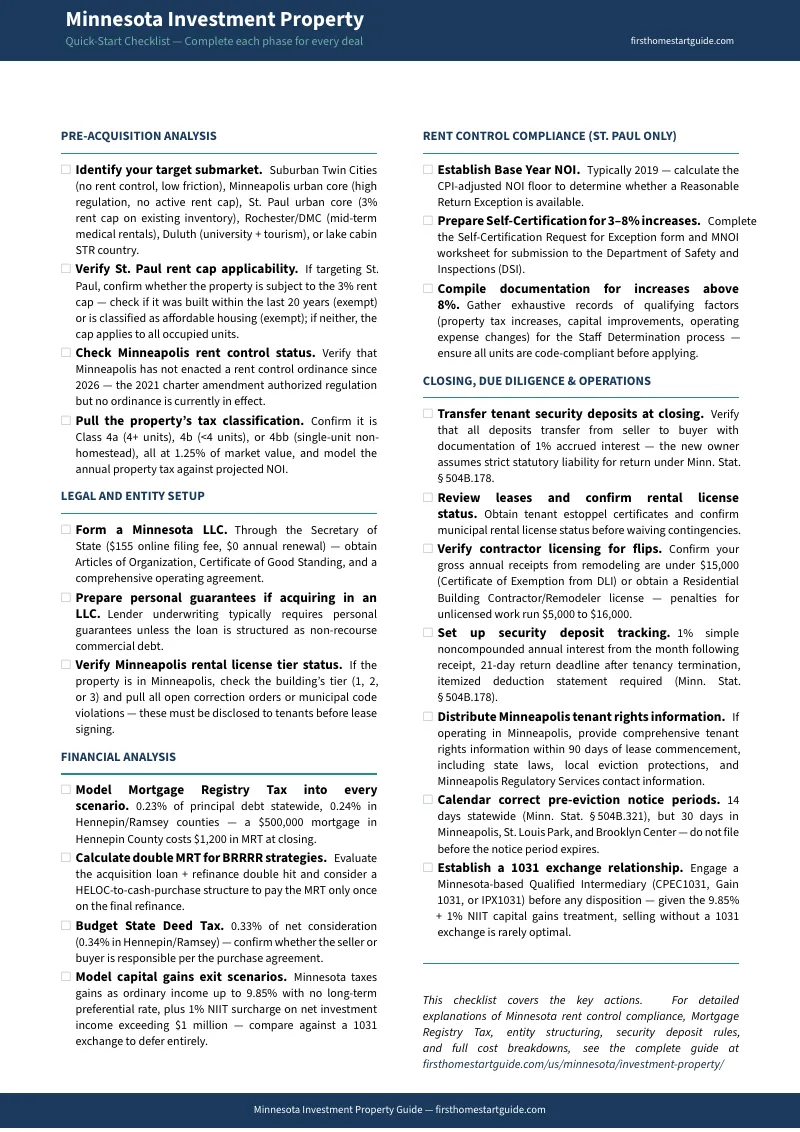
Download the free Minnesota Quick-Start Checklist to see the due diligence framework covering pre-acquisition regulatory assessment, entity setup, MRT exposure calculation, rent control applicability, and post-acquisition compliance. When you're ready for the full rent control navigation system, MRT structuring guide, capital gains deferral analysis, landlord-tenant compliance framework, and 13-chapter investment guide, the complete guide is here.
The spreadsheet works in any state. This guide tells you whether it works in Minnesota.
Frequently Asked Questions
What if the rules change after I buy?
We update the guide when the rules change. Email us any time, even years later, and we'll send you the current edition free.