
You Got Pre-Approved. Then Missouri Happened — the 1% Earnings Tax Nobody Modelled, the MHDC Income Trap That Killed Your 4% Grant, and the St. Louis Property Tax That Changes Every Three Blocks.
You ran the numbers on a three-bedroom in Brookside. The mortgage payment was comfortable, the neighbourhood felt right, and your lender said you were good to go. Then you got your first paycheck after moving to Kansas City and discovered $66 missing. The 1% municipal earnings tax — levied on every dollar of gross income earned or received within KCMO city limits — had started garnishing your pay before federal or state taxes. Nobody put that in the affordability calculator. Over 30 years of homeownership, that is $23,760 in after-tax income you never budgeted for. Your comfortable monthly payment is now tight. Your emergency fund contributions are gone.
Or you are a dual-income household earning $102,000 combined, and your loan officer told you the MHDC First Place program would cover 4% of your loan amount as a forgivable grant for your down payment and closing costs. On a $250,000 home with an FHA loan, that is $9,640 in free money. Then MHDC ran compliance income — not your base salary, but 24 months of total gross earnings for every household member aged 18 and older, including your spouse's overtime, your weekend DoorDash deposits, and the shift differentials your employer paid during the holiday season two years ago. Your compliance income came back at $106,200. The non-targeted limit for a 1-2 person household in the Kansas City MSA is $105,000. You are $1,200 over. The 4% grant is dead. Your loan officer never mentioned that MHDC calculates income differently than the mortgage underwriter.
Or you found a $250,000 home in St. Louis County and budgeted $3,750 for property taxes based on the county average you found online. Then you pulled the parcel record and discovered your home sits in a school district with a voter-approved levy ceiling that produces a tax bill of $5,200 — while an identical home three blocks east, in a different school district boundary, pays $3,100. The 1876 split between St. Louis City and St. Louis County created 88 to 90 independent municipalities with overlapping fire districts, library districts, and school districts, each stacking their own levy on top of the statewide 19% residential assessment ratio. Searching for homes by municipality name tells you almost nothing about your actual tax bill. Only the parcel-level taxing district overlay does.
Or you relocated from Illinois and budgeted 1.5% of the purchase price for transfer taxes, based on your experience in Cook County. Your Missouri closing disclosure showed $0 for transfer taxes. Missouri levies no real estate transfer tax anywhere in the state — a structural advantage worth $3,000 to $6,000 on a typical purchase that you left sitting in your savings account as unnecessary reserves. Meanwhile, you skipped the radon test because your Illinois home tested clean, not knowing that one in three Missouri homes exceeds the EPA's 4.0 pCi/L action level and that the northern, western, and central counties where Kansas City and Columbia sit are classified as Zone 1 — the highest risk category in the country.
The problem is not that you have not researched. The problem is that Missouri layers a title-company closing system where the title company runs the entire transaction without an attorney, two cities with independent 1% earnings taxes that suppress your take-home pay by $800 or more per year, a property tax landscape that varies parcel-by-parcel across 88+ overlapping municipalities in St. Louis County alone, an MHDC down payment assistance program whose compliance income calculation disqualifies buyers who were pre-approved by their own lender, East-West title insurance customs that shift thousands of dollars in closing costs depending on which side of the state you buy, a caveat emptor legal doctrine that places the entire burden of discovering defects on the buyer, and a radon exposure rate that is among the highest in the nation — and no single resource maps all of them into a decision framework you can work through before you commit earnest money.
The Missouri First-Time Home Buyer Guide is a Missouri Buyer Navigation System — a structured walkthrough of every Missouri-specific assistance program, tax trap, closing custom, environmental hazard, and jurisdictional anomaly that determines whether your purchase closes smoothly or falls apart at the title company table. It replaces months of cross-referencing MHDC compliance documents, county assessor databases, municipal earnings tax codes, and conflicting Reddit threads with a single reference that tells you exactly what to verify, exactly what the numbers should look like, and exactly where Missouri transactions go wrong.
What's Inside the Missouri Buyer Navigation System
The complete guide, a quick-start checklist, and 8 standalone printable tools — an earnings tax affordability worksheet, an MHDC program comparison card, a compliance income calculator, a DPA stacking guide, a closing cost worksheet, a Missouri inspection checklist, a KC metro border comparison card, and a regional market reference card you can print and bring to lender meetings, title company closings, and inspections. Ten printable files total.
Covering every stage from financial preparation through post-purchase setup, built specifically for the tax structures, closing customs, and market dynamics that make Missouri different from every other state:
Missouri Affordability Reality Check
The True Monthly Cost formula that every Missouri buyer in Kansas City or St. Louis must run before committing to a purchase price. How the 1% municipal earnings tax reduces your net take-home pay by $66/month on an $80,000 salary — a permanent cash-flow drain that generic mortgage calculators never model. Why buyers qualifying at maximum DTI ratios of 43% to 50% end up cash-flow negative after the earnings tax garnishment starts. The remote work refund mechanism for St. Louis City non-residents: recent appellate court rulings confirm that workers performing duties outside city limits can claim a refund of the 1% tax for days worked remotely, but the one-year statute of limitations and employer verification requirements mean most buyers never recover the money. The complete earnings tax decision matrix for the KC metro border equation: living in KCMO versus Lee's Summit versus Overland Park, and exactly how the tax interacts with Missouri-Kansas cross-border filing, the MO-CR credit form, and the risk of a surprise four-figure bill from the municipal revenue department years after purchase.
MHDC First Place and Next Step Programs Decoded
The two flagship down payment assistance programs from the Missouri Housing Development Commission, broken down in plain language. First Place: restricted to verified first-time buyers and qualified veterans, funded through tax-exempt Mortgage Revenue Bonds, providing a 4% Cash Assistance Loan as a forgivable second mortgage with no monthly payments and no interest. The forgiveness schedule: 100% of the balance remains due if you sell or refinance in the first 60 months, then diminishes by 1/60th each month from month 61 through month 120, reaching zero at year ten. The Non-DPA option: forfeit the 4% grant in exchange for a 0.25% to 0.50% rate reduction on your primary 30-year mortgage — a structural choice that yields tens of thousands in cumulative interest savings over the full amortization. Next Step: identical 4% DPA structure but available to both first-time and repeat buyers with elevated income and purchase price limits. Both programs require a minimum 640 credit score and completion of a HUD-approved homebuyer education course ($50 to $100 via eHome America). The guide walks through which program fits your profile, how to match with an MHDC-certified lender, and the Recapture Tax provision that can claw back a portion of the subsidy if you sell within the first nine years at a profit while your income has risen substantially.
The MHDC Compliance Income Trap
The single most common reason Missouri buyers lose their 4% DPA grant after being pre-approved for the mortgage itself. MHDC does not use your qualifying income — the base salary your lender underwrites against. It calculates compliance income: the gross annual earnings of every household member aged 18 and older who will occupy the home, regardless of whether they are on the loan. The 24-month historical lookback averages your total gross earnings — including overtime, shift differentials, performance bonuses, child support received, and gig economy income from Uber, DoorDash, or freelance work — then projects that average forward for 12 months. A buyer whose base salary falls safely under the limit but whose two-year overtime history pushes compliance income $1,200 over the threshold loses the entire grant. The guide covers exactly how to calculate compliance income before you apply, which income sources MHDC includes that your lender does not, the county-specific limits for every MSA in Missouri, and the strategic timing decisions that can preserve eligibility.
Local Municipal Down Payment Assistance
Beyond MHDC state programs, Missouri municipalities offer heavily funded local grants that can be stacked with your primary financing to eliminate out-of-pocket costs entirely. HomeSTL: the St. Louis Development Corporation's ARPA-funded program providing up to $50,000 for homes in Qualified Census Tracts as a 0% interest loan, fully forgivable after 15 years of residency. FHLB Kansas City: First Federal Bank partners with the Federal Home Loan Bank to offer a $15,000 DPA grant in Jackson, Clay, Cass, and Platte counties for households earning up to 80% AMI. Beyond Housing: zero-interest, 5-year forgivable DPA loans across the St. Louis region — up to $7,000 in St. Louis and Jefferson Counties, $8,000 in Florissant, $10,000 in St. Charles County. Habitat for Humanity of Kansas City: a strict $10,000 grant requiring no repayment for buyers who have not owned a home in three years. City of Columbia: forgivable 0% loan covering up to $10,000 or 10% of the purchase price for low-to-moderate-income buyers. City of Springfield: up to $9,000 deferred and forgiven over 10 years. Restore SGF: a $9,000 grant for historic neighbourhood revitalization in Springfield. The guide maps every active program, its eligibility requirements, its forgiveness schedule, and which ones stack with MHDC.
The St. Louis City-County Property Tax Trap
In 1876, the City of St. Louis formally seceded from St. Louis County to become an independent city, permanently capping its geographic borders. Today, St. Louis County operates as a separate entity surrounding the city, comprising approximately 88 to 90 independent municipalities — Clayton, Chesterfield, Ballwin, Florissant, and dozens more — each with its own layer of taxing authority. Missouri calculates property taxes by multiplying your home's appraised market value by the statewide 19% residential assessment ratio to derive the assessed value, then multiplying that assessed value by the total local levy rate of every overlapping taxing district covering your specific parcel: municipality, fire protection district, library district, and — most critically — the public school district. Because school district levies constitute the vast majority of any property tax bill, two identical $250,000 homes located three blocks apart in St. Louis County can carry annual tax bills that differ by $2,000 or more simply because they feed into differently funded school districts. The guide provides the exact formula, worked examples for major municipalities, and the parcel-level lookup process that tells you your actual tax exposure before you make an offer.
The KC Metro Border Equation
Kansas City straddles the Missouri-Kansas state line, and every buyer in the metro must make a calculation that no national portal models for them. Missouri assesses residential property at 19% of market value. Kansas assesses at 11.5%. On a $400,000 home, the difference in assessed value alone is $30,000 — and the local mill levy applied to that assessed value determines whether the Missouri or Kansas side actually produces a lower tax bill. Layer the KCMO 1% earnings tax on top: a buyer living in Overland Park but commuting to downtown Kansas City still pays the earnings tax to KCMO while also navigating Kansas state income tax and the MO-CR credit form for cross-border relief. A buyer who lives and works entirely in Lee's Summit or Blue Springs avoids the earnings tax altogether. The guide works through the complete 30-year cost comparison — property tax assessment ratios, earnings tax exposure, state income tax rates, school district quality, and commute cost — so you can make the border decision with actual numbers rather than anecdotal advice from Reddit.
Missouri Closing Process
Missouri is a title company state. The title company acts as the neutral escrow agent, conducts the title search, issues title insurance, and presides over the closing table. Attorneys are optional in standard residential transactions. The standard timeline runs 30 to 40 days from mutual acceptance to settlement, governed by the RES-2000 residential sales contract promulgated by Missouri REALTORS. Earnest money: 1% to 2% of the purchase price ($2,000 to $6,000 on a typical home), deposited within 24 to 48 hours. The inspection contingency: a negotiated 7- to 10-day window under the MSC-2050N Inspection Notice form, with a structured objection-response-capitulation dynamic. The appraisal contingency under MSC-2046: if the property undervalues, the seller gets five days to agree to a price reduction or the buyer walks with their deposit. The East-West title insurance divide: in Western Missouri (Kansas City metro), the seller customarily pays the Owner's Title Policy; in Eastern Missouri (St. Louis metro), the buyer pays both Owner's and Lender's policies — a difference of $575 to $640 in closing costs depending on which side of the state you are buying. The Closing Protection Letter: mandated by Senate Bill 833, fixed at $25 by statute, protecting against escrow theft and title agent fraud. And the structural advantage: Missouri charges $0 in real estate transfer taxes anywhere in the state.
Inspections in a Caveat Emptor State
Missouri operates under caveat emptor — "let the buyer beware." Courts will not compensate you for defects discovered after closing unless the seller committed active fraud or intentional concealment. The only explicit disclosure mandate under state law is RSMo 442.606: the seller must disclose if the property was used for methamphetamine production. Everything else is on you. The guide covers the critical inspections for Missouri's specific hazards: radon testing (one in three homes exceeds the EPA's 4.0 pCi/L action level, with Zone 1 high-risk counties covering Jackson, Clay, Boone, and St. Louis County — mitigation systems run $1,000 to $1,500 and are routinely negotiated as seller concessions), lead-based paint in the pre-1978 housing stock concentrated in St. Louis and Kansas City historic cores (EPA RRP certification requirements for any renovation, XRF analyser testing), deteriorating clay sewer laterals and knob-and-tube wiring in older homes that many insurance carriers refuse to underwrite, FEMA flood zone verification for properties near the Mississippi and Missouri Rivers (mandatory NFIP flood insurance for federally backed mortgages in Special Flood Hazard Areas), and rural septic system inspections where a failing system can cost $10,000 to $15,000 to replace.
The Missouri Beneficiary Deed
The single most valuable post-closing action a first-time buyer in Missouri can take. Under RSMo 461.025, a Beneficiary Deed (Transfer on Death deed) allows you to designate who inherits your home immediately upon your death, completely bypassing Missouri's probate court process. Cost: $100 to $500 for an attorney to prepare and record, versus $3,000 to $4,500 for a Revocable Living Trust. The deed has no legal effect during your lifetime — you retain full control to sell, refinance, or revoke without the beneficiary's knowledge or consent. It does not trigger due-on-sale clauses. But it must be signed, notarized, and filed at the county Recorder of Deeds before you die — an unrecorded deed found in a desk drawer is legally void. The guide covers the exact statutory requirements, why you should never name minor children as beneficiaries (forced conservatorship), how joint tenancy interacts with the deed, and the step-by-step recording process.
Regional Market Analysis
Six distinct Missouri markets, each with its own pricing dynamics, financing strategies, and jurisdictional considerations. Kansas City metro: the MO-KS border equation, Brookside and Waldo entry points, Lee's Summit and Blue Springs suburban value, earnings tax avoidance corridors. St. Louis metro: City versus County decision framework, school district property tax differentials, the HomeSTL $50,000 grant for Qualified Census Tracts. Columbia: university-town competition with Mizzou investors for entry-level inventory, the $10,000 city DPA program. Springfield: affordable entry below $200,000, the $9,000 city DPA and Restore SGF grants, Ozarks-adjacent lifestyle. Jefferson City: state-capital economic insulation, government employment stability. Rural Missouri and the Ozarks: USDA zero-down eligibility across vast agricultural corridors, Lake of the Ozarks and Branson vacation-market considerations, well water testing, and septic system requirements.
Who This Guide Is For
- Kansas City metro buyers weighing Missouri versus Kansas who need the complete 30-year cost comparison — property assessment ratios (19% versus 11.5%), the 1% earnings tax impact, state income tax differences, school district quality, and commute cost — before choosing between Brookside, Lee's Summit, Overland Park, or Blue Springs
- St. Louis metro buyers paralysed by the City-County split who cannot determine whether the lower entry prices in the City offset the 1% earnings tax and school district concerns, and who do not know how to pull parcel-level taxing district data to compare actual property tax bills across County municipalities
- Dual-income households counting on the MHDC 4% grant who need to calculate compliance income — not qualifying income — before applying, so overtime, gig earnings, and household members' wages do not disqualify them at underwriting
- Out-of-state relocators from Illinois, Texas, or the coasts who are budgeting for transfer taxes that do not exist in Missouri, missing the earnings tax that does, and assuming their current state's inspection norms cover Missouri's radon and caveat emptor risks
- Military families stationed at Fort Leonard Wood or Whiteman AFB who need to combine VA zero-down financing with MHDC DPA programs and understand USDA eligibility for the rural communities surrounding their base
- Springfield, Columbia, and outstate buyers who want to access local municipal DPA grants, stack them with MHDC programs, and navigate USDA eligibility for properties outside the metro footprints
- Young professionals purchasing their first asset who need the Beneficiary Deed explained in plain language so they can protect their home from probate for $100 to $500 instead of building a $3,000 to $4,500 trust they do not yet need
Why Not Free Tools and Forums?
Free information about buying in Missouri exists. Here is what it actually delivers:
- National portals (Zillow, Bankrate, NerdWallet) estimate your monthly payment without factoring in the Kansas City or St. Louis 1% earnings tax. Their affordability calculators assume your gross income is your gross income — they do not subtract the $800/year municipal garnishment that hits every buyer who lives or works within those city limits. Some still advise Missouri buyers to budget for state transfer taxes that do not exist. None model the St. Louis County parcel-level property tax variation, the MHDC compliance income calculation, or the East-West title insurance custom that shifts $575 to $640 in closing costs depending on geography.
- The MHDC website (mhdc.com) is the authoritative source for program rules, income limits, and certified lender lists. It is also written for institutional loan officers and compliance auditors, not first-time buyers. You will find the 2025 income limit tables but not a plain-language explanation of how the 24-month lookback averages your overtime and gig income to produce a compliance figure your lender never calculated. You will find the 4% DPA forgiveness schedule but not a decision framework for choosing between the Cash Assistance and Non-DPA rate reduction options based on your holding timeline. The data is there. The buyer-facing analysis is not.
- Reddit threads (r/kansascity, r/StLouis, r/FirstTimeHomeBuyer) contain genuine warnings about the earnings tax, the City-County split, and MHDC program complexity — mixed with buyers who received $9,454 surprise tax bills because their employer never withheld the local tax, TurboTax users who discovered the software does not handle municipal returns, and loan officer recommendations from three years ago for programs whose income limits have since changed. Sorting current from outdated takes longer than reading a guide that already did it.
- Local realtor and mortgage broker blogs mention MHDC exists, note that Missouri has no transfer tax, and suggest you "talk to a local lender." They deliberately withhold the step-by-step compliance income calculation, the specific DPA forgiveness schedule, the parcel-level property tax lookup process, and the Beneficiary Deed mechanics — because explaining all of that would eliminate the need for you to book a consultation. You get a lead generation page, not an analytical tool.
This guide fills the Missouri-specific gap — the space between knowing how to buy a home in general and knowing how to buy one in a state where a 1% earnings tax silently reduces your purchasing power, an MHDC compliance income formula can disqualify you after pre-approval, a parcel-level property tax system produces wildly different bills on the same street, a caveat emptor legal doctrine places every inspection burden on you, and a radon exposure rate of one in three homes means skipping the test is a gamble with your family's health. It is the analysis that would take a Missouri real estate attorney, an MHDC-certified loan officer, a county assessor, and a licensed home inspector to assemble — structured as a reference you own permanently.
— Less Than One Month's Earnings Tax
A single year of the Kansas City or St. Louis 1% earnings tax on an $80,000 salary costs you $800. A compliance income miscalculation that kills your MHDC 4% grant costs you $9,640 in free money on a $250,000 FHA loan. A property tax estimate based on a county average instead of your parcel's actual taxing districts can be off by $2,000 or more per year. A skipped radon test in a Zone 1 county means living in a home where the air exceeds the EPA action level — a condition that costs $1,000 to $1,500 to fix if caught during the inspection window and negotiated as a seller concession, or comes out of your pocket entirely after closing.
This guide does not replace your real estate agent, your lender, or your title company. But it gives you the earnings tax affordability model, the MHDC compliance income calculator, the parcel-level property tax lookup process, the inspection checklist calibrated to Missouri's caveat emptor environment, and the Beneficiary Deed walkthrough that ensure you identify every Missouri-specific risk and opportunity before you are contractually committed — instead of discovering them in your first paycheck, your MHDC denial letter, your property tax escrow adjustment, or your first November radon reading.
If it catches a single compliance income trap, connects you with a single stackable DPA program, prevents a single property tax miscalculation, or flags a single inspection risk you would have skipped, it pays for itself before you have finished reading it.
Money-back guarantee, no time limit. If the guide does not sharpen your Missouri home buying analysis and protect your down payment, you pay nothing.
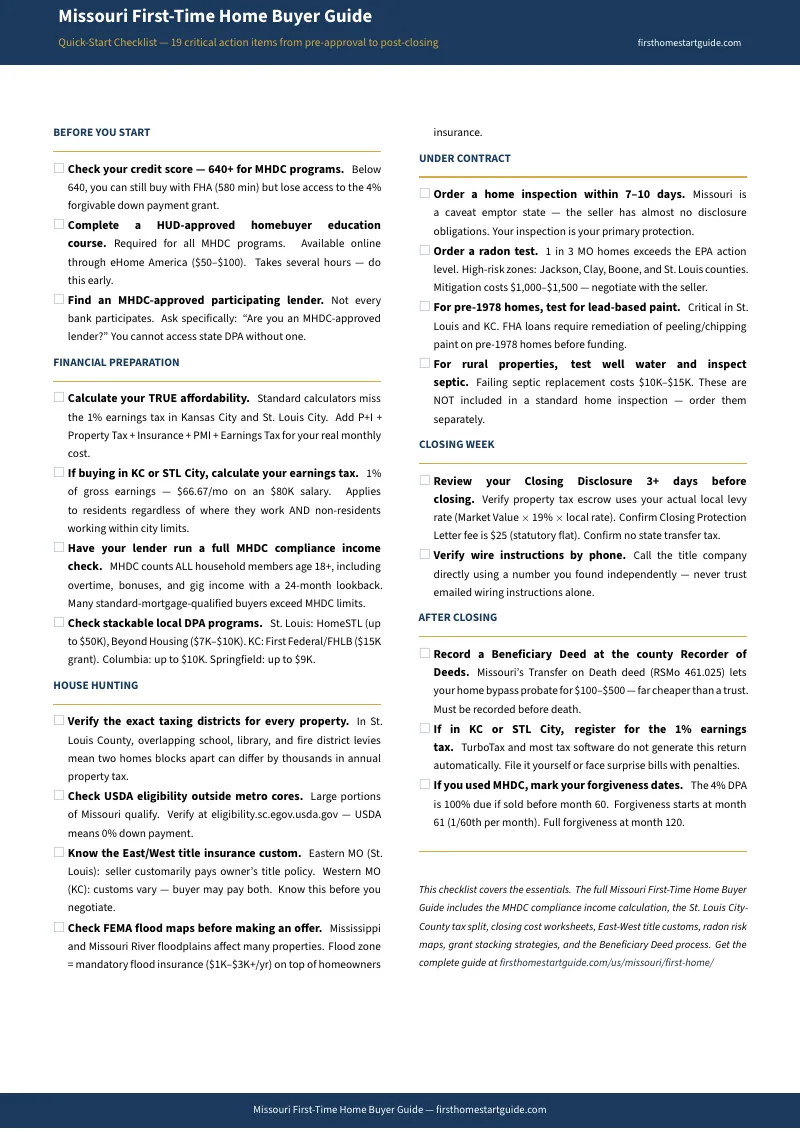
Download the free Missouri Quick-Start Home Buying Checklist to see the step-by-step framework covering financial preparation, program eligibility, earnings tax impact, property tax verification, inspection requirements, and post-purchase essentials. When you are ready for the complete guide with the MHDC program navigator, the earnings tax affordability worksheet, the closing cost breakdown, and the full Missouri buyer system, the complete toolkit is here.
Missouri rewards buyers who understand its local rules. This guide makes sure you do.