
You Found a Cabin Outside Missoula. Then Your Insurance Carrier Denied Coverage Based on a Wildfire Risk Score You Can't See, Montana Has No State FAIR Plan to Fall Back On, and Your Lender Killed the Loan Three Days Before Closing.
You found a three-bedroom on two acres near Lolo listed at $475,000. Or a starter home in Billings where the MBOH 80/20 program eliminates PMI and a NeighborWorks secondary loan covers the 20% gap. Or a USDA-eligible property outside Great Falls where you qualify for 100% financing with zero down. You got pre-approved. You ran the numbers. You made an offer.
Then Montana happens. Your insurance carrier runs a proprietary wildfire risk score on the property --- aerial imagery, vegetation density, slope, wind exposure --- and issues a flat denial. Not a rate increase. A denial. Unlike California or Colorado, Montana has no state-run FAIR plan, no insurer of last resort. Your only option is the surplus lines market, where a non-admitted carrier will underwrite the risk for $4,500 to $7,000 annually instead of $1,800 --- and that premium spike pushes your debt-to-income ratio past 45%, killing your pre-approval. The rural property you're considering in Ravalli County has a septic system installed in 1985 with no permit on file at the county health department --- which makes it illegal, carrying penalties up to $1,000 per day and a potential teardown order if the soil can't support a compliant replacement. The well produces 2.1 gallons per minute during the flow test, which fails the 3-5 GPM threshold your FHA lender requires, and drilling a new well means $15,000 to $40,000 with no guarantee of hitting water. The home you're under contract on sits outside city limits in Flathead County, where the county government explicitly states it "does not have a building department and does not regulate the uniform building codes" --- meaning the footings may have been poured 18 inches deep instead of the 36-inch frost line minimum, and no inspector ever checked. And the closing documents reference a "Trust Indenture" instead of a mortgage, because Montana's Small Tract Financing Act creates a non-judicial foreclosure path where the lender doesn't need a judge's order to sell your home and you have no right of redemption after the trustee's sale.
Here's what no single free resource explains: Montana layers a wildfire insurance crisis where over 50% of properties sit in the Wildland-Urban Interface with no state FAIR plan backstop and surplus lines premiums that routinely destroy mortgage qualification --- against an MBOH 80/20 Combined Loan program that eliminates PMI entirely but requires navigating NeighborWorks secondary financing, county-specific income limits ranging from $95,000 to $142,800, purchase price ceilings that make the program unusable in Bozeman's $702,000-$779,000 median market, and Fannie Mae HFA Preferred underwriting --- against a regulatory vacuum where rural residential construction requires no building permit, no structural inspection, and no certificate of occupancy under MCA 50-60-102 --- against a well and septic due diligence gauntlet where no statewide law mandates septic inspection before sale, arsenic contaminates wells across the Gallatin Valley from Three Forks to Belgrade, and FHA setback requirements disqualify properties on smaller parcels --- against the Small Tract Financing Act's Trust Indenture mechanism that waives your right of redemption and enables non-judicial foreclosure with 120 days' notice --- against environmental legacies where the Clark Fork River Superfund site stretches 43 miles through Silver Bow and Deer Lodge counties and Libby's asbestos contamination persists in Lincoln County --- against a property tax system where biennial reassessments based on January 2024 values produced a 20% statewide increase, and mill levy variations between city and county jurisdictions create 2-3x tax differences on identical homes across a municipal boundary. Each of these has cost real Montana first-time buyers five figures because the information existed --- scattered across MBOH program matrices, county health department permit records, EPA Superfund maps, CSI insurance bulletins, MCA statutes, and Reddit threads --- but nobody had assembled it into a single decision system calibrated to how Montana actually works.
The Montana First-Time Home Buyer Guide is a Montana Risk and Finance Navigation System --- not a motivational overview of Big Sky homeownership, but a structured reference that maps every Montana-specific insurance crisis, assistance program, environmental hazard, building code gap, and transaction risk into a process you work through before your earnest money is at risk and your loan collapses over an uninsurable parcel or an unpermitted septic system. It replaces months of cross-referencing MBOH income limit tables, surplus lines carrier directories, county health department permit archives, EPA contamination boundaries, and forum posts with a single guide that tells you exactly what to verify, exactly what the numbers should look like, and exactly where deals go wrong in this state.
What's Inside the Montana Risk and Finance Navigation System
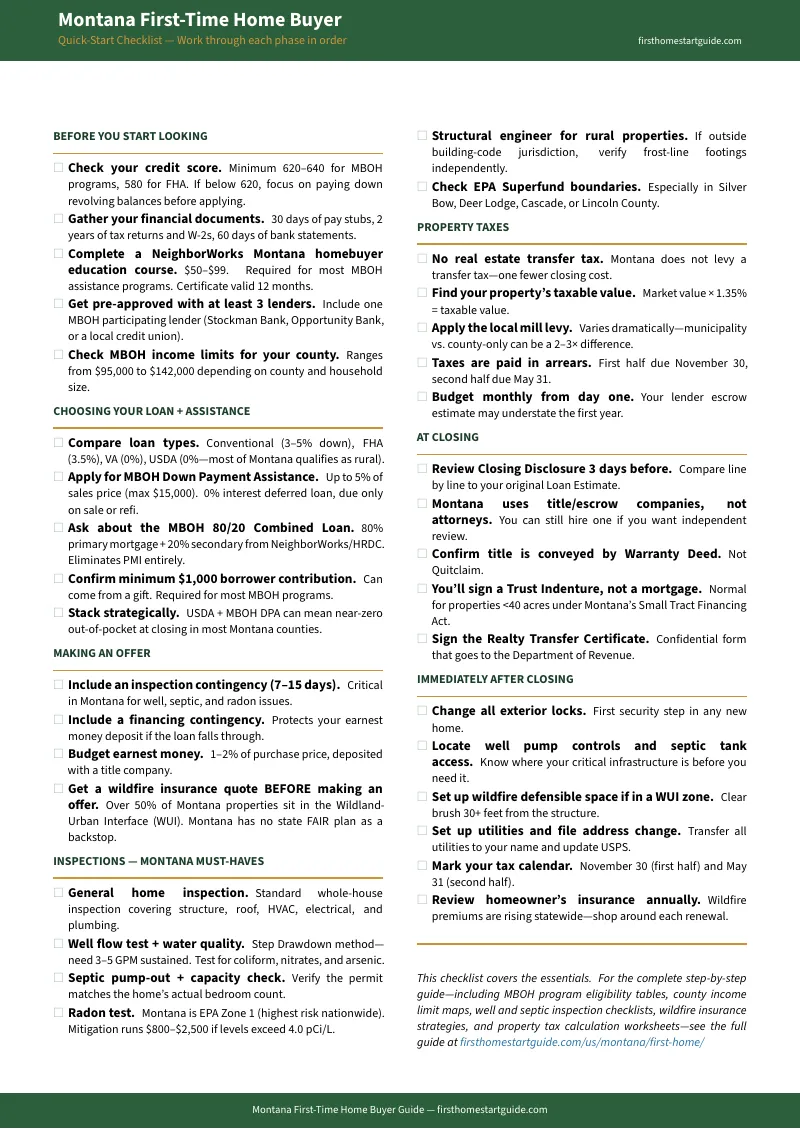
A 70-page guide, a quick-start checklist, and 7 standalone printable worksheets --- covering every stage from pre-approval through post-closing tax management, built specifically for the financial structures, environmental hazards, and regulatory gaps that make Montana different from every other state:
MBOH 80/20 Combined Loan Decoded
Montana's flagship affordability tool pairs an 80% LTV primary conventional mortgage with a secondary loan covering the remaining 20%, provided by NeighborWorks Montana or a regional Human Resource Development Council. Because the primary loan never exceeds 80% LTV, Private Mortgage Insurance is legally waived --- eliminating $200-$400 per month that cash-strapped buyers can't afford. The guide walks you through every eligibility variable: the 620-640 minimum credit score, the 45% maximum DTI cap, the Fannie Mae Desktop Underwriter HFA Preferred approval requirement, county-specific income limits ranging from $95,000 for a small household in Cascade County to $142,800 in Gallatin County, purchase price ceilings of $544,232 standard and $783,192 in targeted high-cost areas, and the critical disconnect between Bozeman's $702,000+ median and the program's standard cap. You'll understand exactly when to search within MBOH Targeted Areas for elevated limits, when to pivot your search to Billings or Great Falls where median prices fall within program range, and how to time your homebuyer education certificate, income documentation, and NeighborWorks secondary financing so nothing disqualifies you mid-transaction.
MBOH Down Payment Assistance
Beyond the 80/20 structure, the MBOH offers a standalone 0% Deferred Down Payment Assistance loan --- up to 5% of the sales price, capped at $15,000, requiring no monthly payments and due only upon sale, refinance, or payoff of the primary mortgage. The minimum borrower contribution is $1,000, which can come from gifted funds. The guide covers the Regular Bond Program's below-market fixed rates, how to stack USDA 100% financing with MBOH DPA for near-zero out-of-pocket closing in rural counties, and the exact sequence for combining federal and state programs without triggering underwriting conflicts.
Wildfire Insurance Crisis Navigator
Over 50% of Montana properties sit in the Wildland-Urban Interface, and insurance premiums have climbed more than 10% annually since 2021 --- with localized spikes of 120% in high-risk mountain terrain. When a standard carrier like State Farm or USAA denies coverage based on a proprietary wildfire risk score, Montana has no state-run FAIR plan to catch you. Your only option is the surplus lines market: non-admitted carriers that charge $4,500-$7,000 annually, exclude certain damage types, and operate without the state insurance guaranty fund backstop. The guide covers HB 195's 5-year lookback rule (insurers cannot penalize you for the previous owner's claims beyond five years), HB 136's mitigation discount framework (ignition-resistant roofing, defensible space perimeters, fire-resistant siding), your legal right to demand disclosure of the data behind your wildfire risk score, and the critical pre-offer protocol: get a binding insurance quote during due diligence, before your earnest money is committed, so a surplus lines premium doesn't destroy your DTI three days before closing.
Well and Septic Due Diligence Protocol
Properties outside municipal boundaries run on private wells and septic systems --- mechanical assets that cost $15,000-$40,000 to drill or $10,000-$30,000 to replace if they fail. A standard home inspection does not cover these. The guide details the Step Drawdown Test for well flow rate verification (the preferred Montana method, pumping in constant-rate stages to measure actual aquifer performance), the 3-5 GPM sustained flow requirement for FHA and VA financing, water quality testing for coliform, nitrates, and arsenic --- with explicit warnings about naturally occurring arsenic contamination in the Gallatin Valley (Three Forks, Belgrade, Manhattan), where buyers must budget $2,000-$4,000 for dual-tank Arsenic Guard treatment systems. For septic, you'll learn why Montana has no statewide mandate for pre-sale inspection (the legislature killed HB 483 and SB 191 under real estate industry opposition), how to verify county permit records for any system installed after 1972, the FHA setback requirements (50 feet from septic tank, 75-100 feet from drain field) that disqualify smaller parcels, and which counties --- Missoula, Lewis and Clark, Flathead --- enforce mandatory transfer inspections that can require connection to municipal sewer at the owner's expense.
No Statewide Building Code: What This Means for Your Purchase
Under MCA 50-60-102, Montana's building code does not apply to residential buildings with fewer than five units outside certified local government jurisdictions. In vast tracts of unincorporated rural Montana, single-family homes can be --- and routinely are --- constructed without structural permits, plan reviews, or foundation inspections. Cities like Bozeman and Missoula enforce International Building Code standards within their limits, but cross the municipal boundary into unincorporated Flathead County or Broadwater County and structural oversight vanishes. The guide identifies which jurisdictions are certified vs. uncertified, explains why rural properties require a private structural engineer (not just a general home inspector) to verify frost-line footing depth (36 inches minimum for single-story, 48 inches for multi-story), and covers the financing risk: conservative national lenders and appraisers will flag unpermitted additions, DIY structural modifications, and buildings that deviate from conventional construction standards --- potentially killing your loan on a property you've already committed earnest money to.
Small Tract Financing Act and Trust Indenture Explained
If you're buying a property of 40 acres or less in Montana --- which covers virtually every suburban lot, city parcel, and small rural acreage a first-time buyer would consider --- your closing documents will reference a Trust Indenture (Deed of Trust), not a traditional mortgage. This isn't cosmetic. Under the Small Tract Financing Act, you grant a security interest to a trustee (typically the title company) who holds a dormant "power of sale" on behalf of your lender. If you default, the lender initiates non-judicial foreclosure: 120 days' notice, published in a local newspaper for three consecutive weeks, posted on the property 20 days before auction --- no judge, no courtroom. The critical tradeoffs: you lose the right of redemption (no buying back after the trustee's sale), but the lender cannot pursue a deficiency judgment against you if the property sells for less than your outstanding balance. The guide translates every element of this legal structure so you understand exactly what you're signing at the title company --- where no attorney sits at the table to explain it.
Environmental Hazard Map
Montana's hardrock mining history left sprawling contamination zones that directly impact real estate transactions. The Clark Fork River Superfund site stretches 43 miles from Butte and Anaconda downstream to Garrison --- over a century of copper smelting deposited arsenic, lead, zinc, and cadmium across entire communities. Libby in Lincoln County contends with widespread asbestos contamination from historic vermiculite mining. The guide maps EPA remediation boundaries for Silver Bow, Deer Lodge, Cascade, and Lincoln counties, identifies ongoing soil removal mandates and restrictive covenants that limit property rights, covers the Montana Mold Disclosure Act (sellers must disclose known mold and provide prior testing results), and addresses radon --- Montana is EPA Zone 1 (highest risk nationwide), with cities like Kalispell averaging 7.5 pCi/L and Ennis at 9.0 pCi/L, both well above the 4.0 pCi/L action threshold. You'll know exactly when to demand sub-slab depressurization mitigation ($800-$2,500) and how to negotiate it during inspection.
Property Tax Mill Levy Calculator
Montana levies no real estate transfer tax --- a genuine closing cost advantage over states like Washington or New York. But property taxes follow a three-step formula that confuses first-time buyers: the Department of Revenue sets market value during biennial appraisal cycles (2025-2026 values reflect January 2024 assessments, averaging 20% statewide increases), market value is multiplied by the 1.35% statutory tax rate to produce taxable value, and local mill levies are applied at $1 per $1,000 of taxable value. On a $400,000 home: $400,000 times 1.35% equals $5,400 taxable value, times 500 local mills divided by 1,000 equals $2,700 annually. But mill levies vary dramatically --- a home inside city limits pays municipal fire, police, and infrastructure mills that an identical home one block outside city limits in unincorporated county land does not. The guide includes a worked example for every calculation step, explains the November 30 / May 31 arrears payment schedule, and shows how to verify your property's exact mill levy before making an offer.
Closing Costs Breakdown
Total estimated buyer-side closing costs on a $400,000 Montana home range from $5,400 to $11,300. The guide itemizes every component: loan origination ($1,000-$2,500), appraisal ($600-$800, frequently higher in rural Montana due to appraiser shortages and travel distances), inspections including well, septic, and radon ($700-$1,200), title settlement ($500-$1,000), lender's title insurance ($68-$150), owner's title insurance ($1,350-$1,550, customarily seller-paid but negotiable), county recording fees ($70-$100 per document under HB 192), prepaid homeowner's insurance ($1,500-$3,500+, volatile due to wildfire risk), and prepaid property tax escrow ($1,000-$2,000). Each line item includes what drives the cost and where Montana deviates from national norms.
Regional Market Analysis
A market-by-market breakdown from Bozeman ($702,000-$779,000) through Missoula ($551,000-$635,000), Helena ($437,000-$589,000), Billings ($432,000), Great Falls ($380,000), and Butte ($340,000) --- with Whitefish ($1,184,000) and Kalispell ($652,000) for Flathead Valley context. Each market includes the primary economic driver, the MBOH program usability (where median prices fall relative to purchase price ceilings), environmental considerations (Superfund in Butte, wildfire in the Flathead, aquifer contamination in Missoula), and the strategic pivot analysis showing where priced-out Bozeman and Missoula buyers can find inventory that aligns with state assistance programs.
Transaction Timeline
A day-by-day reference from accepted offer through county recording, spanning the standard 30-45 day Montana transaction: earnest money deposit within the first three days, the 7-15 day inspection contingency window (which must accommodate well flow tests, septic pump-outs, radon monitoring, and wildfire insurance quoting --- all simultaneously), title commitment review at days 10-15, appraisal and financing clearance at days 21-30 (with explicit warnings about rural appraiser delays and extended travel distances), and final walkthrough plus closing at days 30-45. The timeline flags every deadline where missing a contractual window forfeits your contingency protection or locks you into a purchase regardless of discovered defects.
Standalone Printable Worksheets Included
In addition to the full guide, your purchase includes 7 standalone worksheets designed to print and bring to lender meetings, property viewings, inspections, and closing:
- MBOH Eligibility Worksheet --- Step-by-step self-assessment for the 80/20 Combined Loan, DPA, and Regular Bond Program. Income limit table for five major counties, purchase price ceiling verification, PMI savings calculator, and zero-out-of-pocket strategy with USDA/VA stacking.
- Wildfire Insurance Checklist --- Pre-offer WUI risk screening, three-carrier quoting table, surplus lines broker steps, HB 195 lookback and HB 136 mitigation discount verification, DTI impact calculation, and go/no-go decision checklist.
- Well and Septic Inspection Checklist --- Step Drawdown flow test protocol, water quality testing (coliform, nitrates, arsenic with Three Forks/Belgrade warning), septic pump-out evaluation, FHA/VA setback requirements, county permit verification, and mandatory transfer inspection counties.
- Closing Cost Worksheet --- Every Montana-specific buyer-side line item with fill-in fields, MBOH DPA credit calculation, recording fee calculator under HB 192, property tax proration worksheet, rural inspection cost tracker, and cash reserve planning.
- Mill Levy Tax Calculator --- Three-step property tax formula with fill-in fields, worked $400,000 example, three-property comparison table, city vs. county mill levy explanation, and DOR resource links.
- Environmental Hazard Reference --- Superfund site boundaries (Clark Fork River, Libby asbestos), affected counties table, Montana Mold Disclosure Act requirements, radon city-level averages, FEMA flood zone checklist, and remediation cost reference.
- Transaction Timeline --- Day-by-day from accepted offer through closing and your first 30 days, with Montana-specific deadlines for well/septic/radon/wildfire due diligence, rural appraiser delay warnings, Trust Indenture signing, and year-one financial calendar.
Who This Guide Is For
This guide is for first-time home buyers in Montana who:
- Are buying in or around Bozeman and need to understand why the MBOH 80/20 program's $544,232 standard purchase price ceiling makes it unusable for most Gallatin County inventory --- and how to search within Targeted Areas where the cap rises to $783,192, or strategically pivot to Belgrade, Billings, or Great Falls where program limits and median prices actually align
- Are considering rural or suburban properties with private wells and septic systems and need the Step Drawdown test protocol, arsenic screening for Gallatin Valley wells, FHA setback verification, county permit record checks, and the knowledge that Montana has no statewide pre-sale septic inspection mandate --- meaning the entire burden of discovery falls on you during a 7-15 day contingency window
- Are looking at properties in the Wildland-Urban Interface and need to understand why Montana's absence of a FAIR plan means a single carrier denial can make a property unfinanceable, how to get surplus lines quotes before committing earnest money, and how HB 195 and HB 136 protect you from claim history penalties and reward wildfire mitigation
- Are relocating from out of state and expect building codes, municipal utilities, and an attorney at closing --- but Montana uses title companies, has no statewide residential building code for properties outside certified jurisdictions, runs on private wells and septic in most suburban and rural areas, and secures your loan with a Trust Indenture that enables non-judicial foreclosure with no right of redemption
- Are USDA-eligible buyers who need 100% financing in rural Montana but don't understand how USDA property requirements intersect with well flow testing, septic permit verification, and the strict appraisal standards that disqualify properties where land value dwarfs the home's structural value
- Are buying near Butte, Anaconda, or Libby and need to verify EPA Superfund remediation boundaries, understand restrictive covenants on contaminated parcels, and ensure ongoing soil removal mandates don't impair the property's long-term value or your family's health
Why Not Free Resources?
Free information on buying a home in Montana exists. Here's what it actually delivers:
- The MBOH website publishes income limit tables, purchase price caps, and participating lender lists. It doesn't explain how to determine whether the 80/20 program is mathematically superior to a conventional loan with PMI for your specific income and price point, doesn't walk you through the NeighborWorks secondary financing application sequence, doesn't show how Gallatin County's $142,800 income limit creates the illusion of eligibility when the $544,232 purchase price ceiling disqualifies 90% of Bozeman's inventory, and doesn't map the timing dependencies between homebuyer education certification, DPA application, and primary loan underwriting. You get raw eligibility data without the decision framework that prevents disqualification.
- Realtor blogs and agency websites publish neighborhood guides, market trend summaries, and "top 10 things to know" articles. They rarely mention the wildfire insurance crisis, the absence of a FAIR plan, the surplus lines market, unpermitted septic systems, arsenic in Gallatin Valley wells, the lack of rural building codes, or the Trust Indenture's foreclosure mechanics --- because highlighting deal-killing risks runs counter to securing a commission. The information is optimized for lead generation, not buyer protection.
- NerdWallet and Bankrate Montana guides mention MBOH "offers down payment assistance" in a single paragraph, note that Montana has "no transfer tax," and link to generic first-time buyer tips. They don't explain the 80/20 PMI elimination structure, don't cover the Small Tract Financing Act, don't mention wildfire insurance or well/septic due diligence, don't address the building code vacuum, and provide zero Montana-specific transaction guidance. The content exists for national SEO rankings, not for someone who needs to verify whether their target property's septic system has a valid county permit.
- Reddit threads (r/Montana, r/Bozeman, r/Missoula) contain real buyer stories --- the 120% USAA premium spike, the failed well flow test that killed a USDA loan, the unpermitted septic discovered after closing, the surplus lines policy that added $350 per month to housing costs. These are genuine data points. But they're scattered across years of posts, reflect outdated MBOH limits and market conditions, and offer no systematic framework for preventing the same outcomes. Reading them creates anxiety without providing a decision system.
This guide fills the Montana-specific gap --- the space between knowing how to buy a house in general and knowing how to buy one in a state where a single wildfire risk score can make a property uninsurable and unfinanceable with no state backstop, where the flagship assistance program's purchase price ceiling locks out most inventory in the state's fastest-growing market, where rural homes are built without structural permits or foundation inspections, where well water may contain arsenic and septic systems may be unpermitted and illegal, where your loan is secured by a Trust Indenture that waives your right of redemption, and where environmental contamination from a century of mining persists across four counties. It's the analysis that would take a Montana real estate attorney, an MBOH-approved lender, a wildfire insurance specialist, a licensed well driller, and an environmental consultant to assemble --- structured as a reference you own permanently.
--- Less Than One Surplus Lines Premium Increase
A single wildfire insurance denial forces you into the surplus lines market at $4,500-$7,000 annually instead of $1,800. A failed well flow test after you've waived your inspection contingency means $15,000-$40,000 for a new well with no guarantee. An unpermitted septic system in Ravalli County carries $1,000-per-day penalties and a potential $30,000 replacement. Missing the MBOH purchase price ceiling by $10,000 because you didn't check Targeted Area boundaries loses you the entire 80/20 PMI elimination. Buying a rural property with footings poured 18 inches deep instead of 36 means foundation failure that costs $10,000-$50,000 to remediate.
This guide doesn't replace your real estate agent or your lender. But it gives you the wildfire insurance pre-offer protocol, MBOH 80/20 decision framework, well and septic due diligence checklist, building code jurisdiction verification, Trust Indenture explanation, environmental hazard map, and mill levy calculator that ensure you identify every Montana-specific cost and risk before your earnest money is committed --- instead of discovering them on a surplus lines quote, a failed flow test, a county enforcement notice, or a foreclosure filing you didn't know was possible without a judge.
If it catches a single uninsurable parcel before you commit earnest money, prevents a single MBOH disqualification over a purchase price ceiling you didn't know existed, or saves you from closing on a property with an illegal septic system, it pays for itself before you've finished reading it.
Money-back guarantee, no time limit. If the guide doesn't sharpen your decision-making and protect your budget in Montana's complex, unregulated, and fire-prone housing market, you pay nothing.
Download the free Montana Quick-Start Home Buying Checklist to see the step-by-step action plan covering pre-approval, MBOH eligibility, wildfire insurance, well and septic inspections, and post-closing tax management. When you're ready for the full wildfire insurance navigator, MBOH 80/20 decision framework, well and septic protocol, building code verification guide, and carrying cost worksheet, the complete guide is here.
The listing says "mountain views." This guide tells you whether the mountain comes with insurance, a building permit, and a well that produces water.
Frequently Asked Questions
What if the rules change after I buy?
We update the guide when the rules change. Email us any time, even years later, and we'll send you the current edition free.