
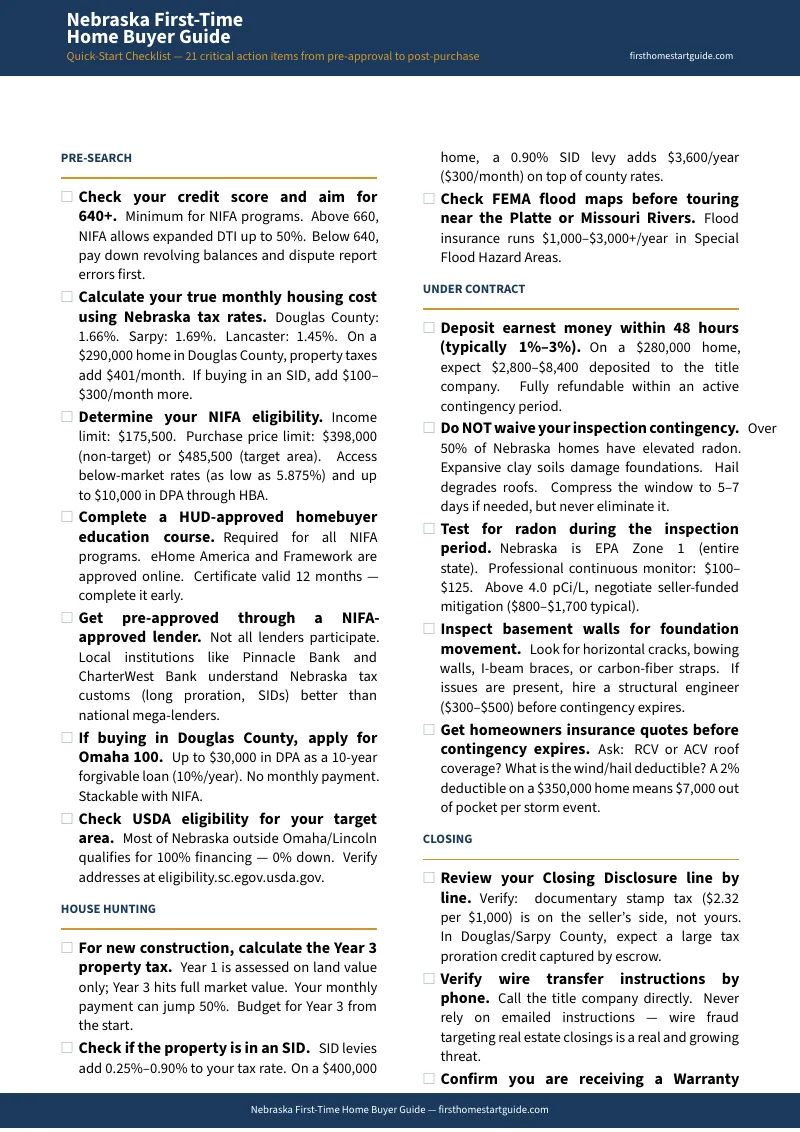
You Found the House. But the SID Levy Isn't on Zillow, Your Escrow Will Jump 50% in Year Three, and Your Insurance Deductible Is $7,000 Per Storm.
You found a three-bedroom in west Omaha listed at $315,000. Or a new build in Papillion where the builder quoted you $2,200/month with "low HOA." Or a starter home in Lincoln where the listing says "move-in ready" and the commute to the Capitol clocks 12 minutes. You got pre-approved. You ran the numbers. You're ready to make an offer.
Then Nebraska happens. Your lender ran the pre-approval using a national average tax rate, but Douglas County's effective rate is 1.66% --- nearly double the national average --- and your monthly escrow jumps $200 before you've even closed. The new build in Papillion sits inside a Sanitary and Improvement District with a separate levy of 0.75%, adding $3,000 per year that doesn't appear on Zillow's estimate. You close in January, and the lender calculates your escrow based on the Year 1 assessment --- land value only. By Year 3, the county assesses the fully completed house at market value, and your monthly payment surges 50%. Your insurance agent quotes you a policy with a 2% wind and hail deductible, which sounds reasonable until you realize that's 2% of your $350,000 dwelling coverage --- $7,000 out of your pocket every time a storm hits, in a state where hail damage is not a question of "if" but "when." And then the radon test comes back at 6.2 pCi/L, well above the EPA action level, in a state where over half of all homes test high.
Here's what no single free resource explains: Nebraska layers one of the highest effective property tax burdens in the country (1.45% to 1.69% depending on county) against a unique suburban financing mechanism called a Sanitary and Improvement District that can add 0.25% to 0.90% in additional levies --- costing $83,000 to $90,000 over a 30-year mortgage --- against a new construction escrow trap where Year 1 land-only assessments create artificially low payments that explode by Year 3, against a homeowners insurance market in crisis where premiums jumped 21% in a single year and carriers have shifted to percentage deductibles and Actual Cash Value roof coverage that can leave you paying $18,000 out of pocket for a $20,000 roof replacement, against statewide EPA Zone 1 radon classification requiring testing and potential $800-$1,700 mitigation on virtually every property, against NIFA down payment assistance programs with target area maps, income limits, and mandatory education requirements that buyers discover but can't navigate, against a seller's market where Omaha buyers are waiving inspections, offering $63,000 over asking, and still losing. Each of these has cost real first-time buyers five figures because the information existed --- scattered across NIFA program matrices, county assessor websites, insurance carrier disclosures, EPA radon maps, and Reddit threads --- but nobody had assembled it into a single decision system calibrated to how Nebraska actually works.
The Nebraska First-Time Home Buyer Guide is a Nebraska Cost Control System --- not a motivational overview of Cornhusker homeownership, but a structured reference that maps every Nebraska-specific tax trap, insurance risk, environmental hazard, and assistance program into a process you work through before your earnest money is at risk and your escrow account is underfunded. It replaces months of cross-referencing county assessor mill levies, SID bond schedules, NIFA program matrices, insurance policy riders, and forum posts with a single guide that tells you exactly what to verify, exactly what the numbers should look like, and exactly where deals go wrong in this state.
What's Inside the Nebraska Cost Control System
A comprehensive guide, a quick-start checklist, and standalone printable tools --- covering every stage from pre-approval through post-closing tax management, built specifically for the financial structures, environmental hazards, and assistance programs that make Nebraska different from every other state:
Property Tax Mechanics and the New Construction Escrow Trap
Nebraska ranks among the top ten states for property tax severity, with Douglas County at 1.66%, Sarpy County at 1.69%, and Lancaster County at 1.45%. On a $290,000 home in Douglas County, that's $4,814 per year --- over $400 per month in escrow alone. The guide breaks down how county assessors value property at 100% of market value (not a discounted ratio like many states), why your purchase price often becomes the new assessment baseline, how to calculate the full effective tax rate using the county assessor's actual mill levy breakdown instead of Zillow estimates, how new construction buyers experience the phased assessment trap (Year 1 land-only, Year 2 partial, Year 3 full market value) that causes 50% escrow payment spikes, the annual protest process and the legal threshold you must clear, and why your pre-approval letter is meaningless if the lender used a national average tax rate instead of county-specific mill levies. If you're buying in Douglas or Sarpy County, this chapter prevents the single most common financial shock Nebraska buyers experience.
SID Shadow Tax Playbook
Sanitary and Improvement Districts are Nebraska's unique mechanism for funding suburban infrastructure --- and the hidden carrying cost that blindsides first-time buyers in every developing suburb around Omaha. When developers build subdivisions outside municipal boundaries, SIDs issue tax-exempt bonds to install streets, sewers, water mains, and parks. Homeowners repay those bonds through an additional property tax levy of 0.25% to 0.90% on top of already-high county taxes. A $400,000 home in an SID with a 0.90% levy pays an extra $3,600 per year --- $300 per month that doesn't appear on any listing estimate. Over 30 years, that's $83,000 to $90,000 in additional taxes compared to an identical home in an established, annexed neighborhood. The guide explains how SIDs work, how to identify whether a property sits in one, the critical difference between SID levies (ongoing until annexation) and standard municipal taxes, and how to model the true carrying cost before you make an offer in Elkhorn, Gretna, Papillion, or any developing corridor.
Homeowners Insurance Risk Framework
Nebraska homeowners insurance premiums increased over 21% in a single year, and the policy structure has shifted in ways that transfer catastrophic risk directly onto the buyer. The guide covers how percentage-based wind and hail deductibles work (2% of dwelling coverage = $7,000+ per storm on a $350,000 home), the critical difference between Replacement Cost Value (RCV) and Actual Cash Value (ACV) roof coverage --- and why an ACV policy on a 15-year-old roof can leave you paying $18,000 out of pocket on a $20,000 replacement after a hail event, how carriers use 30-year depreciation schedules that slash payouts on older roofs, why unpermitted finished basements trigger the 80% coinsurance rule and limit payouts on partial losses, the mandatory sewer and drain backup endorsement for any home with a finished basement, and how to evaluate policy terms before closing so your lender doesn't force expensive lender-placed insurance. If you're buying an older home, this chapter alone can prevent a five-figure surprise after the first storm season.
Radon Testing and Mitigation Protocol
The entire state of Nebraska is classified EPA Radon Zone 1 --- the highest risk category. Over 50% of tested Nebraska homes register radon levels above the EPA's 4.0 pCi/L action threshold. Radon is colorless, odorless, and the second leading cause of lung cancer. The guide covers why radon testing is non-optional in Nebraska (not a "nice-to-have" like in coastal states), the cost of professional testing ($100-$125), what to do when levels come back elevated, how active soil depressurization mitigation systems work and what they cost ($800-$1,700, up to $3,000 for complex foundations), how to negotiate seller-funded mitigation during the inspection contingency, and the new building code mandate requiring passive radon infrastructure in all new construction. If you're waiving your inspection contingency to compete in Omaha's market, this chapter explains exactly what environmental liability you're absorbing.
NIFA Down Payment Assistance Decision Framework
Nebraska runs its DPA programs through NIFA, and choosing the right program structure can save you thousands. The First Home Program offers below-market interest rates (as low as 5.875% on government-backed loans) for first-time buyers. The First Home Targeted Program waives the first-time buyer requirement entirely for properties in designated census tracts and raises the purchase price cap from $398,000 to $485,500. The Welcome Home Program serves buyers earning up to $175,500 who don't meet first-time buyer definitions. And the Homebuyer Assistance (HBA) Program provides up to 5% of the purchase price (capped at $10,000) as a second mortgage at 1% interest over 10 years, with as little as $1,000 out of pocket. The guide maps every program's credit score requirements (640 minimum, expanded DTI at 660+), income limits, target area vs. non-target area purchase price caps, mandatory education requirements, and the specific scenarios where each program wins. Plus local programs that stack: Omaha 100 offers up to $30,000 as a 10-year forgivable loan in Douglas County, and the Omaha Housing Authority's Bridges to Homeownership converts housing vouchers into mortgage assistance for up to 15 years.
The Douglas/Sarpy County Long Proration Custom
Nebraska property taxes are paid in arrears, and the way they're prorated at closing varies dramatically by county. In 91 of 93 Nebraska counties, the title company uses a "short proration" method that credits you only for the current year's accrued taxes. But in Douglas and Sarpy counties --- where most first-time buyers are purchasing --- a "long proration" custom credits you for the current year plus potentially all unpaid prior-year taxes, sometimes generating an 18-month tax credit on your Closing Disclosure. This looks like a windfall, but your lender captures every dollar and deposits it into your escrow account to cover the massive combined tax bills coming due. The guide explains exactly how this works, why the large credit doesn't reduce your out-of-pocket costs, and how to model the true cash-to-close so you don't show up to the closing table short.
Transaction Mechanics and Inspection Strategy
Nebraska is a title company state using Deeds of Trust --- not traditional mortgages. If you default, the lender can foreclose non-judicially, without going to court. The standard inspection contingency runs 5 to 14 days from contract acceptance, and earnest money deposits typically range from 1-3% of the purchase price. The guide covers the escrow timeline from offer to recording (30-40 days), how to negotiate inspection contingencies strategically in a competitive market without waiving them entirely, the statutory seller disclosure requirements under Nebraska Revised Statute § 76-2,120, what to look for in structural inspections (expansive clay soils cause foundation cracking and basement wall bowing in both Omaha and Lincoln), when to hire a structural engineer vs. relying on a general home inspector, and the VA property condition requirements for military buyers using VA loans near Offutt Air Force Base.
Military and VA Buyer Section
Sarpy County's Offutt Air Force Base anchors a massive military buyer population in the Omaha metro. The guide covers VA loan mechanics (zero down, no PMI, but strict property condition requirements), the Nebraska disabled veteran property tax exemption that can save $5,000-$8,000 annually in Sarpy County depending on disability rating, BAH coverage analysis at current Bellevue/Papillion price points, and the USDA loan eligibility map for communities just outside Omaha's urban boundary that retain zero-down USDA financing despite suburban proximity.
Regional Market Profiles: Omaha, Lincoln, Sarpy County, Greater Nebraska
Every market has different pain points. Omaha: acute inventory shortage, bidding wars, SID tax stacking in western suburbs, older housing stock with foundation and radon risks. Lincoln: slightly lower taxes (1.45%), institutional employment stability, but sustained demand keeping days-on-market under 35. Sarpy County: highest effective tax rate at 1.69%, military-heavy market, rapid new construction with SID overlays, escrow trap risk on every new build. Greater Nebraska: USDA eligibility, well and septic considerations, thin inventory, and muted appreciation. Each profile covers the specific financial traps and inspection priorities for that region.
Carrying Cost Worksheet and Closing Timeline
A day-by-day timeline from accepted offer through county recording, with Nebraska-specific deadlines mapped (earnest money delivery within 24-48 hours, inspection contingency window, title commitment review, closing disclosure review 3 days before settlement). Plus a carrying cost worksheet that models every line item: PITI, SID levy, HOA dues, insurance with percentage deductible reserves, radon mitigation amortization, and maintenance reserves --- so your monthly budget reflects what you'll actually pay in Nebraska, not what the listing agent quoted.
Who This Guide Is For
This guide is for first-time home buyers in Nebraska who:
- Are buying their first home in the Omaha or Lincoln metro and need to understand how Nebraska's property tax rates, new construction assessment phasing, and SID levies will actually affect their monthly payment --- not the estimate on Zillow, but the real number their lender will escrow starting in Year 3
- Are relocating from a lower-tax state and need a clear explanation of why a $290,000 home in Douglas County carries $4,814 in annual property taxes, how the 100% market-value assessment works, and what the long proration custom means for their cash-to-close
- Want to claim every dollar of down payment assistance available and need to understand which NIFA program (First Home, First Home Targeted, Welcome Home, or HBA) fits their credit score, income level, and property location --- and whether Omaha 100's $30,000 forgivable loan stacks on top
- Are looking at new construction in Papillion, Gretna, or Elkhorn and need to calculate the true carrying cost including SID levies, because no listing agent or builder will volunteer that the $300,000 home carries an extra $83,000+ in SID taxes over the life of the mortgage
- Need to understand Nebraska's insurance landscape before closing --- specifically how percentage deductibles, ACV vs. RCV roof coverage, and the 80% coinsurance rule interact to determine whether they can actually afford the financial exposure of owning a home in Tornado Alley
- Are active-duty military, veterans, or military spouses buying near Offutt Air Force Base and want to understand the VA disabled veteran property tax exemption, BAH coverage at current Sarpy County prices, and USDA eligibility in communities just outside the metro boundary
- Want every Nebraska-specific tax calculation, insurance risk, environmental hazard, and assistance program in one reference --- instead of assembling it from county assessor websites, NIFA program matrices, EPA radon maps, insurance carrier disclosures, and Reddit threads that may predate the latest SID annexation schedules or NIFA rate changes
Why Not Free Tools and Forums?
Free information on buying a home in Nebraska exists. Here's what it actually delivers:
- NIFA's website publishes program charts, interest rates, income limits, and approved lender lists. It doesn't explain how to choose between the First Home Program and the Welcome Home Program when your income qualifies for both, doesn't show how target area maps affect your purchase price cap, and doesn't cover Omaha 100's forgivable loan or the OHA Bridges to Homeownership program that stack on top. You get the program specs without the decision framework that tells you which combination to apply for.
- Zillow and Realtor.com show estimated monthly payments and "tax information" that omits SID levies entirely, doesn't account for new construction escrow phasing, and reports historical tax bills that reflect the prior owner's assessed value --- not the reassessment triggered by your purchase price. You get a number that looks affordable and isn't.
- Real estate agent blogs and builder content highlight affordable Midwest pricing, new construction amenities, and low crime rates. They minimize SID tax stacking, gloss over the insurance deductible shift from flat-dollar to percentage-based, never explain that a 2% wind deductible means $7,000 per storm on a $350,000 home, and won't mention that waiving your inspection in Omaha means absorbing radon liability in an EPA Zone 1 state. The content is designed to generate leads, not to identify reasons to slow down.
- Reddit threads (r/Omaha, r/Nebraska, r/FirstTimeHomeBuyer) contain genuinely useful buyer experience reports --- people sharing escrow sticker shock, SID payment surprises, and bidding war defeats. But advice from last year doesn't reflect the latest NIFA rate adjustments, current SID annexation schedules, or the most recent insurance carrier policy changes. Sorting current from outdated takes longer than reading a guide that has already done it.
This guide fills the Nebraska-specific gap --- the space between knowing how to buy a house in general and knowing how to buy one in a state where property taxes approach 1.7% in the suburbs, where SID levies can add $90,000 over a mortgage's lifetime, where new construction escrow payments can jump 50% by Year 3, where insurance carriers have shifted storm risk onto the homeowner through percentage deductibles and depreciated roof valuations, where radon is a statewide certainty rather than a regional anomaly, and where the most competitive markets pressure buyers to waive the very inspections that would catch these risks. It's the analysis that would take a Nebraska real estate attorney, a NIFA-approved lender, an insurance advisor, and a radon mitigation specialist to assemble --- structured as a reference you own permanently.
--- Less Than One Radon Mitigation
A single radon mitigation system in Nebraska runs $800 to $1,700. One year of SID levy on a $400,000 suburban home adds $3,600. A 2% wind and hail deductible means $7,000 out of pocket per storm. A new construction escrow shortage can spike your monthly payment by $300 to $600. Choosing the wrong NIFA program can mean paying back assistance you could have received as a forgivable grant through Omaha 100.
This guide doesn't replace your real estate agent or your lender. But it gives you the property tax model, SID lookup protocol, insurance risk framework, radon testing checklist, NIFA decision matrix, and carrying cost worksheet that ensure you identify every Nebraska-specific cost before your earnest money is at risk --- instead of discovering them on your first escrow shortage notice, your first hail claim denial, or your first annual tax bill.
If it catches a single SID levy your listing agent didn't mention, prevents a single ACV roof coverage gap, or saves you from underfunding your escrow account on new construction, it pays for itself before you've finished reading it.
Money-back guarantee, no time limit. If the guide doesn't sharpen your decision-making and protect your budget in Nebraska's high-tax, high-risk housing market, you pay nothing.
Download the free Nebraska Quick-Start Home Buying Checklist to see the step-by-step action plan covering pre-approval, DPA program selection, house hunting, inspections, and post-closing tax management. When you're ready for the full NIFA decision framework, SID shadow tax playbook, insurance risk analysis, radon protocol, and carrying cost worksheet, the complete guide is here.
The house looks affordable on Zillow. This guide tells you whether Nebraska agrees.
Frequently Asked Questions
What if the rules change after I buy?
We update the guide when the rules change. Email us any time, even years later, and we'll send you the current edition free.