
Your Eviction Case Was Thrown Out Because the Notice Said "3 Days." Nebraska Changed That Law in 2019. The Template You Downloaded Didn't.
You found a duplex in Millard projecting 8% cap rate. Or a single-family in Bellevue where the BAH for an E-5 with dependents covers 107% of your PITIA. Or a four-bedroom near UNL where room-by-room leasing pushes gross rent 40% above market rate. You ran the numbers. They cleared. You bought.
Then Nebraska's operational reality arrived. Your eviction filing was dismissed — the judge cited LB 433, which changed non-payment notice from three days to seven in 2019. Your property management template still said three. You restarted the timeline, ate another month of lost rent, and the tenant's free legal aid attorney from the Tenant Assistance Project filed for costs. Meanwhile, your first tax bill landed $4,200 higher than projected — turns out the property sits in an active Sanitary and Improvement District, where bond repayment levies pushed your effective rate past 3%. Your insurance renewal arrived with a 2% wind/hail deductible you didn't catch at closing — meaning the next hailstorm costs you $6,000 out of pocket on a $300,000 property before the insurer pays a dollar. And you just mailed the security deposit refund on day 16, two days past Nebraska's 14-day statutory deadline, exposing you to double-damage penalties and the tenant's attorney fees.
Here's what no single free resource explains: Nebraska layers a property tax regime where SID levies can inflate effective rates to 3% (destroying standard cap rate formulas), against a 14-day security deposit return deadline with double-damage penalties for landlords who miss it by a single day, against eviction notice requirements that changed in 2019 but remain wrong across most online templates and property management blogs, against a catastrophic weather insurance market where 2% percentage deductibles create $6,000 exposures hidden deep in policy binders, against submarket dynamics where Omaha buy-and-hold, Offutt AFB military housing, Lincoln student rentals, and the Omaha-Council Bluffs cross-border arbitrage each require entirely different operational playbooks. Each of these has cost real investors five figures because the information existed — scattered across county assessor databases, NURLTA statute sections, insurance policy endorsements, and BiggerPockets threads from 2017 — but nobody had assembled it into a single operational manual calibrated to how Nebraska actually works today.
The Nebraska Investment Property Guide is The Nebraska Operator's Manual — not a motivational overview of Midwest investing, but a statutory operations reference that maps every Nebraska-specific financial trap, regulatory deadline, and underwriting adjustment into a system you work through before you close, before you lease, and before your first eviction filing. It replaces months of cross-referencing NURLTA statutes, county assessor records, SID bond schedules, and forum posts with a single reference that tells you exactly what Nebraska law requires, exactly what the numbers should look like, and exactly where deals go wrong in this state.
What's Inside The Nebraska Operator's Manual
A comprehensive guide, a quick-start checklist, and six standalone worksheets (eight PDFs) — covering every stage from market selection through post-purchase compliance, built specifically for the regulatory mechanics and tax structures that make Nebraska different from every neighboring state:
SID Tax Assessment and Property Tax Underwriting
Nebraska ranks ninth nationally in effective property tax rates — but that 1.61% state average is deceivingly low. In Douglas County and Sarpy County, actual rates routinely push past 1.80%, and properties inside active Sanitary and Improvement Districts face bond repayment levies that inflate effective rates to approximately 3%. The guide explains exactly how SIDs work (political subdivisions formed by developers to finance infrastructure via tax-exempt bonds repaid through ad valorem levies on property owners), how to identify whether a target property sits inside one, how the six-year developer-to-homeowner board transition affects levy decisions, and how to model the true tax drag before you submit an offer. It includes the complete annual protest timeline — from the January 15 preliminary valuations through the June 30 Board of Equalization deadline to the September 10 TERC escalation — with the specific evidence requirements that prevent your protest from being instantly dismissed under Statute 77-1502's presumption of correctness.
The 14-Day Security Deposit Compliance System
Nebraska Statute 76-1416 gives you exactly fourteen days from tenancy termination to mail the deposit balance with a written itemized statement. Not 30 days. Not 21 days. Fourteen. Within that window, you must inspect the unit, secure vendor bids for damages, finalize invoices, draft the itemized ledger, and postmark the remaining funds. Miss the deadline by a single day, and the tenant can recover the full deposit plus court costs plus attorney fees. If the court finds your failure willful, you face liquidated damages of one month's rent or double the deposit — whichever is less. The guide provides the complete compliance workflow — inspection scheduling, vendor bid timelines, itemization templates, and mailing documentation — so you never trigger the penalty that turns a $1,200 deposit into a $4,000 liability.
Eviction Mechanics: The LB 433 Reality
In 2019, the Nebraska Legislature passed LB 433, amending Neb. Rev. Stat. section 76-1431 to change non-payment notice from three days to seven. A vast amount of content online — including actively hosted property management blogs, downloadable templates, and older forum posts — still explicitly advises a "3-day notice to quit." This information is legally invalid. Issuing a three-day notice completely invalidates your eviction case, forces dismissal, restarts the timeline, and costs a minimum of one month's lost rent due to procedural failure. The guide maps the correct notice periods for every breach type (7 days for non-payment, 14/30 days for material noncompliance, 5 days for violent criminal activity with no right to cure), the summons service requirements (3 days personal, 10 days by mail), the 10-to-14-day hearing window, and the full procedural timeline from notice through writ of restitution — calibrated for a court system where tenants routinely receive free legal aid from the Tenant Assistance Project.
Wind/Hail Insurance Underwriting and the 2% Deductible Trap
Nebraska ranks third nationally in hail loss claims. Insurance premiums have surged over 108% in the past decade — the highest increase in the country. But the premium increase isn't the real danger. Insurers have systematically transitioned from flat-dollar deductibles to percentage-based deductibles for wind and hail damage. A 2% deductible on a $300,000 property means $6,000 out of pocket before the policy pays a dollar toward a new roof. On a $500,000 property, that's $10,000. Many carriers have also abandoned full Replacement Cost Value policies for older roofs, shifting to Actual Cash Value schedules with aggressive depreciation. The guide shows you exactly what to look for in policy binders during due diligence, how to compare RCV versus ACV coverage, how to negotiate deductible structures, and how to size your maintenance reserves to absorb the hail exposure that Nebraska's geography guarantees.
Submarket Playbooks: Omaha, Offutt AFB, Lincoln, and Council Bluffs
Each Nebraska submarket requires a different operational model. The guide provides dedicated analysis for each: Omaha metro buy-and-hold — targeting the 1% rule in a market where Fortune 500 corporate relocations (Berkshire Hathaway, Union Pacific, Mutual of Omaha, ConAgra) create premium tenant demand, with neighborhood-level yield data and the DSCR underwriting adjustments required for high-tax jurisdictions. Offutt AFB military housing — reverse-engineering acquisitions against published BAH tables, setting up military allotment payments, managing PCS turnover cycles, and navigating the spatial quality gradient from base-adjacent to suburban Papillion. Lincoln student rentals — room-by-room leasing mechanics that push yields 40-50% above market, the guarantor lease structure (eight signatures per four-bedroom house), and the two-month business sprint leasing season. Council Bluffs cross-border arbitrage — 27.5% lower housing costs across the river versus Omaha's lenient 10-year inspection cycle, with the regulatory trade-offs that determine which side makes sense for your strategy.
Complete Financial Model with Nebraska-Specific Adjustments
A full worked example showing the gap between national assumptions and Nebraska reality. Standard cap rate formulas assume 1.0-1.2% property taxes — Nebraska demands 1.6-3.0%. Standard maintenance reserves assume flat-dollar insurance deductibles — Nebraska requires reserves for 2% percentage deductibles. The model walks through every holding cost (mortgage, property tax including SID levy, insurance with hail deductible reserves, property management, vacancy, maintenance, capital expenditure reserves), shows the pre-tax and after-tax cash flow position, and stress-tests at current rates plus 2% so you know your true out-of-pocket cost before you commit capital. Includes the income tax reduction schedule (dropping from 5.20% in 2025 to 3.99% by 2027 under LB754) and its impact on net disposition proceeds.
LLC Formation, Documentary Stamp Tax, and Closing Mechanics
Nebraska is a title company state with specific procedural requirements that trip up out-of-state investors. The guide covers the complete closing timeline (30-40 days), Documentary Stamp Tax at $2.25 per $1,000 (increasing to $2.32 effective September 2025), the mandatory LLC newspaper publication requirement (three consecutive weeks in a legal newspaper, followed by affidavit filing), biennial report deadlines, deed of trust mechanics with non-judicial foreclosure power of sale, and the full closing cost stack — so your pro-forma matches reality before you sign.
Who This Guide Is For
This guide is for real estate investors targeting Nebraska who:
- Are buying from out of state — attracted by Omaha's low entry prices, strong corporate tenant demand, and cap rates that look exceptional on paper — but need to understand how SID levies, 2% hail deductibles, and the 14-day deposit rule change the actual numbers before they discover it on their first tax bill, their first storm, or their first turnover
- Are local Omaha or Lincoln operators scaling beyond their first property who need the complete protest timeline, the TERC escalation mechanics, and the SID identification process to protect cash flow as their portfolio grows and their aggregate tax exposure compounds
- Are targeting military housing near Offutt AFB and need to reverse-engineer acquisitions against published BAH tables, structure military allotment payments, and manage PCS turnover without the vacancy losses that catch investors who treat military tenants like standard renters
- Are building a Lincoln student rental portfolio and need the guarantor lease structure, room-by-room leasing mechanics, and the operational tempo required to execute the two-month leasing sprint before academic year start
- Had an eviction dismissed because they used a three-day notice template, missed the 14-day deposit deadline, or discovered their SID levy after closing — and want every Nebraska-specific statute, deadline, and financial calculation in one reference so it never happens again
Why Not Free Tools and Forums?
Free information on Nebraska property investing exists. Here's what it actually delivers:
- BiggerPockets forums contain genuine investor war stories about Omaha's SID levies, hail insurance shocks, and the Offutt AFB market. But the most-cited posts still reference the three-day eviction notice — which has been legally wrong since 2019. Sorting current statutory requirements from pre-LB 433 advice takes longer than reading a guide that has already verified every timeline against current law. You get anecdotes without the compliance system that keeps you out of court.
- Nebraska REIA and MOPOA provide networking, lobbying updates, and generalized market statistics. They don't publish step-by-step operational manuals for executing a TERC protest, structuring military allotment payments, or sizing hail deductible reserves. You get the community without the operations reference that tells you what to do Tuesday morning when the deposit deadline is Thursday.
- County assessor websites provide raw mill levy data and SID boundary maps. They don't explain how to translate that data into a cash flow adjustment, don't model the impact of SID bond maturation on future levy reductions, and don't connect the tax data to the DSCR ratio your lender requires. You get the number without the underwriting framework that makes it actionable.
- Property management blogs and downloadable templates provide generic lease forms and notice templates. Many still specify three-day non-payment notices, 30-day deposit return windows, or flat-dollar deductible assumptions that haven't been accurate in Nebraska for years. Using an outdated template in Nebraska court gets your case dismissed — and the Tenant Assistance Project attorneys know exactly which procedural defects to exploit.
This guide fills the Nebraska-specific gap — the space between knowing how to analyse a rental property in general and knowing how to operate one in a state where SID levies can double your projected tax bill, where a single missed deadline triggers double-damage penalties, where the most common eviction template online is legally invalid, and where a hailstorm creates a $6,000 exposure your pro-forma never modelled. It's the analysis that would take a Nebraska real estate attorney, a tax protest specialist, and a local insurance broker to assemble — structured as a reference you own permanently.
— Less Than One SID Tax Levy Surprise
A single missed SID levy on a $200,000 property runs $2,000 to $4,000 annually — money you never budgeted because you didn't know the district existed. One botched security deposit return costs the deposit plus double damages plus the tenant's attorney fees. One dismissed eviction filing due to a three-day notice adds a full month of vacancy plus legal fees to restart. One uninsured hail claim with a 2% deductible costs $6,000 before the policy activates.
This guide doesn't replace your attorney or your CPA. But it gives you the SID identification system, the 14-day compliance workflow, the correct eviction notice timelines, the insurance underwriting checklist, and the submarket-specific yield models that ensure you identify every Nebraska-specific trap before you close — instead of discovering them on your first tax bill, your first deposit dispute, or your first court date.
If it catches a single SID levy before closing, prevents a single deposit penalty, or saves you from one dismissed eviction filing, it pays for itself before you've finished reading it.
Money-back guarantee, no time limit. If the guide doesn't sharpen your underwriting and protect your cash flow in Nebraska's high-friction operating environment, you pay nothing.
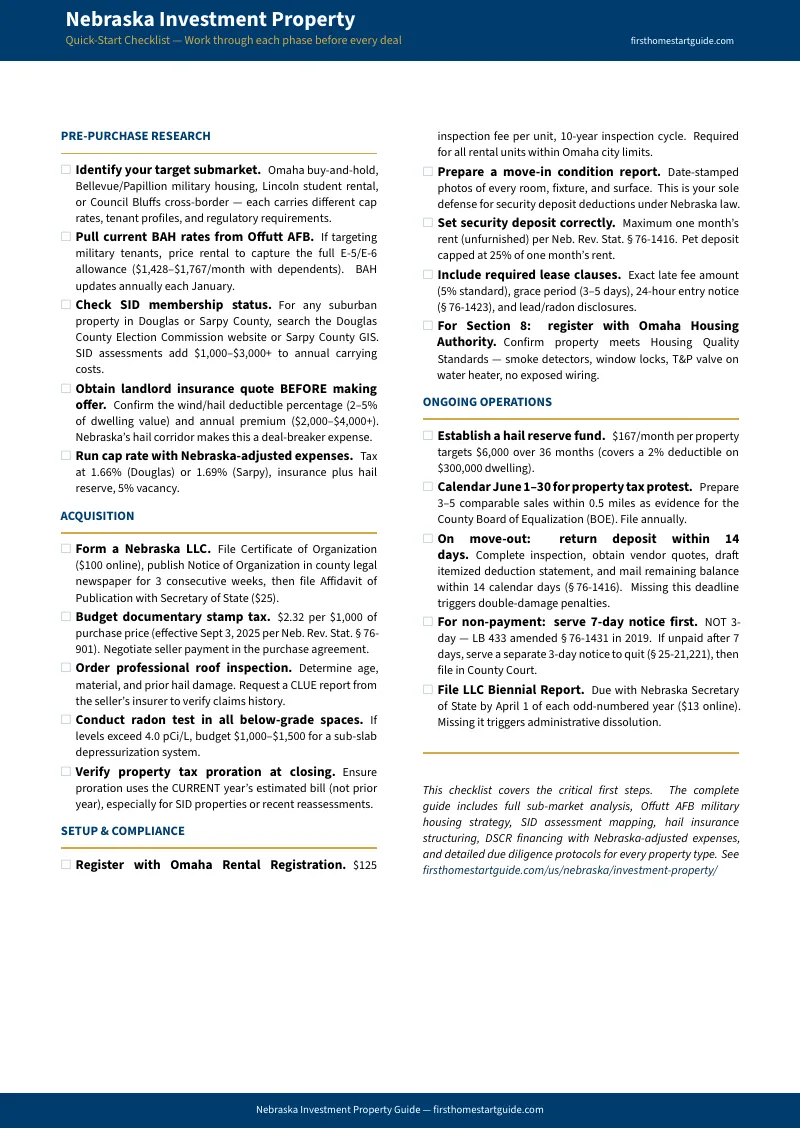
Download the free Nebraska Quick-Start Home Buying Checklist to see the due diligence framework covering SID identification, tax protest timelines, deposit compliance, insurance review, and submarket selection. When you're ready for the full operational manual with worked financial models, eviction procedure maps, and submarket playbooks, the complete guide is here.
The cap rate looks strong on the spreadsheet. This guide tells you whether Nebraska agrees.