
Your Pro Forma Shows 7% Yield. Nevada's HOA CC&Rs Just Made the Property Unrentable.
You found a three-bedroom in Summerlin throwing off $2,400/month on paper. Or a condo near the Strip where AirDNA projects 75% occupancy at $189/night. Or a townhouse in Henderson where the numbers pencil to a 1.2 DSCR with no state income tax on the rental income. The macro case is real. Zero state income tax. Zero state capital gains tax. Summary evictions in three to four weeks. Property tax rates at 0.50%. The spreadsheet works.
Then you close. The Summerlin HOA sends a cease-and-desist letter within 30 days because the CC&Rs cap rentals at 10% and the community is already at 14%. You're on a waiting list that may never clear. The Strip-adjacent condo sits in unincorporated Clark County, where AB 363 caps STR licenses at 1% of the housing stock, the lottery closed in 2023, and the county issued only 174 permits across 300,000 homes. The Henderson townhouse triggers the 8% property tax cap instead of the 3% because you didn't know the Clark County Assessor mails a Rental Affidavit every April that you must return — and missing it costs you $7,584 in compounding tax penalties over ten years. A California investor reads that the Series LLC eliminates state taxes, forms one with ten cells, and gets an $8,800 annual franchise tax bill from the FTB because California charges $800 per cell for any entity whose manager makes a single phone call from a California area code.
Here's what no single resource explains: Nevada layers HOA rental restrictions that override permissive zoning laws, a bifurcated property tax cap that penalizes investors who miss a single affidavit, a fragmented STR licensing regime where four jurisdictions within "Las Vegas" enforce mutually exclusive rules, Series LLC structuring traps that multiply California franchise taxes instead of eliminating them, and reserve study underfunding that triggers special assessments of $3,200+ per unit — without a homeowner vote — into an operating environment that punishes investors who assume "no state tax" means "nothing to worry about." Every one of these has cost real investors five to six figures because the information existed — scattered across NRS Chapter 116, Clark County Assessor forms, HOA resale packages, and BiggerPockets threads from three years ago — but nobody had assembled it into a single due diligence system.
The Nevada Investment Property Guide is an HOA and Tax Due Diligence System — not a motivational overview of Las Vegas real estate, but a structured risk-mitigation framework that maps every Nevada-specific HOA restriction, property tax mechanism, STR regulation, and entity structuring trap into a process you work through before you wire earnest money. It replaces months of cross-referencing CC&Rs, county assessor affidavits, Clark County STR ordinances, and FTB regulations with a single reference that tells you exactly what to verify, exactly what the numbers should look like, and exactly where deals go wrong.
What's Inside the HOA and Tax Due Diligence System
An 11-chapter guide, a standalone 20-item due diligence checklist, and 7 printable tools — an HOA due diligence checklist, property tax cap worksheet, STR compliance reference card, deal analysis worksheet, eviction process reference, submarket comparison card, and entity structure decision guide — covering every stage from market selection through post-purchase setup, built specifically for the regulatory traps and financial mechanisms that make Nevada different from every other no-tax state:
HOA Rental Restrictions and the NRS 116.335 Trap
The single most common way out-of-state investors destroy value in Nevada. Master-planned communities dominate the Las Vegas valley — Summerlin, Southern Highlands, Inspirada, Cadence, Skye Canyon — and their CC&Rs legally override municipal zoning. NRS 116.335 says an HOA "cannot prohibit" renting unless the prohibition existed when you bought — but the statute contains massive loopholes. HOAs define short-term rentals as any lease under 30 days (some communities: under six months) and ban them outright. They enforce rental percentage caps by placing new buyers on waiting lists that may never clear. The guide walks through exactly how to read a resale package, what to look for in the CC&Rs before making an offer, how to verify the current rental percentage against the cap, and the statutory fee caps for resale certificates ($213.84 max) and statements of demand ($190.73 max). Forum sentiment confirms the pattern: investors on BiggerPockets and Reddit report discovering rental prohibitions after closing and facing $25,000+ in legal fees to challenge them — overwhelmingly losing.
The 3% vs. 8% Property Tax Cap
Nevada's property tax rate is low at approximately 0.50%. But the cap on how fast your tax bill can grow is where the real money sits. Owner-occupied homes get a 3% annual cap. Standard investment properties get up to 8%. Over a ten-year hold, that compounding difference erodes $7,584 from your NOI on a property starting at $2,500/year in taxes. The guide covers HUD Maximum Market Rent thresholds by unit type — for a 3-bedroom in Clark County, the 2026/2027 qualifying threshold is $2,139/month — and walks through the strategic calculation: whether pricing your rental just under the HUD ceiling generates higher after-tax returns than pushing rents $200/month above it and absorbing the compounding tax penalty. It also covers the annual Rental Affidavit from the Clark County Assessor that you must sign and return by deadline, because missing it defaults you to the 8% cap automatically — no appeal, no correction.
Short-Term Rental Regulations Across Four Jurisdictions
A "Las Vegas" zip code can fall under the City of Las Vegas (owner-occupied STRs only — absentee investors banned outright), unincorporated Clark County (lottery-based licensing with a 1% cap, 660-foot spacing from other STRs, 2,500-foot buffer from resorts, currently under federal injunction with appeal pending), the City of Henderson (permitted with 660-foot buffers from schools, churches, and other STRs), or the City of North Las Vegas (limited, permit required). The guide maps each jurisdiction's rules, explains the GLVSTRA federal lawsuit and why operating unpermitted during the injunction exposes you to retroactive penalization, and covers the 13% Transient Occupancy Tax that applies regardless of licensing status. It also covers mid-term rentals (30+ days) as the regulatory sweet spot — furnished rentals for traveling nurses, corporate relocations, and insurance displacement tenants that generate 30-60% premiums over long-term leases without STR permits, TOT collection, or nightly occupancy rules.
Series LLC Structuring and the California FTB $800-Per-Cell Trap
Nevada's Series LLC (NRS Chapter 86) is globally marketed as the ultimate asset protection tool. For Nevada residents with 5+ properties, it works — $425 to form, $350/year to maintain, unlimited internal series with isolated liability per cell. For California residents, it's a tax trap. The FTB treats each series as a separate taxable entity and charges $800/year per cell. Ten properties means $8,800/year in California franchise tax alone. The guide covers when the Series LLC makes financial sense, when umbrella insurance ($200-$500/year for $1-2M coverage) is the rational alternative, how to maintain the corporate veil with separate bank accounts and EINs per series, and the specific FTB "doing business" triggers that California investors must avoid — including making management decisions from a California residence.
Las Vegas vs. Reno — Two Different Investment Strategies
Las Vegas (Clark County) is currently a buyer's market in disguise — inventory has surged 77.6% year-over-year, median home price sits at ~$480,000, and 3.6 months of supply gives investors leverage to negotiate price reductions and closing cost concessions. Reno (Washoe County) is structurally constrained at 2.4 months of supply with a median of ~$607,500, driven by the Tahoe-Reno Industrial Center (Tesla, Apple, Google, Amazon). The guide profiles each market's economic engine, rental yield characteristics, tenant demographics, and the capital requirements that make Reno an appreciation play versus Las Vegas as a cash flow market.
Military Housing at Nellis AFB
For investors seeking absolute cash flow stability, the North Las Vegas submarket near Nellis Air Force Base offers tenants whose rent is effectively federally backed through the Basic Allowance for Housing (BAH). An E-7 with dependents receives $1,779/month — enough to cover PITI on single-family homes priced at ~$420,000 with 25% down. The guide covers BAH rates by rank, target neighborhoods (Aliante, Centennial Hills, Providence), PCS cycle turnover expectations (every 2-3 years), and the military lease clause permitting early termination on deployment orders.
Reserve Study Analysis and Special Assessment Risk
Under NRS 116.31152, HOAs must commission a reserve study every five years. Under NRS 116.3115, the board can levy special assessments without a homeowner vote to correct reserve deficits. Real Nevada examples: $3,215 per unit in a single assessment. $221 per unit per month in ongoing surcharges. The guide covers how to request and analyze the reserve study during due diligence, what "percent funded" below 70% means for your cash flow, and how to review three years of board meeting minutes for early signals of impending assessments.
Summary Eviction, Financing, Fix-and-Flip, and Exit Strategies
Nevada's summary eviction process runs 3-4 weeks from the 7-Day Notice to Constable lockout — measured in judicial days, with the burden on the tenant to initiate court action. The guide maps every step with the procedural perfection required to avoid restarting. DSCR loan qualification with Nevada-specific traps (HOA rental caps that deny financing). Hard money terms for fix-and-flip. The owner-builder exemption (NRS 624.031) that flippers misuse — and the one-year sale presumption that triggers Contractors Board penalties. SNWA turf removal rebates at $5.00/sq ft that can exceed the cost of xeriscaping installation. 1031 exchanges with zero state tax leakage. California FTB audit risks for migrants who think buying a Nevada address breaks the tax nexus. Tax lien acquisition with the two-year quitclaim deed protest period.
Who This Guide Is For
This guide is for real estate investors targeting Nevada markets who:
- Are evaluating a property in a master-planned community and need to verify whether the HOA's CC&Rs actually permit your rental strategy — before you discover the rental cap, the waiting list, or the STR ban after closing
- Are a California investor buying in Nevada for the zero-tax advantage and need to understand exactly which entity structures trigger the FTB's $800-per-cell franchise tax, which management activities create "doing business" nexus, and how to execute a clean residency break that survives an audit
- Are modeling short-term rental income on a Las Vegas property and need to determine whether your parcel falls under the City of Las Vegas (absentee STRs banned), Clark County (lottery closed, injunction with appeal pending), Henderson (660-foot buffers), or an HOA that prohibits STRs entirely
- Are targeting investment properties and need to calculate whether pricing rent below HUD's Maximum Market Rent threshold to qualify for the 3% property tax cap generates higher after-tax returns than pushing rents above it and absorbing the compounding 8% penalty
- Are considering military housing near Nellis AFB and need BAH rate tables, target neighborhood profiles, and the exact investment math that makes federally backed tenants the closest thing to a guaranteed yield floor in Nevada
- Are an out-of-state investor evaluating Nevada for the first time and want every state-specific regulation, HOA due diligence step, tax calculation, and entity structuring decision in one reference — instead of assembling it from NRS statutes, Clark County Assessor forms, HOA resale packages, and forum threads that may predate the GLVSTRA injunction
Why Not Free Tools and Forums?
Free information on Nevada real estate investing exists across dozens of sources. Here's what it actually delivers:
- BiggerPockets forums are where someone in a 2022 thread explains Nevada HOA law as if NRS 116.335 protects all rental rights unconditionally, someone in 2024 mentions the GLVSTRA injunction as a green light to operate STRs without permits, and nobody has updated the thread since Clark County voted unanimously to appeal. You'll find useful experience reports mixed with legal interpretations that predate the most consequential regulatory developments. Sorting current from outdated takes longer than reading a guide that has already done it.
- Airbnb and AirDNA show ADR, occupancy, and seasonal revenue projections divorced from the legal reality of the market. They don't tell you the property is in a jurisdiction where absentee STRs are banned, they don't flag that the HOA's CC&Rs prohibit leases under six months, and they don't mention the 13% Transient Occupancy Tax or the $1,000/day fines for unpermitted operation. You get revenue modeling on an assumption that may be illegal.
- National investing books and courses teach cap rate, DSCR, and 1031 mechanics that apply everywhere. They don't mention the HOA rental cap waiting list, the bifurcated property tax system, the annual Rental Affidavit that defaults you to 8% if you miss it, the Series LLC per-cell FTB penalty, or the owner-builder exemption that triggers Contractors Board violations when flippers sell within 12 months. Applying national frameworks to Nevada-specific problems is how investors lose five figures before their first tenant moves in.
- Local REIAs and networking groups provide macroeconomic trends and contractor referrals through seminars and oral tradition. They offer limited comprehensive, written legal resources that an out-of-state investor can reference during the escrow period when CC&R review, reserve study analysis, and entity structuring decisions must happen simultaneously under contractual deadlines.
This guide fills the Nevada-specific gap — the space between knowing how to analyze a rental property in general and knowing how to underwrite one in a state where HOA CC&Rs override zoning law, the property tax cap splits investors into a 3% lane and an 8% lane based on a single affidavit, four jurisdictions within "Las Vegas" enforce mutually exclusive STR rules, and the most popular entity structure for California investors is the one that multiplies their tax burden instead of eliminating it. It's the analysis that would take a real estate attorney, a title company, and a local investor mentor to assemble — structured as a reference you own permanently.
— Less Than One HOA Compliance Violation
A single HOA cease-and-desist letter forces you to halt rental operations and pivot your entire investment thesis — or spend $25,000+ challenging a restriction you could have discovered by reading the CC&Rs before closing. A missed Rental Affidavit locks you into the 8% property tax cap, costing $7,584 in compounding penalties over a ten-year hold. A Series LLC formed without understanding the FTB per-cell rule generates $8,800/year in California franchise taxes on a ten-property portfolio. An unpermitted STR operation in Clark County exposes you to $1,000-$10,000/day fines with retroactive liability if the county prevails on appeal.
This guide doesn't replace your real estate attorney or your CPA. But it gives you the HOA due diligence protocol, property tax cap analysis, STR jurisdiction map, and entity structuring framework that ensure you identify every Nevada-specific risk before you're contractually committed — instead of discovering them on your first HOA violation, your first inflated tax bill, or your first FTB franchise tax notice.
If it catches a single HOA rental restriction before closing, prevents a single property tax cap misclassification, or saves you from structuring a Series LLC that multiplies California taxes instead of eliminating them, it pays for itself before you've finished reading it.
Money-back guarantee, no time limit. If the guide doesn't sharpen your underwriting and protect your capital in Nevada's regulatory environment, you pay nothing.
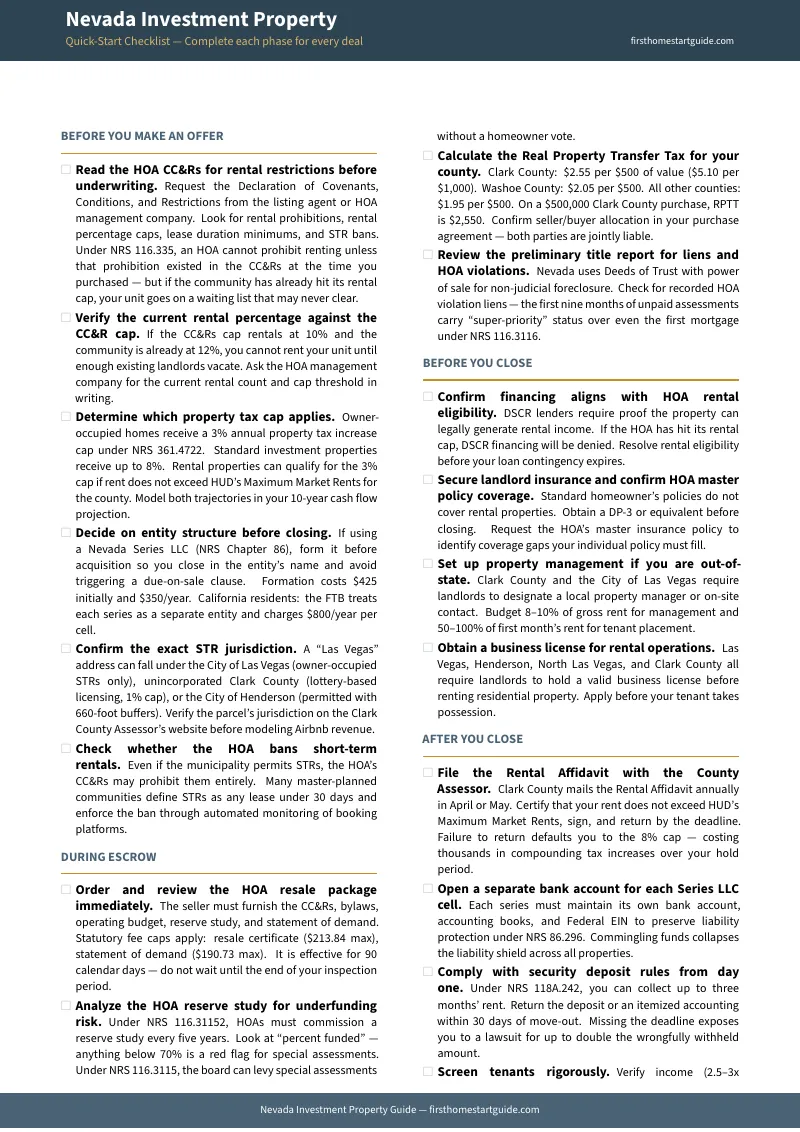
Download the free Nevada Quick-Start Checklist to see the 20-item due diligence framework covering HOA CC&R verification, property tax cap analysis, STR jurisdiction confirmation, entity structuring, and ongoing compliance. When you're ready for the full HOA and Tax Due Diligence System — with reserve study analysis, submarket profiles, military housing math, and the complete 11-chapter investment system — the complete guide is here.
The deal looks good on the spreadsheet. This guide tells you whether Nevada agrees.
Frequently Asked Questions
What if the rules change after I buy?
We update the guide when the rules change. Email us any time, even years later, and we'll send you the current edition free.