
You Moved to New Hampshire to Escape Income Tax. Then a Corroded Oil Tank Under the Backyard Cost You $55,000 Nobody Warned You About.
You found a three-bedroom colonial in Londonderry listed at $450,000. Or a Cape in Bedford where the schools are excellent and the commute to Boston is under an hour. Or a ranch in Concord where the mortgage is $800 less per month than your apartment in Somerville. You ran the numbers, factored in the zero percent income tax on wages, and felt like you just gave yourself a $15,000 raise. Your agent says to move fast. You're ready to write an offer.
Then the details start surfacing. The Bedford home carries a mill rate of $16.49 per thousand — your annual property tax bill is $7,420. But the similar home you passed on in Goffstown? Mill rate of $20.88 — same purchase price, but your annual tax is $9,396. That's $1,976 more per year, enough to change your debt-to-income ratio and potentially shrink your borrowing capacity by $25,000. The Concord ranch has a private well, and the water test comes back showing arsenic at 8.2 parts per billion — above New Hampshire's strict 5.0 ppb limit, the tightest in the nation. The Londonderry home has cut copper lines near the foundation, which means there's a buried oil tank somewhere in the yard. Your closing attorney explains that if it has leaked, you — the new buyer — are strictly liable for cleanup costs. Not the previous owner. You.
Here's the thing about New Hampshire that everyone gets half right: New Hampshire has no state income tax on wages, and that saves a Massachusetts commuter earning $120,000 roughly $6,000 per year. But New Hampshire also has property tax rates among the highest in the nation, varying wildly by town — $11.51 per thousand in Portsmouth to $34.37 in Keene. New Hampshire mandates attorney-supervised closings, adding $800 to $1,500 in fees that don't exist in most states. New Hampshire has arsenic, radon, and uranium occurring naturally in its granite bedrock, contaminating roughly 30% of private wells. New Hampshire holds the current homeowner — not the person who installed it — strictly liable for underground oil tank cleanup costs that routinely reach $15,000 to $55,000. And New Hampshire's down payment assistance programs through the NHHFA cover household incomes up to $176,200 — but most buyers never apply because they don't know they qualify. Getting the tax savings right means getting all of it right — the advantage and the risk — in a single framework.
The New Hampshire First-Time Home Buyer Guide is a Granite State Buyer Defense System — not a motivational overview of New England homeownership, but a structured decision framework that maps New Hampshire's tax advantage, environmental inspection protocols, town-by-town cost analysis, down payment assistance programs, and mandatory attorney closing process into a system you work through before you sign anything. It replaces months of cross-referencing the NH Department of Revenue Administration mill rate tables, NHHFA program eligibility criteria, NHDES arsenic testing protocols, and conflicting advice on r/newhampshire with a single reference that tells you exactly what you save, exactly what you owe, and exactly where first-time buyers lose money in the Granite State.
What's Inside the Granite State Buyer Defense System
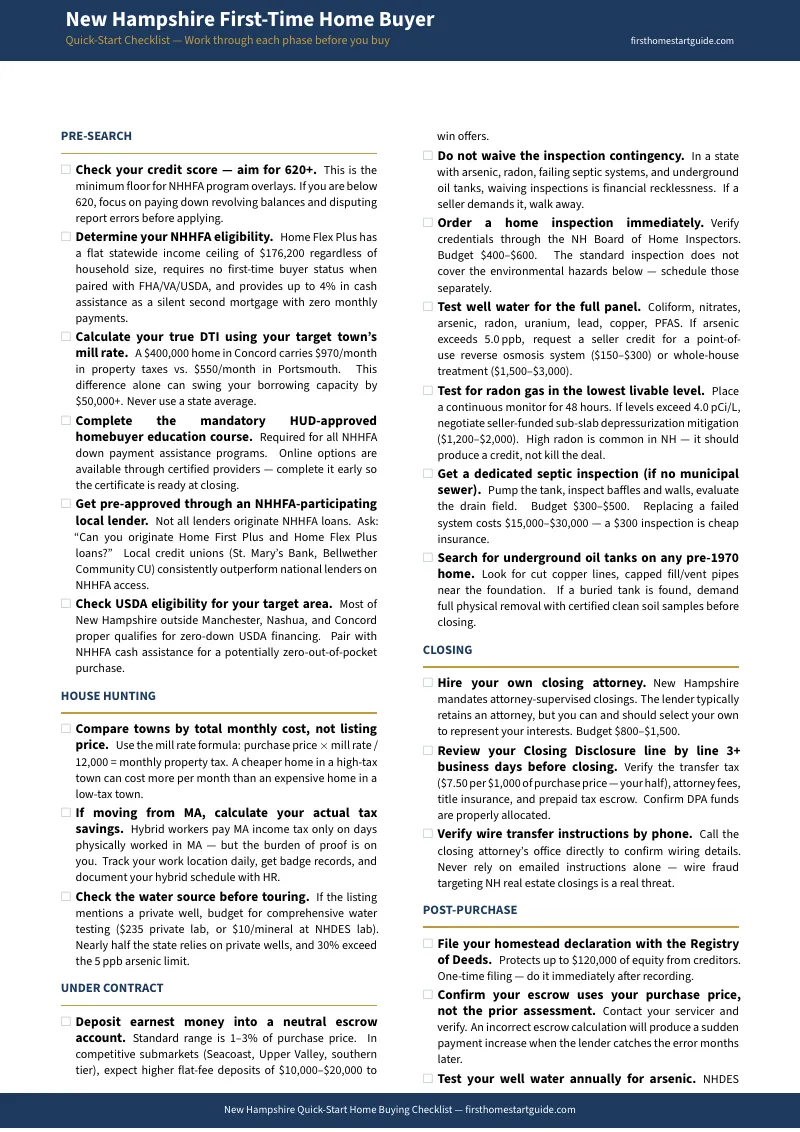
An 11-chapter guide, a printable 23-item step-by-step checklist, and 4 standalone worksheets — covering every stage from calculating your true tax savings through your first New Hampshire winter, built specifically for the legal requirements, environmental hazards, and fiscal realities that make buying here fundamentally different from any other state:
The MA-to-NH Tax Trap — What Hybrid Workers Actually Owe
Everyone says moving to New Hampshire eliminates your state income tax. The guide shows you when that's true and when it's not. If you commute five days a week to a Boston office, you still owe Massachusetts non-resident income tax on 100% of those wages. Hybrid workers pay MA tax only on days physically worked in Massachusetts — but the burden of proof is on you. The guide covers exactly how to track work location days, what documentation to keep, how to request badge records from HR, and how to avoid the double penalty of paying high New Hampshire property taxes while simultaneously leaking thousands in unnecessary payments to the Massachusetts Department of Revenue.
Town-by-Town Property Tax Analysis — The Numbers That Change Which Home You Can Afford
Property tax in New Hampshire isn't a single rate — it's a mill rate set independently by each of the state's 234 municipalities. A $400,000 home costs $4,604 per year in Portsmouth and $13,748 in Keene. That $762 per month difference fundamentally changes your debt-to-income ratio and your purchasing power. The guide includes a mill rate comparison framework covering six regions — southern tier border towns, Seacoast, Merrimack Valley, Upper Valley, Lakes Region, and North Country — with worked examples showing how to calculate the true monthly cost of ownership for any town, so you never get pre-approved based on a generic average and discover at closing that your actual tax bill blows up your DTI ratio.
NHHFA Down Payment Assistance — The $18,000 Most Buyers Never Claim
The New Hampshire Housing Finance Authority offers up to 4% of the loan amount in cash assistance through Home Flex Plus — a silent second mortgage at 0% interest with zero monthly payments, fully forgiven after four years. On a $450,000 purchase, that's up to $18,000 in free money toward your down payment or closing costs. Income eligibility extends to $176,200 — generous enough to cover most Massachusetts transplants. But the forgiveness is contingent on strict occupancy: sell, refinance, or stop using the home as your primary residence within 48 months, and you repay every dollar. The guide covers Home Flex Plus, Home First Plus, Home Preferred Plus, and their integration with FHA, VA, USDA, and Fannie Mae HomeReady — plus the HUD-approved homebuyer education course you must complete to qualify.
Environmental Due Diligence — The Inspections That Can Save You $100,000
This is the chapter that doesn't exist in any free guide. New Hampshire's granite bedrock contains naturally occurring arsenic, radon, and uranium. Nearly half the state relies on private wells, and roughly 30% exceed the state's 5.0 ppb arsenic limit — the strictest in the nation. The guide explains the difference between Arsenic III (neutral charge, evades standard filtration) and Arsenic V (removable by ion exchange or reverse osmosis), the exact NHDES testing protocols, the cost of point-of-use systems ($150-$300) versus whole-house treatment ($1,500-$3,000), and how to negotiate seller credits for remediation. It also covers underground oil tanks — how to identify signs of buried tanks (cut copper lines, capped fill pipes), why you should never accept a "tank test" on vessels older than 20 years, and why strict liability means a leaking tank you didn't install can still cost you $55,000 or more. Plus: radon gas testing (48-hour continuous monitor), septic system inspections ($300-$500), and the SAFETANK program that provides up to $2,250 to eligible homeowners for tank removal.
The Attorney Closing Process — What's Different Here
New Hampshire mandates that a licensed attorney oversee every residential closing. This is not optional. The attorney conducts the title search, prepares closing documents, manages escrow, and supervises document execution. Your lender will retain a closing attorney — but you have the absolute legal right to hire your own separate attorney to review the Purchase and Sale Agreement and represent your interests. The guide walks through the entire process, including the Wet Settlement Law (RSA 477:52) that requires all funds to be unconditionally available at closing — meaning you walk out with your keys the same day, but a late wire transfer will delay everything. Plus the transfer tax breakdown: $7.50 per $1,000 of purchase price on each side, adding $3,375 to your closing costs on a $450,000 home.
Regional Market Intelligence — Six Markets in One State
New Hampshire's housing market operates as six distinct regions, each with different price dynamics, inventory levels, and buyer demographics. Southern tier border towns (Nashua, Salem, Londonderry) attract Massachusetts commuters with the fiercest competition and highest prices. The Seacoast (Portsmouth, Exeter, Dover) commands a premium driven by technology hubs and extreme inventory scarcity. The Merrimack Valley (Manchester, Concord) offers urban convenience at lower price points but with higher mill rates. The Upper Valley (Lebanon, Hanover) anchors to Dartmouth-Hitchcock and draws medical and academic professionals. The Lakes Region offers seasonal and year-round living with unique waterfront assessment rules. And the North Country provides the most affordable housing but with older stock, legacy infrastructure, and greater reliance on USDA financing. The guide maps each region's price ranges, dominant buyer profiles, and the specific risks and opportunities first-time buyers encounter there.
Federal Mortgage Programs — Zero Down in Most of New Hampshire
Most of New Hampshire outside Manchester, Nashua, and the immediate Seacoast qualifies for USDA zero-down financing. The guide covers USDA eligibility maps and income limits, FHA loans (3.5% down, minimum 580 credit score), VA loans for eligible service members, Fannie Mae HomeReady and Freddie Mac Home Possible (3% down for incomes below 80% AMI), and how to stack these federal programs with NHHFA state assistance to minimize out-of-pocket costs at closing.
Who This Guide Is For
This guide is for first-time home buyers in New Hampshire who:
- Are moving from Massachusetts and need to calculate their actual tax savings — including the hybrid commuter trap where you still owe MA income tax on days worked in a Boston office — before they can determine their true purchasing power in New Hampshire
- Are comparing towns and need to understand how mill rates ranging from $11 to $34 per thousand translate into monthly costs that can swing $762 per month on the same purchase price — enough to disqualify them at underwriting
- Are buying a home with a private well for the first time and need to know what to test (arsenic, radon, uranium, coliform, PFAS), what the results mean (5 ppb is the line), what mitigation costs ($150 for point-of-use RO to $3,000 for whole-house treatment), and how to negotiate seller credits for remediation
- Earn under $176,200 and don't realize they qualify for up to 4% of their loan amount in forgivable down payment assistance through NHHFA — money they're leaving on the table because no one told them to apply
- Have never been through an attorney-supervised closing and need to understand the Wet Settlement Law, their right to hire their own attorney, and how the transfer tax split adds $3,375 to their closing costs on a $450,000 home
Why Not Free Tools and Government Websites?
Free information on buying a home in New Hampshire exists across dozens of sources. Here's what it actually delivers:
- The NH Department of Revenue Administration publishes mill rates by municipality. It does not explain how the four-component mill rate (municipal, county, local education, state education) affects your DTI ratio at underwriting, does not compare the true monthly cost across border towns, and does not tell you which towns offer the best value for Massachusetts commuters. You get a spreadsheet without the analysis that tells you what it means for your budget.
- NHHFA's website describes the Home Flex Plus, Home First Plus, and Home Preferred Plus programs. It does not explain the 48-month forgiveness trap on the silent second mortgage, does not show you how to stack state DPA with FHA, VA, or USDA federal programs, and does not tell you which local lenders actually originate NHHFA loans versus which ones don't bother. You get eligibility criteria without the strategy to maximize them.
- NHDES environmental pages provide arsenic testing protocols and the 5 ppb MCL limit. They do not explain the Arsenic III vs. V chemistry that determines which filtration systems actually work, do not give you negotiation language for requesting seller credits, and do not cover how to evaluate underground oil tank risk during inspection. You get scientific data without the buying decision framework.
- Realtor blogs and Zillow guides describe the general New Hampshire market. They rarely explain the environmental liabilities that can cost $15,000 to $100,000 post-closing, because their business model depends on you buying — not on you deciding a particular property has unacceptable risk. They average property tax rates statewide, destroying the town-by-town accuracy that determines whether you can actually afford a home in your target area.
This guide fills the New Hampshire-specific gap — the space between knowing the state has no income tax and knowing how to buy here without walking into an environmental liability, a property tax miscalculation, a down payment assistance program you should have applied for months earlier, or a commuter tax trap that erases your savings. It's the analysis that would take a real estate attorney, an environmental consultant, a mortgage broker, and a tax accountant to assemble — structured as a reference you own permanently.
— Less Than One Hour of Your Closing Attorney's Time
A single underground oil tank cleanup runs $15,000 to $55,000. A missed NHHFA application on a $450,000 loan is up to $18,000 in forgivable assistance you never received. A property tax miscalculation based on statewide averages instead of town-specific mill rates can shrink your purchasing power by $50,000 and kill your loan approval at underwriting. A failed well water test you didn't know to order can expose your family to arsenic levels above the state health limit. Unnecessary Massachusetts income tax payments from a hybrid work schedule you didn't document properly can leak thousands per year.
This guide doesn't replace your closing attorney or your mortgage broker. But it gives you the tax analysis, the environmental inspection protocols, the down payment assistance strategy, and the town-by-town cost comparison framework that ensure you capture every program, avoid every environmental red flag, and understand every closing cost before you sign — instead of discovering them at the closing table, in your first well water test, or on your Massachusetts tax return.
If it catches a single environmental hazard, captures a single assistance program you would have missed, or prevents a single property tax miscalculation, it pays for itself before you finish reading it.
Money-back guarantee, no time limit. If the guide doesn't sharpen your buying strategy and protect your closing costs in New Hampshire's market, you pay nothing.
Your download includes 6 PDFs: the full 11-chapter guide, the 23-item quick-start checklist, plus 4 standalone worksheets you can print and use independently — the True Monthly Cost Comparison (town-by-town), Cash-to-Close Calculator (with NHHFA assistance deduction), Environmental Inspection Checklist, and Town-by-Town Property Tax Comparison.
Download the free New Hampshire Quick-Start Home Buying Checklist to see the 23-item action plan covering pre-search preparation, house hunting, contract negotiations, closing, and post-purchase tasks. When you're ready for the full environmental defense strategy, tax analysis, and regional market intelligence, the complete guide is here.
New Hampshire gives you zero state income tax on wages. This guide makes sure you keep that advantage — and don't lose it to an oil tank, a property tax surprise, or a down payment program you never knew existed.
Frequently Asked Questions
What if the rules change after I buy?
We update the guide when the rules change. Email us any time, even years later, and we'll send you the current edition free.