
The Spreadsheet Says Cash Flow. New Hampshire's Property Tax Bill Says Otherwise.
You found a four-unit in Manchester throwing off an 8.2% cap rate. Or a duplex in Nashua where the rent-to-price ratio beats anything inside the I-95 corridor. Or a lakefront cottage in Meredith where the August ADR hits $350/night and the AirDNA projections show $35,000 in annual revenue. No state income tax. No sales tax. The numbers work. You're ready to wire earnest money.
Then you run the real numbers. The Manchester four-unit sits in a municipality where the property tax rate is $20.24 per thousand -- $10,120 per year on a $500,000 property, more than $3,650 above the national median. Your rental LLC crosses the $109,000 gross receipts threshold, triggering the Business Profits Tax at 7.5% on net income -- the state-level business tax that BiggerPockets threads about "no income tax in NH" never mention. Your three mortgages generate $105,000 in annual interest expense, and because the Business Enterprise Tax bases its 0.55% levy on compensation plus interest paid, you owe BET even though your portfolio is running at a net accounting loss. The Nashua duplex has an underground heating oil tank that no insurance carrier in New Hampshire will cover -- and under strict liability (RSA 146-A), you own the full remediation cost from the moment you take title, even if the leak happened twenty years before you bought the property. The well water test comes back at 7.3 ppb arsenic -- above the state's 5.0 ppb limit, which is twice as strict as the federal standard -- and now the lender won't issue clear-to-close until a certified filtration system is installed and retested. The Meredith STR is capped at 90 rental days per calendar year under the town's short-term rental ordinance, and the town next door -- Moultonborough -- classifies your Airbnb as a Bed and Breakfast requiring planning board review.
Here's what no single resource explains: New Hampshire layers the fourth-highest effective property tax rate in the nation, a two-tiered business tax system that catches leveraged LLCs through the mortgage interest trap (BET on interest paid at a net loss), strict environmental liability for underground oil tanks with no private insurance available and remediation costs routinely exceeding $100,000, well water contamination affecting 30% of private wells (arsenic, radon, PFAS), automatic double-damages penalties for security deposit violations under RSA 540-A, and a town-by-town STR regulatory patchwork -- into a market that punishes investors who mistake "no income tax" for "no tax exposure." Every one of these has cost real investors five to six figures because the information existed -- scattered across NHDES databases, municipal tax rate tables, RSA chapter filings, and BiggerPockets threads from 2022 -- but nobody had assembled it into a single underwriting system.
The New Hampshire Investment Property Guide is a Granite State Investor Compliance Navigator -- not a motivational overview of real estate investing, but a structured due diligence framework that maps every New Hampshire-specific financial trap, environmental liability, and regulatory restriction into a process you work through before you wire earnest money. It replaces months of cross-referencing NH Department of Revenue tax rate tables, NHDES oil tank databases, municipal STR ordinances, and RSA 540-A case law with a single reference that tells you exactly what to verify, exactly what the numbers should look like, and exactly where deals go wrong.
What's Inside the Granite State Investor Compliance Navigator
A 15-chapter guide, a standalone 18-item due diligence checklist, and 8 printable worksheets and reference cards -- covering every stage from entity formation through post-purchase operations, built specifically for the financial traps and environmental liabilities that make New Hampshire different from every other state:
Property Tax Cash Flow Compression Analysis
The defining underwriting challenge in New Hampshire. Because the state funds virtually all municipal services through property taxes, rates vary dramatically by town -- from $5.33 per thousand in Moultonborough to $29.11 per thousand in Concord. On a $500,000 property, that is the difference between $222/month and $1,213/month in property taxes alone -- a $991/month swing that determines whether your asset cash-flows or bleeds. The guide includes a municipality-by-municipality tax rate comparison for every major investment market (Manchester, Nashua, Concord, Portsmouth, Dover, Laconia, Salem, Derry, Meredith, Moultonborough), explains how post-sale reassessment cycles recalculate your tax burden when the purchase price exceeds the current assessed value, walks through the abatement appeal process via the Board of Tax and Land Appeals, and shows you how to underwrite with the actual mill rate instead of the national estimate that Zillow and Redfin get wrong. Without this analysis, your pro forma understates the single largest operating expense in your New Hampshire portfolio.
Business Tax Mechanics: BPT, BET, and the Mortgage Interest Trap
The single most overlooked tax issue for New Hampshire real estate investors -- and the one that BiggerPockets forums and national REIA groups consistently miss. New Hampshire imposes two business-level taxes on rental LLCs: the Business Profits Tax (7.5% on net income, filing threshold $109,000 gross receipts) and the Business Enterprise Tax (0.55% on compensation plus interest paid plus dividends, filing threshold $298,000). The BET's inclusion of interest paid creates a trap for leveraged investors: a portfolio with $3 million in mortgage debt at 7% generates $210,000 in annual interest expense that feeds the BET base -- meaning you owe BET even if your properties ran a net operating loss and your BPT liability is zero. The guide models the combined BPT/BET burden at different portfolio sizes and leverage levels, explains the credit integration system (BET paid offsets BPT liability, with ten-year carryforward), and walks through entity structuring strategies to keep individual LLCs below the $298,000 threshold. A single miscalculation here adds thousands in annual tax liability that your "no income tax" assumption didn't account for.
Underground Oil Tank Liability and Environmental Due Diligence
New Hampshire's reliance on heating oil and its older housing stock create environmental risks that routinely generate six-figure remediation costs -- and no admitted insurance carrier in the state covers home heating oil spills under a standard property policy. Under strict liability (RSA 146-A), the current property owner pays for cleanup regardless of when the discharge occurred. Remediation costs range from $10,000 for minor soil contamination to $350,000+ for severe groundwater saturation. The Petroleum Reimbursement Fund offers up to $500,000 in coverage -- but only if the tank system was in full compliance with NHDES Best Management Practices and NFPA 31 standards at the time of discharge. Commercial portfolio deductibles scale from $5,000 per facility (1-3 sites) to $30,000 per facility (20+ sites). The guide walks through the complete oil tank inspection protocol, the P&S contingency language that protects you, the UST removal and soil testing process ($2,000-$5,000), and the compliance requirements for the Petroleum Reimbursement Fund. This single chapter can prevent the $100,000+ surprise that has ended more New Hampshire investment careers than any market downturn.
Well Water Contamination: Arsenic, Radon, and PFAS
Nearly half of all New Hampshire residents rely on private bedrock wells -- and the state's granite geology makes these wells highly susceptible to naturally occurring contaminants. Approximately 30% of private wells exceed the state's 5.0 ppb arsenic limit (twice as strict as the federal 10 ppb standard). About 24% exceed the 10,000 pCi/L radon threshold. And 27% have tested positive for PFAS levels exceeding state limits, particularly in the southern tier. Under House Bill 398 (effective January 2025), sellers must provide written PFAS notification to buyers. Landlords face habitability exposure under RSA 540:13-d if well water fails to meet safety standards -- tenants can withhold rent, and local health officers can condemn the building. The guide covers NHELAP-accredited testing protocols, filtration system specifications and costs ($2,000-$8,000), the mandatory disclosure requirements for arsenic, radon, lead, and PFAS, and the habitability obligations that follow you for the life of the tenancy.
RSA 540-A Security Deposit Compliance System
New Hampshire's security deposit statute carries automatic financial penalties with no judicial discretion. Miss the 30-day return deadline, commingle deposit funds with your operating account, or fail to provide a receipt with the required bank name, account number, and interest rate -- and you owe the tenant double the deposit amount, plus their attorney's fees, automatically. Willful violations escalate to treble damages. The tenant can enforce this by filing a 540-A petition in district court at no cost. The guide maps every compliance requirement (maximum deposit amount, escrow account rules, receipt specifications, interest payment obligations, the elderly tenant exception, joint-and-several liability for roommate situations), provides the 30-day return calendar system, explains the itemized deduction requirements with supporting documentation, and covers the exemptions for small owner-occupied buildings. One administrative error on a $2,000 deposit costs $5,000 to $7,000 after double damages and attorney fees.
Lakes Region and White Mountains STR Regulatory Patchwork
New Hampshire has no state-level short-term rental regulation. Every municipality writes its own rules -- and the rules vary dramatically between neighboring towns. Meredith caps rentals at 90 days per year and requires a Special Exception from the Zoning Board of Adjustment. Moultonborough classifies STRs as Bed and Breakfasts requiring planning board review. Gilford requires a three-year Conditional Use Permit with a site plan, fire chief inspection, and a 24-hour local contact within 60 minutes. Portsmouth prohibits STRs in all residential zones (upheld by the NH Supreme Court). The guide maps the regulatory requirements for every major STR market, provides conservative underwriting models based on a 90-day operating cap, walks through the 8.5% Meals and Rooms Tax registration process, and includes the Laconia seasonal revenue data (monthly ADR and occupancy) that shows why underwriting STRs on annual averages instead of monthly reality is how investors run out of cash reserves in April.
Regional Market Analysis, Financing, and Operations
Four sub-markets dissected with cap rates, median prices, demand drivers, and strategy fit: the Southern Commuter Belt (Manchester, Nashua, Salem, Derry -- driven by 80,000 daily Massachusetts commuters and no state income tax), the Seacoast (Portsmouth, Dover, Durham -- high barriers, strong appreciation, student housing dynamics), the Capital Region (Concord -- state government anchor, highest property taxes), and the Vacation Corridors (Lakes Region and White Mountains -- seasonal STR revenue with seven-to-one peak-to-trough swings). Financing strategies for conventional, DSCR, community bank portfolio, hard money, and FHA house-hack loans. The eviction process under RSA 540 with timeline, notice requirements, and prohibited self-help penalties ($1,000 per day per violation). Winter operations budgeting for snow removal, heating fuel, pipe freeze prevention, and ice dam management. The Real Estate Transfer Tax ($7.50 per thousand per party, no 1031 exemption). Tax deed investing under RSA Chapter 80. 1031 exchange mechanics in a no-income-tax state.
Who This Guide Is For
This guide is for real estate investors targeting New Hampshire markets who:
- Are relocating capital from Massachusetts and assume "no income tax" means "no tax exposure" -- without realizing that New Hampshire's property tax rates, BPT at 7.5%, and the BET mortgage interest trap can create a combined carrying cost that rivals or exceeds the Massachusetts tax burden they're trying to escape
- Are analyzing a multi-family in Manchester or Nashua and need to model the real cash flow picture -- property taxes at $20.24/$16.83 per thousand, BPT/BET liability at your portfolio size, and winter operating costs -- not the generic national pro forma that understates New Hampshire carrying costs by thousands of dollars per year
- Are under contract on a property with a heating oil system and need to understand the full liability chain -- strict liability under RSA 146-A, the private insurance gap, UST removal protocol, Petroleum Reimbursement Fund eligibility requirements, and the portfolio-level deductible scaling that creates $30,000 per-facility exposure at twenty sites
- Are buying a property on a private well and need to verify arsenic, radon, and PFAS levels against New Hampshire's strict limits -- and understand the landlord habitability obligations under RSA 540:13-d that make contaminated well water a rent-withholding and building-condemnation risk
- Are setting up an STR in the Lakes Region and need to know whether your specific town requires a Special Exception, a Conditional Use Permit, planning board review, or nothing at all -- and how to underwrite seasonal revenue with a conservative 90-day operating cap instead of AirDNA's twelve-month projection
- Are a new or out-of-state landlord who needs a complete RSA 540-A security deposit compliance system -- escrow requirements, receipt specifications, the 30-day return calendar, itemized deduction documentation, and the elderly tenant exception -- before a single administrative error triggers automatic double damages and attorney fees
Why Not Free Tools and Forums?
Free information on New Hampshire real estate investing exists across dozens of sources. Here's what it actually delivers:
- BiggerPockets forums are where someone in a 2023 thread posts cap rate projections for a Manchester four-unit and someone responds with "don't forget the high property taxes" without specifying the actual rate, someone mentions the BET in passing but conflates it with the BPT, and nobody explains the mortgage interest trap that makes leveraged portfolios owe business tax at a net loss. You'll find genuinely useful experience reports mixed with advice that applies to landlord-friendly states, not to New Hampshire's specific regulatory and tax framework. Sorting current from outdated takes longer than reading a guide that has already done it.
- NHDES databases and RSA chapter filings give you the raw statutes and regulatory requirements. They don't model the BPT/BET interaction at your portfolio size, don't calculate the Petroleum Reimbursement Fund deductibles at your facility count, don't explain how RSA 540-A double damages work in practice, and don't connect the environmental compliance requirements to your investment cash flow. You get compliance data without the investment analysis that determines whether the deal works after compliance costs.
- National investing books and courses teach cap rate, DSCR, and 1031 mechanics that apply everywhere. They don't mention the BET mortgage interest trap, don't cover the oil tank insurance gap, don't address arsenic at 5.0 ppb versus the federal 10 ppb, don't map the Lakes Region STR patchwork, and don't explain why RSA 540-A's automatic double damages make New Hampshire security deposit administration fundamentally different from most other states. Applying national frameworks to New Hampshire-specific problems is how investors lose five figures on their first deal.
- Local REIAs and investor meetups focus heavily on networking and deal-sharing. They lack structured, technical guides that walk investors through the regulatory, tax, and environmental compliance frameworks unique to New Hampshire. You get connections, not the systematic due diligence process that catches the oil tank, the arsenic, and the BET liability before they cost you real money.
This guide fills the New Hampshire-specific gap -- the space between knowing how to analyze a rental property in general and knowing how to underwrite one in a state where property tax rates that rank fourth-highest nationally, a business tax system that catches leveraged LLCs through interest paid, uninsured oil tank liability under strict liability, well water contamination in 30% of private wells, and automatic double-damages penalties for deposit errors can each independently turn a profitable deal into a losing one. It's the analysis that would take a New Hampshire CPA, an environmental remediation consultant, and a landlord-tenant attorney to assemble -- structured as a reference you own permanently.
-- Less Than One BET Filing Surprise
A single BET liability you didn't model because you assumed "no income tax" means no business tax adds hundreds to thousands in annual tax depending on your leverage -- every year you own the portfolio. A property tax bill underwritten with Zillow's estimate instead of the actual municipal mill rate understates your largest operating expense by $2,000 to $6,000 per year. An underground oil tank leak on an uninsured property generates $100,000 to $350,000 in remediation costs with no insurance recovery. A well water test that comes back at 7 ppb arsenic -- above the state's strict 5.0 ppb limit -- stalls your closing until a $2,000-$5,000 filtration system is installed and retested. A security deposit returned on day 33 instead of day 30 triggers automatic double damages, attorney fees, and a court filing the tenant can pursue at zero cost.
This guide doesn't replace your New Hampshire CPA or your real estate attorney. But it gives you the property tax analysis, BPT/BET modeling, oil tank due diligence protocol, well water testing framework, RSA 540-A compliance system, and STR regulatory map that ensure you identify every New Hampshire-specific risk before you're contractually committed -- instead of discovering them on your first tax filing, your first NHDES notice, or your first 540-A petition.
If it catches a single BET liability you didn't model, prevents a single oil tank surprise, or saves you from one security deposit violation that would have triggered automatic double damages, it pays for itself before you've finished reading it.
Money-back guarantee, no time limit. If the guide doesn't sharpen your underwriting and protect your capital in New Hampshire's regulatory environment, you pay nothing.
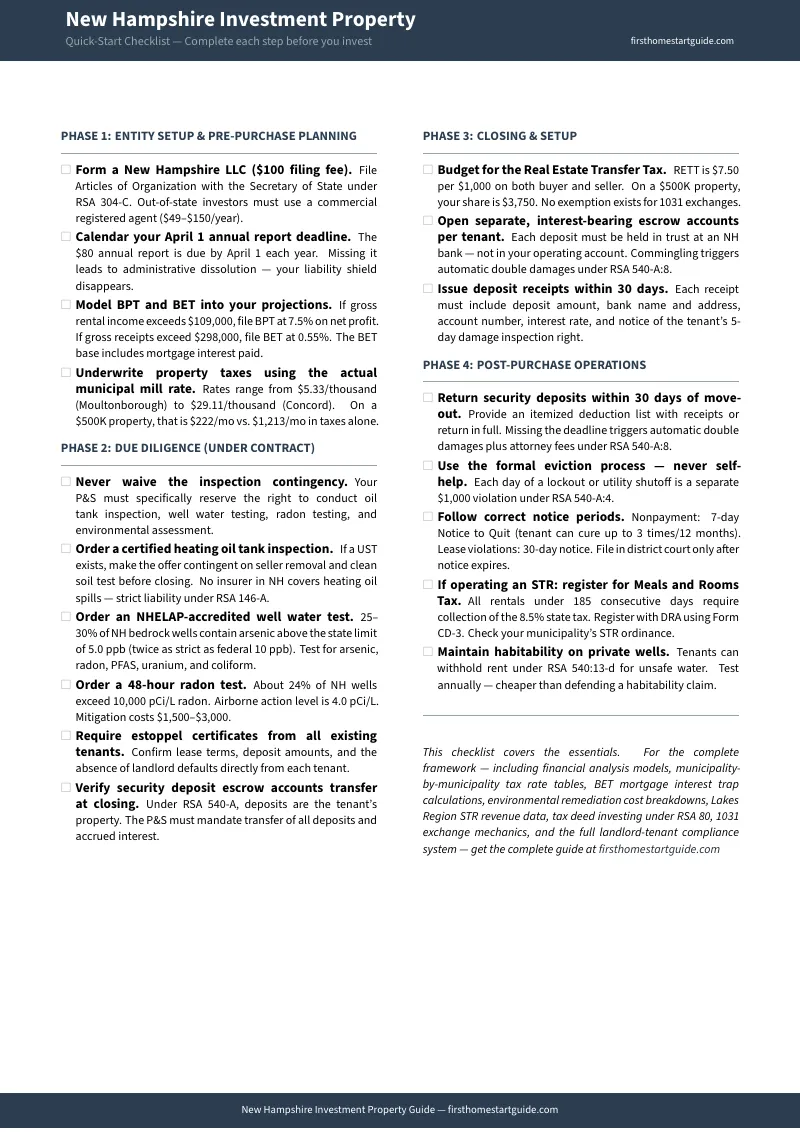
Download the free New Hampshire Quick-Start Checklist to see the 18-item due diligence framework covering entity setup, environmental inspection, tax analysis, closing, and post-purchase compliance. When you're ready for the full property tax analysis, BPT/BET modeling, oil tank liability assessment, well water testing protocol, RSA 540-A compliance system, and the complete 15-chapter investment framework, the complete guide is here.
The deal looks good on the spreadsheet. This guide tells you whether New Hampshire agrees.