
The Deal Cash-Flows on Paper. The Anti-Eviction Act, 117 Rent Control Municipalities, the Exit Tax, and Lead Paint Mandates Will Make Sure It Doesn't.
You found a triplex in Jersey City projecting 7% gross yield with three month-to-month tenants paying $400 below market. Or a pre-war four-unit in Newark listed at a 9% cap rate. Or a cash-flow positive duplex in Camden where the DSCR clears 1.25 and the price-to-rent ratio looks better than anything within 90 miles of Manhattan. The spreadsheet works. You're ready to wire earnest money.
Then you discover the Jersey City triplex sits in a rent-controlled municipality where annual increases are capped at CPI, and because the month-to-month tenants are protected by the Anti-Eviction Act, you cannot refuse to renew their tenancy, period — a lease expiration in New Jersey does not terminate a tenancy, and attempting a 30% rent increase to force vacancies gives a judge grounds to throw out your eviction as "unconscionable." The Newark four-unit was built in 1962, which means mandatory lead-based paint inspections every tenant turnover or every three years, dust wipe sampling in a municipality where childhood blood lead levels exceed 3%, and $1,000-per-week penalties if you miss the 30-day cure window. The Camden duplex requires you to hold tenant security deposits in a dedicated interest-bearing account, pay out interest annually, and return the full deposit plus accrued interest within exactly 30 days of move-out — and if you fail to notify the tenant of the account location within 30 days of collecting it, the tenant can legally apply the entire deposit to rent.
Here's what no single resource tells you: New Jersey layers the strictest anti-eviction statute in the country (the Anti-Eviction Act, N.J.S.A. 2A:18-61.1) where tenants hold what courts have described as a "tenancy for life" and landlords must prove one of exactly 17 statutory grounds to file for removal, 117 municipalities with independent rent control ordinances covering 66% of the state's renter households, a 2022 lead-based paint inspection mandate (P.L. 2021, c. 182) that imposes recurring inspection costs on every pre-1978 rental with penalties of $1,000 per week for non-compliance, the highest property taxes in the nation that mathematically eliminate the "1% Rule" in most northern markets, a capital gains regime that taxes all gains as ordinary income up to 10.75% with zero capital loss carryforwards, and a mandatory "Exit Tax" withholding that locks up the greater of 10.75% of your gain or 2% of the gross sale price at closing — even if you sold at a loss. Every one of these has cost real investors five to six figures because the information existed — scattered across N.J.S.A. statutes, municipal rent leveling board websites, DCA inspection databases, Division of Taxation forms, and BiggerPockets threads where pre-2022 advice sits alongside post-mandate reality — but nobody had assembled it into a single underwriting system.
The New Jersey Investment Property Guide is a New Jersey Regulatory Navigation System — not a motivational overview of Garden State real estate, but a structured framework that maps every NJ-specific eviction restriction, rent control overlay, lead paint mandate, tax trap, and compliance deadline into a process you work through before you wire earnest money. It replaces months of cross-referencing state statutes, municipal ordinances, DCA enforcement databases, and outdated forum posts with a single reference that tells you exactly what to verify, exactly what the numbers should look like, and exactly where deals go wrong.
What's Inside the New Jersey Regulatory Navigation System
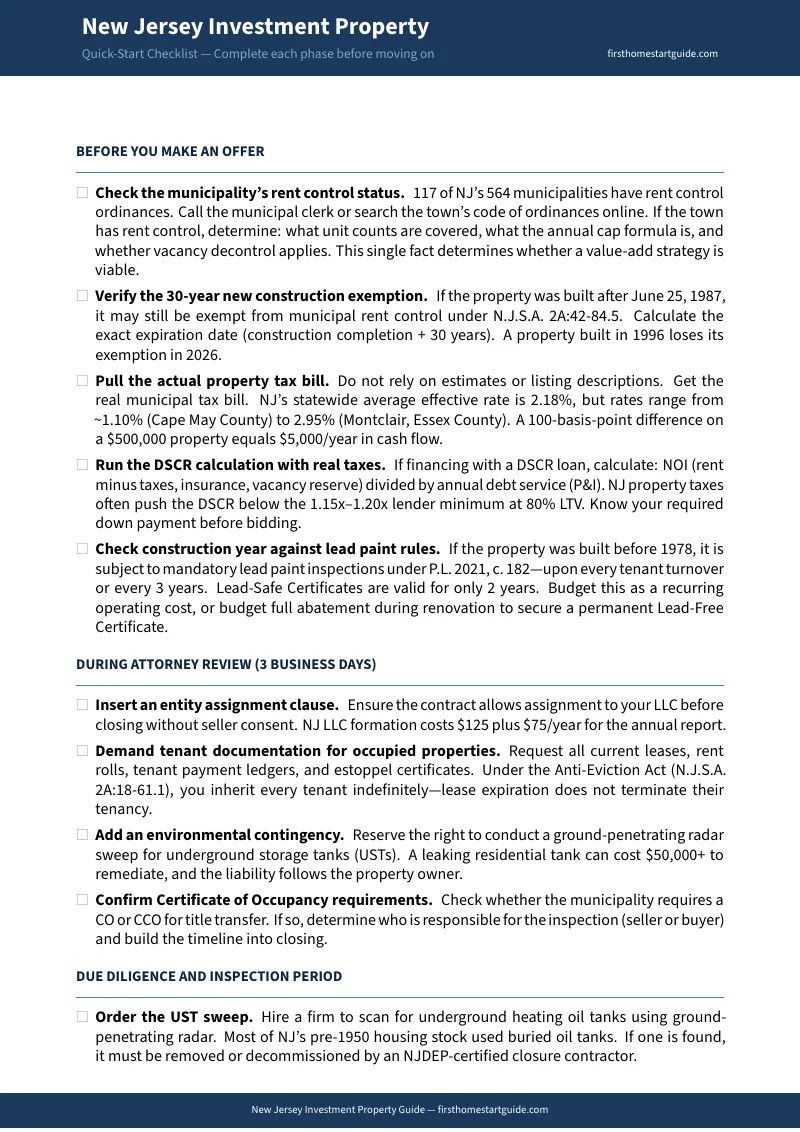
A comprehensive guide, a quick-start due diligence checklist, and 6 standalone worksheets and reference cards — 8 PDFs total covering every stage from pre-acquisition analysis through ongoing compliance, built specifically for the eviction restrictions, rent control patchwork, lead paint mandates, and punitive tax framework that make New Jersey different from every other state:
The Anti-Eviction Act — Why You Cannot Evict a Tenant When Their Lease Ends
In most states, a lease expiration means the landlord can choose not to renew. In New Jersey, it means nothing. The guide deconstructs the Anti-Eviction Act's "just cause" framework: the 17 specific statutory grounds required to file for eviction, the Notice to Cease and Notice to Quit procedural timeline that adds weeks to months before you can even file suit, the critical difference between non-payment cases (no prior notice required, but tenant can cure by paying at the hearing) and behavioral Notice cases (strict procedural sequence or the judge dismisses), the owner-occupied exemption for two-or-fewer-unit buildings where the landlord physically resides on the premises, the seasonal tenancy exemption for occupancies under 125 days, and the real-world "shadow eviction" strategies investors use to force voluntary vacancies through rent increases — including why a judge can block the entire strategy as unconscionable under N.J.S.A. 2A:18-61.1(f).
Rent Control — 117 Municipalities, Vacancy Decontrol, and the 30-Year Cliff
New Jersey delegates rent control to individual municipalities, and 117 of the state's 564 towns have enacted ordinances — covering roughly 66% of all renter households. The guide provides the rent control municipality reference, explains how local ordinances typically cap annual increases to CPI or 2-4% fixed rates, details vacancy decontrol provisions (which towns let you reset to market rate on turnover, which do not), covers capital improvement surcharge mechanics and the bureaucratic rent leveling board petition process, and highlights the critical 30-year new construction exemption (N.J.S.A. 2A:42-84.5) — including the rolling expiration cliff where buildings constructed in the early 1990s are losing their exemptions right now, subjecting previously deregulated units to municipal rent control for the first time.
Lead-Based Paint Inspections — The 2022 Mandate That Changed Operating Costs Overnight
P.L. 2021, c. 182 requires recurring lead inspections for every pre-1978 rental in New Jersey — on every tenant turnover or every three years, whichever comes first. The guide covers the two-tier inspection system (visual assessment in low-risk municipalities versus dust wipe sampling in municipalities where 3% or more of children under six test positive for elevated blood lead), the Lead-Safe Certification requirement and its two-year validity window that creates cyclical compliance costs, the $1,000-per-week penalty for non-compliance after a 30-day cure period, full EPA-certified abatement contractor requirements when hazards are found, and the targeted exemptions that make post-1978 construction, seasonal rentals under six months, and large multi-family buildings with clean 10-year inspection histories highly prized acquisition targets.
Property Taxes — The Highest in the Nation and What They Do to Cash Flow
New Jersey property taxes consistently rank first nationally and consume a larger percentage of gross rental income than in any other state. The guide covers property tax rates by county, explains why the "1% Rule" is mathematically impossible in most North Jersey markets, details the appeal process and timeline for challenging assessments, covers the Payment in Lieu of Taxes (PILOT) program that institutional developers use to make large projects viable — including the 2026 Jersey City audit where the new mayor is forensically reviewing 100+ active PILOT agreements and threatening retroactive enforcement — and provides the tax underwriting framework that separates viable deals from margin traps.
Capital Gains, the Exit Tax, and the Loss Carryforward Prohibition
New Jersey taxes all capital gains as ordinary income — no preferential long-term rate. The top bracket reaches 10.75% on income over $1 million. The guide covers the full bracket structure, the state's absolute prohibition on capital loss carryforwards (losses that exceed gains in a given year vanish permanently with zero future tax benefit), the Exit Tax withholding mechanics for non-resident sellers (the greater of 10.75% of the estimated gain or 2% of the gross sale price, withheld at closing even on a losing sale), the GIT/REP form requirements, the timeline for filing NJ-1040NR to recover withheld funds, the GIT/REP-3 exemption for active NJ residents and Section 121 exclusions, and why the withholding can destroy 1031 exchange timelines by locking up capital in state escrow for months.
Acquisition Process — Attorney State Mechanics, Transfer Fees, and Timeline
New Jersey is an attorney state where attorneys represent both parties in the transaction. The guide covers the standard 45-60 day closing timeline, the three-day attorney review period that is standard in all NJ contracts, realty transfer fees (1% graduated to 2% over $1M with a mansion tax adding 1% over $1M), title search and insurance requirements, financing options including DSCR loans and hard money for fix-and-flip projects, and entity structuring considerations for holding NJ investment property.
Security Deposits — Interest-Bearing Accounts, Annual Payouts, and Penalty Traps
New Jersey's security deposit law imposes accounting requirements that catch landlords from less-regulated states completely off guard. The guide covers the 1.5x monthly rent collection ceiling, the mandatory interest-bearing account requirement (no commingling with operating funds), annual interest payouts to tenants, the strict 30-day return window with itemized deductions via certified mail, and the penalty for failing to notify tenants of the account location within 30 days — the tenant can apply the entire deposit to rent.
Regional Market Analysis — North Jersey, South Jersey, and the Shore
Three distinct investment regions with fundamentally different strategies. North Jersey: high entry prices, compressed 4-6% cap rates, appreciation-dependent returns requiring deep capital reserves. South Jersey: lower prices, 8-12% cap rates with immediate cash flow, but elevated tenant management intensity and population outmigration risk. The Shore: seasonal short-term rental arbitrage that bypasses the Anti-Eviction Act and lead paint mandates entirely through the 125-day and seasonal exemptions. The guide provides realistic yield expectations for each region and identifies the structural factors that drive returns in each.
Who This Guide Is For
This guide is for real estate investors targeting New Jersey markets who:
- Are analyzing a New Jersey rental property and need to know whether the municipality has rent control, what the allowable annual increase is, whether vacancy decontrol applies, and how many years remain on the 30-year new construction exemption before the property falls under local rent leveling
- Are acquiring a tenant-occupied property and need to understand that you are inheriting those tenants indefinitely under the Anti-Eviction Act — including the exact grounds, notice procedures, and timelines required to file for removal, and why "wait for the lease to end" is not a legal strategy in New Jersey
- Are buying a pre-1978 building and need to budget for the 2022 lead paint inspection mandate — visual assessments versus dust wipe sampling based on your municipality's childhood blood lead data, Lead-Safe Certification validity windows, remediation costs, and $1,000/week non-compliance penalties
- Are an out-of-state investor (NYC, Philadelphia, or elsewhere) who needs to understand the Exit Tax withholding that will lock up 2% of your gross sale price or 10.75% of your gain at closing — even on a losing sale — and how to plan around the 6-12 month refund timeline
- Are building a multi-property portfolio and need to account for New Jersey's 10.75% capital gains rate, the prohibition on capital loss carryforwards that eliminates your ability to offset bad exits against future gains, and the security deposit accounting requirements that apply to every unit
- Want every NJ-specific regulation, tax calculation, compliance deadline, and market analysis in one reference — instead of assembling it from N.J.S.A. statutes, municipal rent board websites, DCA inspection databases, Division of Taxation forms, and forum posts that still cite pre-2022 lead paint rules
Why Not Free Tools and Forums?
Free information on New Jersey real estate investing exists across dozens of sources. Here's what it actually delivers:
- BiggerPockets and Reddit forums are where someone in a 2020 thread recommends buying a triplex with below-market tenants and "just waiting for the leases to end" to raise rents — without mentioning that lease expiration does not terminate a tenancy in New Jersey and you cannot remove those tenants without proving one of 17 statutory grounds before a judge. Another poster suggests a 30% rent increase to force vacancies, and a local investor immediately flags the unconscionability defense that can get the entire eviction thrown out. You'll find useful experience reports mixed with advice that predates the 2022 lead paint mandate, references outdated Exit Tax withholding rates, and conflates general landlord-tenant law with New Jersey's specific Anti-Eviction Act provisions. Sorting current from outdated takes longer than reading a guide that has already done it.
- New Jersey REIA meetings provide excellent in-person networking and deal-sourcing connections, but notoriously lack comprehensive, written, continuously updated digital resources. You'll meet experienced investors who know the market cold, but walking away with a structured reference that covers the Anti-Eviction Act grounds, the rent control municipality list, the lead paint inspection tiers, and the Exit Tax math requires assembling months of meeting notes and hoping nothing was misstated.
- N.J.S.A. statutes and DCA publications provide the law itself — the full text of the Anti-Eviction Act, the lead paint mandate, the security deposit statute. They are written for attorneys and compliance officers, not for investors underwriting deals. You'll find the 17 grounds for eviction listed in legal language but not a decision framework that tells you whether your specific property, tenancy type, and municipality combination gives you any realistic path to removing a problem tenant. The rules are there. The analysis that tells you whether to buy or walk is not.
- National investing books and courses teach cap rate analysis, DSCR calculation, and 1031 exchange mechanics that apply everywhere. They don't cover the Anti-Eviction Act's prohibition on non-renewal, the 117 rent-controlled municipalities, the 2022 lead paint inspection mandate's two-tier system, New Jersey's elimination of capital loss carryforwards, or the Exit Tax withholding mechanics for non-residents. Applying national frameworks to New Jersey-specific problems is how investors discover the Anti-Eviction Act on their first eviction attempt instead of during due diligence.
This guide fills the New Jersey-specific gap — the space between knowing how to analyze a rental property in general and knowing how to underwrite one in a state where the Anti-Eviction Act, 117 rent control ordinances, the 2022 lead paint mandate, the highest property taxes in the country, a 10.75% capital gains rate with no loss carryforwards, and the Exit Tax withholding can each independently turn a profitable deal into a losing one. It's the analysis that would take a New Jersey real estate attorney, a CPA with NJ tax specialization, and a lead paint compliance consultant to assemble — structured as a reference you own permanently.
— Less Than One Lead Paint Inspection
A single lead-safe inspection on a pre-1978 building runs $300-$500 per unit — and that's before remediation. One eviction filing based on a procedural error in the Notice to Cease sequence costs $3,000-$8,000 in legal fees and three to six months of lost rent. An Exit Tax withholding on a $1.2 million sale locks up $24,000 of your capital for 6-12 months even if you sold at a loss. A rent increase that a judge rules unconscionable gets your entire eviction complaint dismissed and leaves you with the same below-market tenant plus the attorney bills.
This guide doesn't replace your New Jersey real estate attorney or your CPA. But it gives you the Anti-Eviction Act decision framework, the rent control municipality reference, the lead paint compliance checklist, the Exit Tax calculations, and the due diligence system that ensure you identify every NJ-specific risk before you're contractually committed — instead of discovering them at your first eviction hearing, your first lead inspection deadline, or your first closing table.
If it catches a single rent control oversight, prevents a single eviction procedural error, or saves you from buying a pre-1978 building without budgeting for lead compliance, it pays for itself before you've finished reading it.
Money-back guarantee, no time limit. If the guide doesn't sharpen your underwriting and protect your capital in New Jersey's regulatory environment, you pay nothing.
Download the free New Jersey Quick-Start Home Buying Checklist to see the due diligence framework covering pre-acquisition verification, eviction law compliance, lead paint requirements, and tax obligations. When you're ready for the full Anti-Eviction Act analysis, rent control reference, lead paint compliance system, Exit Tax strategy, and complete investment framework, the complete guide is here.
The deal looks good on the spreadsheet. This guide tells you whether New Jersey agrees.