
Your Pro Forma Says 7% Cap Rate. New Mexico's Land Grant History, Water Rights Law, and Tax Lightning Say Otherwise.
You found a fourplex near Kirtland AFB where E-5 BAH of $2,175/month covers the mortgage with room to spare. Or a Santa Fe adobe that commands $350/night on Airbnb during opera season. Or a Las Cruces rental at $180,000 where the cap rate makes Denver investors weep. The numbers work. You're ready to wire earnest money from Colorado or California.
Then New Mexico reveals what the spreadsheet can't capture. The Kirtland fourplex was owned by the same family for twenty years. Their property tax bill shows $1,200/year because the 3% annual cap suppressed the assessed value to $140,000 — but you're buying at $320,000. Under NMSA 7-36-21.2, the cap is completely lifted upon change of ownership. Your first tax bill doubles. Later, you transfer the property into your LLC for liability protection. Under Giddings v. SRT-Mountain Vista, LLC, that transfer triggers a second reassessment — Tax Lightning strikes twice. The Santa Fe adobe is generating $4,800/month gross STR revenue. You file your GRT return expecting the NMSA 7-9-53 lease deduction to apply — but the Taxation and Revenue Department classifies stays under 30 days as a license, not a lease. Your deduction is denied. You owe 5.125% to 8.6875% GRT on every dollar plus municipal lodgers' tax. The Las Cruces property deed says "with all appurtenant water rights." You close. Six months later, a neighboring farmer calls the Office of the State Engineer claiming those rights were severed and sold to his predecessor in 1987. Under Turner v. Bassett, a transfer permit creates a presumption of severance — even if the deed never mentioned it. Standard title insurance explicitly excludes water rights. It is the only exception that cannot be deleted.
Here's what BiggerPockets threads and agent blogs never consolidate into one framework: New Mexico layers a 3% property tax cap that is completely lifted upon sale (Tax Lightning), community property law that voids any real estate contract missing a spouse's signature under NMSA 40-3-13, water rights that are legally severable from land and excluded from title insurance coverage, acequia commissions with statutory authority to deny water transfers off the ditch system, Spanish and Mexican land grant title clouds requiring $1,500–$15,000 quiet title actions, a Gross Receipts Tax that exempts long-term leases but fully taxes STR income, a security deposit return deadline where missing 30 days forfeits all rights to withhold and triggers attorney fee liability, and adobe construction that catastrophically fails when renovated with standard materials. Each one of these has cost real investors five to six figures because the information existed — scattered across NMSA statutes, Office of the State Engineer files, acequia bylaws, and county assessor portals — but nobody assembled it into a single operational system.
The New Mexico Investment Property Guide is a Land Grant & Water Rights Due Diligence System — not a motivational overview of New Mexico real estate, but a structured acquisition, compliance, and operations framework that maps every New Mexico-specific financial trap, regulatory requirement, and property risk into a process you work through before you wire earnest money. It replaces months of cross-referencing OSE water records, NMSA statutes, acequia commission bylaws, county assessor portals, and Magistrate Court procedures with a single reference that tells you exactly what to verify, exactly what the numbers should look like, and exactly where deals go wrong.
What's Inside the Land Grant & Water Rights Due Diligence System
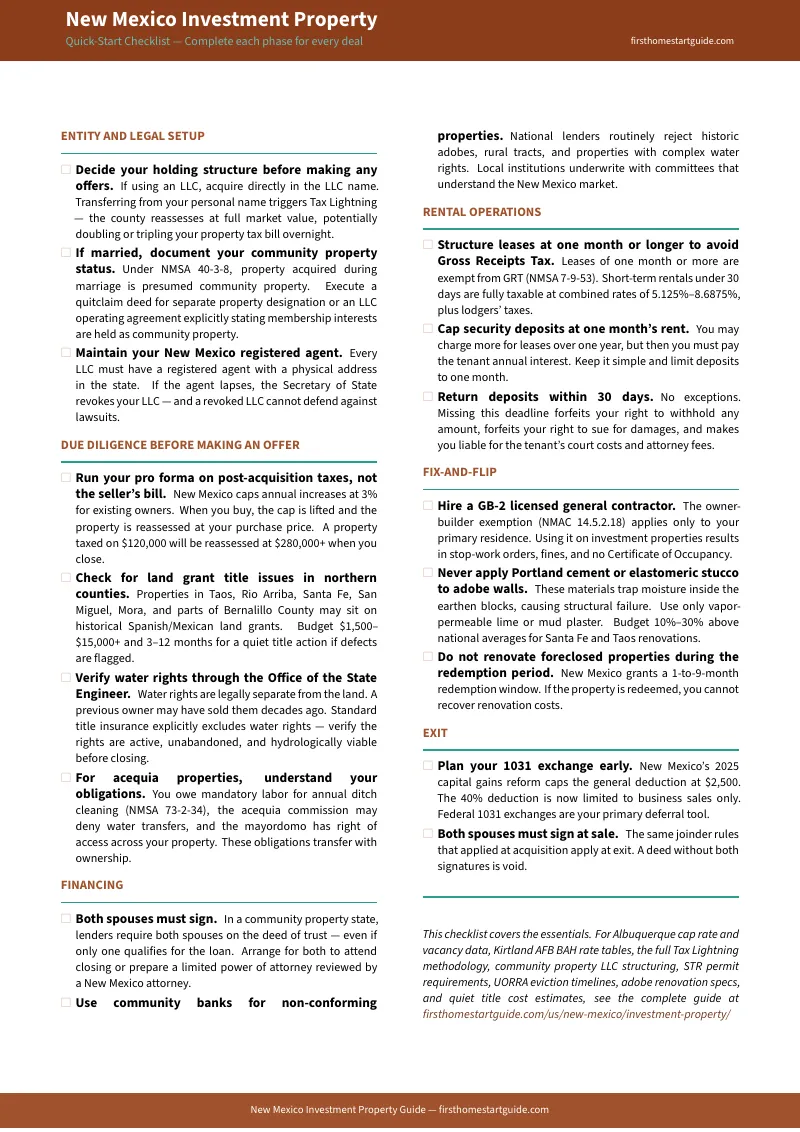
A 12-chapter guide and an 18-item due diligence checklist — covering every stage from entity structuring through exit planning, built specifically for the legal complexity and property risks that make New Mexico unlike any other state:
Entity Structuring and Community Property
New Mexico is one of nine community property states. Under NMSA 40-3-13, any contract to sell, mortgage, or transfer community real property is void — not voidable, void — unless both spouses sign. One missing signature unwinds the entire transaction. But community property also creates a significant federal tax advantage: under IRS Revenue Procedure 2002-69, a married couple can treat a jointly owned LLC as a disregarded entity, filing a standard joint 1040 with Schedule C and Schedule E instead of complex Form 1065 partnership returns. The guide covers the spousal joinder requirement, the disregarded entity election, operating agreement language, divorce risk provisions, and registered agent maintenance — so your entity structure protects your assets and optimizes your taxes rather than creating a title defect or a surprise reassessment.
Tax Lightning and the 3% Cap Reset
New Mexico caps annual property tax increases at 3% for existing owners. When you buy, the cap is lifted entirely and the county assessor reappraises at your purchase price. A property held for 15 years with a capped assessed value of $120,000 is reassessed at $280,000 when you close — your tax bill more than doubles overnight. Transferring into an LLC triggers a second reassessment. The guide covers the exact Tax Lightning calculation, how to model post-acquisition taxes into your pro forma before making an offer, the Giddings precedent for LLC transfers, and why you must acquire directly in the LLC name rather than buying personally and transferring later.
Water Rights Verification and Acequia Governance
Water rights in New Mexico are legally separate from the land and can be severed, sold, or abandoned without the property deed reflecting the change. The Supreme Court's Turner v. Bassett ruling means a transfer permit creates a presumption of severance even if your deed says "with all appurtenant water rights." Title insurance explicitly excludes water rights — it is the only non-deletable exception. If your property is on an acequia, the commission has 120 days to review and may deny any water transfer off the ditch system. You owe mandatory labor for annual ditch cleaning, and the mayordomo has right of access across your land. The guide covers OSE verification steps, forfeiture and abandonment risk assessment, acequia transfer authority, water banking protections, and the five-point due diligence checklist that prevents you from closing on a property where the water rights were stripped decades ago.
Land Grant Title Clouds and Quiet Title Actions
Properties in Taos, Rio Arriba, Santa Fe, San Miguel, Mora, and parts of Bernalillo County may sit on historical Spanish and Mexican land grants with centuries of informal heirship transfers. Standard title insurance includes non-negotiable exceptions for unrecorded rights, boundary disputes, and water rights. Clearing title defects requires a quiet title action — a formal lawsuit costing $1,500 to $15,000+ and taking 3 to 12+ months. The 2007 amendment protects land grant political subdivisions from new adverse possession claims, but claims that vested before June 15, 2007 remain valid. The guide explains how to read preliminary title reports for land grant red flags, how to budget quiet title costs into your acquisition pro forma, and when to walk away.
Submarket Investment Analysis
Albuquerque's six distinct submarkets dissected with cap rates, vacancy rates, and strategy alignment: Northeast Heights ($400,000 median list, stable long-term tenants), Southeast Heights/Kirtland AFB (military BAH-backed cash flow with E-5 rates of $2,175/month), Southwest quadrant ($320,000 entry with higher rental volatility), Nob Hill/University (premium rents from professionals and graduates), Rio Rancho (suburban growth play), and South Valley (agricultural zoning with valuable water rights and high title complexity). Plus Santa Fe (premium market with the strictest STR regulations in the state) and Las Cruces (NMSU student housing and White Sands contractor demand). Each submarket mapped against the regulatory burden, title risk, and tenant profile that determines whether your strategy actually works.
Gross Receipts Tax: Long-Term vs. Short-Term
New Mexico's GRT is not a sales tax — it taxes the privilege of doing business. The critical distinction: leases of one month or longer are exempt under NMSA 7-9-53, but stays under 30 days are classified as a license and fully taxable at combined rates of 5.125% to 8.6875%, plus municipal lodgers' and hospitality taxes. The guide covers the lease-versus-license classification, STR tax obligations for Santa Fe and Albuquerque operators, and why the GRT on services (property management, contractor labor, realtor commissions) indirectly elevates your operating costs even on long-term rentals.
Landlord-Tenant Law (UORRA)
New Mexico has no rent control, but the Uniform Owner-Resident Relations Act contains procedural landmines. Security deposits are capped at one month's rent for leases under one year. The 30-day return deadline is absolute: miss it and you forfeit the right to withhold any amount, forfeit the right to sue for property damage, and become liable for the tenant's court costs and attorney fees. Eviction requires a 3-day notice for non-payment, a 7-day notice for standard violations, and a filing in Magistrate Court (or Metropolitan Court in Bernalillo County). Total timeline: 4 to 6 weeks. The guide covers notice drafting, court filing procedures, the $250 bad-faith penalty, and the specific eviction quirks for military tenants under the SCRA.
Adobe Renovation and the Portland Cement Trap
If you're flipping in Santa Fe or Taos, you'll encounter authentic adobe construction that commands massive market premiums. The single most expensive hidden condition: previous owners applied rigid Portland cement stucco, trapping moisture inside the earthen blocks and causing the adobe to turn to mud and structurally fail. Proper restoration requires vapor-permeable lime or mud plaster at $5.00–$12.00+ per square foot, plus 10%–30% above national averages for skilled earthen-masonry tradesmen. The guide covers NMAC 14.7.4 construction code requirements, moisture management physics, historic district overlay restrictions, and the owner-builder exemption trap that prohibits unlicensed contracting on investment properties.
18-Item Due Diligence Checklist
A standalone printable checklist organized across five phases — Entity and Legal Setup, Due Diligence Before Making an Offer, Financing, Rental Operations, Fix-and-Flip, and Exit — covering the New Mexico-specific verification steps that out-of-state investors most commonly skip. Tax Lightning calculation, land grant title review, OSE water rights verification, acequia obligation assessment, community property documentation, GRT structuring, security deposit compliance, and contractor licensing. Print it, run it on every deal, and catch the compliance gaps before they become five-figure problems.
8 Standalone Worksheets and Reference Cards
Print-ready tools you use on every deal: a Tax Lightning Worksheet to calculate the post-acquisition reassessment and LLC transfer impact, a Water Rights Due Diligence checklist for the 5-step OSE verification process, a Submarket Comparison card mapping all 8 New Mexico markets with cap rates and strategy alignment, an Eviction Process Reference covering the UORRA timeline and security deposit rules, an STR Regulatory Reference comparing Albuquerque and Santa Fe permit requirements, a Closing Cost Worksheet with NM-specific line items, an Entity Structuring Reference for community property and LLC decisions, and an Adobe Renovation Reference with plaster specifications and contractor checklists for Santa Fe and Taos properties.
Who This Guide Is For
This guide is for real estate investors targeting New Mexico markets who:
- Are analyzing a New Mexico property and need to verify whether the deal actually works once you calculate the post-acquisition Tax Lightning reassessment, water rights status, land grant title risk, and GRT exposure — not the seller's current tax bill and a generic mortgage calculator estimate
- Are under contract on a property in Taos, Rio Arriba, or Santa Fe County and the preliminary title report flagged land grant exceptions or heirship issues — and need to understand whether a $3,000 quiet title action fixes it or a $15,000 contested proceeding makes the deal uneconomic
- Found a property with a deed that says "with all appurtenant water rights" but need to verify through the Office of the State Engineer whether those rights are active, unabandoned, and hydrologically viable — because title insurance explicitly excludes water rights and a previous owner may have severed them decades ago
- Are evaluating a Kirtland AFB rental and need the exact 2026 BAH rates, submarket vacancy data, military lease clause requirements under the SCRA, and the turnover frequency that determines whether the military tenant strategy beats civilian long-term leasing in the Southeast Heights
- Are considering a Santa Fe or Albuquerque STR and need the specific permit requirements, the 1,000-permit cap and proximity restrictions in Santa Fe, the GRT tax classification that makes STR income fully taxable unlike long-term leases, and the lodgers' tax obligations that further reduce your net yield
- Are married and investing through an LLC and need to understand the spousal joinder requirement that voids unsigned contracts, the disregarded entity election that simplifies federal taxes, and the Tax Lightning trigger when transferring property into an LLC after purchase
- Want every New Mexico-specific regulation, tax calculation, title risk, and compliance requirement in one reference — instead of assembling it from NMSA statutes, OSE records, acequia bylaws, county assessor portals, and Magistrate Court rules across two dozen browser tabs
Why Not Free Tools and Forums?
Free information on New Mexico real estate investing exists across dozens of sources. Here's what it actually delivers:
- BiggerPockets forums are where someone in a 2022 thread says "New Mexico has no transfer tax, great cap rates, easy money," someone else replies with a Tax Lightning horror story after the 3% cap reset, and a third poster recommends an Albuquerque agent who retired last year. You'll find useful Kirtland AFB rental analysis mixed with advice that predates the 2025 capital gains deduction restriction, the current Santa Fe STR permit cap, and the Giddings LLC transfer precedent. Sorting current from outdated takes longer than reading a guide that has already done it.
- County assessor websites give you individual data points — an assessed value here, a tax rate there. They don't tell you that the assessed value reflects a 3% cap that won't apply after your purchase, don't flag the Tax Lightning from a subsequent LLC transfer, and don't connect the seller's low tax bill to the post-acquisition reassessment that will double your holding costs. You get the data without the analysis that determines whether the deal works.
- National investing books and courses teach cap rate, DSCR, and 1031 mechanics that apply everywhere. They don't mention Tax Lightning, community property joinder requirements that void unsigned contracts, water rights severability excluded from title insurance, acequia transfer-denial authority, land grant quiet title actions, the GRT lease-versus-license distinction for STRs, the 30-day security deposit forfeiture rule, or NMAC 14.7.4 adobe construction codes. Applying national frameworks to New Mexico's civil-law-influenced, historically complex property environment is how investors from Colorado and California lose five figures on compliance gaps they never knew existed.
- Real estate agent advice focuses on getting the deal closed, not on protecting your post-purchase economics. Your agent won't calculate the Tax Lightning reassessment, won't verify water rights through the OSE, won't check whether the acequia commission has transfer-denial authority, and won't tell you that the 30-day security deposit deadline runs from the date the tenant surrenders the premises — not from the date you inspect for damages.
This guide fills the New Mexico-specific gap — the space between knowing how to analyze a rental property in general and knowing how to underwrite one in a state where Tax Lightning reassessment, severable water rights excluded from title insurance, land grant title clouds, community property joinder requirements, acequia governance, and the GRT lease-license distinction can each independently turn a profitable deal into a losing one. It's the analysis that would take a New Mexico real estate attorney, a water rights specialist, and a title examiner to assemble — structured as a reference you own permanently.
— Less Than One Hour of a Water Rights Attorney
A single Tax Lightning reassessment after a change of ownership doubles your property tax bill overnight. A water right that was severed decades ago and excluded from title insurance costs you the irrigation value of the land. A quiet title action on a land grant property runs $1,500 to $15,000. A missed 30-day security deposit deadline forfeits your right to withhold any amount and makes you liable for the tenant's attorney fees. A Portland cement stucco job over unstabilized adobe turns a $50,000 renovation into a $120,000 structural remediation.
This guide doesn't replace your real estate attorney or your water rights specialist. But it gives you the Tax Lightning calculation methodology, water rights verification checklist, land grant due diligence framework, community property compliance system, and landlord-tenant procedure guide that ensure you identify every New Mexico-specific risk before you're contractually committed — instead of discovering them in your first tax bill, your first title defect, or your first tenant dispute.
If it catches a single Tax Lightning miscalculation, prevents a single water rights loss, or saves you from one quiet title action you could have avoided, it pays for itself before you've finished reading it.
Money-back guarantee, no time limit. If the guide doesn't sharpen your underwriting and protect your capital in New Mexico's unique legal and property environment, you pay nothing.
Download the free New Mexico Quick-Start Home Buying Checklist to see the 18-item due diligence framework covering entity setup, title verification, water rights, rental operations, and exit planning. When you're ready for the full Tax Lightning analysis, water rights verification system, land grant due diligence framework, and 12-chapter investment guide, the complete guide is here.
The deal looks good on the spreadsheet. This guide tells you whether New Mexico agrees.
Frequently Asked Questions
What if the rules change after I buy?
We update the guide when the rules change. Email us any time, even years later, and we'll send you the current edition free.