
You Have Googled "How Much Are Closing Costs in NYC," Read Three Reddit Threads About Co-op Board Rejections, and Still Cannot Figure Out Whether the Mansion Tax Applies to Your $1.01 Million Offer, Whether a CEMA Will Actually Save You Money After the Seller Takes Half, or Whether SONYMA's Cancellable PMI Is Worth More Than the FHA Loan Your Lender Keeps Pushing.
You have been pre-approved for a mortgage and started looking at two-bedrooms in Brooklyn co-ops, condos in Queens, or split-levels on Long Island. You may have found a co-op you love, started assembling the board package, and then learned that the board requires 18 months of post-closing liquidity on top of your 20% down payment and $4,000 attorney fee — and that they can reject you without explanation after you spend three months waiting. Or you are buying a condo near the $1 million line and your broker casually mentioned the Mansion Tax, so you spent an evening trying to figure out whether offering $999,000 instead of $1,010,000 saves you $10,000 or just guarantees your offer gets rejected. Or you relocated upstate to Rochester for work, discovered that your signed purchase contract can be voided by the seller's attorney within three business days for no stated reason, and now you are wondering whether you actually have a deal or just a handshake.
The problem is not a shortage of information. StreetEasy has pricing history. The SONYMA website publishes income limits and lender lists. Reddit threads in r/AskNYC describe board interviews in gruesome detail. But no single resource explains how the Mortgage Recording Tax, the Mansion Tax, and the state transfer tax stack on a specific purchase price — and what a Purchase CEMA actually saves you after you split the tax savings 50/50 with the seller and pay $1,500 in additional legal fees. Nobody models the lifetime cost difference between SONYMA's cancellable PMI and FHA's permanent MIP at your income bracket, or explains how to stack a $100,000 HomeFirst grant with a SONYMA DPAL and a $75,000 AHC grant without disqualifying yourself from any of them. Nobody walks you through a co-op board minutes review so you know what "pending Local Law 97 compliance" actually means for your monthly maintenance three years from now. And nobody warns you that buying a charming farmhouse in the Hudson Valley without a septic engineering inspection can saddle you with a $14,000 to $25,000 replacement bill before you have unpacked a single box.
The New York First-Time Home Buyer Guide is a New York Transaction Map — a single, structured reference that navigates both of the state's radically different real estate ecosystems, from the co-op board gauntlets and layered tax penalties of downstate to the attorney approval clauses and rural infrastructure risks of upstate. It replaces weeks of cross-referencing SONYMA program descriptions, parsing outdated Reddit threads, hoping your agent explains the Mansion Tax cliff before you overshoot it, and guessing whether your co-op board package is strong enough to survive scrutiny.
What's Inside the New York Transaction Map
A comprehensive 16-chapter guide, a quick-start checklist, and 8 standalone printable worksheets — covering every stage from understanding whether you should buy a co-op, condo, or house through closing day and post-purchase filings, built specifically for the tax structures, legal requirements, board approval mechanics, and assistance programs that make buying in New York unlike buying in any other state:
The Co-op Board Survival Guide — From Package Assembly to Interview Day
Roughly 70% of New York City's for-sale apartment inventory is cooperative housing. Buying a co-op means purchasing shares in a corporation, not real estate — and the corporation's board of directors can reject you for virtually any reason without explanation. The guide walks you through the entire board gauntlet: assembling the financial dossier (tax returns, bank statements, employment verification, reference letters), meeting the board's post-closing liquidity requirements (typically 12 to 24 months of mortgage plus maintenance in liquid reserves after down payment and closing costs), preparing for the interview itself, and understanding why 25% to 30% debt-to-income is the board's real threshold — not the 43% to 50% your bank approved. You will know exactly what boards scrutinize, what gets applicants rejected, and how to structure your finances to pass before you waste three months waiting for an answer.
The Tax Gauntlet — Mansion Tax, MRT, Transfer Tax, and the Pricing Dead Zone
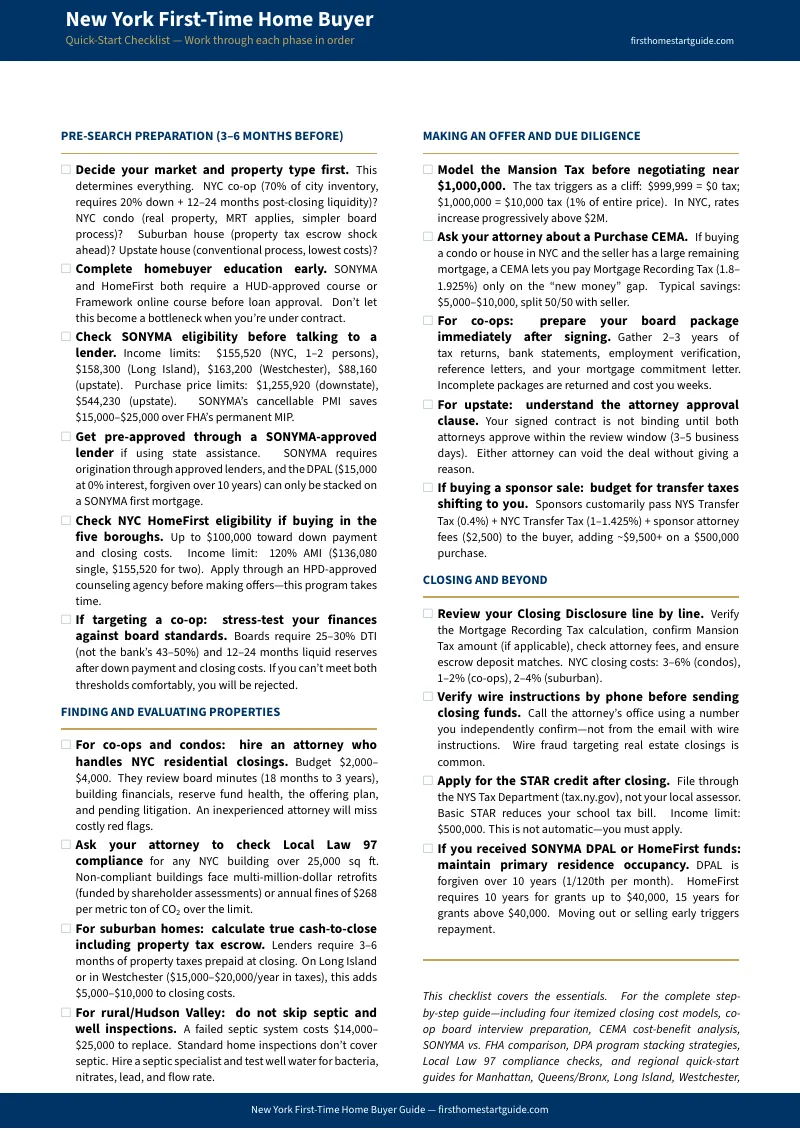
New York imposes taxes on real estate transactions that do not exist in most states, and they stack. The Mansion Tax triggers as a cliff, not a bracket: $999,999 costs $0 in Mansion Tax; $1,000,000 costs $10,000 (1% of the entire price). In NYC, the rate escalates progressively to 3.9% above $25 million. The Mortgage Recording Tax adds 1.8% to 1.925% of your loan amount in the five boroughs — on a $1.04 million mortgage, that is $19,990 due at closing. Co-op buyers pay zero MRT because share loans are not recorded mortgages. The guide provides itemized closing cost models at four price points across property types (NYC condo, NYC co-op, suburban house, upstate house) so you see the exact dollar impact of each tax layer before you make an offer — not when the Loan Estimate arrives.
The CEMA Strategy — How to Cut Your Mortgage Recording Tax in Half
A Consolidation, Extension, and Modification Agreement lets you assume the seller's outstanding mortgage balance, so you pay the 1.8% to 1.925% Mortgage Recording Tax only on the "new money" gap between their remaining balance and your total loan amount. On a $1,000,000 condo purchase with an $800,000 mortgage, if the seller's remaining balance is $500,000, a CEMA saves over $9,600 in recording taxes. But it requires the seller's cooperation, adds $1,000 to $2,000 in legal fees, delays the closing, and market convention splits the savings 50/50 with the seller. The guide provides the cost-benefit analysis — net savings after the seller's split and the additional legal fees — so you know when a CEMA is worth pursuing and when the friction exceeds the savings.
DPA Program Stacking — SONYMA + DPAL + HomeFirst + AHC + LIHP
New York offers one of the most powerful layered assistance systems in the country, but each program has different income limits, occupancy requirements, and forgiveness timelines that interact in non-obvious ways. SONYMA Achieving the Dream provides 97% financing with cancellable PMI. DPAL adds up to $15,000 at 0% interest, forgiven over 10 years. NYC HomeFirst provides up to $100,000 toward down payment and closing costs. AHC grants offer up to $75,000. LIHP on Long Island provides up to $50,000. The guide maps which programs stack with which, the income and purchase price limits for each combination, and the occupancy requirements that trigger repayment — so you capture every dollar you qualify for without accidentally disqualifying yourself from a program worth more.
SONYMA vs. FHA — The Lifetime Cost Comparison Your Lender Will Not Run
FHA loans with less than 10% down carry permanent mortgage insurance that cannot be cancelled — ever. You pay it for the life of the loan, then pay closing costs again to refinance out of it. SONYMA uses private mortgage insurance that automatically cancels when your principal reaches 80% of the original property value, or you can request early cancellation with an appraisal showing sufficient appreciation. On a $400,000 upstate purchase, the lifetime MIP cost difference between SONYMA and FHA can exceed $15,000 to $25,000. The guide provides side-by-side models showing the crossover point where SONYMA's slightly higher rate is offset by the PMI cancellation, so you make the decision on math, not on which loan product your lender earns a higher commission originating.
The Suburban Escrow Shock — Property Tax Prepayment in Westchester, Nassau, and Suffolk
First-time buyers budgeting for a down payment and closing costs in Westchester, Nassau, or Suffolk County are routinely blindsided by the lender's escrow requirement. To protect against tax lien foreclosure, lenders require you to prepay three to six months of property taxes into an escrow account at closing. In counties where property taxes run $15,000 to $20,000 per year, that is $5,000 to $10,000 in additional cash-to-close that does not appear on any generic closing cost calculator. The guide includes escrow shock calculations at typical suburban tax rates so you build the full cash requirement into your budget from the start — not when the final Closing Disclosure arrives three days before you wire funds.
The Hudson Valley and Upstate Transition — Attorney Approval, Septic, and Well Water
Upstate New York uses an attorney approval clause that gives both attorneys three to five business days to void a signed contract for any reason — or no reason at all. Your deal is not locked until the approval window closes. For buyers moving from the city to the Hudson Valley or Catskills, the guide covers the rural infrastructure risks that urban buyers consistently underestimate: septic system engineering inspections (tank age, sludge level, baffle condition, absorption field integrity, and the county construction permit that proves the system is legal), well water testing protocols (bacteria, nitrates, lead, flow rate), and the specific environmental contingencies you cannot waive in a bidding war without accepting five-figure liability.
Board Minutes Forensics — What Your Attorney Should Be Looking For
For co-op and condo buyers, the building's board meeting minutes are the definitive record of physical deterioration, financial instability, and pending liabilities that standard property inspections cannot reveal. Your attorney should request 18 months to three years of minutes before you place a 10% deposit in escrow. The guide explains what your attorney should be flagging: chronic pest or water damage, pending litigation, upcoming capital assessments (roof, facade, elevator modernization), reserve fund depletion, Local Law 97 carbon compliance costs, and any discussion of special assessments that could increase your monthly obligation by hundreds of dollars within a year of closing.
Regional Quick-Start Guides — Six Market-Specific Roadmaps
New York is not one real estate market. It is at least six. The guide provides regional quick-start guides for Manhattan and Brooklyn (co-op dominated, highest taxes, longest timelines), Queens and the Bronx (more affordable co-ops and condos, emerging neighborhoods), Long Island (suburban property taxes, LIHP grants, USDA-eligible pockets), Westchester and Rockland (commuter suburbs, escrow shock territory), the Hudson Valley and Catskills (rural infrastructure, attorney approval, remote worker migration pricing), and upstate metros — Albany, Syracuse, Rochester, Buffalo (SONYMA sweet spot, lowest costs, fastest timelines). Each section covers median prices, timeline expectations, dominant property types, and the specific programs and risks most relevant to that region.
Who This Guide Is For
- NYC renters who have been pre-approved for a mortgage but have never navigated a co-op board and need to understand post-closing liquidity requirements, board interview preparation, and the financial difference between co-ops and condos before they commit to a property type
- Buyers negotiating a purchase price near the $1 million Mansion Tax cliff who need to model whether a $999,000 offer saves them $10,000 or whether the seller's counteroffer at $1,050,000 is actually cheaper after accounting for negotiation leverage and market timing
- First-generation home buyers who qualify for multiple DPA programs and need a stacking strategy — not just a list of programs — to combine SONYMA, DPAL, HomeFirst, AHC, or LIHP without violating any program's occupancy or income restrictions
- Remote workers moving from NYC to the Hudson Valley or Catskills who have never dealt with septic systems, well water, or the attorney approval clause that can void their signed contract within three business days
- Long Island and Westchester buyers who need to budget for escrow shock (property tax prepayment at closing) and understand the STAR exemption before their first tax bill arrives
- Upstate buyers in Albany, Syracuse, Rochester, or Buffalo who want to compare SONYMA's cancellable PMI against FHA's permanent MIP and figure out whether the DPAL rate increase is worth the $15,000 in free down payment assistance
Why Not Free Resources?
Free information on buying your first home in New York exists across government websites, agent blogs, and Reddit threads. Here is what it actually delivers:
- The SONYMA website publishes income limits, purchase price caps, and a list of participating lenders. It does not explain how to stack DPAL with HomeFirst, model the lifetime cost difference between SONYMA's cancellable PMI and FHA's permanent MIP, or tell you whether the 0.40% rate increase for DPAL is worth accepting at your price point. You get the program catalog without the financial modeling that makes the programs actionable.
- StreetEasy provides exhaustive listing data, pricing history, and inventory indexing. It does not explain what a co-op board actually evaluates, how the Mortgage Recording Tax interacts with the Mansion Tax at your price point, or what "pending assessment" in the building's financials means for your maintenance charges in two years. It indexes the market without explaining the transaction.
- Real estate agents will walk you through offers and closings. Most will not proactively explain the CEMA strategy, model your escrow shock in Westchester, or tell you that the co-op you love requires 24 months of post-closing liquidity that your bank's pre-approval letter never tested for. Their business model rewards closing speed, not buyer education on tax mitigation and board preparation.
- Reddit threads in r/AskNYC and r/FirstTimeHomeBuyer contain genuine buyer experiences — but a 2023 thread about SONYMA income limits may not reflect 2026 thresholds, a commenter's CEMA experience in Manhattan does not apply to Long Island's different MRT rate, and "just get a good attorney" does not tell you what your attorney should be looking for in the board minutes or how to evaluate whether a $3,000 attorney is better than a $2,000 one. Sorting current from outdated and applicable from irrelevant takes longer than reading a guide that has already done it.
This guide fills the New York-specific gap — the space between knowing you want to buy and knowing how to navigate a state with two entirely different real estate ecosystems, layered taxes that can add $30,000 to your closing costs, a board approval process that can reject you without explanation, and a down payment assistance system worth up to $190,000 in combined grants that no single government website explains how to stack.
— Less Than One Hour of Your Real Estate Attorney's Time
A New York real estate attorney costs $2,000 to $4,000. The Mansion Tax on a $1,000,000 purchase is $10,000 — triggered by a single dollar over the threshold. The Mortgage Recording Tax on an $800,000 NYC condo mortgage is $15,400. A failed co-op board application costs you the non-refundable application fee, the attorney fees for the contract you cannot close on, and three months of lost time in a market where prices do not wait. A single missed STAR exemption filing costs you hundreds of dollars every year you do not correct it. A septic system replacement in the Hudson Valley runs $14,000 to $25,000.
This guide does not replace your closing attorney. But it gives you the co-op board preparation strategy, the tax gauntlet breakdown, the CEMA cost-benefit analysis, the DPA program stacking map, the escrow shock calculations, and the rural inspection protocols that ensure you identify every New York-specific trap and capture every New York-specific advantage before you make an offer — not when the board rejects your package, the Closing Disclosure arrives with a tax line you did not budget for, or the septic inspector finds a failed absorption field the seller did not mention.
If it saves you from a single Mansion Tax miscalculation, a single unprepared board interview, or a single missed assistance program, it pays for itself before you finish reading it.
Money-back guarantee, no time limit. If the guide does not sharpen your due diligence and protect your investment in New York's housing market, you pay nothing.
Download the free New York Quick-Start Home Buying Checklist to see the step-by-step framework covering co-op vs. condo decisions, tax modeling, board preparation, and closing. When you are ready for the full transaction map, DPA stacking strategy, CEMA analysis, and complete regional breakdowns, the complete guide is here.
New York's real estate market does not penalize what you do not know — it charges you for it. This guide makes sure you stop paying the ignorance tax.
Frequently Asked Questions
What if the rules change after I buy?
We update the guide when the rules change. Email us any time, even years later, and we'll send you the current edition free.