
You Ran the Numbers on a Brooklyn Brownstone. But You Didn't Know the Building Has 47 Years of Hidden Rent-Stabilized History, That Evicting a Non-Paying Tenant Takes 15 Months, or That Refinancing Triggers a $19,000 Tax the Seller Never Mentioned.
You found a two-family brownstone in Crown Heights projecting 6% gross yield. Or a six-unit walkup in the Bronx where the seller's rent roll shows market-rate rents on every unit. Or a distressed duplex in Buffalo where the BRRRR math pencils out beautifully at an 8% cap rate. You ran the deal analyzer. You lined up financing. You're ready to close.
Then New York happens. Your attorney pulls the DHCR Registration Summary and discovers four of the six Bronx units have been rent-stabilized since 1974 -- the seller's "market-rate" rents are illegal overcharges, and you're now liable for treble damages on every dollar above the legal regulated rent. You close on the brownstone and a tenant stops paying rent. You file in Housing Court, where 177,000 active cases are stacked ahead of yours, and your attorney tells you the average non-payment eviction now takes 15 months -- during which you cover mortgage, taxes, insurance, and legal fees with zero rental income. You refinance your Buffalo property to pull equity and your lender hands you a closing disclosure showing a $19,220 Mortgage Recording Tax -- a cost that doesn't exist in 48 other states and hits you on every refinance, not just the original purchase. And when you try to sell the brownstone three years later, you discover the buyer's Mansion Tax bracket jumps from 1.0% to 1.25% at $2 million -- meaning you must price at $1.99 million or concede $25,000 to keep the deal alive.
Here's what no single free resource explains: New York layers a rent stabilization system where one million apartments are permanently frozen under the HSTPA against a Good Cause Eviction law that gives tenants a presumptive right to lease renewal with rent increases capped at CPI + 5% against a Housing Court system averaging 15-month eviction timelines against a Mortgage Recording Tax of 1.8-1.925% that hits on every refinance and cash-out against Local Law 18's effective ban on short-term rentals in all five boroughs against progressive Mansion Tax brackets from 1% to 3.9% that create pricing cliffs at every threshold against a capital gains tax environment where state and city rates combine to exceed 14.7%. Each of these has cost real New York investors tens of thousands because the information existed -- scattered across DHCR filings, HPD building profiles, Housing Court statistics, OSE registration rules, and Reddit threads from landlords who learned the hard way -- but nobody had assembled it into a single investment framework calibrated to how New York actually works in 2026.
The New York Investment Property Guide is a New York Regulatory Defense System -- not a motivational overview of NYC real estate, but a structured reference that maps every New York-specific regulation, tax mechanism, exemption strategy, and geographic market into a process you work through before your earnest money is at risk. It replaces months of cross-referencing DHCR databases, HPD portals, Housing Court statistics, ACRIS title records, Rent Guidelines Board orders, and BiggerPockets threads with a single guide that tells you exactly what to verify, exactly what the numbers should look like, and exactly where deals go wrong in this state.
What's Inside the New York Regulatory Defense System
A comprehensive guide, a quick-start checklist, and 8 standalone worksheets and reference cards (10 PDFs) -- covering every stage from pre-purchase research through post-closing operations, built specifically for the regulations, taxes, exemptions, and market dynamics that make New York unlike any other state:
Rent Stabilization Forensic Due Diligence
Prior to the 2019 HSTPA, landlords could exit stabilization through luxury decontrol and vacancy allowances. Those pathways are permanently closed. The guide walks you through the complete verification process: pulling the HPD building profile, cross-referencing year built via NYC PLUTO zoning maps (6+ units built pre-1974 are presumptively stabilized), checking the RGB Rent Stabilized Building List, and requesting the definitive DHCR Registration Summary for each unit's legal registered rent. It covers how to identify suspicious "preferential rent" classifications, how to spot aggressive post-2019 rent hikes that circumvent HSTPA regulations, what IAI (Individual Apartment Improvement) and MCI (Major Capital Improvement) caps mean for your renovation budget, and the catastrophic financial consequences of discovering stabilized units after closing -- including rent rollbacks and treble damages for historical overcharges.
Good Cause Eviction Compliance and Exemption Strategy
The 2024 Good Cause Eviction law gives tenants a presumptive right to lease renewal and caps annual rent increases at the lower of 10% or CPI + 5% (8.79% for the 2025-2026 cycle). The guide maps every exemption: the small landlord carve-out (10 or fewer units statewide, aggregated across all natural persons behind every LLC), owner-occupied buildings with 10 or fewer units, new construction with a Certificate of Occupancy after January 1, 2009 (exempt for 30 years), and high-rent units exceeding 245% of Fair Market Rent. It covers which upstate municipalities have opted in (Albany, Ithaca, Kingston, Rochester), how to structure acquisitions to maintain exemption status, and the RPL 231-C disclosure notice you must attach to every lease.
Housing Court Timeline and Eviction Underwriting
NYC Housing Court has 177,000 active cases. The average non-payment eviction takes 15 months. The guide explains why: the Right to Counsel law mandates adjournments when tenants lack legal representation, case volumes surged 440% after the pandemic moratorium expired, and judges routinely grant extensions. It covers how to model this timeline into your cash reserves (budget 18 months of carrying costs per unit as a worst-case scenario), the difference between non-payment and holdover proceedings, and why tenant screening has become the single most important operational skill for New York landlords.
Mortgage Recording Tax and CEMA Strategy
New York's MRT is 1.8% on mortgages under $500,000 and 1.925% on mortgages of $500,000 or more -- triggered not just on acquisition but on every refinance, HELOC, and cash-out event. For BRRRR investors, this is a repeated penalty on capital velocity. The guide covers the CEMA (Consolidation, Extension, and Modification Agreement) mechanism that lets you pay MRT only on the "new money" by having the original lender assign the existing mortgage to the new lender. It details the operational delays (30-75 additional days), the requirement for lender cooperation, the title chain requirements, and when a CEMA fails -- forcing the full tax.
Local Law 18: STR Ban and Pivot Strategies
Local Law 18 effectively banned unhosted short-term rentals in NYC. Active Airbnb listings dropped 64% within six months of enforcement -- from 22,000 to fewer than 8,000. The guide covers the exact registration requirements (host must be physically present, maximum 2 guests, guests must have access to entire unit), the $2,500+ fines landlords face if tenants illegally sub-lease on Airbnb, how to register on the OSE Prohibited Buildings List to shield yourself, and the pivot strategies: 30-day minimum corporate rentals, traditional long-term leases, or tax-advantaged exits to redeploy capital to the Catskills or Hudson Valley where STR remains viable.
Mansion Tax Brackets and Exit Pricing Strategy
The progressive Mansion Tax creates pricing cliffs at every bracket threshold. Listing at $2.05 million forces the buyer into the 1.25% bracket -- a $25,625 cash liability at closing -- destroying deal velocity. The guide maps every bracket from $1 million (1.0%) through $25 million+ (3.9%), explains how to model After Repair Value against bracket thresholds on fix-and-flip projects, and covers the interaction with NYC Real Property Transfer Tax (1.0-2.625%, seller-paid) and NYS transfer tax (0.4%, seller-paid). On a $1.5 million NYC property, total transaction taxes can exceed $45,000.
Capital Gains and 1031 Exchange Framework
New York taxes capital gains as ordinary income -- no preferential rate, no inflation adjustment. Combined state (up to 10.9%) and NYC (up to 3.876%) rates can exceed 14.7%. The guide covers 1031 exchange execution: the requirement to engage a Qualified Intermediary before closing, the 45-day identification window and 180-day closing deadline, the three-property rule, how to avoid generating taxable "boot," and why building your replacement property shortlist before the relinquished sale closes is non-negotiable in a low-inventory market.
Geographic Market Comparison
New York is two fundamentally different investment environments. The guide provides data-driven profiles of NYC (sub-5% cap rates, appreciation play, extreme regulatory density), Buffalo (8.2% cap rates, 57.7% five-year price growth, BRRRR territory), Rochester (opted into Good Cause, university-driven demand), Syracuse (97.4% rental occupancy, student housing), Albany (government employment stability), Hudson Valley (bifurcated STR market, $50K/year average per listing), and Long Island (ETPA expansion creating new stabilization risk). Each profile includes the strategy, the numbers, and the specific risks.
18-Item Quick-Start Checklist
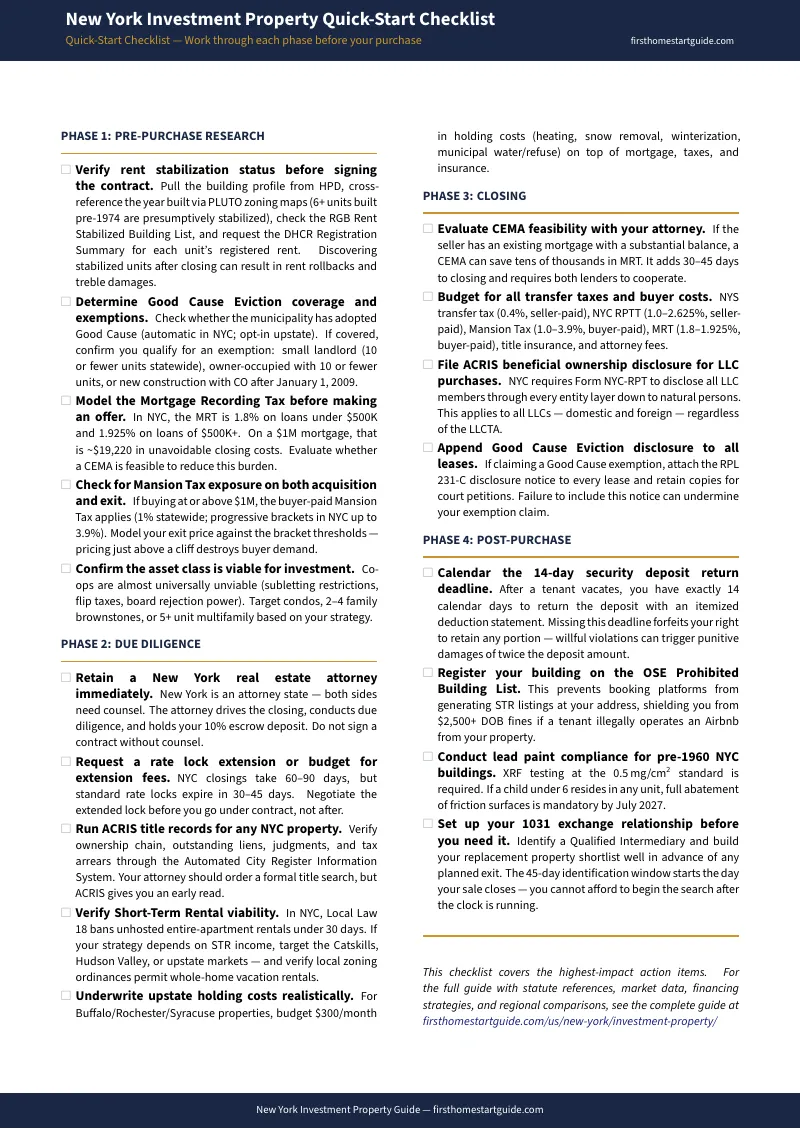
A structured checklist covering four phases -- pre-purchase research, due diligence, closing, and post-purchase -- with every New York-specific verification step. Items include rent stabilization checks, Good Cause exemption confirmation, MRT/CEMA evaluation, Mansion Tax modeling, ACRIS title search, STR viability verification, upstate holding cost underwriting, security deposit compliance, OSE registration, lead paint testing, and 1031 exchange preparation.
8 Standalone Worksheets and Reference Cards
Print-ready tools you can bring to an attorney meeting, use during property evaluation, or reference while structuring a deal:
- Transaction Cost Worksheet -- model Mansion Tax, MRT, CEMA savings, transfer taxes, and total closing costs for a specific deal
- Rent Stabilization Verification Checklist -- 5-step verification process with checkboxes for HPD, PLUTO, RGB, DHCR checks plus IAI/MCI cap reference
- Geographic Market Comparison Card -- side-by-side comparison of all 7 NY markets with cap rates, strategies, risks, and Good Cause status
- Good Cause Eviction Quick Reference -- exemption table, LLC aggregation rules, geographic coverage, and permitted eviction grounds
- Mansion Tax Bracket Reference -- all 8 progressive brackets with pricing cliff strategy and exit cost modeling
- 1031 Exchange Timeline Tracker -- fillable tracker for the 45-day identification and 180-day closing deadlines with boot avoidance checklist
- Eviction Reserve Calculator -- worksheet for modeling NYC (15-month) and upstate (4-month) worst-case carrying costs and legal fees
- CEMA Decision Guide -- MRT rate reference, savings calculator, feasibility checklist, and failure scenarios
Who This Guide Is For
This guide is for real estate investors targeting New York rental or flip properties who:
- Are acquiring multifamily assets in NYC and need to verify rent stabilization status before closing -- including how to pull DHCR Registration Summaries, interpret preferential rent classifications, and avoid treble-damage liability from historical overcharges
- Need to understand the 2024 Good Cause Eviction law -- which exemptions apply, how the rent increase cap works, which upstate municipalities have opted in, and how to structure acquisitions to maintain landlord autonomy
- Are executing BRRRR or cash-flow strategies and need to model the Mortgage Recording Tax on every refinance -- including when a CEMA saves you $15,000+ and when it fails
- Previously operated short-term rentals in NYC and need a pivot strategy after Local Law 18 eliminated 64% of the city's Airbnb inventory -- whether that means 30-day corporate rentals, traditional leases, or exiting the NYC market entirely
- Are evaluating upstate markets (Buffalo, Rochester, Syracuse) as alternatives to NYC's compressed cap rates and regulatory burden, but need realistic underwriting that accounts for winterization, snow removal, municipal costs, and Good Cause opt-in status
- Are planning an exit and need to model the Mansion Tax brackets, transfer taxes, and combined state-and-city capital gains exposure -- or execute a 1031 exchange within the 45-day identification window
- Want every New York-specific regulation, tax, exemption, and market dynamic in one reference -- instead of assembling it from DHCR databases, HPD portals, Housing Court statistics, OSE rules, and BiggerPockets threads from investors who already made the expensive mistakes
Why Not Free Tools and Forums?
Free information on investing in New York real estate exists. Here's what it actually delivers:
- BiggerPockets forums provide excellent macro-level overviews of Buffalo cap rates, BRRRR math, and market comparisons. They don't cover NYC rent stabilization forensics, HSTPA implications for IAI/MCI budgets, CEMA execution timelines, or the interaction between Good Cause Eviction and LLC ownership aggregation. You get the market thesis without the operational framework that determines whether the deal actually works.
- DHCR and HPD websites publish raw data -- building lists, registration summaries, rent guidelines. They don't explain how to cross-reference these databases against PLUTO maps to identify hidden stabilization risk, don't flag preferential rent anomalies, and don't walk you through the financial consequences of getting it wrong. You get the data without the interpretation.
- Real estate brokerage blogs highlight NYC as a world-class investment destination. They rarely quantify the Mortgage Recording Tax impact on BRRRR capital velocity, don't model the 15-month eviction timeline into cash reserve requirements, and never explain why a $2.05 million listing price destroys deal velocity because of the Mansion Tax bracket cliff. The content is designed to generate buyer leads, not to identify reasons to adjust your underwriting.
- Reddit threads (r/realestateinvesting, r/nyclandlords, r/Brooklyn) contain genuine operational panic -- landlords posting about $30,000-$50,000 in unrecoverable rent during eviction proceedings, investors discovering rent-stabilized units post-closing, operators sharing $10,000 fines from tenants running illegal Airbnbs. The experiences are real, but the advice is fragmented, often contradictory, and spread across hundreds of threads. Sorting current law from pre-HSTPA advice takes longer than reading a guide that has already done it.
This guide fills the New York-specific gap -- the space between knowing how to invest in real estate generally and knowing how to invest in a state where one million apartments are permanently rent-stabilized, where eviction timelines average 15 months, where every refinance triggers a 1.9% tax, where short-term rentals are effectively banned in the city, and where combined capital gains taxes exceed 14.7%. It's the analysis that would take a New York real estate attorney, a DHCR compliance specialist, and a tax strategist to assemble -- structured as a reference you own permanently.
-- Less Than One Hour of a New York Real Estate Attorney
A New York real estate attorney charges $2,000 to $5,000 for a standard closing. A single DHCR rent stabilization audit from a compliance consultant runs $500 to $1,500 per building. Discovering hidden rent-stabilized units after closing triggers rent rollbacks and treble damages -- potentially hundreds of thousands of dollars. A 15-month non-payment eviction costs $30,000 to $50,000 in carrying costs and legal fees. Paying the full Mortgage Recording Tax instead of executing a CEMA on a $1 million refinance costs an unnecessary $19,220. Pricing a flip at $2.05 million instead of $1.99 million triggers a Mansion Tax bracket jump that destroys buyer demand and strands the asset.
This guide doesn't replace your real estate attorney or your tax advisor. But it gives you the rent stabilization verification protocol, Good Cause Eviction exemption analysis, CEMA execution framework, Housing Court timeline modeling, Local Law 18 compliance checklist, Mansion Tax exit strategy, 1031 exchange playbook, and upstate market data that ensure you identify every New York-specific risk before your earnest money is committed -- instead of discovering them on your closing disclosure, your first Housing Court petition, or your first Mansion Tax bracket surprise.
If it catches a single hidden rent-stabilized unit, prevents a single avoidable MRT payment, or keeps you from pricing into the wrong Mansion Tax bracket, it pays for itself before you've finished reading it.
Money-back guarantee, no time limit. If the guide doesn't sharpen your underwriting and protect your investment in New York's unique regulatory environment, you pay nothing.
Download the free New York Quick-Start Home Buying Checklist to see the 18-item action plan covering pre-purchase research, due diligence, closing, and post-purchase operations. When you're ready for the full rent stabilization forensics, CEMA strategy, Good Cause exemption framework, and geographic market analysis, the complete guide is here.
The deal pencils out on the spreadsheet. This guide tells you whether New York agrees.