
You Have Run the Cap Rates, Compared Charlotte to Raleigh, and Decided North Carolina Cash-Flows. You Have Not Modeled the Due Diligence Fee You Cannot Recover, the Auction You Cannot Finalize, or the Military Tenant Who Can Terminate in 30 Days.
You have read BiggerPockets threads on the Charlotte rental market, compared cap rates to your current metro, and concluded that North Carolina's combination of job growth, no rent control, and a declining state income tax rate makes it one of the strongest investment corridors in the Sun Belt. You may have browsed Realtor.com listings near NC State, run a DSCR calculator on a Fayetteville duplex, or attended a Charlotte REIA meetup where someone described their cash-on-cash returns without mentioning the $5,000 they lost on a deal that fell through.
Then you make an offer on a Raleigh investment property. Your agent explains the due diligence fee — a "good faith deposit" that secures the contract. You write $4,000 into the Form 2-T, treating it the way you treat earnest money back home. Two weeks later the appraisal comes in low and your lender adjusts the terms. You terminate the contract, expecting a refund. The $4,000 is gone. It was paid directly to the seller on Day 1, it is non-refundable under any circumstance short of seller breach, and the contract you signed says exactly that. In New York or California, you would get your deposit back. In North Carolina, you just paid $4,000 for the education that this is not your home state's contract system.
Or you win a tax foreclosure auction at the Wake County courthouse, celebrate the acquisition, and call your hard money lender to start the renovation draw. Three days later, another investor files an upset bid — 5% above yours. The 10-day clock resets. On Day 8, another bid arrives. The clock resets again. Your deposit is locked in the Clerk of Court's trust account for six weeks while the bidding war plays out, and you cannot deploy that capital into another deal. The "winning bid" was just the opening offer in a statutory loop that can run indefinitely under NCGS § 1-339.25.
Or you buy a rental near Camp Lejeune, underwrite 12-month occupancy based on BAH-backed rent, and project a 7.5% cap rate. In month four, your tenant receives PCS orders to Fort Hood. Under the Servicemembers Civil Relief Act, the lease terminates with 30 days' written notice. You are prohibited from charging any penalty. Your projected annual cash flow collapses in a single phone call, and the only recourse you have is to find the next military tenant before the next mortgage payment is due.
These scenarios are not edge cases. They are the standard operating conditions of investing in North Carolina real estate. The due diligence fee system, the upset bid mechanism, the military lease termination framework, and the OBX municipal permit labyrinth are structural features of this market — and every one of them has cost real investors real money because they applied generic investment analysis to a jurisdiction with unique legal mechanics.
The North Carolina Investment Property Guide is a North Carolina Capital Deployment System — a single, structured reference that maps every transactional mechanism, landlord-tenant statute, tax advantage, and submarket nuance into a step-by-step framework for acquiring, managing, and exiting investment property in North Carolina using North Carolina's actual rules. It replaces months of cross-referencing BiggerPockets forums, local REIA presentations, and attorney consultations with a reference that tells you exactly how the DD fee works, exactly when the upset bid clock resets, exactly what the SCRA requires, and exactly where capital gets trapped.
What's Inside the North Carolina Capital Deployment System
A comprehensive investment guide, a quick-start checklist, and 6 standalone printable tools (8 PDFs) — covering every stage from choosing your investment corridor and structuring your entity through closing your first acquisition, managing tenants, and optimizing your exit, built specifically for the legal frameworks, tax mechanics, and submarket dynamics that make investing in North Carolina different from every other state:
The Due Diligence Fee — How Smart Investors Turn a Penalty Into an Options Contract
Most out-of-state investors treat the DD fee like earnest money. It is not. The guide explains the full Form 2-T mechanics — how the DD fee is paid directly to the seller on Day 1, why it is non-refundable regardless of inspection results or financing failures, how it differs from the refundable earnest money deposit held in the attorney's trust account, and how sophisticated investors structure low-DD-fee contracts on off-market and wholesale deals to create zero-risk options on distressed properties. Includes typical fee ranges for the 2025-2026 market: $2,000-$5,000 standard, up to $10,000+ in competitive Charlotte and Triangle bidding.
The Attorney-Closing System and Contract Selection
North Carolina is one of a handful of states where real estate transactions must be processed by a licensed attorney — not a standalone title company. The guide covers the closing attorney's full role (title search, document preparation, trust account management, deed recording), the 30-45 day closing timeline, and the critical distinction between Form 2-T (residential 1-4 units) and Form 580-T (commercial 5+ units). Mixing residential addenda with commercial contracts creates unenforceable contingencies — a mistake that costs investors their repair negotiations.
Financing: DSCR, Hard Money, VA House-Hacking, and the DTI Escape
Conventional investment loans cap out quickly — personal DTI limits and Loan-Level Price Adjustments make scaling past three or four properties nearly impossible. The guide walks through DSCR loans (underwritten on the property's rental income, no personal income verification, 1.20-1.25 ratio threshold), hard money and bridge lending for fix-and-flip and BRRRR strategies, community bank portfolio loans for 5+ unit properties, and the VA house-hacking strategy where military-affiliated investors purchase a 2-4 unit property with zero down, live in one unit, and rent the rest.
LLC Formation, Tax Trajectory, and the Annual Report Trap
Forming an NC LLC costs $125. The annual report costs $200 — and if you miss the April 15th filing deadline, the state issues a dissolution notice and gives you 60 days before stripping your liability protection entirely. The guide covers entity structuring decisions for single-property vs. multi-property portfolios, North Carolina's flat income tax (4.25% declining to a legislatively scheduled 3.99% in 2026), capital gains taxed as ordinary income with no state surcharge, and the corporate tax rate trajectory that phases out entirely by 2030.
Property Taxes: County-Level Rates and Reappraisal Risk
North Carolina has no statewide property tax. What you pay depends entirely on which county you buy in — and within counties, municipal overlays can nearly double the effective rate. Mecklenburg County (Charlotte) runs approximately 0.80%. Wake County (Raleigh) averages 0.75%. Durham County layers a $0.4371 city rate on top of the $0.5542 county rate, pushing the combined effective rate above 1.00%. The guide includes a comparison worksheet covering all major investment counties with reappraisal cycle timing so you can model the impact of rising assessments on your NOI.
Summary Ejectment: The 30-45 Day Eviction That Changes Your Underwriting
In New York, eviction takes 6-12 months. In North Carolina, the entire process — from the initial 10-day notice through the magistrate hearing, appeal window, and sheriff lockout — takes approximately 30-45 days. The guide maps the complete statutory timeline: the 10-day notice to quit, filing in Small Claims Court, the 7-day magistrate hearing window, the rent bond mechanism that forces appealing tenants to pay rent into the court or face immediate eviction, and the Writ of Possession executed by the county sheriff within 5-7 days. This speed fundamentally reduces your cash-reserve requirements compared to tenant-protective states.
The Tenant Security Deposit Act — Rules That Cost You Treble Damages
Commingling security deposits with operating funds, failing to notify the tenant of the bank within 30 days, or missing the 30/60-day return deadlines does not just create a lawsuit — it forfeits your entire right to retain any portion of the deposit and exposes you to treble damages. The guide covers maximum deposit limits (2 months for standard leases, 1.5 months for month-to-month), the dedicated trust account requirement, the 30-day refund timeline, the 60-day extension for complex damage assessment, and the six-month hold rule for tenants who leave without a forwarding address.
Military Market Investing: BAH, SCRA, and PCS Vacancy Modeling
Fort Liberty (Fayetteville) and Camp Lejeune (Jacksonville) offer BAH-backed rent that functions as a federal income guarantee. The guide includes 2025-2026 BAH rates by rank, submarket targeting (Hope Mills, Spring Lake, Holly Ridge, Goldsboro), and the critical lease termination analysis that most military market pro formas ignore: the federal SCRA vs. state NCGS § 42-45 interaction, why the SCRA's strict prohibition on liquidated damages often supersedes the state's narrower penalty allowances, and how to underwrite PCS-driven turnover so a single deployment order does not destroy your annual cash flow projection.
Outer Banks and Coastal STRs: The 180-Day Rule and the Municipal Maze
The North Carolina Vacation Rental Act governs all short-term rentals, and its 180-day rule catches every new owner who does not read the statute before closing. If you buy a property with existing bookings, you must honor every booking ending within 180 days of recording your deed — no cancellations, no rate increases, no renovations. Beyond the VRA, each OBX municipality imposes its own permit requirements: Kill Devil Hills requires an annual vacation rental permit, occupancy limits tied to septic capacity, mandatory off-street parking, a local contact who can respond within one hour, and specific fire safety and evacuation posting requirements. The guide maps the state-level obligations and the town-by-town fragmentation across Dare and Currituck counties.
Tax Sales and the Upset Bid Loop
Winning a courthouse auction in North Carolina does not win you a property. The guide explains the 10-day upset bid process (NCGS § 1-339.25 and § 45-21.27) — how any competing investor can file a bid at least 5% or $750 higher, how every valid upset bid resets the 10-day clock entirely, how your deposit gets locked in the county trust account for the duration, and the sniping strategy that experienced investors use to wait until the final days of each cycle. It also covers deposit requirements, default consequences, and why the original owner's redemption right expires when the upset period closes — making NC fundamentally different from states that allow post-sale redemption.
Fix-and-Flip: The $40,000 Licensing Threshold
Under NCGS § 87-1, any renovation exceeding $40,000 in combined labor and materials requires a licensed North Carolina General Contractor. Splitting a $70,000 project into smaller contracts to evade the threshold is a state law violation that triggers stop-work orders. The guide covers your three options (hold a GC license in your LLC, keep projects under $40,000, or hire a licensed firm), trade-specific permit requirements for electrical, plumbing, and structural work even under the threshold, and the historic district preservation codes in Charlotte and Raleigh that add time and cost to exterior renovations.
Exit Strategy: 1031 Conformity and the 4% Withholding Trap
North Carolina fully conforms to federal Section 1031, but out-of-state investors selling NC property face a 4% withholding on the total sale price — not 4% of profit, 4% of the entire sale. On a $400,000 property, that is $16,000 withheld by the closing attorney and sent to the NC Department of Revenue. If you are completing a 1031 exchange, you must file Form IT-AFF3 before closing to exempt the proceeds. The guide explains the exemption filing process, capital gains treatment at the flat state rate, and the excise tax (Revenue Stamps) at $1.00 per $500 of sale price.
Market-by-Market Analysis: Charlotte, Triangle, Triad, Asheville, and Military
Charlotte's banking-driven demand, the Triangle's academic and biotech anchoring, the Triad's 6.0-7.5% cap rates on lower acquisition costs, Asheville's geographic constraints and luxury STR potential, and the military submarkets where vacancy rates track 20% below national averages. The guide breaks each market into specific submarket recommendations: University City student housing, South Charlotte appreciation plays, Durham's temporary vacancy softening creating buying opportunities, near-NC-State four-bedroom rentals commanding $3,400+/month, and the Fayetteville and Jacksonville corridors where BAH rates set the effective rent floor.
Who This Guide Is For
- Charlotte and Triangle professionals entering real estate investment who need a structured framework for the DD fee system, entity structuring, and neighborhood-level analysis — not another BiggerPockets motivational thread about "passive income"
- Out-of-state investors deploying capital from New York, California, or New Jersey who understand real estate but not North Carolina's transactional mechanics — the non-refundable DD fee, the attorney-closing requirement, and the upset bid process are unfamiliar territory that has cost unprepared investors thousands
- Military market investors targeting Fort Liberty and Camp Lejeune who need to model BAH-backed rental income alongside PCS-driven turnover and the SCRA lease termination protections that eliminate your ability to charge break fees
- Outer Banks and coastal STR operators who need the 180-day booking rule, Dare and Currituck county permit requirements, and the state and local tax collection obligations mapped out before they close on a beachfront property
- Distressed asset investors bidding at courthouse tax sales and foreclosure auctions who need to understand that the initial bid is not the winning bid — the upset bid process can extend for weeks and trap your capital in a county trust account
Why Not Free Resources?
Free information on North Carolina real estate investing is everywhere. Here is what it actually covers:
- BiggerPockets has thousands of posts on Charlotte and Raleigh. Most generalize — "great market, landlord friendly, growing population." They do not explain how the DD fee differs from earnest money, when to use a $0 DD fee strategy on wholesale deals, or how to structure contracts so a failed appraisal costs you nothing. Forum advice from 2023 about DD fee ranges is outdated in the post-pandemic normalized market.
- Local REIAs focus on networking and deal sourcing, not statutory analysis. They will introduce you to hard money lenders and property managers. They will not walk you through the upset bid clock reset mechanism, the difference between Form 2-T and Form 580-T, or the treble damages exposure from mishandling security deposits under the Tenant Security Deposit Act.
- Real estate attorney blogs cover individual topics — a post on DD fees here, a post on eviction there. None of them connect the due diligence period to the financing timeline to the entity structuring decision to the exit tax treatment in a single, sequenced framework. You get fragments that require an attorney consultation to assemble.
- Military housing websites publish BAH rates but do not connect them to investment underwriting. They do not explain the interaction between federal SCRA protections and North Carolina's NCGS § 42-45, the scenarios where the state statute supersedes the federal law, or how to model PCS-driven vacancy into a realistic pro forma.
This guide fills the North Carolina investment gap — the space between knowing the cap rates look attractive and knowing how to deploy capital in a state where the due diligence fee is gone on Day 1, the courthouse auction is not final for 10+ days, the eviction process runs in 30-45 days instead of 12 months, military tenants have a federally protected exit, and the exit withholding tax traps 4% of your entire sale price if you do not file the right form before closing.
— Less Than a Single Due Diligence Fee You Cannot Recover
The average North Carolina due diligence fee in a normalized market runs $2,000 to $5,000 — non-refundable, paid directly to the seller, and gone whether the deal closes or not. A failed appraisal, a financing denial, a bad inspection — under the Form 2-T, none of these get your DD fee back. A mishandled security deposit triggers treble damages. The 4% non-resident withholding on a $400,000 sale locks up $16,000 with the Department of Revenue until you file for a refund. A missed LLC annual report dissolves your liability protection.
The guide costs a fraction of a single DD fee and covers the entire system — from the DD fee strategy that turns a penalty into an options contract, through the eviction timeline that changes your reserve requirements, to the 1031 exemption filing that keeps your exchange capital intact.
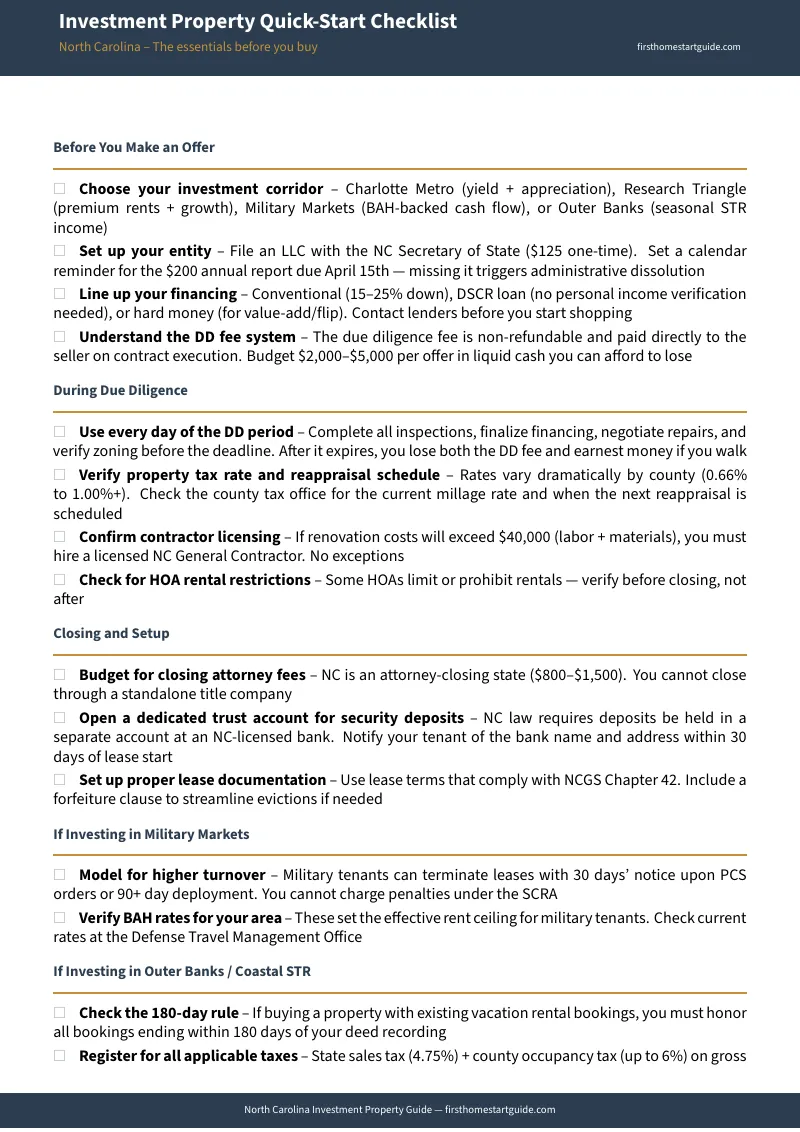
Download the free Quick-Start Checklist to see the 20-item framework, or get the full North Carolina Investment Property Guide with the complete statutory analysis, market-by-market intelligence, military underwriting templates, and standalone printable tools.
Frequently Asked Questions
What if the rules change after I buy?
We update the guide when the rules change. Email us any time, even years later, and we'll send you the current edition free.