
You Found the House. But Someone Else Owns What's Underneath It, the City Just Attached $120,000 in Hidden Debt to Your Lot, and Closing Requires a Physical Book That Takes Three Weeks to Update.
You found a three-bedroom in south Fargo listed at $260,000. Or a newer construction in West Fargo where the agent quoted "low taxes, no transfer tax." Or a clean split-level near Grand Forks Air Force Base where the listing says "move-in ready, VA-assumable." You got pre-approved. You ran the numbers. You're ready to make an offer.
Then North Dakota happens. Your title company tells you they can't close for three weeks because they need to physically locate, update, and bind a historical Abstract of Title book --- and a licensed attorney must examine it and issue a formal Title Opinion before a title insurance policy can even be written. Your agent mentions the previous owner retained the mineral rights, which means an energy company could legally access the subsurface beneath your home for drilling --- and the Surface Owner Protection Act gives you compensation, not a veto. The property in West Fargo sits in a subdivision where special assessments for infrastructure were certified at $87,000 per lot, turning your $260,000 home into a $347,000 obligation that your lender folds into escrow, spiking your monthly payment by hundreds. And the radon test on the tightly sealed basement comes back at 7.1 pCi/L --- well above the EPA action threshold --- in a state where elevated radon is the norm, not the exception.
Here's what no single free resource explains: North Dakota layers a property transfer system built on physical, bound Abstract of Title books that delay closings by weeks and require Attorney's Title Opinions mandated by NDCC 26.1-20-05, against a mineral rights framework where previous owners routinely severed the subsurface estate --- leaving residential buyers legally subordinate to energy companies that hold the dominant mineral interest and can access the surface for drilling operations subject only to damage compensation under the Surface Owner Protection Act (NDCC Chapter 38-18), against a municipal finance system where rapidly growing cities like Fargo, West Fargo, and Horace fund infrastructure through special assessments that attach directly to individual parcels and have blindsided homeowners with certified bills of $35,000 to $120,000, against elevated statewide radon levels that accumulate in the deep, tightly sealed basements standard in winterized North Dakota construction, against a historically flood-prone Red River Valley where the $3.2 billion FM Area Diversion Project will eliminate mandatory flood insurance for thousands of properties by 2029, against NDHFA assistance programs with overlapping eligibility rules where choosing the wrong program leaves thousands of dollars of available assistance on the table. Each of these has cost real first-time buyers five figures because the information existed --- scattered across county recorder offices, NDHFA program matrices, abstract company fee schedules, special assessment portals, EPA radon maps, FEMA floodplain databases, and Reddit threads about base housing --- but nobody had assembled it into a single decision system calibrated to how North Dakota actually works.
The North Dakota First-Time Home Buyer Guide is a North Dakota Risk Navigation System --- not a motivational overview of Peace Garden State homeownership, but a structured reference that maps every North Dakota-specific property rights hazard, municipal debt trap, environmental liability, and assistance program into a process you work through before your earnest money is at risk and your closing gets derailed by an abstract that takes three weeks to update. It replaces months of cross-referencing county recorder mineral chains, NDHFA program matrices, special assessment portals, FEMA flood maps, and PCS housing forums with a single guide that tells you exactly what to verify, exactly what the numbers should look like, and exactly where deals go wrong in this state.
What's Inside the North Dakota Risk Navigation System
A comprehensive guide, a quick-start checklist, and standalone printable tools --- covering every stage from pre-approval through post-closing management, built specifically for the property rights, municipal finance, environmental hazards, and assistance programs that make North Dakota different from every other state:
Mineral Rights and Subsurface Sovereignty
North Dakota's oil boom history means mineral rights have been routinely severed from surface estates for decades. When you buy a home, you may own the surface while entirely different entities --- corporations, fractionalized heirs, distant trusts --- own everything beneath it. The mineral owner holds the legally dominant estate, meaning an energy company could construct drilling pads, access roads, or pipeline infrastructure near your home without your consent. The Surface Owner Protection Act (NDCC Chapter 38-18) requires developers to provide written notice and compensate for surface damages, but it does not give you the right to stop operations. The guide explains how severance works, why standard title searches don't reliably reveal mineral ownership, how to hire a Landman to trace subsurface chains through county recorder offices and district courts, and the 20-year dormant mineral abandonment rule under North Dakota law --- the mechanism that allows surface owners to reclaim unused mineral rights by recording a statement of succession. If you're buying anywhere in western North Dakota or in any county with historical energy activity, this chapter prevents the most consequential blind spot a first-time buyer can have.
Special Assessment Audit System
North Dakota's rapidly growing cities fund localized infrastructure through special assessments --- targeted bond debt attached directly to individual parcels that benefit from new water mains, street paving, storm sewers, and flood protection. Unlike general property taxes, these assessments are specific to your lot and can represent massive, unexpected obligations. In the Fargo suburb of Horace, homeowners who voted to approve infrastructure builds under the assumption that assessments would cost roughly $8,000 received certified bills ranging from $35,000 to over $120,000. The financial shock caused at least two foreclosures and triggered lawsuits against the city. The guide explains exactly how the assessment system works, how to audit both uncertified and certified assessment balances on county tax portals like FargoParcels.com before making an offer, how assessments are amortized into your monthly mortgage escrow, and why lenders factor them into your debt-to-income ratio. If you're buying in Fargo, West Fargo, Horace, or any expanding suburban corridor, skipping this audit is the fastest path to financial ruin in North Dakota real estate.
Abstract of Title Navigation
While most states close real estate transactions through rapid digital title insurance, North Dakota relies on the Abstract of Title system --- a physical, bound book containing the complete legal history of every event recorded against a specific parcel, stretching back to the original government patent or homestead grant. Every sale requires the seller to locate the original abstract, deliver it to a licensed county abstract company, and pay to have it continued with all new deeds, mortgages, easements, and liens since the last transaction. Under NDCC 26.1-20-05, no title insurance policy can be issued until a licensed North Dakota attorney has independently examined the updated abstract and issued a formal Attorney's Title Opinion. The guide covers the full process timeline (typically three weeks versus 48-hour digital closings elsewhere), the regulated fee structure ($191 base certificate plus $19 per entry and $12 per name searched, paid by the seller), the buyer's responsibility for the attorney review fee, and the critical requirement to securely store the original book after closing --- because a lost Abstract requires a full, prohibitively expensive historical recreation from the original government patent forward. No replacement copy exists.
Flood Insurance and the FM Diversion Strategy
The Red River Valley's unique northward flow and flat geography make Fargo-Moorhead and Grand Forks highly susceptible to catastrophic spring flooding. Properties in FEMA Special Flood Hazard Areas with federally backed mortgages must carry NFIP policies --- averaging $500 to $557 per year in Fargo, $718 in Grand Forks, and $1,204 in Valley City. But the flood landscape is undergoing a generational shift. The $3.2 billion FM Area Diversion Project --- a 30-mile stormwater diversion channel with earthen embankments and control structures --- is scheduled for physical completion in March 2027, protecting over 273,000 people. After completion, the Metro Flood Diversion Authority will petition FEMA for a Letter of Map Revision, expected by 2029. Once issued, the mandatory flood insurance requirement will be permanently lifted for thousands of properties. The guide shows you exactly how to model this 2027-2029 timeline into your long-term equity and cash-flow projections --- turning a current cost burden into a strategic advantage for buyers entering the market today.
Radon Testing and Mitigation Protocol
North Dakota has naturally elevated radon levels, and the deep, tightly sealed basements typical of winterized construction create ideal accumulation conditions. Radon is a radioactive gas that seeps from the soil and poses severe respiratory health risks with prolonged exposure. Under NDCC 47-10-02.1 and HB 1186, sellers must provide formal written disclosure of known radon concentrations before signing a purchase agreement. The standard North Dakota Association of Realtors disclosure form includes a mandatory radon section. The guide covers why independent professional testing during your inspection period is non-negotiable, how sub-slab depressurization mitigation systems work, typical costs, and how to negotiate seller-funded installation before closing.
NDHFA Assistance Program Decision Framework
The North Dakota Housing Finance Agency runs four distinct programs, and choosing the wrong one leaves thousands of dollars of available assistance on the table. FirstHome provides below-market interest rates for first-time buyers (no principal residence owned in the past three years) --- the average borrower earns $74,758 and purchases a home for roughly $240,000. Start pairs a 30 or 40-year first mortgage with 3% down payment assistance (minimum $3,000 for income-eligible applicants), requiring only $500 out of pocket --- but it cannot be combined with other DPA programs. HomeAccess extends below-market rates to single parents, veterans, and disabled households regardless of prior ownership. Roots drops all income and purchase price limits entirely. The guide maps every program's income thresholds ($93,500 for 1-2 person households, $110,000 for 3+), the acquisition cost ceiling ($481,176 for single-family, scaling to $925,491 for fourplexes), mandatory homebuyer education requirements, approved lender selection, and the specific combinations that are prohibited. This decision must happen before you choose a lender.
Military PCS Buyer Playbook
Minot Air Force Base and Grand Forks Air Force Base generate a steady flow of VA-loan-eligible buyers navigating compressed PCS timelines. The guide provides micro-neighborhood breakdowns for both bases: in Grand Forks, the newer post-1997 flood infrastructure of the south end near Columbia Mall versus the historical Riverside neighborhood, with specific areas to avoid. In Minot, the 20-30 minute base-to-city commute, the extreme blizzard conditions that can strand off-base personnel for days when roads go to "black" status, and the base housing trade-off --- proximity and weather protection versus losing your entire BAH and living under HOA-style restrictions on pets, vehicles, and modifications. The guide covers VA loan mechanics in a low-appreciation market, the $4,000 married-couple relocation stipend and what it covers (snowblowers, insulation, cold-weather gear), and BAH retention math for off-base ownership.
Williston and the Bakken Energy Market
The Williston-centric Bakken region operates on boom-bust cycles tied to global energy markets and horizontal drilling economics. During the 2010-2014 boom, one-bedroom apartments in Williston commanded $2,394 per month --- eclipsing San Francisco. Current capitalization rates sit at approximately 11%, attracting risk-tolerant investors while penalizing owner-occupants seeking stable appreciation. The guide covers how to underwrite a home purchase against global crude oil price trends, how to evaluate the physical quality of hastily constructed boom-era housing stock, infrastructure gaps (limited shopping, understaffed services, life-flight medical reliance), and how to plan a viable exit strategy if energy economics force relocation. If you're buying in Williams County, this chapter prevents the most expensive mistake you can make: treating a volatile energy-market investment like a stable residential purchase.
Rural and USDA Buyer Transition
Most of North Dakota qualifies for USDA 100% financing. The guide covers current income limits ($119,850 for 1-4 person households, $158,250 for larger households), property eligibility standards (structural soundness, working heating and plumbing, paved or all-weather road access), and county-specific loan limits ($324,700 for standard single-family in Stark, Stutsman, Ward, and most other counties). Beyond financing, the guide addresses the homesteading transition: managing well water and septic systems, operating generators during multi-day blizzard power outages, maintaining aging HVAC systems to prevent winter pipe freezing, and the chainsaw and timber management reality that no rental apartment prepares you for.
Closing Cost Advantage and Transaction Mechanics
North Dakota charges zero real estate transfer tax --- a significant advantage that saves buyers thousands compared to most states. Total buyer-side closing costs range from 2% to 5%, including loan origination (typically 1%), appraisal, title insurance ($3.75 per $1,000 of property value), home inspection ($200-$400), and the attorney's title examination fee. The seller pays to continue the Abstract of Title ($191 base plus $19 per entry). The guide provides a line-by-line Closing Disclosure walkthrough calibrated to North Dakota's unique fee structure so you know exactly what each charge is and who pays it.
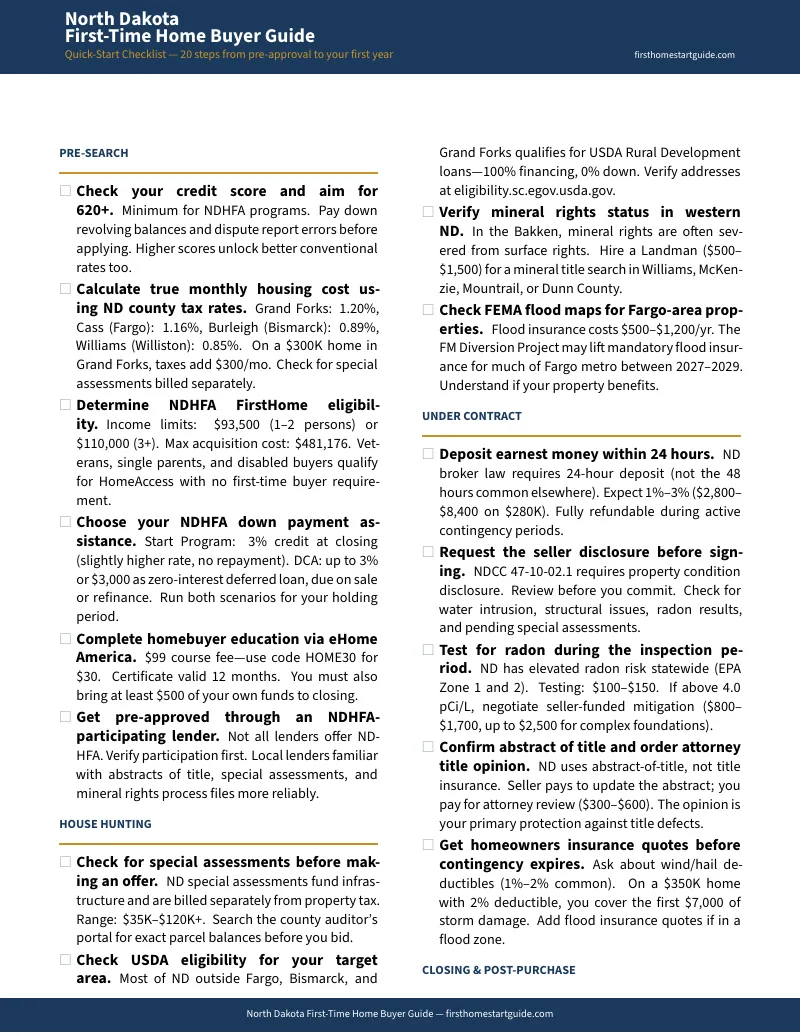
Quick-Start Checklist and Carrying Cost Worksheet
A 20-item chronological checklist covering every phase from pre-approval through your first year of ownership, with North Dakota-specific verification steps built into each stage. Plus a carrying cost worksheet that models every monthly obligation: mortgage principal and interest, property taxes, special assessment amortization, flood insurance (current and post-diversion projections), homeowner's insurance, radon mitigation reserves, and maintenance --- so your budget reflects what you'll actually pay in North Dakota, not what the listing agent quoted.
Standalone Printable Tools
Nine standalone PDFs you can print, save to your phone, or bring to meetings --- each one built for a specific North Dakota action step:
- NDHFA Program Comparison Card --- All four programs (FirstHome, Start, HomeAccess, Roots) side-by-side with income thresholds, stacking rules, and a quick decision guide. Bring to your lender meeting.
- Special Assessment Audit Checklist --- Step-by-step audit protocol with fillable rows to track certified and uncertified balances across multiple properties. Use before every offer.
- Mineral Rights Investigation Protocol --- Seven-step protocol for tracing subsurface ownership, hiring a Landman, and evaluating the 20-year abandonment rule. Essential in western North Dakota.
- Abstract of Title Process Reference --- The five-step abstract process with timeline, fee structure, cost breakdown, and secure storage instructions. Take to closing.
- Radon Testing and Mitigation Protocol --- Testing steps, EPA thresholds, mitigation costs, and negotiation checklist with fillable test record. Use during your inspection period.
- Closing Cost Worksheet --- Fillable worksheet covering every buyer-side and seller-side cost, NDHFA assistance credits, and wire transfer requirements under North Dakota's Good Funds Law.
- Carrying Cost Worksheet --- Monthly cost model including mortgage, property taxes, special assessments, flood insurance, radon reserves, and a three-property comparison table.
- Flood Insurance and FM Diversion Strategy --- Current NFIP costs by city, the FM Diversion Project timeline, and the strategic case for buying in flood zones before the 2029 FEMA map revision.
- Key Contacts and Resources --- One-page fridge sheet with every state program, federal resource, county assessor, and key number you need throughout the process.
Who This Guide Is For
This guide is for first-time home buyers in North Dakota who:
- Are buying their first home in Fargo, West Fargo, or Horace and need to audit special assessments before an offer --- because uncertified assessment balances don't appear on any listing and have blindsided suburban buyers with five-figure and six-figure obligations that caused foreclosures
- Are buying property anywhere in the state and need to understand whether mineral rights are severed, what that means for their legal exposure, how to trace subsurface ownership, and whether dormant rights can be reclaimed through the 20-year abandonment provision
- Are relocating from another state and have never encountered an Abstract of Title system, an Attorney's Title Opinion requirement, or a closing process that takes three weeks instead of 48 hours --- and need to understand the regulatory framework before their purchase timeline derails
- Are military personnel PCSing to Minot or Grand Forks Air Force Base and need micro-neighborhood guidance, VA loan tactics in a low-appreciation market, and a realistic assessment of winter commute conditions before committing to off-base ownership
- Are energy sector workers in Williston evaluating whether to buy in a market where cap rates, construction quality, and property values are all driven by global crude oil dynamics rather than local fundamentals
- Want to claim every dollar of NDHFA assistance available --- FirstHome, Start, HomeAccess, or Roots --- and need to understand income limits, stacking rules, and approved lender requirements before selecting a program that leaves money on the table
- Are considering buying in the Fargo-Moorhead floodplain and need to model the strategic impact of the FM Diversion Project completing in 2027 and the FEMA map revision expected by 2029 --- turning current flood insurance overhead into a future equity advantage
- Want every North Dakota-specific property rights hazard, municipal debt trap, environmental liability, and assistance program in one reference --- instead of assembling it from county recorder offices, NDHFA matrices, abstract company schedules, special assessment portals, and PCS housing forums
Why Not Free Tools and Forums?
Free information on buying a home in North Dakota exists. Here's what it actually delivers:
- NDHFA's website publishes program descriptions, rate sheets, and income limits. It doesn't explain how to choose between FirstHome and Start when both could apply, doesn't show which combinations are prohibited, doesn't cover the approved lender selection process in detail, and doesn't address how to stack DPA with VA loan benefits. You get the program specs without the decision framework.
- Zillow and Realtor.com show estimated monthly payments that don't include special assessments. A property in West Fargo with $60,000 in uncertified assessments looks identical to one with zero --- same estimated payment, same tax estimate, same "affordability" score. The difference is hundreds of dollars per month in escrow that surfaces after you've already closed.
- Real estate agent blogs and local Realtor content emphasize low median prices, no transfer tax, and Fargo's recession-resistant economy. They don't volunteer that mineral rights may be severed, that the abstract process adds three weeks to closing, that special assessments can create six-figure obligations, or that radon testing is urgent in a state with naturally elevated levels. The content is designed to generate listing inquiries, not to identify reasons to pause.
- Reddit threads (r/fargo, r/northdakota, military PCS forums) contain genuine buyer experience reports --- people sharing special assessment shock, mineral rights confusion, base housing complaints, and Williston market trauma. But advice from 2023 doesn't reflect current NDHFA rate adjustments, updated FEMA flood maps, or the latest special assessment certifications in Horace. Sorting current from outdated takes longer than reading a guide that has already done it.
This guide fills the North Dakota-specific gap --- the space between knowing how to buy a house in general and knowing how to buy one in a state where mineral rights beneath your property may belong to someone else, where municipal special assessments can attach six-figure debt to your lot overnight, where closing requires locating and continuing a physical Abstract of Title book and securing a mandatory Attorney's Title Opinion, where radon accumulates in every winterized basement, where flood insurance costs are about to undergo a generational collapse, and where NDHFA runs four overlapping programs with conflicting stacking rules. It's the analysis that would take a North Dakota energy attorney, a title examiner, a Landman, an NDHFA-approved lender, and a flood insurance specialist to assemble --- structured as a reference you own permanently.
--- Less Than One Abstract of Title Update
A single Abstract of Title update runs $191 plus $19 per entry. Hiring a Landman to trace mineral ownership costs hundreds per hour. One overlooked special assessment can add $35,000 to $120,000 to your property obligations. The wrong NDHFA program selection can mean repaying assistance you could have received at a lower rate or with fewer restrictions. A radon mitigation system runs $800 to $1,700. Flood insurance in Grand Forks averages $718 per year --- soon to be eliminated entirely for thousands of properties.
This guide doesn't replace your real estate agent, your lender, or your attorney. But it gives you the mineral rights investigation protocol, special assessment audit system, abstract process walkthrough, NDHFA decision framework, flood insurance strategy, and carrying cost worksheet that ensure you identify every North Dakota-specific risk before your earnest money is committed --- instead of discovering them when a Landman delivers bad news, a special assessment commission certifies its bills, or your abstract takes three weeks and your rate lock expires.
If it catches a single uncertified special assessment your listing agent didn't mention, identifies a severed mineral interest your title search missed, or prevents you from choosing the wrong NDHFA program, it pays for itself before you've finished reading it.
Money-back guarantee, no time limit. If the guide doesn't sharpen your decision-making and protect your budget in North Dakota's uniquely complex property landscape, you pay nothing.
Download the free North Dakota Quick-Start Home Buying Checklist to see the step-by-step action plan covering pre-approval, NDHFA program selection, mineral rights verification, special assessment audits, and closing navigation. When you're ready for the full mineral rights investigation protocol, special assessment audit system, abstract walkthrough, NDHFA decision framework, flood insurance strategy, and carrying cost worksheet, the complete guide is here.
The house looks affordable on Zillow. This guide tells you whether North Dakota agrees.
Frequently Asked Questions
What if the rules change after I buy?
We update the guide when the rules change. Email us any time, even years later, and we'll send you the current edition free.