
The Numbers Work Until North Dakota's Severed Mineral Estate, Bakken Volatility, and Abstract Title System Rewrite Them
You found a fourplex in Fargo throwing off 7% cap rates with NDSU student demand guaranteeing tenants. Or a single-family near Minot Air Force Base where BAH payments cover your entire mortgage. Or a cash-flowing duplex in Williston where oil boom rents hit $2,500/month and the cash-on-cash return is extraordinary. The DSCR clears. The price-to-rent ratio looks strong. You're ready to wire earnest money.
Then North Dakota shows up. The Fargo fourplex sits in Cass County — 1.16% effective property tax rate, the highest in the state — and the student tenant base turns over every August, accelerating property wear and compressing your actual NOI once you account for cyclical vacancy. The Minot rental depends entirely on a BAH rate the DoD recalibrates annually — a single base realignment or rate reduction restructures your yield ceiling overnight. The Williston duplex was built as a temporary man camp barracks during the 2012 Bakken rush, hastily converted to permanent housing with inferior materials and severe deferred maintenance. And the rural acreage you liked outside Bismarck? The mineral rights were severed in 1987. An energy company holds the dominant estate and has the legal right to build a well pad, lay a pipeline, and grade an access road across your property — and your title insurance policy specifically excludes coverage.
Here's the problem: North Dakota combines a severed mineral estate doctrine where the mineral owner holds dominant legal status over your surface property, a Bakken energy market where the entire western economy is a derivative of crude oil prices and vacancy can spike from 3% to 40% in a single commodity cycle, a traditional abstract-of-title system where closings require both an abstractor's compilation and an attorney's title opinion that can delay transactions by weeks, the nation's most aggressive military housing BAH dynamics where yields are mathematically insulated from recession but structurally vulnerable to DoD policy shifts, and a 3-day eviction notice statute that makes operations extraordinarily efficient but accelerates turnover during commodity busts. Each of these has cost real investors thousands because the information existed — scattered across County Recorder abstracts, NDCC statutory chapters, DoD BAH tables, and BiggerPockets threads — but nobody had assembled it into a single underwriting system.
The North Dakota Investment Property Guide is a North Dakota Investor Due Diligence System — not a generic overview of Midwest real estate, but a structured compliance and underwriting framework that maps every North Dakota-specific mineral rights trap, military market dynamic, landlord-tenant advantage, tax mechanism, and cold-climate construction liability into a process you work through before you wire earnest money. It replaces months of cross-referencing County Recorder abstracts, NDCC century code chapters, DoD BAH rate tables, and community bank portfolio loan terms with a single reference that tells you exactly what to verify, exactly what the numbers should look like, and exactly where deals go wrong in this state.
What's Inside the North Dakota Investor Due Diligence System
A 12-chapter guide, a due diligence checklist, and 3 standalone printable reference tools — covering every stage from market selection through exit strategy, built specifically for the mineral rights doctrine, military housing economics, Bakken volatility, and tax advantages that make North Dakota different from every other state:
Mineral Rights Due Diligence and Surface Owner Protections
The single most dangerous due diligence failure in North Dakota real estate. Under the doctrine of mineral estate dominance, the mineral owner holds the "dominant" estate while your surface property is legally "servient." An energy company that owns or leases the mineral rights beneath your investment property has an implied legal right to use the surface to the extent reasonably necessary to access, explore, and extract those minerals — build access roads, lay pipelines, install well pads. Standard title insurance policies specifically exclude severed mineral rights. North Dakota lacks full property disclosure statutes requiring sellers to disclose severance at closing. The only way to verify true mineral ownership is to trace the chain of title through the County Recorder's Office — cross-referencing township, range, and section records alongside grantor/grantee indexes, probate records, and divorce decrees. County officials are legally prohibited from performing this research for you. The guide covers the complete title trace protocol, how to retain a specialized landman or mineral title attorney, how to leverage the Dormant Mineral Act (NDCC 38-18.1) to reclaim abandoned mineral interests that have gone unused for 20 years, and how to negotiate binding Surface Damage Agreements that define access routes, well pad placement, and compensation schedules under the Surface Owner Protection Act (NDCC 38-11.1).
Four-Market Investment Analysis — Fargo, Bismarck, Military Towns, Bakken
North Dakota's real estate market is not one market — it is four fundamentally different economies. Fargo (Cass County) is the institutional anchor: NDSU, Sanford Health, and Microsoft drive a massive rental base, but the city issues 1,200 housing permits annually against 1,800 units of demand — a structural 600-unit shortfall pushing rents upward at 8% annually. Bismarck (Burleigh County) commands a rental premium reaching $1,312/month for single-family homes, paired with the state's lowest effective property tax rate at 0.89% — delivering superior NOI on a per-dollar basis. Grand Forks and Minot are military-backed markets where BAH payments create recession-proof, government-underwritten rental floors. And Williston is the Bakken — the most volatile real estate market in the United States, where rents hit $3,000/month during oil booms and vacancy spikes to double digits when crude crashes. The guide analyzes each submarket with current rent data, tax rates, BAH tables, vacancy dynamics, and the specific strategy that works in each one — and the strategies that will fail.
Military Housing BAH Strategy with 2026 Rate Tables
The military market investor in North Dakota builds their entire thesis on capturing the Basic Allowance for Housing — a tax-free DoD stipend calibrated to local median rent, utilities, and a 5% member cost-sharing mechanism. Because BAH is tax-free, mortgage lenders frequently "gross up" this allowance, dramatically improving a service member's debt-to-income ratio and maximizing their purchasing power. The guide includes forward-looking 2026 BAH rate tables for Grand Forks AFB and Minot AFB across E-5, E-6, O-1, and O-3 ranks, with implied asset purchasing targets at current VA loan rates. An E-5 with dependents at Grand Forks gets $1,731/month — supporting a ~$190,000 property acquisition. An O-3 at Minot gets $2,262/month — supporting ~$240,000. Grand Forks is uniquely powerful because it combines military BAH stability with the University of North Dakota's educational demand anchor, creating the most diversified rental market in the upper Midwest.
Landlord-Tenant Law — 3-Day Eviction, Dual Judgment, and the Pet Deposit Ceiling
North Dakota is structurally engineered to protect capital velocity. The 3-day notice to quit for non-payment (compare to Minnesota's 14-day notice) radically accelerates the removal of non-performing tenants. The dual-judgment system allows a single court proceeding to grant both property recovery and full monetary damages — in Minnesota, recovering unpaid rent requires filing an entirely separate civil lawsuit. Pet deposits are capped at the greater of $2,500 or two months' rent, providing a financial buffer against property destruction. Security deposits max at one month's rent (two months for tenants with felony convictions). The 30-day deposit return window includes an itemized deduction requirement, with treble damages for wrongful withholding. The guide maps the complete statutory framework with side-by-side comparisons against Minnesota and South Dakota, so you understand exactly where North Dakota gives you operational leverage that neighboring states don't.
Abstract Title System and Closing Mechanics
North Dakota uses the traditional abstract of title system — a chronological historical summary of every recorded document affecting a parcel from the original land patent to the present. Under NDCC § 26.1-20-05, title insurance cannot be issued until the abstract has been independently reviewed by a licensed North Dakota attorney, who renders a formal Attorney's Title Opinion. This dual-layered system creates specific timeline friction (30-40 day closings are standard) and cost variables (lost or outdated abstracts requiring recreation can add weeks and thousands in fees). But it also means no transfer tax at closing — North Dakota's constitutional prohibition (Measure 2, 2014) eliminates the $6,600+ transfer friction you'd face on a $2M deployment just across the border in Minnesota. The guide covers the complete closing process, recording fee structures, margin compliance requirements, and how to manage the abstract update timeline proactively.
Tax Framework — 40% Capital Gains Exclusion and Property Tax Arbitrage
North Dakota's tax environment is designed for capital retention. The 40% long-term capital gains exclusion means a $100,000 gain has $40,000 immediately excluded from state taxation — the remaining $60,000 is taxed at the top 2.50% bracket, producing an effective rate of just 1.50% on property dispositions. Income tax rates are ultra-compressed: 0.0% on the first $48,475, 1.95% up to $244,825, and a ceiling of 2.50%. No rent control exists. Property tax rates vary meaningfully by county — Burleigh County (Bismarck) at 0.89% versus Cass County (Fargo) at 1.16% creates a $810/year differential on a $300,000 property that compounds to $8,000+ over a ten-year hold. The guide includes the complete tax arbitrage analysis, 1031 exchange strategy for out-of-state capital, LLC formation via FirstStop ($135 filing fee, $50 annual report), and the specific county recording fee structure.
Cold-Climate Construction, Contractor Licensing, and Fix-and-Flip Logistics
North Dakota's brutal winters (historical lows reaching -44°F in Bismarck) impose severe physical constraints on construction that out-of-state investors rarely anticipate. Concrete becomes dense and brittle in sub-zero temperatures — contractors rely on portable flameless ground heaters to maintain curing temperatures and prevent exposed pipe ruptures. The North Dakota State Plumbing Board enforces strict UPC modifications requiring high-R-value foam sleeve insulation with self-regulating heat trace cables rated to -40°F. Pipes penetrating exterior walls must be installed within packed sleeves or metallic pipe to handle expansion and contraction. Any renovation exceeding $4,000 requires a state contractor license (Class A through D, from $100 to $450). The guide covers licensing thresholds, mechanic's lien notice requirements (10-day certified mail rule), the plumbing winterization protocol, and realistic construction timelines for each season.
Who This Guide Is For
This guide is for real estate investors targeting North Dakota markets who:
- Are analyzing a North Dakota property and need to verify whether the deal works once you account for mineral rights severance, county-specific property tax rates, the abstract title system timeline, cold-climate construction costs, and market-specific vacancy dynamics — not the generic underwriting assumptions that work in states with unified mineral estates and standardized title processes
- Are targeting military housing near Minot AFB or Grand Forks AFB and need precise 2026 BAH rate tables, implied property acquisition targets by rank, and the mathematical framework for aligning your debt service to government-underwritten rental income
- Are evaluating Williston or the Bakken and need to distinguish genuine multifamily investments from converted boom-era man camps with inferior construction, understand the WTI crude price correlation to local vacancy, and stress-test your occupancy model against a commodity recession
- Are an out-of-state investor deploying 1031 exchange capital and need to understand why standard title insurance doesn't cover severed mineral rights, how the dominant mineral estate doctrine can legally authorize surface disruption of your property, and how to verify mineral ownership before you're contractually committed
- Are comparing North Dakota against Minnesota and South Dakota and need a side-by-side analysis of eviction timelines, security deposit limits, transfer taxes, capital gains treatment, and operational friction — to understand exactly where North Dakota gives you structural advantages that neighboring states don't
- Want every North Dakota-specific regulation, tax mechanism, BAH calculation, mineral rights protocol, and cold-climate construction requirement in one reference — instead of assembling it from County Recorder abstracts, NDCC century code chapters, DoD BAH rate tables, and BiggerPockets threads that may already be outdated
Why Not Free Tools and Forums?
Free information on North Dakota real estate investing exists across dozens of sources. Here's what it actually delivers:
- BiggerPockets forums contain genuinely useful discussions about Fargo cap rates and Williston rental yields — mixed with advice about mineral rights from investors in states where the doctrine works completely differently, BAH-based strategies that reference last year's rate tables, and Bakken market analysis that predates the most recent oil price cycle. Sorting current from outdated across scattered threads takes longer than reading a guide that has already verified every statute, rate table, and regulatory framework against current sources.
- National investing courses ($997 to $5,000+) teach cap rate analysis, DSCR mechanics, and 1031 exchange strategy that apply everywhere. They don't cover mineral estate dominance, the abstract title system, North Dakota's 3-day eviction advantage, the 40% capital gains exclusion, BAH-backed military market mathematics, Bakken commodity correlation, or cold-climate construction constraints. Applying national frameworks to North Dakota-specific risks is how investors absorb five-figure surprises on their first deal.
- Local REIA meetings and real estate agent blogs provide general market sentiment and conventional deal analysis. They don't explain how to trace mineral ownership through the County Recorder's Office, how to negotiate a Surface Damage Agreement, how the Dormant Mineral Act can reclaim abandoned subsurface rights, or how county recording margin requirements can push your documents into a higher fee tier.
- DoD and military housing websites publish BAH rate tables but don't connect them to local property acquisition targets, don't explain the gross-up calculation that improves military tenant purchasing power, and don't map the specific risk of base realignment or rate reduction to your yield model.
This guide fills the North Dakota-specific gap — the space between knowing how to analyze a rental property in general and knowing how to underwrite one in a state where a third party can legally build a pipeline across your investment property, where the entire western economy swings with crude oil prices, where closings require both an abstractor and an attorney before title insurance can be written, and where winter construction costs double if you don't plan around a five-month freeze. It's the analysis that would take a mineral title attorney, a local community banker, a military housing specialist, and a cold-climate contractor to assemble — structured as a reference you own permanently.
— Less Than One Title Opinion
A single mineral rights issue you didn't discover before closing means an energy company can legally disrupt your investment property — and your title insurance won't cover it. One Williston acquisition that turns out to be a converted man camp costs $50,000+ in deferred maintenance that wasn't visible during a standard inspection. A BAH-backed rental strategy built on last year's rate tables means your debt service model is wrong from day one. A 1031 exchange into North Dakota without understanding the abstract title timeline means your exchange window expires before the attorney's title opinion clears.
This guide doesn't replace your North Dakota real estate attorney, your mineral title specialist, or your community bank relationship. But it gives you the mineral rights due diligence protocol, market-by-market underwriting analysis, military housing BAH framework, landlord-tenant operational playbook, and cold-climate construction specifications that ensure you identify every North Dakota-specific risk before you're contractually committed — instead of discovering them on your first title review, your first commodity downturn, or your first frozen pipe.
If it catches a single mineral rights issue, prevents a single man camp acquisition, or saves you from a county tax rate you didn't budget for, it pays for itself before you've finished reading it.
Money-back guarantee, no time limit. If the guide doesn't sharpen your underwriting and protect your capital in North Dakota's regulatory environment, you pay nothing.
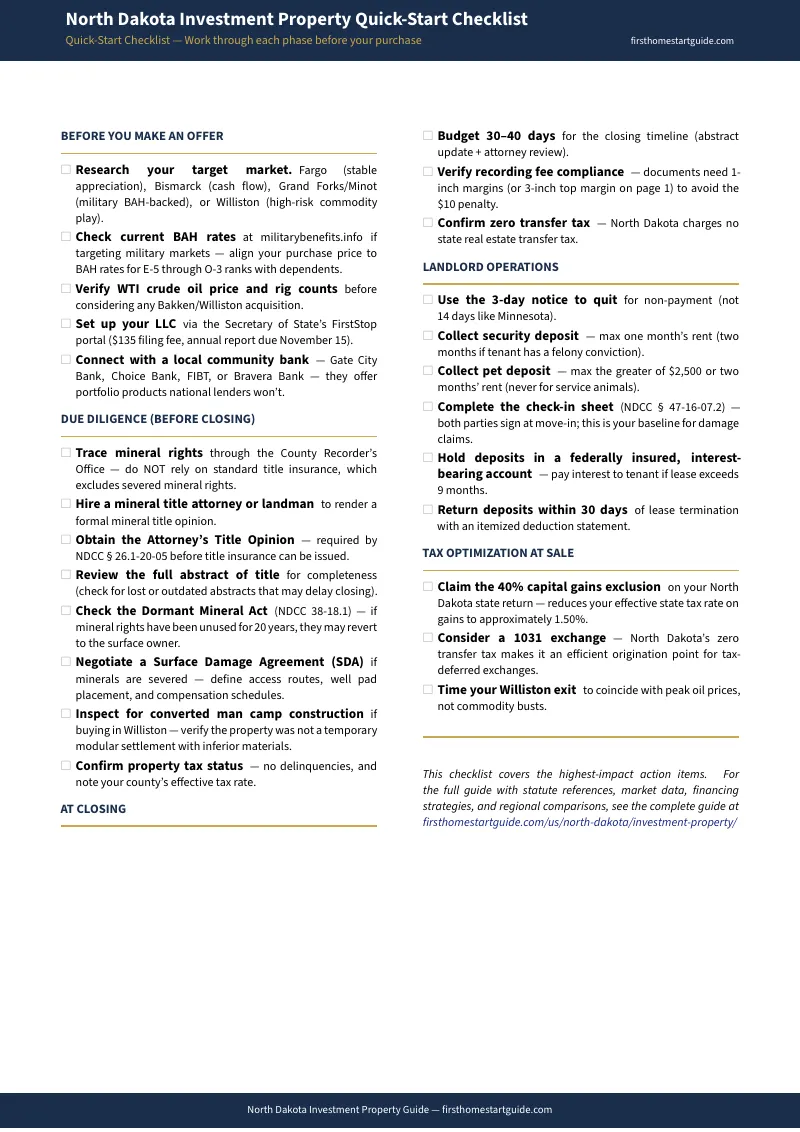
Download the free North Dakota Quick-Start Checklist to see the due diligence framework covering pre-purchase research, mineral rights verification, BAH rate analysis, landlord-tenant compliance, and tax optimization. When you're ready for the full mineral rights protocol, four-market analysis, military housing framework, and 12-chapter investment guide, the complete guide is here.
The deal works on the spreadsheet. This guide tells you whether North Dakota agrees.
Frequently Asked Questions
What if the rules change after I buy?
We update the guide when the rules change. Email us any time, even years later, and we'll send you the current edition free.